You are suffering from a fever and go to the hospital; now you have to make an appointment and wait in a long queue. That was a traditional process. Today, digital healthcare brings the clinic to the patient, enabling seamless appointment booking, virtual consultation, and digital prescriptions right from home.
This cuts unnecessary visits to the hospital. Also, healthcare providers can expand their services globally, be aware of the patient’s health, and scale down operational costs. These eHealth apps offer significant benefits; however, the path to development is complex. It is crucial to have a clear understanding of the cost, timeline, and the app type you want to build before partnering with a healthcare mobile app development company.
This blog highlights the core app types, development costs, implementation timelines, and security standards essential for building a successful digital health platform.
What is healthcare mobile app development?
Healthcare app development is the process of creating apps catered to the specific requirements of the medical industry. While healthcare mobile apps keep a record of our medical history, these apps represent a wide array of features helpful in making operations seamless. The apps follow strict healthcare regulations and compliance requirements. Also, modern healthcare-focused applications cover intelligent operations and precisely follow AI governance prerequisites for optimal and responsible AI usage. These applications work differently for patients and doctors through bidirectional communication.
| Feature | What the patient sees | What the medical team sees |
|---|---|---|
| Scheduling | Feature to book appointments and receive automated reminders. | Handle schedules and approve appointments. |
| Virtual Care | Secure telehealth visits and complete digital intake forms before appointments. | Provide virtual consultations to patients and keep their records. |
| Health Tracking | Track metrics such as heart rate, blood pressure, and glucose. | Monitor patient biometrics through a dashboard. |
| Prescriptions | View active medications and pharmacy details. | Create and send e-prescriptions (eRx) and review medications. |
| Medical Records | Access lab reports, test results, imaging records, and clinical documents. | Access and update patient records through EHR integrations. |
Why Businesses Are Investing in Healthcare Apps
The healthcare IT market has boomed for decades. According to market research, the global healthcare IT market size was valued at USD 851.4 billion in 2025 and is projected to grow from USD 981.1 billion in 2026 to USD 2,790.1 billion by 2033, at a CAGR of 23.2% from 2026 to 2033.
This rapidly growing graph shows that healthcare apps are driving a fundamental shift in how the medical care industry is delivered and consumed daily. This growth is attracting businesses to invest in medical applications, which offer a wide range of features to providers, patients, and organizations. Below, we discuss many other factors that attract businesses to invest in healthcare web app development.
Fast Decision-Making
One of the most prominent advantages of modern healthcare mobile app development is minimizing the time between data collection and clinical action. It provides you with the capability to make decisions quickly through structured data, real-time access, and instant, proper guidance.
- Clinical Decision Support Systems.
- AI-Driven Triage.
- Interoperability standards.
Cost Saving
Rising patient volumes and administrative demands place a heavy financial strain on medical providers. Healthcare apps alleviate this burden by digitizing core services like video consultations, automated appointment booking, and remote patient monitoring. By reducing reliance on physical infrastructure and streamlining routine tasks, providers cut operational overhead while improving patient care efficiency.
- Lowering Long-Term Software Maintenance Costs.
- Reducing Administrative Overhead and Workflow Inefficiencies.
- Minimizing Regulatory and Security Compliance Penalties.
Enhanced Patient Consultation
Telehealth and virtual consultation features let providers see more patients without expanding physical infrastructure. Patients get quicker access to care, and providers can extend their reach beyond the walls of a clinic, a win for both sides of the relationship.
- Deliver follow-up care without in-person visits.
- Patient engagement through convenient virtual care.
- Support scalable healthcare delivery with telehealth solutions.
Types of Healthcare Apps
The eHealth market offers multiple applications that help you to improve healthcare management and well-being. So, based on their purpose, digital health applications are divided into six categories.
| Healthcare App Type | Core Purpose | Key Features | Business Value |
|---|---|---|---|
| Telemedicine & Virtual Care Apps | Remote consulting facility between patients and healthcare providers. | Video and audio consultationsAppointment schedulingE-prescriptions | Focus on reducing hospital visits and improving clinical service viability. |
| Mental Health & Wellness Apps | Focus on mental health therapy and preventive healthcare. | Mood trackingMeditation and mindfulness programsPersonalized wellness plans | Enhancing patient engagement and increasing access to mental health services. |
| Medication Management Apps | Keep patients’ records and improve medication adherence. | Medication remindersPrescription trackingPharmacy integration | Goal to improve medical negligence and streamline prescription management. |
| Chronic Disease Management Apps | Track and manage long-term health conditions such as diabetes or hypertension. | Health and symptom trackingBlood glucose or blood pressure monitoringProgress reports and alerts | Focus on patient monitoring and support long-term disease management. |
| Women’s Health (FemTech) Apps | Provide personalized healthcare for women’s reproductive and wellness needs. | Menstrual cycle trackingFertility monitoringOvulation predictions | Provide personalized healthcare experiences and increase patient retention. |
| Patient Portal & EHR/EMR Apps | Give patients secure access to healthcare records and provider services. | Electronic health records (EHR/EMR) accessLab reports and medical historyAppointment management | Improves clinical workflow, enhances patient self-service, and enables secure healthcare data access. |

Telemedicine App
A telemedicine app connects patients with doctors through secure video or chat. This removes the need for in-person visits for non-emergency issues. It includes appointment scheduling, digital prescriptions, and payment processing. This type of healthcare app can:
- Expand medical services beyond the region.
- Reduce waiting time with a virtual consultant
- Track patients through a remote consultant
- Enable scalable digital healthcare delivery across regions.
Mental Health & Wellness Apps
Mental health apps connect you with a physiotherapist, keep your details secure, and keep a record of your daily task management. According to health industry research in 2015, the number of mobile health apps focused on mental health has rapidly increased. A World Health Organization (WHO) survey of 15,000 mHealth apps revealed that 29% focus on mental health diagnosis, treatment, or support. The National Institute of Mental Health (NIMH) has pointed to mental health apps as cost-effective and scalable solutions to address the mental health treatment gap.
- Patient engagement with personalized care plans.
- Continuous mental health tracking.
- Support preventive care through digital wellness programs.
- Increase access to licensed mental health professionals.
Medication Management Apps
Medication management apps keep your medical history in a structured way with privacy. These apps mainly focus on the problem that most patients feel is difficult to take medicine as prescribed. So, these healthcare app features of medication management include proper reminders of dosage frequency, medication form, and special instructions.
- Schedule dosage for the prescribed medication
- Access to provider-shared medication management
- Drug interaction alerts improve patient safety.
- Digital prescriptions reduce administrative workload.
Chronic Disease Management Apps
Chronic disease management apps work with your long-term health conditions. These apps connect with the glucometer and blood pressure monitor and collect data. Tracking this kind of data helps to provide remote patient monitoring and, in some cases, medical device classification, which you used to collect data.
- Proactive care with continuous health insights.
- Reduce hospital revisits through remote monitoring.
- Secure health data synchronization across healthcare systems.
- Support long-term treatment with progress tracking.
Women’s Health (FemTech) Apps
Women’s Health (FemTech) apps are focused on female medical conditions. They include advanced biotechnology, AI, and digital health. The privacy stakes are high for these applications because reproductive data is among the most sensitive health data a consumer can hold. This is serving as a central pillar in the modern health industry, personalized and responsive to the biological realities of women’s lives.
- Wearable integration for women’s health data.
- Personalized care journeys across every life stage.
- Fertility tracking with personalized health recommendations.
- Preventive healthcare through continuous wellness monitoring.
Patient Portal & EHR/EMR Apps
Patient portals & EHR/EMR apps provide direct and secure access to their medical records. It includes lab results, visit history with the doctor, appointment booking, and direct consultation with medical teams. These are strictly covered by the EHR. This app cannot work as a standalone app; it is a patient-facing window.
- Secure communication with healthcare professionals.
- Synchronize patient records across healthcare systems.
- Support FHIR and HL7 healthcare interoperability.
- Improve patient self-service through digital health access
Essential Healthcare App Features
Creating eHealth applications means not just adding advanced technologies. The real purpose of digital health applications is to make life easier for patients and healthcare providers. Users are attracted to and feel more trust in those apps that are easy to use, save time & cost, and maintain their privacy.
Multilingual Support
Patients connect globally in these applications and speak different languages. They found difficulty understanding medical terms, but they can easily learn those terms in the provided languages, which enhances the user experience. This is the reason that a well-maintained eHealth app must be multilingual.
AI-Powered Clinical Decision Support (CDS)
Clinics make fast decisions in a short period of time with huge amounts of data under tight regulations. AI integration in clinical tools speeds up operations by quickly analyzing the data and providing insights related to it. However, proper maintenance is crucial to ensure long-term functionality and reduction of errors.
Prescription Management and Refilling
Handling prescriptions must be easy through an appropriate app. Users can easily request medication refills or arrange deliveries through pharmacy integration. Advanced features may include missed-dose alerts to the caretaker. Patients can check the drug name by scanning the barcodes.
Healthcare App Development Process
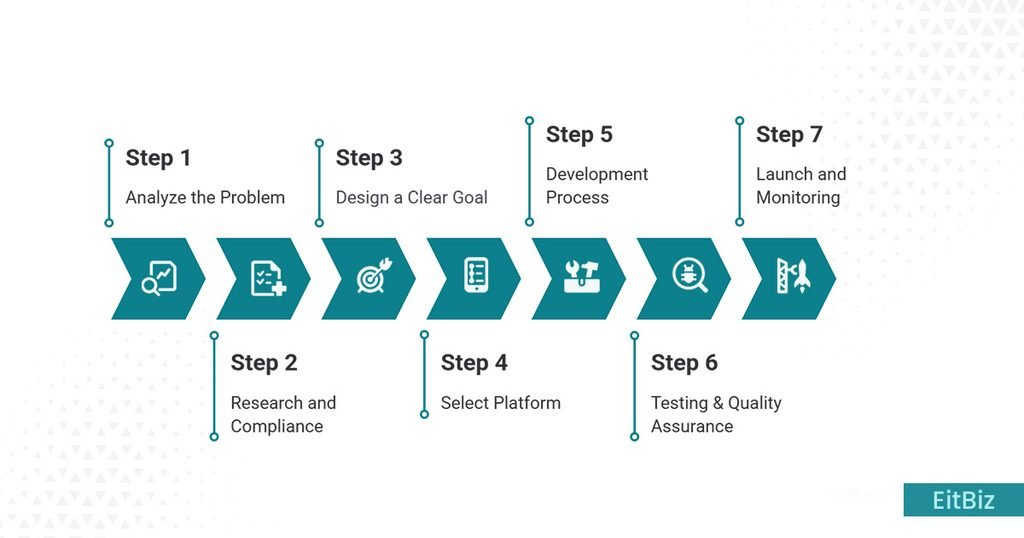
Building a healthcare app is more than just doing coding. To develop a secure, scalable, and user-friendly app, you need to follow a clear set of steps. Below, we discuss the steps that are required for a mobile app development company to complete any eHealth application.
Step 1: Analyze the Problem
The process of medical app development demands a proper problem to develop any application. The app must be familiar with users’ problems by demonstrating its value to enhance their eHealth experiences.
- What kind of problem can eHealth solve?
- Identify the target audience?
- Why choose you over the other apps?
Step 2: Research and Compliance
After finding the problem, medical device app development requires deep research because this industry is highly regulated, and applications handle patient data with high security and privacy. Market research helps you to understand competitive value and identify key differentiators for the app.
Step 3: Design a Clear Goal
Selecting a clear design and goal is the first key to building a secure and scalable app. Prepare a set of tools and frameworks that help to protect data and allow your app to grow when more users join it. When you pick the design for the app, keep it simple and accessible so that it is easy to use. Creating prototypes and testing them with real users helps the app to improve its look.
Step 4: Select Platform
After defining problems, doing research, and finalizing the design and goals, the fourth step is to select a platform, meaning where you want to deploy your application: Android, iOS, or web. You can also add a Home Assistant device integration to ensure that your application also has a voice command feature.
Step 5: Development Process
Starting development technically is the fifth step; the team starts to architect your app from frontend to backend. Using an agile method, which means building and testing in small steps and making improvements along the way. A professional eHealth app development agency ensures secure data transmission and encryption protocols.
Step 6: Testing & Quality Assurance
Testing is a critical step to check for bugs, security gaps, and compliance with eHealth care rules. Include real users for testing functionality, performance, security, and usability to help identify issues before deployment.
- Functional testing
- Performance testing
- Security testing
- Usability testing
Step 7: Launch and Monitoring
When you complete all steps, deploy your app on the selected platform or distributed users. The process of healthcare mobile app development is not completed here. After the deployment of the app, you need to track its status, take feedback, and fix issues. Stay connected with users and providers to help your app be better, safer, and more useful over time.
- Maintain regular updates and fix bugs.
- Performance monitoring with analytics tools.
- User feedback form and iterative improvements.
HIPAA, Security & Compliance
Compliance isn’t a checkbox; it’s the foundation of every trustworthy healthcare app. The regulatory frameworks, security protocols, and access controls businesses must implement to protect patient data and avoid costly penalties.
Why HIPAA Matters for Healthcare Apps
HIPAA compliance isn’t optional for any app operating in the U.S. healthcare space; it’s a legal mandate that protects patient privacy and carries strict penalties for violations. Building compliance from day one, rather than retrofitting it later, saves both money and reputational risk.
GDPR, HITECH, and Other Healthcare Regulations
If your app serves patients in the EU, GDPR compliance is equally essential, while HITECH strengthens HIPAA’s enforcement around electronic health records. Depending on your target markets, you may need to comply with multiple overlapping frameworks simultaneously.
EHR/EMR & Third-Party Integrations
No healthcare app operates in isolation. Seamless integration with existing medical systems is critical for real-world adoption. The standards and integrations that connect your app to the broader healthcare ecosystem.
Understanding EHR and EMR Integration
Electronic Health Records (EHR) and Electronic Medical Records (EMR) systems are the backbone of modern healthcare data. Any new app needs to integrate smoothly with these systems rather than existing as an isolated one.
HL7 and FHIR Standards for Data Exchange
HL7 and FHIR are the industry-standard protocols that allow different healthcare systems to exchange data reliably. Building your app around these standards ensures interoperability with hospital systems, labs, and insurance providers.
Technology Stack
The right technology stack determines how secure, scalable, and future-ready your healthcare app will be. The frontend, backend, AI, and cloud technologies that power high-performing, compliant clinical platforms today.
Frontend Technologies for Healthcare Apps
React Native and Flutter are popular choices for cross-platform mobile builds, while React.js and Angular dominate on the web side, offering responsive, accessible interfaces.
Backend Technologies for Secure Healthcare Platforms
Node.js, Python (Django), and Java (Spring Boot) are common backend choices, chosen for their scalability and strong security ecosystems.
AI and Machine Learning Technologies
TensorFlow, PyTorch, and specialized NLP libraries power features like symptom checkers, predictive diagnostics, and automated documentation.
Healthcare App Development Cost
One of the most common questions business owners ask is simple: how much does healthcare app development cost to develop a mobile app? The honest answer is: it depends heavily on complexity, features, and compliance requirements. Understanding these factors helps healthcare providers make informed decisions and avoid budget surprises.
| Healthcare App Type | Estimated Development Cost (USD) |
| Telemedicine App | $40,000 – $120,000 |
| Remote Patient Monitoring | $60,000 – $150,000 |
| Mental Health App | $35,000 – $90,000 |
| AI-Powered Healthcare App | $80,000 – $250,000+ |
Telemedicine App
Typically ranges from $40,000 to $120,000 depending on video infrastructure, EHR integration, and payment gateway complexity.
Remote Patient Monitoring (RPM)
Generally falls between $60,000 and $150,000, driven up by wearable device integrations and real-time data processing needs.
Mental Health App
It usually costs $35,000 to $90,000, depending on whether it includes live therapy sessions or is purely self-guided.
AI-powered Healthcare App
Can range from $80,000 to $250,000+, since machine learning models, training data, and ongoing model refinement add significant development effort.
Development Timeline
Understanding how long development takes helps businesses plan launches, allocate resources, and set stakeholder expectations. This provides realistic timelines across different healthcare app types, from lightweight MVPs to enterprise-grade EHR systems.
| App Type | Estimated Timeline |
| MVP or Prototype App | 6 – 10 weeks |
| Patient Engagement or Wellness App | 3 – 4 months |
| Telemedicine App | 4 – 6 months |
| Chronic Disease Management App | 5 – 7 months |
| Comprehensive EMR/EHR System or Provider-Facing Tools | 8 – 12+ months |
Challenges & Considerations
Healthcare app development comes with unique hurdles that generic software projects rarely face. From data privacy to patient adoption, businesses must navigate several critical challenges to build an app that’s secure, functional, and genuinely used by patients and providers alike.
Patient Security, AI Integration, and API Challenges
Protecting patient data while integrating AI, IoMT devices, and legacy hospital systems requires careful planning, rigorous validation, and close IT coordination, all without compromising compliance or performance.
- Encrypt data and enforce strict access controls
- Validate AI models before clinical deployment
- Coordinate closely with hospital IT teams
- Test integrations thoroughly to avoid delays
Patient Experience and Engagement
Even a technically sound app fails without adoption. Designing intuitive, friction-free experiences and maintaining engagement through smart notifications is often harder than building the app itself.
- Prioritise simple, intuitive user flows.
- Use notifications to drive consistent engagement.
- Gather feedback for continuous improvement
How to Choose the Right Healthcare App Development Company
Selecting the right development partner is as important as the app idea itself. The key criteria businesses should evaluate to ensure they’re working with a team equipped for healthcare’s unique demands.
Industry-Relevant Experience
Not every developer understands the pressure of clinical workflows or regulatory demands. Look for a partner with a proven portfolio with relevant experience, then ask how much it costs to develop a mobile app.
Healthcare App Compliance & Security
Your development partner should have demonstrable experience with HIPAA, GDPR, and other relevant frameworks; this isn’t something to learn on the job with your project as the test case.
Industry-Relevant Experience
- Understands clinical workflows, not just code
- Avoids costly rework from inexperience
- Brings proven patterns from past projects
- Reduces onboarding and ramp-up time
- Speaks the language of healthcare stakeholders
Not every developer understands the nuances of clinical workflows or regulatory demands. Look for a partner with a proven portfolio in medical app development services, not just general software work.
AI Remains at the Core of Modern eHealth Development
As AI healthcare app development becomes standard rather than optional, choose a partner who can build intelligent features like predictive analytics and automated triage, not just basic CRUD applications.
- Builds predictive, not just reactive, features
- Offers real machine learning expertise
- Goes beyond basic CRUD applications
- Understands clinical AI validation requirements
- Keeps pace with evolving AI standards
Whether you need an eHealth device app for a connected hardware product or custom mobile app development for a patient-facing platform, the right partner should offer transparency on cost, timeline, and compliance from the very first conversation.
Future of Healthcare App Development
The healthcare app landscape is evolving fast, driven by emerging technologies reshaping patient care. These innovations are set to define the next generation of healthcare applications and digital health strategy.
AI & Machine Learning
AI is moving healthcare from reactive to predictive, flagging risks before symptoms even appear and personalizing treatment plans based on individual patient data.
- Flags health risks before symptoms appear
- Personalizes treatment based on patient data
- Automates documentation, freeing provider time
- Improves diagnostic accuracy over time
- Powers smarter, adaptive symptom checkers
Blockchain
Blockchain technology is emerging as a way to secure medical records with tamper-proof audit trails, giving patients more control over who accesses their data.
- Creates tamper-proof medical record trails
- Gives patients control over data access
- Improves transparency across care providers
- Reduces fraud in medical record-keeping
- Supports secure cross-institution data sharing
IoT Integration
Connected devices from smartwatches to implantable sensors are turning continuous health monitoring into the new standard of care, rather than the exception.
- Connects wearables for continuous tracking
- Enables real-time alerts for anomalies
- Reduces hospital visits through remote monitoring
- Supports implantable and at-home devices
- Shifts care from reactive to preventive
How EitBiz Helps in Building a HIPAA-Compliant Mobile App
EitBiz is a leading player in the healthcare application development market that delivers scalable, secure, user-friendly eHealth applications with HIPAA certifications. We have over 9 years of excellence in building compliance-ready (like GDPR, HITECH, HL7, or more) healthcare applications. Our team has a strong foothold in understanding the nuances of medical industry app development.