Every business knows the power of cross-platform mobile apps!
And why not?
The market size of cross-platform app development frameworks in 2025 is set to reach around $50 billion, growing at a CAGR of 20% from 2025 to 2033.
Sounds surprising, doesn’t it?
And what’s more astonishing is that some of the best examples of cross-platform app development are none other than Firefox, Chrome, and Instagram.
If you are planning to make a real big impact just like these big names, it’s time to switch to a popular framework, i.e., “Xamarin”!
Xamarin is a well-known open-source cross-platform framework that aids in faster development of mobile apps for different operating systems.
But have you ever wondered why businesses are going crazy over “Xamarin” in 2026?
Without further ado, let’s dive in!
What is Xamarin?
To put it simply, Xamarin is an open-source cross-platform app development framework that may help build scalable cross-platform apps for iOS, Android, and Windows using a single codebase. With Xamarin, you will not be limited to a single language. Instead, you can use multiple languages like C# and .NET within a single project. Furthermore, it enables developers to write the code once and run it wherever they want. They don’t need to learn multiple languages and skill sets while saving you time and money in the long run.
But that’s not just about Xamarin! There’s more to the story!
- Nearly 13,000 apps have been built using the Xamarin framework, which has resulted in nearly 2 billion downloads.
- Around 14% of developers use Xamarin for cross-platform app development.
- The average market share of Xamarin apps is 1.89%.
That’s the untouched popularity of Xamarin in the app development landscape. If you’re still in a dilemma whether to choose it, here are some of the reasons that can make you think “twice”.
Xamarin Cross-Platform Development Features
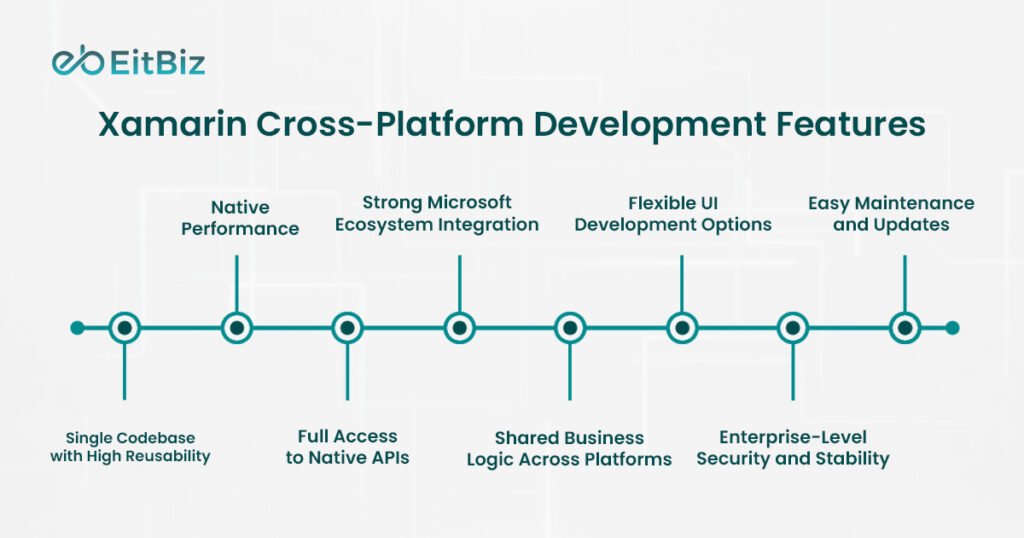
Xamarin cross-platform app development has long been a preferred choice for businesses looking to build robust, scalable applications using a single codebase. Backed by Microsoft, Xamarin offers a powerful set of features that make it suitable for enterprise-grade cross-platform mobile app development.
1. Single Codebase with High Reusability
One of the biggest advantages of cross-platform mobile app development that Xamarin offers is the ability to share up to 90% of the code across iOS, Android, and Windows platforms. This significantly reduces development time, minimizes duplication, and ensures consistency across devices.
2. Native Performance
Unlike many other cross-platform app development frameworks, Xamarin delivers near-native performance. It compiles code directly into native binaries, allowing apps to perform almost as efficiently as fully native applications. This makes it a strong contender for performance-driven business apps.
3. Full Access to Native APIs
Xamarin provides direct access to platform-specific APIs and features. Developers can easily integrate device capabilities such as camera, GPS, sensors, and notifications without limitations. This level of control is essential for building feature-rich mobile applications.
4. Strong Microsoft Ecosystem Integration
A key highlight of xamarin app development is its seamless integration with Microsoft tools like Visual Studio, Azure, and .NET libraries. This makes it an ideal choice for enterprises already using Microsoft technologies and looking to scale efficiently.
5. Shared Business Logic Across Platforms
With Xamarin, developers can write core business logic once and reuse it across multiple platforms. This ensures consistent functionality and simplifies maintenance, which is especially beneficial for large-scale applications.
6. Flexible UI Development Options
Xamarin offers two approaches for UI development:
- Xamarin.Forms for building a shared UI across platforms
- Native UI development for platform-specific customization
This flexibility allows developers to balance speed and customization based on project needs.
7. Enterprise-Level Security and Stability
Xamarin is widely trusted for building secure applications. With support for secure authentication, encryption, and enterprise-grade architecture, it is often chosen by organizations that prioritize data security and compliance.
8. Easy Maintenance and Updates
Since most of the code is shared, updates and bug fixes can be implemented quickly across all platforms. This reduces long-term maintenance costs and ensures a smoother development lifecycle.
What are the Benefits of Choosing Xamarin for Cross-Platform App Development?
Let’s take a look at the benefits of choosing Xamarin for cross-platform app development.
Benefit #1: Code Reusability
One of the biggest benefits of Xamarin is that it allows you to write code once and run it everywhere. Thus, developers don’t need to run into building separate apps for iOS or Android, which ultimately saves time, effort, and money. Furthermore, the professional developers you hire will have enough time to launch products on multiple platforms without compromising their resources. It won’t be wrong to say that the framework is quite consistent and practical.
Benefit #2. Native-Like Performance
Another major benefit of Xamarin is that your mobile app will always have an edge over other competitors due to its superior performance. The best part is that they perform like native apps and don’t feel slow or clunky. Furthermore, the framework runs into platform-specific APIs and hardware acceleration, which means users don’t notice the difference when they swipe through screens. Since the framework is popular for boosting the app’s speed, it helps avoid lags.
Benefit #3. Reduce Development Costs
Another major benefit of investing in Xamarin for cross-platform app development is that it significantly reduces development costs to the fullest. There is no denying that building two separate apps for both Android and iOS. When you choose Xamarin, you simply invest in a single codebase, which means that there will be lower development costs, small teams, and simpler maintenance. Furthermore, your business will generate more value for every penny it spends.
Benefit #4. Quick Access to Native APIs
One of the major reasons to invest in Xamarin is that it provides you with quick and direct access to device features. There’s no hassle in using the GPS, camera, contacts, or even some platform-specific functions without running into multiple complexities. Furthermore, developers don’t need to reinvent the wheel for each operating system. With Xamarin, you can easily build apps that feel local to each device while facilitating seamless integration.
Benefit #5. Testing and Maintenance
No matter what kind of app you want to build, you cannot overlook the importance of app testing. But unlike other platforms that usually burn a lot of hours, Xamarin makes app testing much easier. Since it requires only a single codebase, developers can easily run tests once instead of doing it separately for multiple platforms. Thus, it makes it easier for businesses to foster quick and seamless maintenance and keep potential bugs and errors at bay.
Benefit #6. Faster Development with Familiar Tools
Last but not least, Xamarin is a popular cross-platform framework that works within the Microsoft ecosystem. Developers use Visual Studio, C#, and .NET, tools that many already know. There’s no steep learning curve. Teams can jump in quickly and focus on building features instead of learning new languages. Furthermore, it significantly boosts the speed of the entire process, which means faster development and a better competitive edge.
Choosing the Right Cross-Platform Framework for Your Business
Selecting the ideal framework is a critical step in successful cross-platform app development. With multiple cross-platform app development frameworks available, such as Xamarin, .NET MAUI, React Native, and Flutter, businesses must evaluate their needs carefully before making a decision.
The right choice depends on several factors, including project complexity, budget, team expertise, and long-term goals.
1. Define Your Business Requirements
Start by identifying what your application needs:
- Is it a simple MVP or a complex enterprise solution?
- Do you need high performance or rich UI?
- What platforms are you targeting (iOS, Android, web, desktop)?
For example, xamarin app development is often preferred for enterprise-grade solutions, while Flutter or React Native may suit startups aiming for faster deployment.
2. Consider Development Speed and Time-to-Market
If your priority is launching quickly, frameworks like React Native and Flutter offer faster development cycles. However, for long-term scalability and structured development, cross-platform mobile app development Xamarin or .NET MAUI may be more suitable.
3. Evaluate Team Expertise
Your team’s existing skills play a major role:
- If your developers are experienced in C# and .NET, Xamarin cross-platform app development or MAUI is a natural fit
- If your team is skilled in JavaScript, React Native is a better option
Choosing a framework aligned with your team reduces training time and development costs.
4. Analyze Performance Needs
Performance is crucial for apps with complex features:
- Xamarin and .NET MAUI provide near-native performance
- Flutter offers excellent rendering performance
- React Native works well but may require optimization for heavy apps
This is especially important when comparing react native vs xamarin or xamarin vs flutter for performance-sensitive applications.
5. Assess Long-Term Support and Future Scope
Technology evolves quickly, so choosing a future-ready framework is essential:
- Xamarin vs MAUI clearly shows that MAUI is the future of Microsoft-based development
- Flutter and React Native continue to grow with strong community support
Businesses should prioritize frameworks with active updates and long-term viability.
6. Budget and Cost Efficiency
One of the main benefits of cross-platform mobile app development frameworks is cost savings. However, costs can vary:
- Xamarin and MAUI may involve a higher initial setup, but offer strong scalability
- React Native and Flutter reduce development costs with faster builds
Balancing upfront investment with long-term ROI is key.
7. Maintenance and Scalability
Think beyond development:
- Will your app need frequent updates?
- Do you plan to scale features over time?
Frameworks like .NET MAUI and Flutter provide better scalability, while Xamarin is still widely used for maintaining existing enterprise applications.
What Replaced Xamarin? Introduction to .NET MAUI
For years, Xamarin was a leading choice for cross-platform app development, especially within the Microsoft ecosystem. However, as technology evolved and developer needs changed, Microsoft introduced a more advanced solution, .NET MAUI (Multi-platform App UI).
So, what replaced Xamarin? The answer is simple: .NET MAUI is the official successor to Xamarin, designed to overcome its limitations and provide a more streamlined development experience.
Why Was Xamarin Replaced?
While xamarin app development offered strong capabilities, it had certain challenges:
- Complex project structure with multiple platform-specific files
- Slower UI development compared to modern frameworks
- Increasing demand for better performance and scalability
- Need for a unified development experience across devices
What is .NET MAUI?
.NET MAUI is a next-generation framework for cross-platform mobile app development that allows developers to build apps for iOS, Android, Windows, and macOS using a single codebase and project structure.
It is part of the unified .NET ecosystem and represents a major evolution in cross-platform app development frameworks.
Key Improvements in .NET MAUI Over Xamarin
1. Single Project Structure
Unlike Xamarin, which required multiple projects for different platforms, .NET MAUI uses a single unified project. This simplifies development and makes code management much easier.
2. Enhanced Performance
.NET MAUI delivers better performance through optimized architecture and deeper integration with modern .NET versions.
3. Simplified UI Development
UI creation is more intuitive and streamlined, reducing the complexity developers often faced in Xamarin.
4. Broader Platform Support
While Xamarin focused mainly on mobile platforms, .NET MAUI expands support to desktop environments like Windows and macOS.
5. Future-Ready Framework
In the Xamarin vs. MAUI comparison, MAUI clearly stands out as the future of Microsoft-based app development frameworks, with ongoing updates and strong support.
Xamarin vs .NET MAUI vs Other Frameworks
Choosing the right technology is crucial for successful cross-platform mobile app development. Here is the difference between Xamarin vs. .NET MAUI vs. React Native vs. Flutter vs, Ionic.
| Feature | Xamarin | .NET MAUI | Other Frameworks (React Native / Flutter) |
|---|---|---|---|
| Status | Legacy but supported | Modern & actively developed | Highly active and evolving |
| Language | C# | C# (.NET) | JavaScript (React Native), Dart (Flutter) |
| Performance | Near-native | Better than Xamarin | Good to excellent (Flutter leads in UI performance) |
| Project Structure | Multiple projects | Single project | Single codebase |
| Development Speed | Moderate | Faster | Fast (ideal for MVPs) |
| Best Use Case | Enterprise & legacy apps | Scalable modern apps | Startups, UI-rich apps |
| Future Scope | Declining | Strong | Very strong |
Final Thoughts
So, there you have it! That’s a complete conclusion to the top 6 reasons to choose Xamarin for cross-platform app development in 2026! As a matter of fact, building a mobile app is quite challenging and demands strenuous effort. However, Xamarin comes to the rescue and makes the entire process hassle-free.
If you’re planning to build a mobile app using Xamarin, there’s no other professional partner better than EitBiz!
We are a dedicated Xamarin app development company that effectively harnesses state-of-the-art technologies and tools to build scalable, feature-rich, and rapid apps that attract, engage, and convert. Our team of Xamarin app developers first understands your objectives and then provides a systematic roadmap for your mobile app development.
Have a mobile app project in mind? If so, Contact EitBiz today, you can call us at +1(317)463-7064 and get in touch with our Xamarin developers. We’re eager to provide you with prompt assistance.