Let’s start with a simple reality: mobile is no longer just a channel; it’s the backbone of how modern enterprises operate, engage, and grow.
According to Statista, global smartphone users have crossed 7 billion, and mobile apps account for over 90% of total mobile time spent. Meanwhile, enterprise mobility spending continues to surge as organizations prioritize digital transformation. Gartner reports that by 2026, more than 70% of enterprise applications will be mobile-first or mobile-optimized.
But here’s the catch.
Despite massive investments, many enterprise mobile initiatives fail to deliver ROI. Apps get built, but they don’t scale. Features get added, but they don’t solve real business problems. Teams move fast, but in the wrong direction.
That’s where mobile app consulting comes in.
Instead of jumping straight into development, enterprises are increasingly relying on app development consulting services to define the right strategy, choose the right technologies, and align mobile initiatives with business goals.
This guide will walk you through everything you need to know about mobile app consulting services for enterprises in 2026, what they are, why they matter, how to choose the right partner, and what it actually costs.
Why Enterprises Need Mobile App Consultants?
Enterprise mobile apps are fundamentally different from consumer apps. They involve complex integrations, strict security requirements, and multiple stakeholders. Without a clear roadmap, projects can quickly spiral out of control.
Here’s why enterprises are turning to mobile app strategy consulting:
1. To Avoid Costly Mistakes Early
Building an app without validation is risky. Many enterprises invest heavily in development only to realize later that:
- The user experience is flawed
- The business model doesn’t work
- The app doesn’t integrate well with existing systems
A good mobile app development consulting partner helps you validate ideas before writing a single line of code.
2. To Align Technology with Business Goals
Mobile apps should not exist in isolation. They must support:
- Revenue growth
- Operational efficiency
- Customer engagement
- Data-driven decision-making
With app strategy consulting services, enterprises can ensure that their mobile initiatives directly contribute to measurable outcomes.
3. To Handle Complex Enterprise Ecosystems
Enterprise environments often include:
- Legacy systems
- ERP and CRM platforms
- Cloud infrastructure
- Security frameworks
Consultants specializing in enterprise mobile app development understand how to integrate mobile solutions into these ecosystems without disruption.
4. To Accelerate Time-to-Market
Speed matters. But speed without direction leads to failure.
A structured enterprise mobile app strategy guide helps teams:
- Prioritize features
- Choose the right architecture
- Avoid rework
This significantly reduces development time and costs.
5. To Stay Competitive
In 2026, enterprises are competing on digital experience. Companies that invest in enterprise mobile app solutions gain a clear advantage in:
- Customer retention
- Employee productivity
- Operational efficiency
Key Services Offered by App Consulting Firms
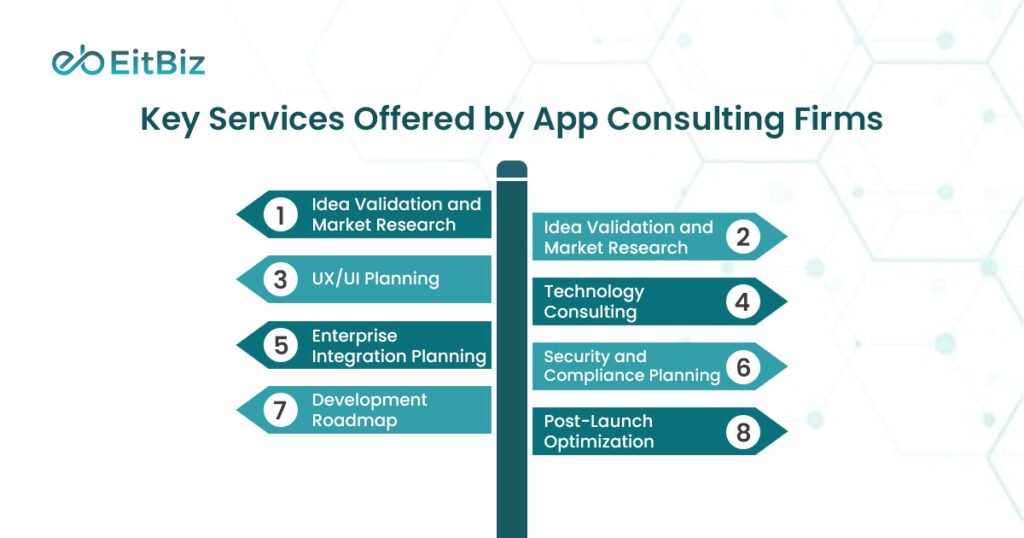
Not all consulting services are the same. A reliable mobile app consulting company offers a comprehensive suite of services designed to guide enterprises from idea to execution. Here’s a more detailed, humanized breakdown of what each service actually involves and why it matters.
1. Idea Validation and Market Research
Before any development begins, consultants take a step back and evaluate whether your app idea is worth pursuing. This phase focuses on understanding real market demand, identifying competitors, analyzing user behavior, and estimating revenue potential. Instead of relying on assumptions, consultants use data to validate your concept. This reduces the risk of building something users don’t need. It’s one of the most critical stages in mobile app consulting services for enterprises, because it sets the foundation for everything that follows.
2. Mobile App Strategy Development
Once the idea is validated, the next step is to define a clear and actionable strategy. Consultants outline who your target users are, what core features your app should include, how it will generate revenue, and which technology stack best fits your goals. This phase ensures that your app is not just functional, but also aligned with business objectives. Effective mobile app consulting helps enterprises avoid scope creep and stay focused on outcomes that matter.
3. UX/UI Planning
A well-designed app is easier to use, more engaging, and more likely to succeed. Consultants focus on crafting user journeys that feel natural and efficient. They create wireframes, define user flows, and build prototypes to visualize the experience before development starts. This process allows teams to identify usability issues early and fix them quickly. Strong UX/UI planning ensures that the final product is intuitive, which is essential for user adoption and retention.
4. Technology Consulting
Choosing the right technology is a critical decision that impacts performance, scalability, and cost. Consultants guide enterprises through options such as native versus cross-platform development, backend architecture choices, and cloud infrastructure setup. They also plan how APIs and third-party integrations will work. With expert mobile app development consulting, businesses can avoid technical debt and ensure their app is built on a future-ready foundation.
5. Enterprise Integration Planning
Enterprise apps rarely operate in isolation. They need to connect with existing systems like ERP software, CRM platforms, and internal tools. Consultants map out how these integrations will work and ensure seamless data flow across systems. This is especially important in mobile app development for enterprises, where operational efficiency depends on connected ecosystems. Proper integration planning prevents bottlenecks and ensures smooth business processes.
6. Security and Compliance Planning
Security is not optional for enterprise applications. Consultants help design systems that protect sensitive data and meet industry regulations. This includes implementing data encryption, setting up secure authentication methods, and ensuring compliance with standards relevant to your industry. By addressing security early, enterprises reduce the risk of breaches and build trust with users and stakeholders.
7. Development Roadmap
A clear roadmap turns strategy into execution. Consultants create a structured plan that outlines timelines, key milestones, and resource allocation. This helps teams stay organized and aligned throughout the project. It also makes it easier to track progress and manage expectations across stakeholders. A well-defined roadmap is essential for delivering projects on time and within budget.
8. Post-Launch Optimization
Launching the app is just the beginning. After release, consultants continue to monitor performance, analyze user feedback, and recommend improvements. This may include fixing usability issues, adding new features, or optimizing performance. Many mobile app consulting company providers offer ongoing support to ensure the app evolves with user needs and market trends. Continuous optimization helps enterprises maximize long-term value from their mobile investment.
How to Choose the Right Consulting Partner?
Choosing the right partner can make or break your project. A well-qualified consultant brings clarity, structure, and direction. The wrong one can lead to wasted time, budget overruns, and poor outcomes. Here’s a practical, no-nonsense guide on how to choose a mobile app consulting company for your enterprise.
1. Evaluate Industry Experience
Start by looking at the firm’s experience in your specific industry. Every sector, whether it’s healthcare, fintech, retail, or logistics, comes with its own challenges, regulations, and user expectations. A consulting partner who understands your domain will already know common pitfalls and best practices. Also, check if they’ve worked on similar business models and handled enterprise-level projects. This reduces onboarding time and increases the chances of success.
2. Check Technical Expertise
A strong consulting partner must be technically sound. They should have a deep understanding of modern frameworks, cloud platforms, and evolving security standards. This includes knowledge of scalable architectures, API integrations, and cross-platform development approaches. When it comes to mobile app development consulting, technical decisions directly impact performance and long-term sustainability, so this is not an area to compromise.
3. Review Case Studies
Case studies provide real proof of what a consulting firm can deliver. Look beyond surface-level claims and ask for detailed examples of past projects. Focus on measurable outcomes, such as improved user engagement, faster deployment, or cost savings. Client testimonials also offer insights into how the firm works in real scenarios. A reliable mobile app consulting company should be transparent about its track record.
4. Assess Strategic Thinking
Be cautious of firms that jump straight into development without asking deeper questions. Strong app consulting services prioritize understanding your business problem first. They focus on aligning the app with your long-term goals, identifying the right features, and ensuring scalability. Strategic thinking means they are not just building an app, they are helping you solve a business challenge effectively.
5. Understand Their Process
A structured approach is a sign of maturity and reliability. A professional mobile app consulting company typically follows a step-by-step process that includes discovery, research, strategy formulation, planning, and execution support. This ensures nothing is overlooked and every phase is properly documented. A clear process also makes collaboration easier and keeps the project on track.
6. Evaluate Communication
Enterprise projects involve multiple stakeholders, so clear communication is essential. Your consulting partner should provide regular updates, use collaborative tools, and actively involve your team in key decisions. Poor communication often leads to misunderstandings and delays. On the other hand, transparent and consistent communication builds trust and keeps everyone aligned throughout the project lifecycle.
7. Consider Scalability
Your business will grow, and your mobile app needs to grow with it. Choose a consulting partner who can support future expansion, whether it’s adding new features, scaling infrastructure, or adapting to new technologies. The right partner will think beyond the immediate project and help you build a solution that evolves over time. This is especially important for long-term enterprise mobile app solutions.
Cost of Mobile App Consulting in 2026
Let’s talk numbers.
The cost of mobile app consulting services in 2026 varies widely based on several factors.
Average Cost Breakdown
| Service Type | Estimated Cost |
|---|---|
| Basic Consultation | $5,000 – $15,000 |
| Strategy Development | $15,000 – $40,000 |
| Full Consulting Package | $40,000 – $50,000+ |
What are the Key Factors That Affect the Cost of App Consulting Services?
The cost of consulting is not fixed. It varies based on multiple practical factors that directly influence the level of effort, expertise, and time required. Understanding these variables will help you better estimate the cost of mobile app consulting services in 2026 and plan your budget more effectively.
1. Project Complexity
The more complex your app idea is, the higher the consulting cost will be. Simple apps with limited features require basic planning, while enterprise-grade applications demand deeper analysis, multiple stakeholder inputs, and detailed technical architecture. Complex projects often involve integrations, scalability planning, and risk assessments, which increase the scope of mobile app consulting efforts.
2. Industry Requirements
Certain industries naturally require more rigorous planning due to strict regulations and compliance standards. For example, healthcare and finance applications must follow data protection laws, security frameworks, and audit requirements. This adds extra layers of validation and documentation, increasing the overall cost of mobile app consulting services for enterprises in these sectors.
3. Scope of Services
The total cost also depends on how many services you need. Basic advisory or a one-time consultation will cost significantly less than a full-service package that includes strategy development, UX planning, technical consulting, and post-launch support. Comprehensive app development consulting services involve more time, resources, and expertise, which naturally raises the price.
4. Consultant Expertise
Experience plays a major role in pricing. Highly skilled consultants with a proven track record in enterprise mobile app development typically charge higher fees. However, they also bring better insights, faster problem-solving, and reduced risk. While it may seem expensive upfront, experienced consultants often save money in the long run by preventing costly mistakes.
5. Geographic Location
The location of your consulting partner can significantly impact costs. Firms based in North America or Western Europe usually charge higher rates compared to those in Asia or Eastern Europe. However, cost should not be the only deciding factor. When evaluating a mobile app consulting company, balance pricing with expertise, communication, and reliability to get the best overall value.
Latest Trends in Enterprise Mobile Apps (2026)
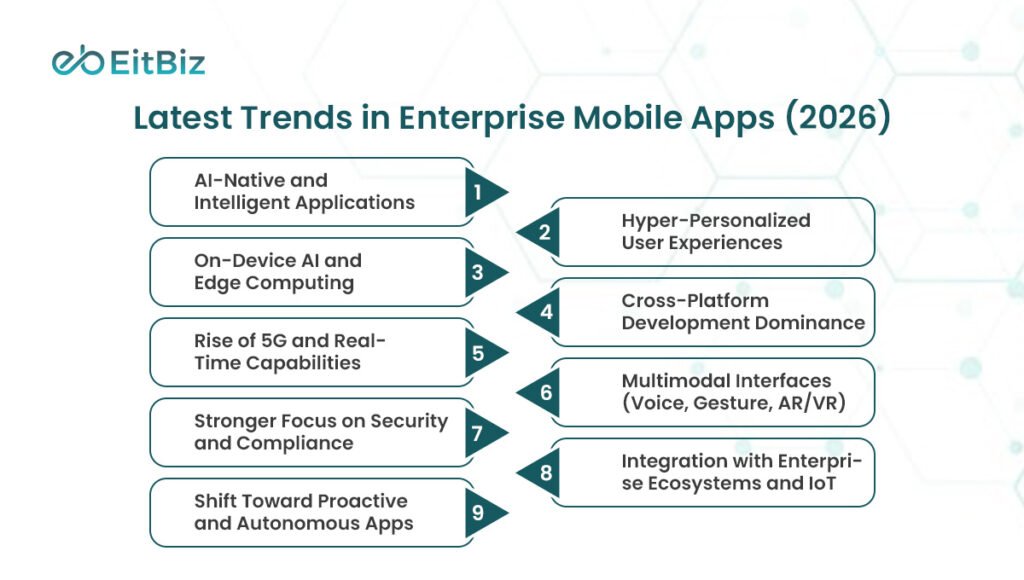
Enterprise mobile apps are evolving rapidly in 2026. They are no longer just tools for basic operations; they are becoming intelligent, adaptive, and deeply integrated systems that drive business outcomes. Here are the most important trends shaping enterprise mobile app development, explained in a practical and easy-to-understand way.
1. AI-Native and Intelligent Applications
Artificial intelligence is no longer an add-on feature; it is the foundation of modern apps. In 2026, a large share of enterprise apps will be built as AI-native, meaning they can predict user behavior, automate tasks, and make real-time decisions. Reports suggest that over 70% of apps now include embedded AI capabilities, and many enterprises are integrating task-specific AI agents into their systems. This shift is transforming apps from passive tools into proactive assistants that improve efficiency and decision-making.
2. Hyper-Personalized User Experiences
Static interfaces are becoming outdated. Modern enterprise apps now adapt dynamically based on user behavior, preferences, and context. Two users may see completely different interfaces within the same app. This level of personalization improves engagement and productivity, especially for employee-facing applications. Apps are increasingly designed to deliver relevant information at the right time, reducing friction in daily workflows.
3. On-Device AI and Edge Computing
Speed and privacy are top priorities in 2026. Instead of relying entirely on cloud processing, many enterprise apps are shifting toward on-device intelligence. This means data is processed locally on the device, enabling faster response times and better data security. It also allows apps to function even with limited connectivity. This trend is particularly important for industries that handle sensitive data or require real-time performance.
4. Cross-Platform Development Dominance
Enterprises are increasingly choosing cross-platform frameworks to build apps faster and more cost-effectively. Instead of developing separate apps for iOS and Android, businesses are using technologies like Flutter and React Native to create a single codebase. This approach reduces development time, ensures consistency across platforms, and simplifies maintenance, making it a key trend in mobile app development for enterprises.
5. Rise of 5G and Real-Time Capabilities
With the expansion of 5G networks, enterprise apps are becoming faster and more responsive. This enables real-time data processing, smoother video streaming, and advanced use cases like augmented reality (AR) and remote collaboration. Businesses can now build apps that support instant communication and real-time analytics, which is critical for industries like logistics, healthcare, and manufacturing.
6. Multimodal Interfaces (Voice, Gesture, AR/VR)
User interaction is expanding beyond touchscreens. Enterprise apps now support voice commands, gesture controls, and immersive technologies like AR and VR. These multimodal interfaces improve accessibility and make apps more intuitive to use, especially in environments where hands-free interaction is necessary. For example, field workers can use voice-enabled apps to access data without interrupting their tasks.
7. Stronger Focus on Security and Compliance
As mobile apps handle more sensitive business data, security is becoming a top priority. Enterprises are adopting advanced security measures such as zero-trust architectures, biometric authentication, and end-to-end encryption. Compliance with data protection regulations is also driving changes in how apps are designed and deployed. This trend is critical for building trust and ensuring long-term sustainability.
8. Integration with Enterprise Ecosystems and IoT
Enterprise apps are becoming more connected than ever. They now integrate seamlessly with internal systems like ERP, CRM, and analytics platforms, as well as external IoT devices. This allows businesses to create unified ecosystems where data flows smoothly across systems. As a result, organizations can gain better visibility, improve decision-making, and automate complex processes.
9. Shift Toward Proactive and Autonomous Apps
Modern enterprise apps are moving from reactive to proactive behavior. Instead of waiting for user input, they can anticipate needs and take action automatically. For example, apps can send alerts, generate reports, or suggest actions based on real-time data. This shift is redefining how businesses interact with technology and is becoming a core part of enterprise mobile app solutions.
Conclusion
Enterprise mobile apps in 2026 are no longer just digital tools; they are critical business assets that drive growth, efficiency, and customer engagement. But success doesn’t come from development alone. It starts with clarity, strategy, and the right decisions at the right time. That’s exactly where mobile app consulting plays a vital role. From validating ideas to defining scalable architectures, consulting helps enterprises reduce risks, optimize costs, and build solutions that actually deliver results. Whether you’re planning a new product or upgrading an existing system, investing in the right guidance can make a measurable difference.
If you’re looking for a trusted partner to guide your journey, EitBiz stands out as a reliable mobile app consulting company with proven expertise in delivering scalable enterprise mobile app solutions. Their team combines strategic thinking with technical excellence to help businesses turn ideas into high-performing mobile applications. From initial strategy to post-launch support, EitBiz offers end-to-end mobile app consulting services for enterprises tailored to your unique business needs.