Large language models (LLMs) can answer questions, summarize documents, and automate business workflows. However, they cannot automatically access a company’s latest internal data. This can lead to outdated responses, inaccurate answers, or limited business context.
Retrieval-augmented generation (RAG) addresses this limitation by connecting LLMs to relevant external data. Businesses can implement this capability through managed services or custom development. Understanding what RAG as a service is and when you should build custom instead helps you choose the right solution for your AI requirements.
What is RAG as a Service
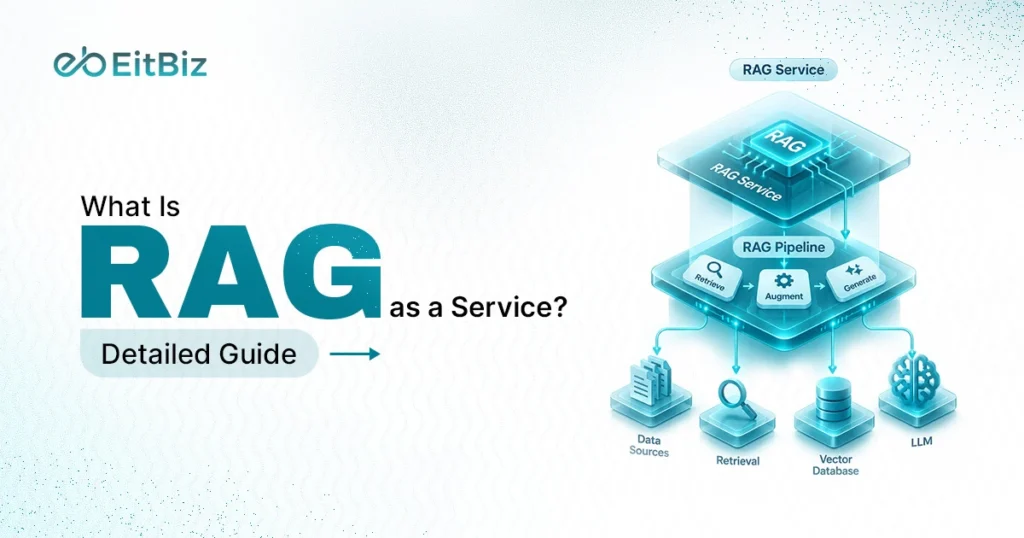
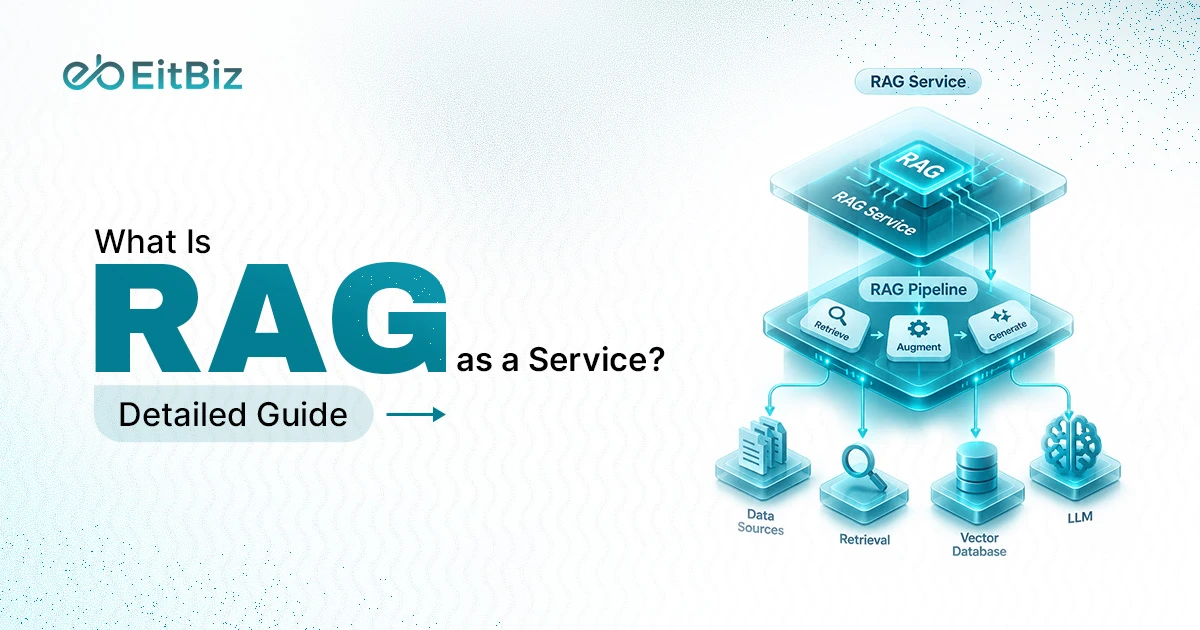
RAG as a service (RAGaaS) is a managed solution that provides the infrastructure, tools, and expertise required to build, deploy, and maintain retrieval-augmented generation applications. In RAG system development, businesses rely on service providers to manage essential components.
A RAG-as-a-service provider typically handles:
- Data ingestion from multiple business sources.
- Document processing, chunking, and content preparation.
- Embedding generation and vector database management.
- Pipeline monitoring, optimization, and performance support.
RAG connects an LLM to an external knowledge base, allowing it to retrieve relevant information before generating a response. This enables businesses to deliver answers based on internal documents, databases, and other knowledge sources without retraining the underlying model. Businesses can also leverage large language model development expertise to build more advanced AI-powered applications.
Benefits of RAGaaS for Businesses
RAG as a service provider system requires expertise in data engineering, AI models, vector databases, and infrastructure management. A managed solution reduces much of this engineering responsibility, allowing businesses to focus on their applications and business goals.
| Key Benefit | How It Helps Businesses |
|---|---|
| Faster Implementation | Accelerates deployment with prebuilt tools and integrations. |
| Reduced Maintenance | Minimizes infrastructure management and maintenance responsibilities. |
| Easier Scalability | Supports growing data volumes and query workloads. |
| Specialized Expertise | Provides access to experienced AI engineering professionals. |
These benefits make this service suitable for businesses to adopt AI-powered applications without managing the entire technical infrastructure.
How Does RAG Work as a Service
A RAG-as-a-Service (RAGaaS) platform provides businesses with a managed environment to build, deploy, and operate Retrieval-Augmented Generation (RAG) workflows. It simplifies the process of connecting business data with large language models (LLMs) by handling data preparation, information retrieval, and response generation. Although features vary across platforms, a typical RAGaaS workflow involves three key stages.
Data Ingestion and Preparation
A RAGaaS platform starts by connecting to business data sources, including PDFs, CRM systems, cloud storage, and internal knowledge bases. The platform automatically extracts, cleans, and processes this information before dividing documents into smaller sections called chunks. This structured preparation makes large volumes of business data easier to organize, index, and retrieve when users submit queries.
Indexing and Retrieval
Once the data is prepared, the RAGaaS platform converts text chunks into numerical representations called vector embeddings. It stores these embeddings in a searchable vector database, allowing the platform to identify relevant information based on user queries.
The indexing and retrieval process typically involves:
- Converting text chunks into numerical vector embeddings.
- Storing embeddings in a searchable vector database.
- Processing user queries to identify relevant information.
- Retrieving contextually relevant data from connected sources.
Depending on the platform’s RAG architecture, it may use semantic search, keyword search, or hybrid retrieval methods to improve search accuracy and relevance.
Response Generation
After retrieving relevant information, the RAGaaS platform passes the selected context to an integrated LLM. The model uses this additional information to generate responses that are relevant to the user’s query and grounded in the business’s own data.
The platform delivers the generated response through an application, chatbot, or API integration. This allows businesses to provide context-aware answers without building and managing the entire RAG infrastructure themselves.
Context Augmentation and Response Generation
It sends the searched information to the LLM as additional context. The model uses the context to generate a response relevant to the user’s question.
This approach helps ground AI-generated answers in available business information. Some implementations also provide source citations, allowing users to verify the information behind a response.
RAG as a Service vs. Custom RAG
It helps businesses connect large language models (LLMs) to external knowledge sources. They differ in development complexity, infrastructure management, and long-term costs. The table below highlights RAG-as-a-service vs. custom differences to help you choose the right approach for your business.
| Comparison Factor | RAG as a Service | Custom RAG |
|---|---|---|
| Development | Uses prebuilt components and integrations | Requires building a tailored architecture |
| Deployment | Faster implementation and launch | Requires more development and testing |
| Customization | Limited to provider-supported capabilities | Offers greater architectural flexibility |
| Infrastructure | Managed by the service provider | Managed by internal teams or partners |
| Maintenance | The provider handles many operational tasks. | Internal teams manage ongoing maintenance. |
| Scalability | Depends on provider infrastructure and limits | Designed around specific workload requirements |
| Cost Structure | Subscription or usage-based pricing | Development and operational expenses |
| Best Suited For | Standard RAG applications and faster deployment | Complex workflows and specialized requirements |
Development Time and Complexity
Managed RAG solutions reduce initial engineering work because essential components are already available. Businesses can use existing connectors, APIs, and retrieval mechanisms instead of developing the entire pipeline.
Custom RAG requires more planning and development. Teams must design the architecture, select technologies, integrate data sources, and test retrieval performance. Although the process takes longer, it provides greater control over implementation.
Flexibility and Customization
A managed RAGaaS platform offers customization within its supported features and configurations. This works well for standard applications, but businesses may face limitations when they need specialized retrieval strategies or complex integrations.
Developers can select embedding models, configure chunking strategies, implement hybrid search, introduce reranking, and optimize individual pipeline components.
Ownership and Long-Term Costs
RAGaaS generally involves subscription, usage, or service fees. These costs may be easier to estimate initially, but they can increase with query volume, storage, and additional features.
Custom RAG requires an initial investment in development, infrastructure, and technical expertise. Businesses gain greater control over their technology choices and operational expenses. The more economical option depends on workload, maintenance requirements, and total cost of ownership.
Approach That Business Should Choose
Choose retrieval-augmented generation as a service if you prioritize faster deployment, managed infrastructure, and reduced engineering overhead. It is particularly suitable for standard applications, such as internal knowledge assistants and customer support chatbots. Custom RAG is a better fit when your business requires specialized integrations or specific security configurations.
It considers a hybrid approach by using managed infrastructure while customizing retrieval components to meet specific business requirements. Ultimately, evaluate your technical needs and long-term goals before deciding whether to build or buy.
When Should You Choose RAG as a Service
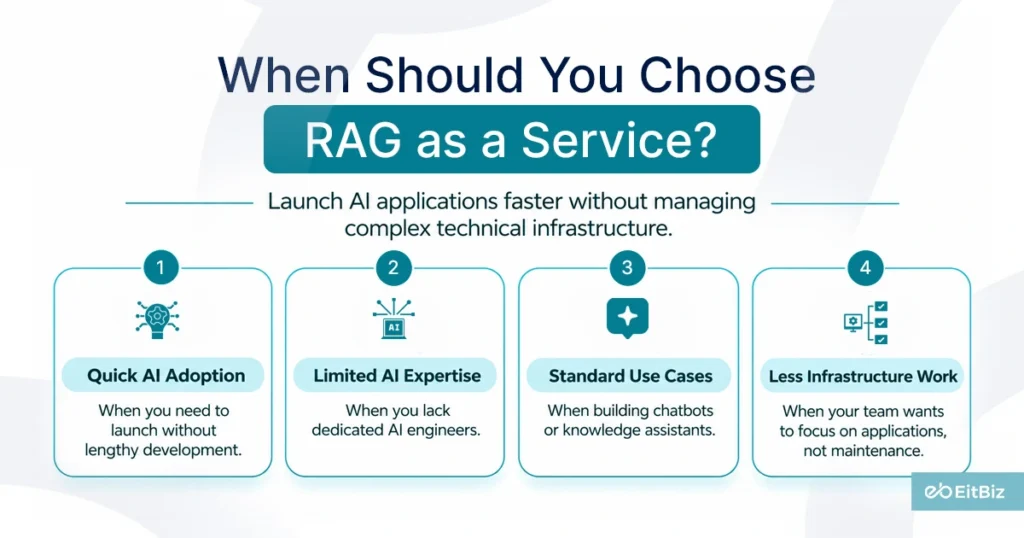
Managed services through this approach are a practical choice when businesses want to introduce AI-powered retrieval without taking responsibility for every technical component.
Need to Launch Quickly
If you want to test AI assistant or document search capabilities, a managed RAG-as-a-service platform can accelerate implementation with prebuilt integrations and reduce development effort.
Limited In-House AI Expertise
Organizations without dedicated AI engineers or infrastructure specialists can use a provider’s technical expertise to implement and maintain applications.
Requirements Fit Standard Workflows
Applications such as internal knowledge assistants, customer support chatbots, and document search systems often follow established retrieval workflows. A managed solution can support these use cases without requiring extensive customization.
Common use cases include:
- Internal knowledge assistants for employee support.
- Customer support chatbots for common queries.
- Document search across business knowledge repositories.
Prefer Managed Operations
If your team wants to focus on application development rather than infrastructure maintenance, RAGaaS is a suitable option. It covers all responsibilities of the provider, including monitoring, updates, and troubleshooting.
When Should You Build a Custom RAG Solution Instead
A managed platform may not provide enough flexibility for businesses with specialized technical requirements. In such cases, custom RAG development offers greater control over the system’s architecture and behavior.
Complex Data and Integration Requirements
Businesses working with proprietary databases, legacy applications, and multiple enterprise systems may need integrations beyond standard platform connectors. Custom development allows engineers to design the best RAG-as-a-service for data pipelines around existing infrastructure and business workflows.
Greater Control Over RAG Architecture
If your application wants specialized retrieval methods, custom chunking, hybrid search, or advanced reranking, building your own RAG stack can provide the necessary flexibility. You can also experiment with different embedding models and retrieval configurations.
Strict Security and Compliance Requirements
Organizations handling confidential or regulated information may require specific data residency, access controls, encryption policies, and deployment environments. Custom RAG allows teams to design security measures around these requirements, although compliance still depends on implementation and operational practices.
Expect Specialized Workloads at Scale
Applications with high query volumes, complex retrieval requirements, or predictable workloads may benefit from custom infrastructure optimization. Building your own system can help control performance and resource allocation, provided you have the expertise to manage it.
How To Choose a RAG-as-a-Service Platform?
Choosing the right platform requires more than comparing features and subscription prices. Businesses should evaluate how to choose a RAG-as-a-service platform that fits their data infrastructure, security requirements, and long-term AI goals.
Data Source Compatibility
Check whether the platform supports your existing data sources, including databases, cloud storage, CRM systems, and document formats. Strong integration capabilities reduce implementation complexity.
Look for compatibility with the following data sources:
- PDF documents, Word files, and spreadsheets.
- SQL and NoSQL databases for structured data.
- CRM platforms and enterprise business applications.
- APIs for connecting third-party business systems.
Retrieval Quality and Evaluation
Evaluate semantic search, hybrid retrieval, reranking, and relevance testing. Test the platform with real business queries to understand whether it retrieves useful information and generates reliable responses.
Security and Data Governance
Review encryption, role-based access controls, data isolation, retention policies, and compliance requirements. An enterprise RAG platform should provide security capabilities that align with your organization’s data protection policies.
Scalability and Performance
Consider query throughput, response latency, indexing capacity, and support for growing data volumes. The platform should handle your expected workloads without compromising retrieval performance.
Pricing and Vendor Flexibility
Compare subscription fees, usage-based charges, storage costs, and API limitations. Also, check whether you can export your data, switch models, or migrate to another solution without significant disruption.
Conclusion
RAG as a service is more accessible than building and managing AI infrastructure. It helps businesses with complex data environments or specialized requirements, which may benefit more from custom development.
The key is to choose an approach that supports your current needs without restricting future growth. At EitBiz, we help businesses evaluate their AI requirements and develop scalable RAG solutions, from managed implementations to custom architectures. Connect with our team to explore the right approach for your business.