Artificial intelligence is deeply embedded across enterprise environments, driving everything from automated workflows to strategic decision-making. In fact, 88% of organizations now use AI in at least one business function.
Yet, a critical gap remains: while teams move fast to deploy these features, executive leadership faces a widening visibility gap. Every unmanaged, rogue AI model currently running in your enterprise is an unquantified liability regarding data privacy, compliance, and algorithmic bias.
The solution is not to slow down innovation, but to implement structured AI governance frameworks. Enterprise AI governance establishes the exact policies, controls, and operating structures required to manage AI risks across their entire lifecycle.
In this post, we’ll discuss how Enterprise AI Governance helps organizations manage AI risk, establish control frameworks, and scale AI responsibly across the enterprise.
What is Enterprise AI Governance?
Organizations now actively embed AI into customer service, supply chain operations, financial processes, cybersecurity, and business automation to improve efficiency and decision-making. As adoption accelerates, they also face rising risks such as biased outputs, regulatory pressure, lack of transparency, and operational failures. This creates a constant need to balance innovation with control, trust, and compliance.
To manage this balance effectively, organizations must establish a structured approach that defines how they build, deploy, and oversee AI systems across the enterprise.
This is where the Enterprise AI governance comes in!
It defines the policies, processes, controls, and decision-making frameworks that guide how organizations develop, deploy, monitor, and manage AI systems responsibly. Instead of treating AI as an isolated technical capability, organizations embed governance across the entire lifecycle to align AI outcomes with business objectives, risk appetite, and regulatory requirements.
In practice, organizations implement enterprise AI governance by assigning clear ownership across business, technology, risk, and compliance teams. They define standards for model development and deployment, enforce approval workflows, and continuously monitor AI systems for performance, fairness, and compliance. Many organizations also adopt AI governance platforms and integrated frameworks to centralize oversight and gain real-time visibility into AI behavior at scale.
What are the Benefits of Enterprise AI governance for Modern Business?
Organizations rely on this approach because it allows them to scale AI adoption without losing control over outcomes or exposing the business to unmanaged risk.
Key benefits of enterprise AI governance include:
- Organizations establish clear accountability across teams that develop, approve, and monitor AI systems
- Organizations enable responsible AI practices by embedding transparency, fairness, and ethical safeguards into operations
- Organizations reduce regulatory, operational, and reputational risks through standardized controls and oversight mechanisms
- Organizations scale AI governance implementation across multiple systems, use cases, and business units
- Organizations improve visibility and control by using governance solutions that track model performance, behavior, and compliance in real time
When organizations implement enterprise AI governance effectively, they scale AI responsibly while maintaining control, ensuring compliance, and aligning AI systems with long-term business strategy.
Why is an AI Governance Framework Essential for Responsible AI Adoption?
Many organizations rush to adopt AI because they want faster decision-making, greater efficiency, and stronger competitive advantages. However, deploying AI without a structured governance strategy often creates challenges.
Models can produce biased outcomes, violate privacy regulations, generate inaccurate results, or make decisions that no one can fully explain. An effective AI governance framework helps organizations prevent these issues before they escalate.
Without clear governance, teams often operate in silos. Different departments may follow inconsistent standards, creating gaps in compliance and oversight. A centralized framework eliminates this fragmentation by defining AI governance responsibilities, standardizing processes, and enabling consistent decision-making across the enterprise.
An effective AI governance framework helps organizations:
- Establish clear policies for ethical AI development, deployment, and monitoring.
- Define AI governance responsibilities across leadership, compliance, technology, and business teams.
- Support responsible AI governance by promoting transparency, fairness, and accountability.
- Strengthen regulatory compliance and reduce operational, legal, and reputational risks.
- Enable successful AI governance implementation through standardized processes and oversight mechanisms.
- Provide the foundation for deploying advanced AI governance solutions and an enterprise-wide AI governance platform.
- Support large-scale digital transformation initiatives while maintaining control over AI-related risks.
AI Governance vs AI Ethics: Differences, Examples, and Objectives
AI governance and AI ethics are closely related, but they serve different purposes in how organizations manage artificial intelligence systems. Governance focuses on structure and control, while ethics focuses on values and responsible intent.
AI governance defines the formal systems that organizations use to manage AI. It includes policies, procedures, accountability structures, compliance requirements, and operational controls that guide how AI is built, deployed, and monitored. AI ethics, on the other hand, focuses on the moral principles that shape AI behavior, such as fairness, transparency, inclusivity, and harm prevention.
In simple terms, governance operationalizes oversight, while ethics defines what “responsible AI” should look like.
Key differences between AI governance and AI ethics
| Aspect | AI Governance | AI Ethics |
| Focus | Focuses on the structure, control, and enforcement of AI systems | Focuses on moral principles and responsible AI behavior |
| Nature | Operational and rule-based | Principle-driven and value-based |
| Purpose | Ensures AI systems are managed, monitored, and compliant | Ensures AI systems are fair, transparent, and socially responsible |
| Implementation | Implemented through policies, frameworks, controls, and workflows | Implemented through ethical guidelines and design principles |
| Enforcement | Enforceable through regulations, audits, and organizational accountability | Not always enforceable; it depends on organizational commitment |
| Scope | Covers AI lifecycle management, risk control, and compliance | Covers fairness, bias, transparency, and human impact |
| Outcome | Produces controlled, compliant, and auditable AI systems | Produces trustworthy, fair, and responsible AI systems |
Examples
- AI governance example: An organization enforces approval workflows before deploying any machine learning model in production and continuously monitors models for compliance and performance drift.
- AI ethics example: A company decides not to use facial recognition in high-risk surveillance systems due to concerns about bias and civil liberties, even if it is legally permissible.
Objectives
AI governance aims to ensure control, compliance, accountability, and operational consistency across all AI systems. It helps organizations scale AI safely while managing risk and regulatory obligations.
AI ethics aims to ensure fairness, transparency, human well-being, and trust in AI systems. It guides organizations to design and use AI in ways that align with societal values and reduce harm.
Together, AI governance and AI ethics ensure that organizations not only build AI systems that work effectively but also deploy them responsibly and sustainably.
What Are the Key AI Governance Responsibilities Across the Enterprise?
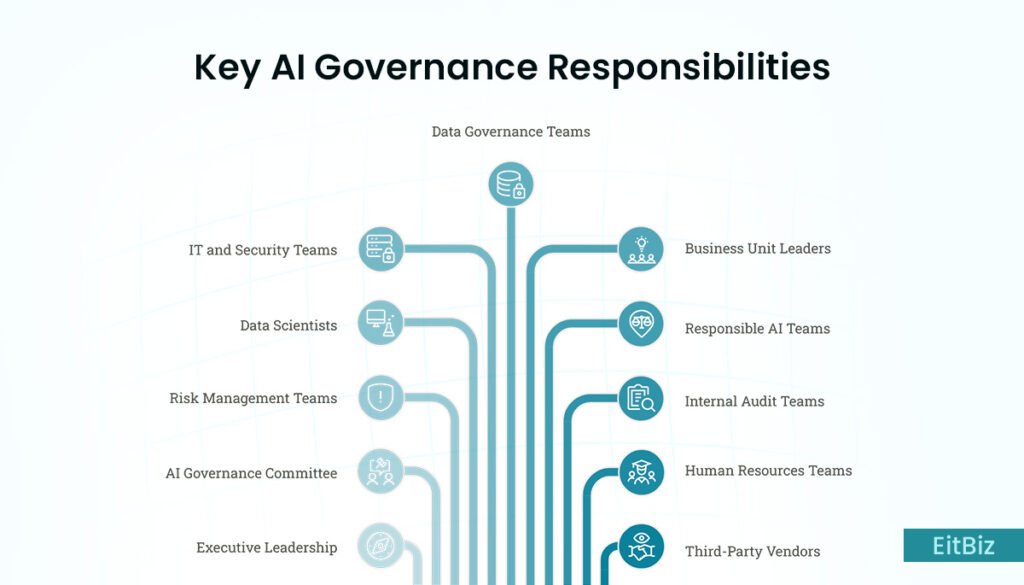
Successful AI governance responsibilities extend beyond the IT department. Organizations need a cross-functional governance structure where leaders, technical teams, compliance experts, and business stakeholders work together to ensure AI systems remain secure, ethical, compliant, and aligned with business goals.
- Executive Leadership: Establish AI strategy, governance priorities, and enterprise-wide accountability.
- AI Governance Committee: Oversee policy enforcement, risk management, and governance decision-making.
- Legal and Compliance Teams: Ensure AI systems comply with regulations, industry standards, and privacy requirements.
- Risk Management Teams: Identify, assess, and mitigate operational, financial, and reputational AI risks.
- Data Scientists and AI Engineers: Develop, test, document, and maintain AI models according to governance standards.
- IT and Security Teams: Protect AI infrastructure, data assets, and models from security threats and unauthorized access.
- Data Governance Teams: Maintain data quality, integrity, accessibility, and compliance throughout the AI lifecycle.
- Business Unit Leaders: Ensure AI initiatives align with business objectives and deliver measurable outcomes.
- Ethics and Responsible AI Teams: Evaluate AI systems for fairness, transparency, accountability, and bias mitigation.
- Internal Audit Teams: Monitor governance effectiveness and verify adherence to AI policies and controls.
- Human Resources Teams: Support AI governance training, awareness programs, and workforce readiness initiatives.
- Third-Party Vendors and Partners: Follow organizational governance standards when delivering AI solutions or services.
How Can Organizations Achieve Successful AI Governance Implementation?
Successful AI governance implementation does not happen by accident. Organizations must design it deliberately, embed it into existing workflows, and treat it as a continuous capability rather than a one-time project. The goal is simple: make AI safe, compliant, transparent, and business-aligned at scale while still enabling speed and experimentation.
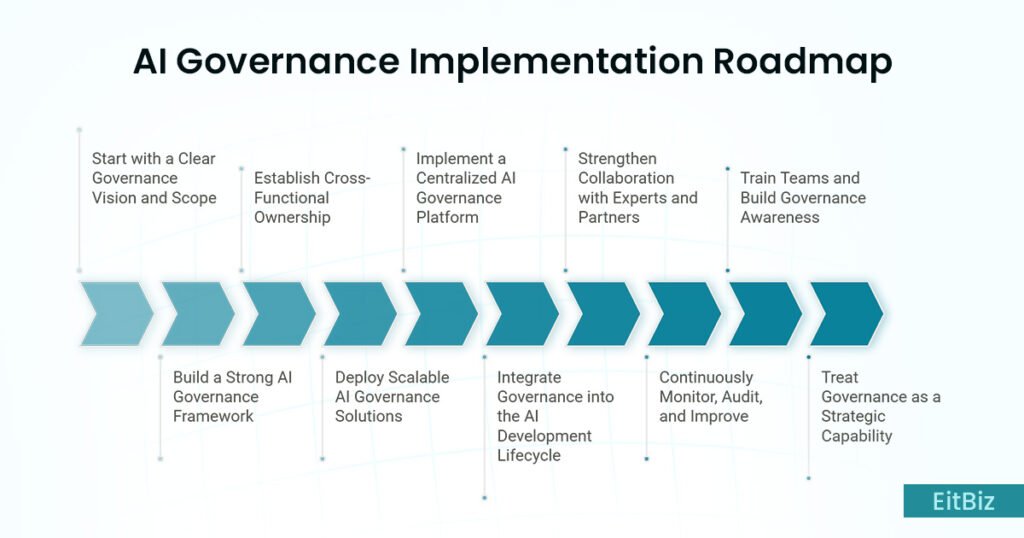
Start with a Clear Governance Vision and Scope
Organizations must first define what they want governance to achieve. Some focus on regulatory compliance, while others prioritize ethical AI, risk reduction, or operational control. A clear scope ensures governance efforts do not become overly complex or disconnected from business needs.
Leadership must align on priorities such as responsible AI governance, risk tolerance, and enterprise AI maturity goals.
Build a Strong AI Governance Framework
A structured AI governance framework forms the backbone of implementation. It defines policies, standards, and controls for the entire AI lifecycle, including data usage, model development, deployment, and monitoring.
This framework should clearly connect to AI governance responsibilities, ensuring every stakeholder knows their role in maintaining compliance and accountability.
Establish Cross-Functional Ownership
Governance fails when it sits in isolation. Organizations must distribute ownership across business, technical, legal, and risk functions.
Executive teams define strategy, data scientists ensure model integrity, compliance teams manage regulatory alignment, and IT teams secure infrastructure. This shared ownership model strengthens AI enterprise governance and reduces blind spots.
Deploy Scalable AI Governance Solutions
Manual governance processes cannot support enterprise-scale AI. Organizations need automated AI governance solutions that track models, monitor risks, and enforce policies in real time.
These solutions help standardize workflows, reduce human error, and improve visibility across AI systems deployed in different departments.
Implement a Centralized AI Governance Platform
A unified AI governance platform brings all governance activities into one environment. It provides model inventories, audit trails, risk dashboards, and compliance tracking tools.
This centralization allows organizations to monitor AI performance continuously and respond quickly to emerging issues.
Integrate Governance into the AI Development Lifecycle
Governance should not be an afterthought. It must be embedded directly into design, development, testing, and deployment phases.
When organizations integrate governance early, they reduce rework, avoid compliance gaps, and ensure smoother scaling of AI initiatives.
Strengthen Collaboration with Experts and Partners
Many enterprises accelerate implementation by working with an AI development company, leveraging AI integration services, or engaging AI consulting services.
These partners help design governance models, implement tools, and align AI systems with industry best practices.
Continuously Monitor, Audit, and Improve
AI systems evolve, and so should governance. Organizations must continuously monitor models for drift, bias, performance degradation, and compliance risks.
Regular audits and feedback loops ensure governance remains effective as AI systems scale across the enterprise.
Train Teams and Build Governance Awareness
Even the best frameworks fail without adoption. Organizations must train employees on policies, ethical standards, and governance tools.
Building awareness ensures consistent execution of AI governance implementation across all departments.
Treat Governance as a Strategic Capability
Ultimately, governance should not be seen as a limitation but as a business enabler. Strong governance accelerates Digital Transformation, reduces operational risk, and builds trust with customers and regulators.
Enterprise AI Governance: A Real-World Example
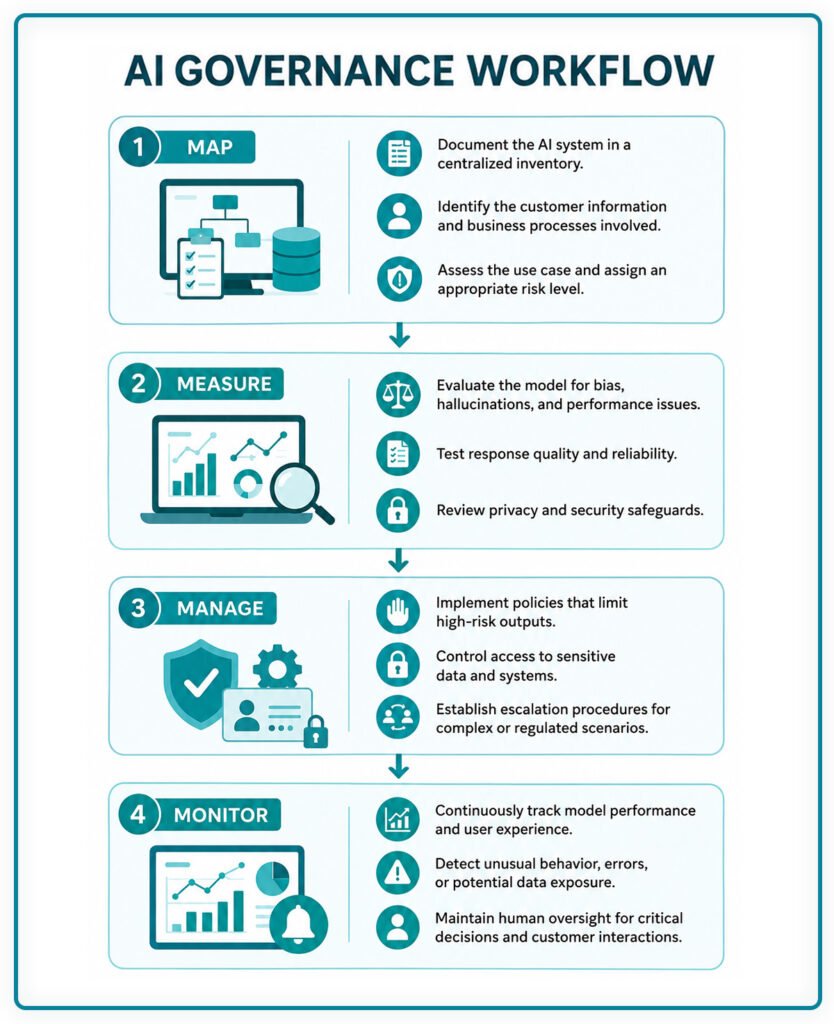
Leading organizations build AI governance around the National Institute of Standards and Technology AI Risk Management Framework (AI RMF). This approach helps ensure AI systems remain transparent, secure, compliant, and aligned with business objectives throughout their lifecycle.
A practical example is IBM WatsonX.governance, which provides oversight for AI models by tracking decisions, monitoring risk, and enforcing governance controls.
Key governance capabilities include:
- Model transparency: Maintains a record of how AI-generated outputs are produced, improving explainability and auditability.
- Shadow AI management: Detects and reduces risks associated with employees using unauthorized AI tools.
- Performance monitoring: Tracks metrics such as accuracy, relevance, bias, and reliability to identify issues early.
Business Outcome
Organizations that align their AI programs with the NIST AI RMF and governance platforms such as IBM WatsonX.governance can create a structured, repeatable approach to AI oversight. This helps ensure AI systems remain transparent, trustworthy, secure, compliant, and subject to ongoing monitoring. As a result, governance becomes an integrated operational capability that supports innovation while reducing business and regulatory risk.
How Does Enterprise AI Governance Support Digital Transformation and Business Process Automation?
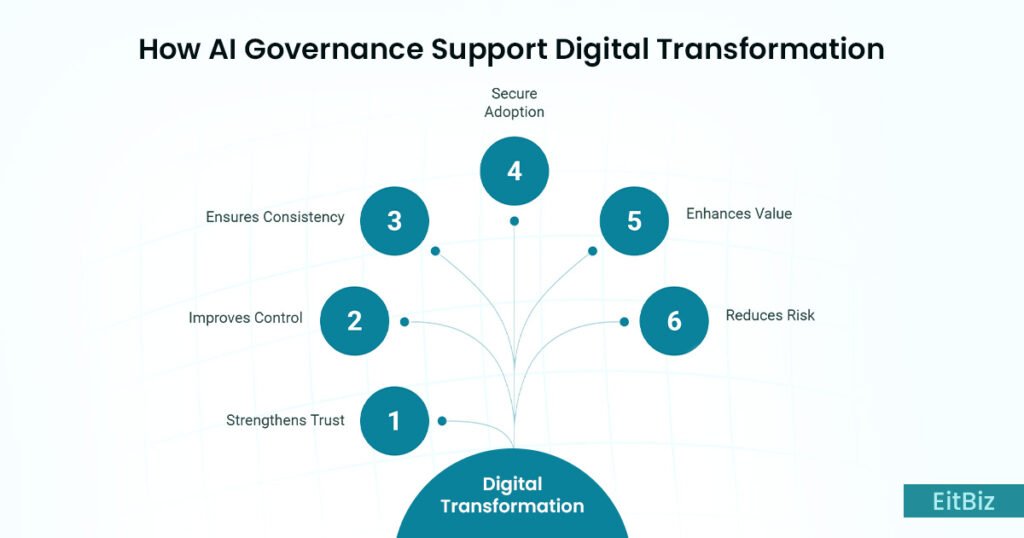
Modern organizations adopt digital transformation to become faster, smarter, and more efficient. At the same time, they invest heavily in business process automation to reduce manual effort and improve decision-making speed. However, both initiatives rely on AI systems that introduce complexity, risk, and accountability challenges.
Enables Safe and Scalable Digital Transformation
Digital transformation depends on deploying AI across multiple systems, departments, and customer touchpoints. Without governance, these deployments often become fragmented and inconsistent.
Enterprise AI Governance ensures every AI initiative follows a unified AI governance framework, allowing organizations to scale transformation efforts without losing control over data, compliance, or performance.
Strengthens Trust in Automated Decision-Making
As organizations automate more decisions through AI, trust becomes a major factor. Employees, customers, and regulators need confidence that automated systems are fair, transparent, and reliable.
Governance builds this trust by enforcing responsible AI governance, ensuring models are explainable, auditable, and aligned with ethical standards.
Improves Control Over Business Process Automation
Business process automation powered by AI can streamline workflows in finance, HR, supply chain, and customer service. However, automation without oversight can lead to errors at scale. AI governance introduces controls that define how automation systems operate, when human intervention is required, and how exceptions are handled.
Ensures Consistency Across Enterprise Systems
Digital transformation often involves multiple tools, platforms, and AI models developed by different teams or vendors. Without governance, this leads to inconsistent standards and duplicated efforts.
A strong AI enterprise governance structure standardizes processes, ensuring all AI systems follow the same policies, documentation requirements, and performance benchmarks.
Supports Secure and Compliant AI Adoption
As organizations digitize operations, they must also comply with data protection laws, industry regulations, and internal policies.
AI governance ensures compliance is built into every stage of transformation, reducing legal risk and improving audit readiness across automated workflows and AI-driven systems.
Enhances Value from AI Investments
Organizations often struggle to realize full ROI from digital transformation initiatives due to poor coordination and a lack of oversight.
With structured AI governance implementation, businesses align AI projects with strategic goals, ensuring automation and transformation efforts directly contribute to measurable business outcomes.
Reduces Risk in Large-Scale Automation
Automation increases speed but also amplifies errors when systems are not properly governed. A single flawed model can impact thousands of transactions instantly.
Governance frameworks introduce monitoring, validation, and risk controls that detect issues early and prevent widespread disruption.
Connects Strategy, Technology, and Operations
Ultimately, Enterprise AI Governance acts as the bridge between business strategy, AI technology, and operational execution. It ensures that transformation initiatives and automation programs do not operate in isolation but remain aligned with enterprise objectives.
How Can an AI Development Company like EitBiz Strengthen Governance Efforts?
Strong enterprise AI governance does not emerge from policy alone. It depends on how effectively organizations translate governance principles into the actual architecture of AI systems. This is where the gap between intent and execution often appears, and where specialized engineering capability becomes critical.
EitBiz, as an AI development company, plays a direct role in closing this gap by embedding governance into the design and delivery of AI systems rather than treating it as an external compliance layer. Instead of applying governance after deployment, EitBiz integrates it into the core development lifecycle so that every model operates within defined accountability, transparency, and control boundaries from the beginning.
At the implementation level, EitBiz reinforces governance through engineering practices such as audit logging, model versioning, automated compliance checks, and continuous monitoring of model performance and drift. It also enables organizations to operationalize governance at scale through integrated AI systems, enterprise-wide AI integration services, and centralized AI governance platforms that provide real-time visibility, traceability, and control.
Partner with EitBiz to operationalize enterprise AI governance as a built-in capability, ensuring your AI systems are scalable, auditable, and aligned with business and regulatory expectations from day one.