Every technology leader understands the frustration of project delays caused by limited bandwidth or missing niche expertise. In fact, over 60% of organizations face skill gaps in emerging technology. This makes it harder for them to stay aligned with the rising trends.
The real challenge lies in the cost, risks, and complexity of traditional hiring practices. This growing gap between opportunity and execution is why many organizations are opting for a staff augmentation strategy.
It is a quick, efficient, and more flexible way to scale any team. This approach has a significant value in keeping a business agile to keep up with the tech changes and user demands. However, finding the right staff augmentation service provider is tough and requires a structured evaluation process to ensure the partnership aligns with your project.
This blog highlights the staff augmentation benefits, types, challenges, and best practices you must follow while opting for this strategic hiring.
What is Staff Augmentation?
Staff augmentation is a flexible outsourcing strategy where an organization temporarily adds external personnel to its existing team. Simply put, it allows a business to fill a vacant skill gap(s) in its in-house team. The goal is to augment the size of the team and its capability to complete a specific project. This approach allows:
- A business to hire specialized remote developers for a certain duration.
- External professionals work under the company’s direct supervision. They act as an extension to the team.
- Quick onboarding of experts with greater flexibility.
How Does Staff Augmentation Work?
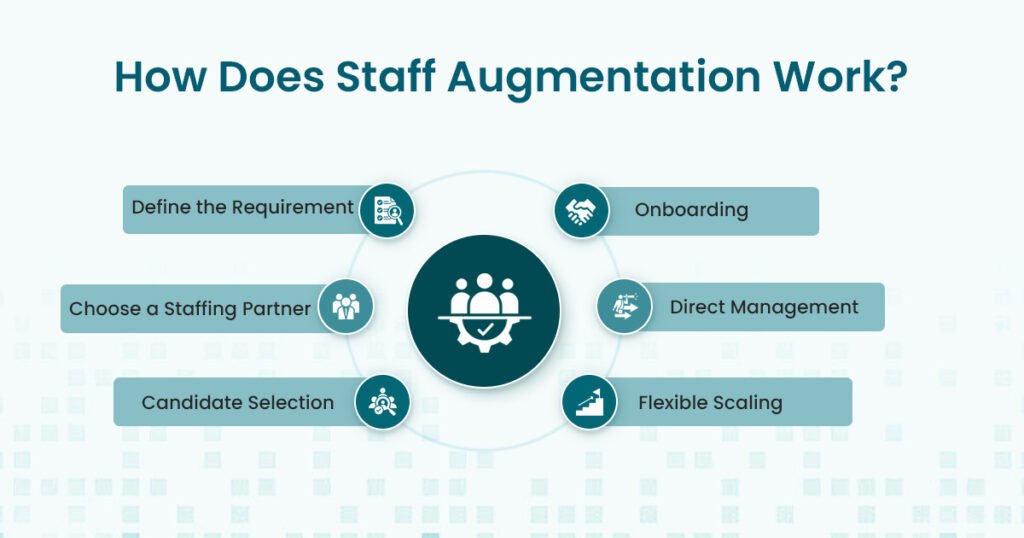
Staff augmentation is a flexible hiring model that allows a business to temporarily hire skilled experts. Here is how it works in practice:
- Define the Requirement
Identify what specific skills your business is missing or capacity needs.
- Choose a Staffing Partner
Choose a staffing partner that specializes in filling the gap.
- Candidate Selection
The staffing provider shares pre-vetted candidates with you to interview and finalize the best among them.
- Onboarding
The selected professionals will join the team and use the same tools, attend meetings, and align with internal workflows.
- Direct Management
The augmented staff will report to a dedicated manager about the project’s progress.
- Flexible Scaling
When the project ends or needs change, you can hassle-free scale up or down the augmented staff.
Example
An EdTech company is building a new AI-enabled application. They require two AI developers for a specific tenure. Instead of indulging in traditional recruitment practices, they can hire AI developers through a staff augmentation model. They will work daily with the company’s in-house team. Once the project is completed, the contract ends.
Why Traditional Hiring Slows Down Growth?
Traditional hiring is often too slow to bridge the gap between slipping deadlines and current market demand. It creates tension around the speed and quality of development, which impacts innovation. Here is how it slows down a business’s growth:
- Long Recruitment Cycles
The traditional hiring method is often layered around various processes and evaluation rounds, which can take up to 2 to 4 weeks to hire developers. During this time period, the project stalls, resulting in the loss of a potential opportunity.
- High Cost
Recruitment expenses, training costs, salaries, benefits, infrastructure, etc., all add up and increase the hiring cost. If the role is for a short-term project only, the ROI is questionable.
- Skill Gap
The market evolves faster than traditional hiring pipelines. By the time you hire AI developers for a specific project, the required AI-only skills get shifted.
- Overburdened Internal Teams
Sometimes roles stay unfilled, and existing employees take up that work. This reduces their productivity, which increases errors and eventually leads to burnout.
Why do Businesses Choose IT Staff Augmentation?
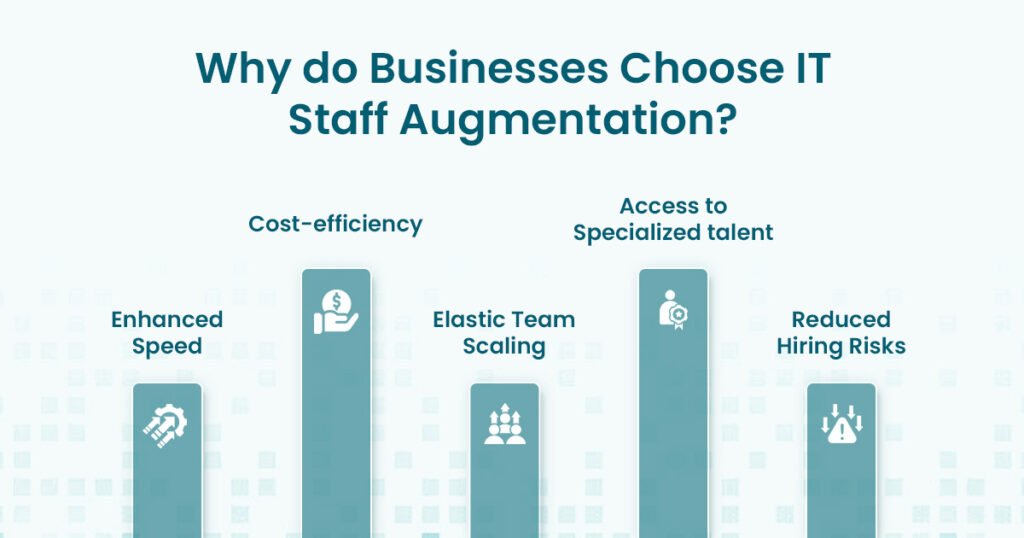
The traditional hiring model has various inefficiencies, especially when a project requires utmost attention. To overcome these barriers, IT staff augmentation services appear as a strategic help. It offers various benefits that attract leading businesses to choose this model.
- Enhanced Speed
Staff augmentation allows a business to hire skilled professionals quickly in days or weeks, rather than in months.
- Cost-efficiency
You are not bound to long-term commitments like salaries or other benefits. You only pay for the skills you need and the time experts are working on your project.
- Elastic Team Scaling
Augment your team or down as you need, depending on the project’s requirements.
- Access to Specialized talent
Hire machine learning developers, a cybersecurity team, quality analysts, or a DevOps expert through IT staff augmentation; you can hire any specialized expert locally and quickly.
- Reduced Hiring Risks
Staff augmentation works on a temporary hiring model. Since the roles are temporary and performance is visible, the hiring risk is also lower than a permanent hire.
Key Use Cases of Staff Augmentation
There may be various instances when businesses can opt for staff augmentation. It can either be for a short-term project or a long-term project, depending on specific requirements. Here are some of the use cases where hypothetically staff augmentation fits:
- A Startup Building MVP
Startups often work with tight timelines and limited budgets. Hiring a full-time team to build an MVP is not an ROI-focused decision for a startup to consider. But, temporarily hiring remote developers or designers to build a minimum viable product is feasible for a startup.
- Enterprises Migrating to Cloud
Migration of legacy enterprise-based software to the cloud requires specific skills and hands-on experience. Retraining internal teams or hiring permanent staff members can be time-consuming and cost-inefficient. Instead, an enterprise can augment its workforce with temporary cloud experts to ensure smooth and efficient migration.
- Companies Adopting New Technologies
When businesses digitally transform and adopt emerging technologies like AI, ML, NLP, and more, they often lack in-house expertise. IT staff augmentation provides immediate access to specialized technologies. The experts can implement and guide the in-house team without long onboarding cycles.
- Rapid Prototyping
A staff augmentation firm can help with testing new ideas, building prototypes, or launching pilot projects. It offers speed without diverting core teams from their primary responsibilities.
Types of IT Staff Augmentation Models
Staff augmentation offers flexible models that precisely cover every business challenge. Whether short-term or long-term temporary hiring, you can hire developers who are suitable for the needs of your organization.
Geographic Models
These staff augmentation models are the workforce strategies that determine where the talent is sourced. It typically offers three models that are chosen based on the need to balance costs, time zone alignment, and cultural fit.
- Onshore Staff Augmentation
This model allows a business to hire vetted professionals within the geographical limits. For instance, a tech firm in the USA can work with experts across the United States. This allows:
- Smoother collaboration among in-house and external teams due to no language barriers.
- Improves coordination among teams because of time-zone alignment.
- Enhanced understanding of local businesses and cultures.
This model offers maximum control, seamless collaboration, and communication. However, the cost of onshore staff augmentation is generally higher than the other models.
The onshore augmentation model is ideal for projects that require frequent face-to-face collaboration.
- Nearshore Staff Augmentation
The nearshore model allows a business to hire skilled professionals from nearby countries, especially those in 1-3 time zones. A company in the North American region can opt to collaborate with developers from Latin America or from Eastern Europe. That company can:
- Communicate effortlessly with developers across the region
- Save costs in comparison to the onshore staff augmentation model
- Hire software developers, machine learning experts, cybersecurity professionals, etc., from a wide, technically strong talent pool.
Nearshore augmentation balances the cost and collaboration, is convenient for daily standups, and has fewer language barriers. However, it is less cost-effective than the offshore model for staff augmentation and can have cultural and language barriers.
The model is ideal for companies needing real-time collaboration and support.
- Offshore Staff Augmentation
This model helps source technical professionals who are geographically distant. A company in the USA can hire dedicated remote developers from countries like India, Vietnam, etc. Offshore staff augmentation enables a company to:
- Save at least 20 to 50% of the actual cost of spending as compared to the nearshore or onshore hiring model
- Easily scale up or down the number of developers as the project’s specific needs require
- Improve the market readiness of a project within or before the stipulated time.
This model empowers the potential of 24/7 development cycles. However, time-zone gaps can cause communication issues.
It is ideal for well-defined tasks and projects that require round-the-clock support.
Duration Models
In addition to where the staff is located, staff augmentation is also categorized by how long a business needs the support and the scope of implementation.
- Short-term Augmentation
This model allows a business to immediately fill the temporary gaps in a team. This typically lasts from a few weeks to a couple of months. It is an ideal way to augment the staff during seasonal spikes in workload or to bring in niche expertise to complete a specific project.
- Long-term Augmentation
This model allows a business to hire software staff augmented professionals for a longer duration. The external experts became a semi-permanent extension of the internal team as the duration lasts longer than 6 months.
It is an ideal staff augmentation model for ongoing product development or maintenance where a business requires continuous support.
Hybrid Model
Hybrid staff augmentation is a strategic workforce approach. It combines the strength of different sourcing methods to build a balanced distributed team. The model typically combines internal employees with external augmented experts or mixes graphical models to optimize speed, cost, and control.
Staff Augmentation vs Outsourcing vs. In-House Hiring: Which is Better for Your Business?
Choosing among staff augmentation, traditional outsourcing, or in-house hiring typically depends on the budget, control, speed, and flexibility. Staff augmentation enables a business to instantly hire specialized talent for a specific tenure. Whereas, in-house hiring takes a long tenure to onboard individuals for a permanent position. The table encompasses crucial differences:
| Criteria | Staff Augmentation | Outsourcing | In-House Hiring |
| Cost | Cost-efficient for short-term projects | Budget-friendly for large-scale projects | Cost can be high due to salaries and additional benefits |
| Control | Greater control over the augmented professionals | Lower control, as the vendor manages the outsourced team. | High-level of control as everything is managed by the hiring company |
| Speed | Hiring can be completed within days or weeks | Typically slower than the augmented staff strategy | Comparatively slower than all. Hiring can take weeks to months. |
| Flexibility | Offers improved flexibility to scale up or down a team | Provides long-term structural ability | Offers limited scalability |
| Risks | Integration and alignment with in-house teams can be a challenging aspect. | Lack of control, goal misalignment, and communication barriers. | Can be of high risk if wrong hires are made. |
| Focus | It is short-term and niche-focused | The focus with traditional outsourcing is end-to-end | Long-term and core business-focused |
| Ideal for | Short-term projects that require niche-specific expertise | Long-term projects that require specialized skills | Building a cohesive team |
The Difference Between Staff Augmentation vs Managed Services
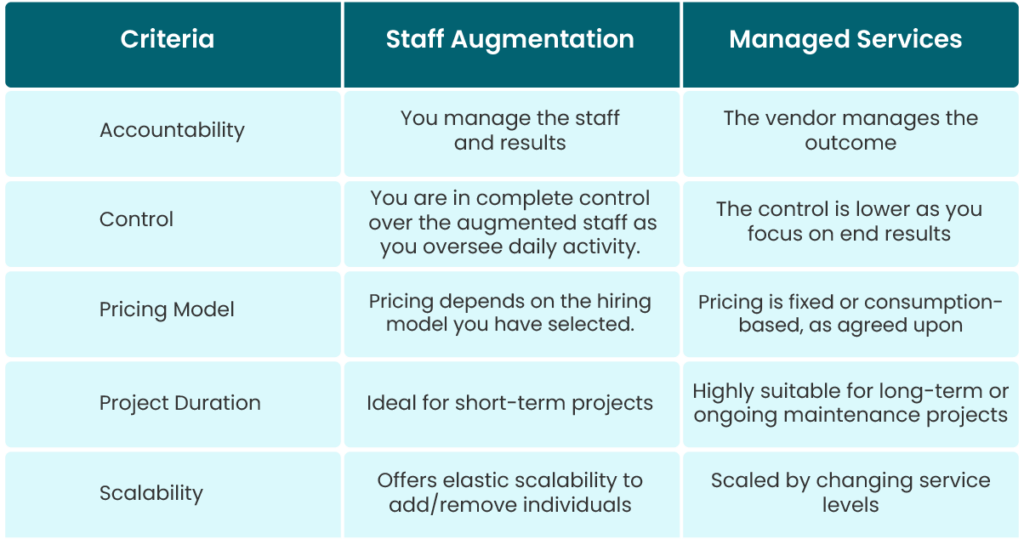
Staff augmentation and managed services are two different outsourcing models. The first impulse of most peoples’ that managed services is a fancy name for staff augmentation, which is not true as both involve vastly different scopes of work. The table highlights the difference between staff augmentation and managed services:
Which is Ideal for Whom?
Staff augmentation allows you to hire app developers or cloud-security experts quickly with complete control over their daily actions.
The managed services model is best for businesses that want to offload a complex function completely so they can focus on their core operations.
Challenges of IT Staff Augmentation
While staff augmentation benefits are numerous, the challenges of this business model can’t be ignored. Relying on external talent introduces difficult, high-stakes challenges that can either delay or disrupt the project. The complexity in the adaptation of this model must be considered. Here are some of them:
- Integration Inefficiency
Augmented staff may feel like strangers/outsiders while collaborating with the internal team. Time zone alignment, differences in work styles, or cultural mismatch can possibly be the reasons for lower team productivity and increasing inefficiency.
This can be solved by creating a structured onboarding process that you would offer to full-time employees.
- Knowledge Transfer Issues
It might be possible that when a project gets completed and the augmented staff leaves, the vital project knowledge stays with them. This can create continuity gaps.
It can be solved by enforcing comprehensive documentation practices. Also, creating a policy around scheduling a handover session with external temporary staff to ensure knowledge stays within the company.
- Security & Compliance
The team you augmented can sometimes need access to sensitive information (such as data, intellectual property, or code). This can create serious security risks and increase the chances of cybercrime.
The solution is to enforce a strict NDA signature before augmenting a specific team to protect IP rights. And, share role-based access to systems to ensure you safeguard data from external breaches.
- External Dependency
You must focus on the fact that relying too heavily on external teams can weaken the capability of your internal team, which creates long-term vulnerability.
The best way is to only hire developers on a temporary role for specific project needs. Also, upskill your in-house team to perform strategic functions.
Best Practices for Successful Staff Augmentation
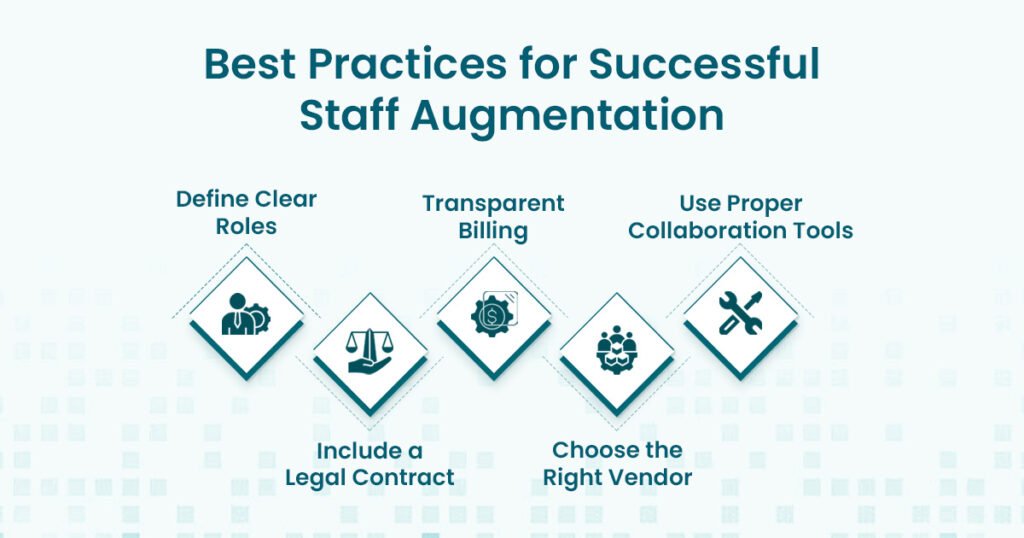
Strategy is foremost essential to hire augmented staff. To succeed in 2026, you must shift from simple need awareness to identifying the right vendor by asking the right questions. To deliver real value, you must consider some of the best practices that help in a successful partnership.
- Define Clear Roles
The first and foremost step to take before you opt for augmenting staff in your business is to define roles clearly. It can be done by clearly outlining:
- Responsibilities and deliverables
- Setting KPIs
- Required skills and experience
- Reporting structure
- Expected tenure
This clarity ensures that the augmented staff will not face integration and communication challenges.
- Include a Legal Contract
After defining roles, you must include a legal hiring contract. This will cover:
- Scope of work
- Confidentiality and IP rights
- Payment terms
- Termination contracts
A clear legal agreement will help you safeguard your business’s privacy or ownership of work done by the augmented staff.
- Transparent Billing
You must define clear pricing for the hiring of augmented staff. Remember, including unclear pricing can erode trust. Ensure that the pricing is transparent, which can be easily understood by either AI staff augmentation professionals or cybersecurity experts. The external temporary staff understands how billing will work, whether a flat fee or project-based pricing.
- Choose the Right Vendor
Once you have finalized the pricing, the next step is to opt for the right vendor to hire experts. Your staff augmentation provider is a strategic partner. Remember, the apt professional can accelerate your project delivery. But how do you choose the right vendor?
- Evaluate their domain expertise
- Check past client experiences and case studies
- Assess their hiring and vetting process
- What to look for?
- Check their proven track record in your industry
- Strong talent pool and quick turnaround time
- Provides flexibility in scaling teams up or down
- What to avoid?
- Vendors with a vague pricing structure
- Lack of a technical screening process
- Overpromising an unrealistic timeline
- Questions to ask vendors
- What is their recruitment or vetting process?
- What happens if a resource doesn’t perform?
- How quickly can a resource be scaled?
- Ask for relevant case studies
- What to look for?
- Use Proper Collaboration Tools
It is crucial to have an efficient collaboration process when working with distributed teams to stay aligned with the progress. You can use tools for communication, project management, documentation, and knowledge sharing. Using these tools consistently ensures alignment and reduces friction among teams.
Cost of Opting for IT Staff Augmentation
IT staff augmentation is often seen as a cost-effective alternative to traditional hiring. This strategic temporary hiring’s actual cost depends on factors like location, skill, tenure, and pricing models. It removes long-term expenses and benefits, but staff augmentation introduces variable costs that require careful planning and transparency.
IT Staff Augmentation Cost by Region
Location is the prime factor that majorly influences the cost of staff augmentation. Here is what the cost looks like:
| Region | Cost |
| North America | $60 – $180/hr |
| Western Europe | $45 – $150/hr |
| Eastern Europe | $25 – $110/hr |
| Southeast Asia | $15 – $90/hr |
Every region’s cost differs based on the region. If you hire app developers from Southeast Asia, you are charged as low as $15/hr for a simple project in comparison to experts from different regions.
Cost by Role and Seniority
Developers’ role and seniority also hinder the cost of development, such as hiring from a region. Here is the tabular representation:
| Role | Cost |
| General Developer | $35 – $110/hr |
| AI/ML Engineer | $65 – $150/hr |
| Cloud Experts | $50 – $130/hr |
| Test Automation | $20 – $75/hr |
*Note: The above tables cover the approximate cost of developers based on regions, role, and seniority.
Do not Overlook Hidden Costs
Most companies overlook hidden costs that can disrupt their entire budget. Costs related to onboarding, ramp-up, management, tools access, contract terms, and compliance fees. Having a clear understanding of the hidden costs can improve profitability and enhance operational efficiency. Thus, you must not overlook these hidden costs of staff augmentation while opting for this hiring model.
Future of Staff Augmentation
The future of staff augmentation is quickly shifting. The advent of Gen AI has transcendingly altered this vertical by infusing more enhanced capabilities.
- AI-Powered Talent Matching
Artificial Intelligence is gradually becoming the default in every organization and business model. In staff augmentation, AI integration will assist in finding the culturally compatible vetted talent within a few hours, instead of weeks. Staff augmenting service providers can use analytics to predict ramp time or churn risks.
- Hyper Specialization in Niche Tech
The rise of high-demand technology like quantum computing, NLP, ML, blockchain, and more is quite evident. Staff augmentation will be the primary way through which companies can secure rare expertise and hold a premium position in the market.
- Hybrid Team Model
The future workforce will be a combination of internal teams, external augmented staff, and AI agents. Companies can adopt sprint-based scaling for 3 months or less in the near future to launch products and improve productivity.
Hire EitBiz for Augmented Staff
Staff augmentation provides the necessary flexibility to a business for quick team scaling with specialized experts. However, finding the right vendor can be challenging because of inconsistent talent quality, lack of transparency, and communication gaps. This is where EitBiz can help you. We are a reliable team of qualified professionals who pay extreme focus on quality-first metrics.
We offer skilled IT professionals who can easily integrate with your internal team. Whether you are looking to hire developers, designers, or quality analysts, our staff augmented services are designed to match your specific project requirements. We ensure clear communication and offer transparent pricing for a hassle-free hiring process.
We connect you with specialized experts to eliminate hiring delays and project risks. With us, you have a dependable extension of your team committed to driving your project forward.