Key Takeaways
- MACH architecture provides a flexible foundation for enterprise technology transformation by using Microservices, API-first, Cloud-native, and Headless principles to improve agility and scalability.
- A composable enterprise architecture enables faster innovation by allowing organizations to integrate best-of-breed solutions instead of relying on rigid, monolithic systems.
- Legacy system modernization becomes less risky with MACH because businesses can modernize applications incrementally, minimizing downtime and maintaining business continuity.
- A successful digital transformation strategy requires more than new technology. Aligning MACH architecture with business goals, security, and phased implementation ensures long-term value and sustainable growth.
- Partnering with an experienced technology provider like EitBiz can simplify MACH adoption, helping organizations modernize legacy systems, strengthen cloud-native security, and accelerate enterprise transformation with confidence.
Enterprise technology transformation is a top priority for modern businesses, but why do so many initiatives fall short? Outdated systems, disconnected applications, and rigid infrastructure often slow innovation and make it difficult to keep up with changing customer expectations.
So, how can organizations modernize without disrupting operations? This is where the importance of MACH architecture comes in!
It offers a flexible approach by enabling a composable enterprise architecture, supporting a cloud native security platform, and strengthening every transformation. It also simplifies legacy systems, helping businesses replace outdated systems with scalable, future-ready solutions.
In this blog, we’ll explore the strategic role of MACH architecture in driving enterprise technology transformation and why it has become a key foundation for long-term business success.
Why is MACH Architecture Transforming Modern Enterprises?
Irrespective of a business’s size, everyone demands technology that can adapt to changing customer expectations and market demands. However, traditional monolithic systems often make innovation slow, costly, and difficult. This is where MACH architecture is transforming the way modern enterprises build and manage their digital ecosystems.
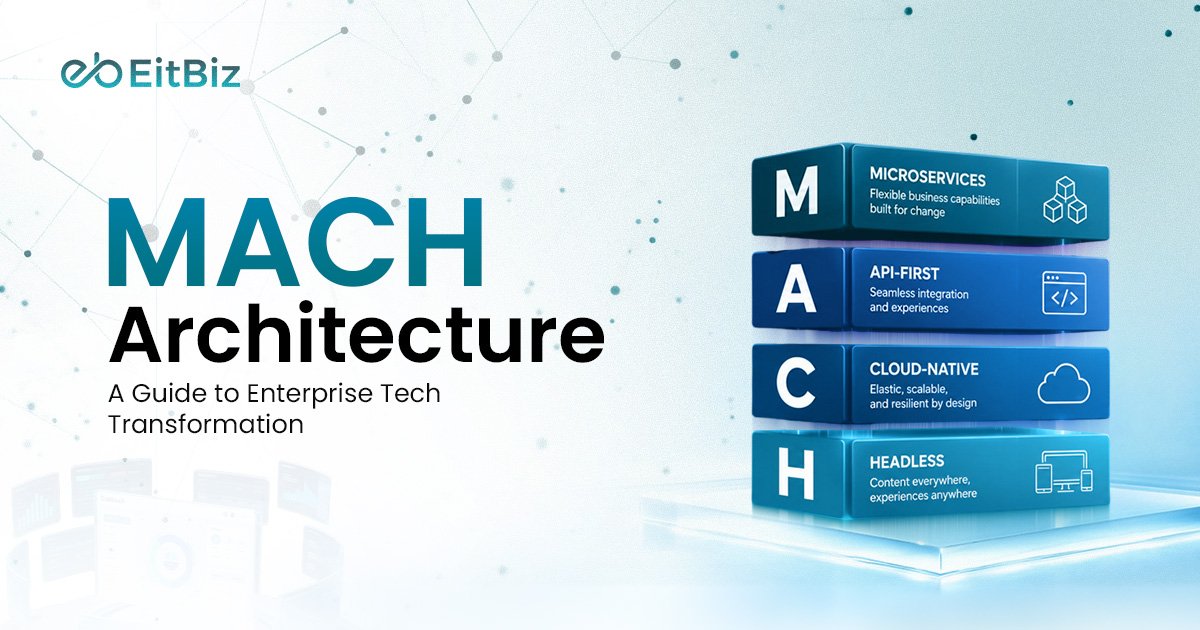
MACH stands for Microservices, API-first, Cloud-native, and Headless. Instead of relying on a single, tightly connected application, it breaks systems into independent components that can be developed, updated, and scaled separately. This modular approach gives businesses greater flexibility and reduces the risks associated with large-scale technology upgrades.
The four core principles of MACH architecture are:
- Microservices: Divide applications into independent services that can be built, deployed, and maintained separately.
- API-first: Enable seamless communication and integration between different applications and platforms.
- Cloud-native: Leverage cloud infrastructure to improve scalability, reliability, and performance.
- Headless: Separate the front end from the back end, allowing businesses to deliver personalized experiences across multiple digital channels.
Importance of Enterprise Technology Transformation for Long-Term Business Growth
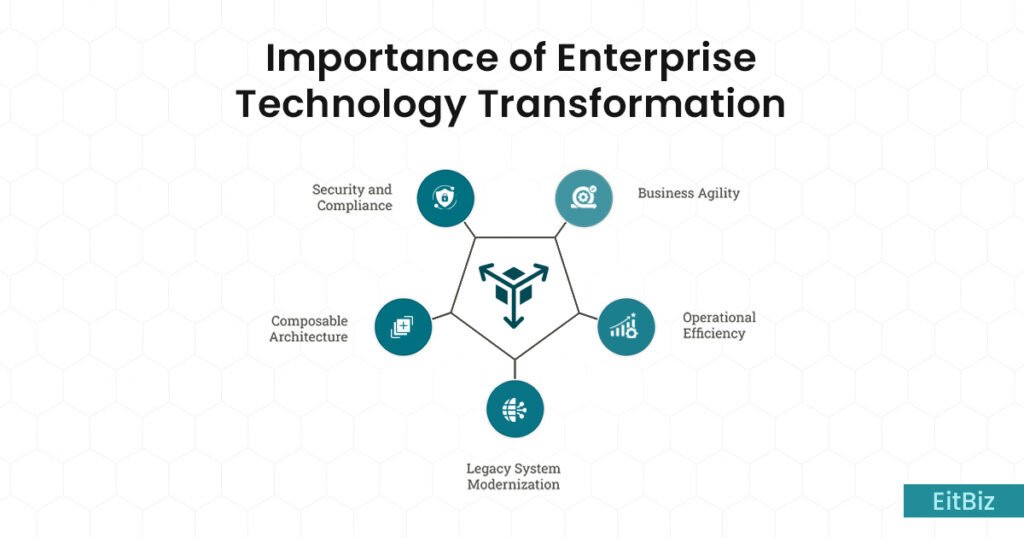
A well-planned transformation goes beyond adopting new tools. It helps organizations modernize operations, improve collaboration, and build a strong digital transformation strategy that supports future business goals. Here are the key reasons why enterprise technology transformation is essential:
1. Enhances Business Agility
Markets change quickly, and customer expectations evolve just as fast. Modern technology enables businesses to respond to these changes without lengthy development cycles or costly system overhauls. Instead of waiting months to introduce a new feature or service, organizations can innovate faster and stay ahead of competitors.
Example: A retail brand can quickly launch a new loyalty program or integrate a new payment gateway without disrupting its existing online store.
2. Boost Operational Efficiency
Many organizations still depend on manual processes and disconnected systems that reduce productivity. Enterprise technology transformation automates repetitive tasks, connects business applications, and improves data sharing across departments.
3. Legacy System Modernization
Legacy systems often become expensive to maintain and difficult to integrate with modern applications. Legacy system modernization allows businesses to replace or upgrade outdated technologies without rebuilding everything from scratch.
Example: A bank can modernize its customer management system while keeping essential financial applications operational, ensuring minimal disruption to daily services.
4. Facilitate a Composable Enterprise Architecture
Modern businesses require flexibility to adopt new technologies as their needs evolve. A composable enterprise architecture allows organizations to combine best-of-breed applications instead of relying on a single, rigid platform. This modular approach makes it easier to scale operations, integrate new tools, and adapt to changing business requirements.
5. Security and Compliance
As businesses expand their digital footprint, cyber threats become more sophisticated. Enterprise technology transformation supports the adoption of a cloud native security platform that provides continuous monitoring, automated threat detection, and stronger access controls. Modern security practices also help organizations comply with industry regulations and protect sensitive business data.
Why does MACH Architecture Determine the Success of Enterprise Transformation?
Tech upgradation requires an architectural foundation that enables organizations to respond to changing user expectations, market dynamics, and business priorities. MACH architecture plays a vital role here by allowing businesses to upgrade their systems gradually. This enables businesses to adopt quick innovation while maintaining operational stability.
Enables Incremental Legacy System Modernization
For most enterprises, legacy applications remain deeply embedded in core business processes, making wholesale replacement impractical. MACH supports legacy system modernization by allowing organizations to modernize specific business capabilities independently while existing systems continue to operate. This phased approach minimizes disruption, delivers measurable business value earlier, and allows modernization investments to align with changing priorities rather than fixed project timelines.
Frame a Composable Enterprise Architecture
Enterprise technology must continuously adapt to acquisitions, new digital channels, regulatory changes, and evolving customer expectations. Rather than depending on a single technology vendor, MACH architecture enables a composable enterprise architecture where specialized applications integrate seamlessly through APIs. This gives organizations the flexibility to introduce, replace, or enhance individual capabilities without affecting the broader technology ecosystem.
Improves Organizational Agility
While MACH architecture is often associated with faster software delivery, its broader impact is organizational. Independent services allow product teams to own specific business capabilities, reducing cross-team dependencies that often delay innovation. As a result, organizations can introduce new features, respond to customer feedback, and adapt to market changes without waiting for large, coordinated enterprise releases.
Strengthens Scalability and Operational Resilience
Enterprise workloads rarely increase evenly across every application. Seasonal demand, geographic expansion, or new digital initiatives often impact only specific business functions. MACH architecture allows organizations to scale individual services independently, improving performance while optimizing infrastructure costs. When combined with a cloud native security platform, it also strengthens security, compliance, and operational visibility across distributed environments.
Aligns Technology with a Long-Term Digital Transformation Strategy
Technology modernization creates sustainable business value only when it supports broader organizational goals. Rather than treating MACH architecture as a one-time implementation initiative, leading enterprises incorporate it into a long-term digital transformation strategy focused on customer experience, operational resilience, innovation, and business growth. This ensures modernization decisions are driven by measurable outcomes rather than short-term technology trends.
A successful strategy typically includes:
- Business-driven modernization priorities
- Clearly defined governance and ownership
- Continuous performance measurement
- Incremental expansion based on business outcomes
Role of MACH Architecture in Building an Effective Digital Transformation Strategy
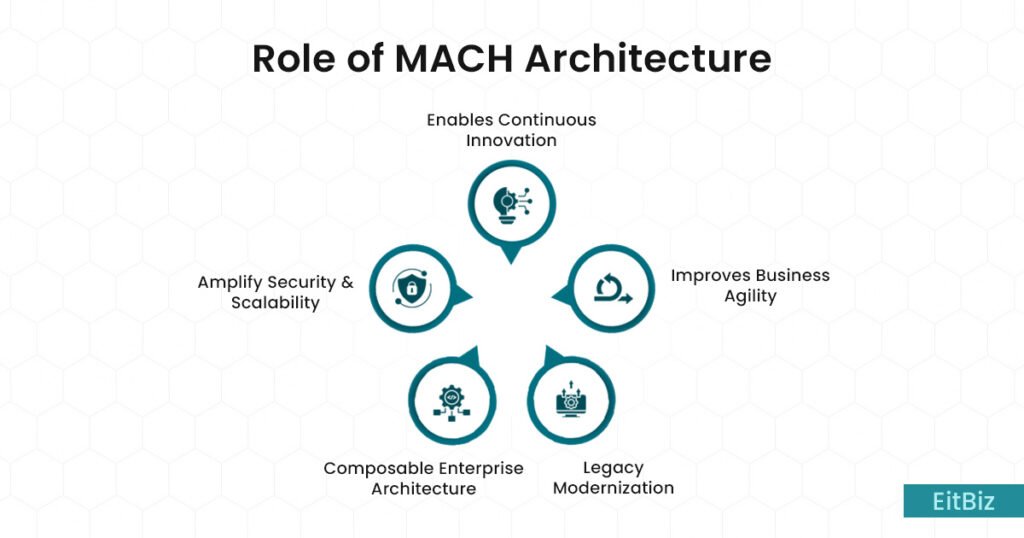
MACH architecture enables businesses to adopt a modular approach. This allows a business to build an impact-driven transformation strategy with flexibility to make changes and innovate continuously.
1. Enables Continuous Innovation
MACH allows organizations to introduce new features, services, or technologies independently, reducing development time and enabling faster innovation. Businesses can respond to market changes without overhauling their entire IT infrastructure.
2. Improves Business Agility
Customer expectations and industry trends change rapidly. MACH gives organizations the flexibility to adapt quickly by updating specific services instead of rebuilding complete applications.
3. Supports Legacy System Modernization
Many digital transformation initiatives fail because organizations attempt to replace all legacy systems at once. MACH supports gradual legacy system modernization, reducing costs, minimizing risks, and ensuring uninterrupted business operations.
4. Creates a Composable Enterprise Architecture
MACH enables businesses to build a composable enterprise architecture, allowing them to combine specialized applications that work together seamlessly. This flexibility makes it easier to scale operations and adopt emerging technologies as business needs evolve.
5. Amplify Security and Scalability
Because MACH is built around cloud-native principles, it works effectively with a cloud native security platform. Organizations benefit from improved scalability, automated security updates, better disaster recovery, and stronger protection against evolving cyber threats.
Ultimately, MACH architecture provides the technical foundation that helps organizations execute a successful digital transformation strategy while remaining agile, innovative, and future-ready.
When Does MACH Architecture Deliver the Most Value?
While MACH architecture offers significant advantages, it isn’t a one-size-fits-all solution. Organizations gain the most value when modernization is driven by clear business objectives rather than the desire to adopt the latest technology. Enterprises managing complex digital ecosystems or frequent product changes are often better positioned to realize their long-term benefits.
MACH architecture is particularly effective when organizations need greater flexibility, faster innovation, and the ability to evolve their technology stack without disrupting business operations.
MACH delivers the greatest value when organizations:
- Need to modernize legacy systems without interrupting critical operations.
- Manage multiple digital channels, such as websites, mobile apps, and customer portals.
- Frequently launch new products, features, or digital experiences.
- Require seamless integration between multiple business applications and third-party platforms.
- Want to reduce vendor lock-in by adopting a composable enterprise architecture.
- Are expanding through acquisitions or entering new markets that require scalable technology.
How Can Organizations Align MACH Architecture with their Digital Transformation Strategy?
Adopting MACH architecture is only one part of a successful transformation. Organizations must ensure that their technology investments directly support their business objectives. Here are the key steps to align MACH with a digital transformation strategy:
- Align your organization’s end goal with the technology upgrade decision. Ensure it supports measurable business outcomes.
- Prioritize a phased legacy system modernization approach that ensures business continuity throughout the transformation journey.
- Pick a flexible, API-driven solution that can easily integrate with your existing solution.
- Ensure you implement a cloud-native security platform that helps protect applications, APIs, and sensitive data while supporting security regulations.
- Every stakeholder must efficiently collaborate throughout the planning and implementation process. This ensures complete MACH architecture adoption that supports your organizational goals.
- Measure and optimize the performance of the MACH-driven solution to ensure efficient return on investment.
How to Successfully Adopt MACH Architecture?
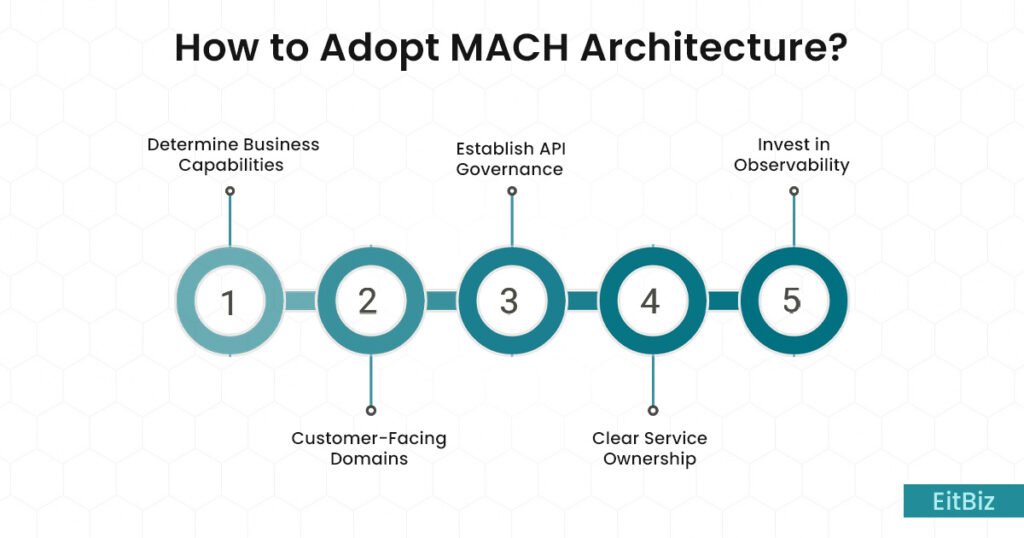
Adopting MACH architecture is less about replacing technology and more about changing how enterprise systems are designed, managed, and evolved. Organizations that see the greatest return don’t attempt to modernize everything at once. Instead, they follow a phased approach that balances business priorities with technical complexity.
1. Determine Business Capabilities Before Applications
Rather than starting with existing systems, identify the business capabilities that create the most value or friction. Understanding how functions such as customer onboarding, order management, or inventory operations support business goals helps organizations prioritize modernization efforts where they will deliver the greatest impact.
2. Prioritize Customer-Facing Domains
Modernizing customer-facing applications first often delivers faster business value while minimizing operational risk. Digital storefronts, mobile applications, self-service portals, and customer support platforms can be modernized independently while core systems continue supporting critical business operations.
This phased approach allows organizations to validate their architecture, processes, and governance before expanding modernization across the enterprise.
3. Establish API Governance Early
APIs are the foundation of MACH architecture, making governance a strategic priority rather than a technical afterthought. Defining API standards, versioning policies, authentication mechanisms, and lifecycle management early helps maintain consistency as the number of services grows.
Without clear governance, organizations risk creating integration challenges that become increasingly difficult to manage over time.
4. Focus on Clear Service Ownership
As applications become more modular, accountability becomes increasingly important. Each service should have a dedicated team responsible for its development, performance, security, and ongoing maintenance.
5. Invest in Observability Before Scaling
As the number of independent services increases, monitoring the health and performance of the entire ecosystem becomes more complex. Investing in centralized logging, distributed tracing, real-time monitoring, and performance analytics provides teams with the visibility needed to detect issues quickly and maintain system reliability.
Organizations that build observability into their architecture from the outset are better equipped to scale confidently while maintaining service quality.
What Challenges Do Organizations Face When Adopting MACH Architecture?
Although MACH architecture offers significant advantages, implementation is not without challenges. Organizations need careful planning, skilled teams, and a clear digital transformation strategy to realize their full potential.
Some of the most common challenges include:
1. Integrating Legacy Systems
Many organizations operate complex legacy environments that were not designed for API-based integration. Connecting these systems with modern applications often requires additional planning and technical expertise.
2. Maintaining Security Across Distributed Systems
As applications become more distributed, managing APIs, user identities, and workloads becomes increasingly complex. Implementing a robust cloud native security platform is essential to maintain consistent security across the ecosystem.
3. Managing Organizational Change
Moving from monolithic applications to a modular architecture requires changes in development processes, governance, and organizational culture. Employees may need training to adopt new tools and workflows.
4. Building Technical Expertise
MACH technologies involve cloud-native development, APIs, microservices, and DevOps practices. Organizations may need to upskill existing teams or hire specialists to support implementation.
5. Controlling Integration Complexity
While a composable enterprise architecture provides flexibility, integrating multiple specialized applications requires strong governance, documentation, and API management to avoid unnecessary complexity.
| Parameter | Traditional Modernization | MACH-Based Modernization |
|---|---|---|
| Modernization Approach | Large, one-time migration or “rip-and-replace” projects | Incremental modernization through independently deployable services |
| Architecture | Monolithic and tightly coupled applications | Modular microservices connected through APIs |
| Deployment Model | Infrequent, large-scale releases | Continuous delivery with smaller, frequent deployments |
| Scalability | The entire application must be scaled | Individual services scale independently based on demand |
| Technology Flexibility | Limited by vendor-specific ecosystems | Supports best-of-breed solutions within a composable enterprise architecture |
| Integration | Complex and time-consuming integrations | API-first approach simplifies integration across applications and platforms |
| Business Disruption | Higher risk of downtime during upgrades | Phased modernization minimizes operational disruption |
Traditional Modernization vs. MACH-Based Modernization: How is MACH Architecture Different?
Organizations evaluating modernization strategies often struggle to understand how MACH architecture differs from traditional approaches. While conventional modernization typically relies on large, infrequent upgrades, MACH emphasizes continuous evolution through modular components. The comparison below highlights the key differences and why many enterprises are adopting a more composable approach.
Best Practices for a Successful MACH-Driven Enterprise Technology Transformation
Successfully adopting MACH architecture requires more than choosing the right technology. Organizations need a structured approach that aligns modernization efforts with long-term business objectives. The following best practices can improve the success of a MACH-based enterprise technology transformation:
1. Focus on Clear Business Goals
Start with measurable objectives such as improving customer experience, reducing operational costs, accelerating product launches, or increasing system scalability. Technology should always support business outcomes.
2. Modernize in Phases
Avoid replacing all legacy systems simultaneously. A phased modernization strategy minimizes operational risks and allows teams to learn from each implementation stage before expanding further.
3. Design for APIs from the Beginning
An API-first mindset ensures applications can integrate easily with both existing and future technologies. This creates a more flexible and scalable technology ecosystem.
4. Invest in Cloud-Native Security
Protecting applications and APIs should be part of every modernization initiative. Implementing a cloud native security platform strengthens cyber resilience and supports regulatory compliance throughout the transformation process.
5. Build a Composable Enterprise Architecture
Choose modular, interoperable solutions that can evolve with changing business needs. A composable enterprise architecture gives organizations the flexibility to adopt new technologies without replacing their entire infrastructure.
6. Encourage Collaboration Across Teams
Business leaders, developers, operations teams, and security specialists should collaborate throughout the project. Cross-functional alignment helps ensure technology decisions support organizational priorities.
7. Measure Performance Continuously
Monitor key metrics such as deployment frequency, application performance, customer satisfaction, operational efficiency, and return on investment. Continuous measurement enables organizations to refine their digital transformation strategy and maximize long-term value.
Be MACH-Ready with EitBiz
Digital Enterprise transformation is no longer a one-time modernization initiative. Organizations need architectures that evolve continuously as business priorities change. MACH provides that foundation, but long-term success depends on disciplined governance, phased implementation, and alignment between technology and business strategy.
That’s where EitBiz can help.
With extensive experience in enterprise technology transformation, EitBiz helps businesses design and implement scalable, future-ready digital solutions tailored to their unique goals. Whether you’re modernizing legacy systems or building a composable enterprise architecture, our experts guide you through every stage of the journey.
Here’s how EitBiz adds value:
- Develops customized MACH adoption roadmaps aligned with your business objectives.
- Modernizes legacy applications using a phased, low-risk migration approach.
- Builds scalable, API-first, and cloud-native solutions for long-term growth.
- Integrates best-of-breed technologies to create a flexible, composable enterprise architecture.
- Implements robust security practices with a cloud native security platform.
- Provides ongoing support, optimization, and maintenance to ensure continuous innovation.