Key Takeaways
- Generative AI focuses on content creation and productivity, while agentic AI focuses on execution, automation, and decision-making in business operations.
- The best results come from combining generative AI with autonomous AI agents in business, enabling end-to-end workflows instead of isolated tasks.
- Companies are shifting from basic tools to AI automation for B2B workflows, where agentic AI drives real operational impact.
- Use generative AI business use cases 2026 for quick wins, and then expand into agentic systems for long-term efficiency and scalability.
- Businesses must focus on use cases, data readiness, and governance to maximize the business impact of agentic AI and ensure successful AI adoption.
Let’s face it!
Most businesses today are not struggling with whether to adopt AI. They’re struggling with how to adopt it in a way that actually delivers results.
Over the past two years, AI has gone from a buzzword to a boardroom priority.
According to a recent McKinsey report, over 70% of organizations are now using AI in at least one business function, yet only a small percentage are seeing meaningful bottom-line impact.
That gap is where things start to break down.
Many companies rushed into Generative AI tools for content, coding, and productivity, expecting transformation. What they got instead were incremental improvements, not operational change. At the same time, a new wave, Agentic AI, is emerging, promising something far bigger: systems that don’t just assist humans but actually take actions, make decisions, and run workflows autonomously.
Here’s the problem:
Most enterprises still don’t fully understand the difference between agentic AI vs generative AI, and as a result:
- They invest in the wrong tools
- They apply AI to the wrong use cases
- They fail to move beyond isolated experiments
The consequence? AI remains a cost center instead of a growth driver.
This is exactly why understanding the agentic AI vs generative AI differences is no longer optional; it’s foundational to building a real, scalable AI strategy in 2026.
In this blog, we’ll cut through the noise and focus on what actually matters:
- Where each type of AI fits in your business
- What problems they solve (and don’t solve)
- How leading enterprises are using them today
- And how you can move from AI experimentation to real business impact
Because in 2026, the companies that win with AI won’t be the ones using it the most; they’ll be the ones using the right kind of AI, in the right place, with a clear strategy.
What is Generative AI?
Generative AI is a type of artificial intelligence designed to create new content rather than just analyze existing information. It learns patterns from large datasets and then uses those patterns to generate outputs such as text, images, code, audio, video, and structured data.
In simple terms, instead of only answering questions or classifying information, generative AI can actually produce something new that didn’t explicitly exist before.
This is why it has become one of the most widely adopted AI technologies in business today.
A key reason behind its rapid enterprise adoption is productivity impact.
According to a McKinsey report, generative AI could add the equivalent of $2.6 trillion to $4.4 trillion annually across industries through improved productivity and automation of knowledge work.
Key Characteristics of Generative AI
Generative AI represents a shift in how digital systems support knowledge work and enterprise decision-making. Its effectiveness depends on how well it is guided, integrated, and governed in real-world environments.
Prompt-driven intelligence
Outputs depend heavily on the quality of human instructions. Well-structured prompts produce more accurate and relevant results, making prompt engineering a key capability in enterprise adoption.
Probabilistic generation model
Generative AI does not retrieve fixed answers. Instead, it predicts likely outputs based on learned patterns, which can introduce variability and occasional hallucinations.
Multimodal output capability
Modern systems can generate and interpret multiple formats such as text, images, code, audio, and video, enabling broader business applications beyond traditional text generation.
Context-aware but limited memory
These systems maintain short-term contextual understanding within a session but lack persistent long-term memory unless connected to external data systems.
Human-in-the-loop requirement
Enterprises rely on human validation to ensure accuracy, compliance, and alignment with business goals, especially in high-stakes use cases.
Fine-tuning and customization
Organizations can adapt generative models using proprietary datasets to improve domain-specific performance and relevance.
Integration with enterprise ecosystems
Generative AI is increasingly embedded into CRMs, ERPs, productivity tools, and APIs, making it a layer within workflows rather than a standalone tool.
Compute and cost sensitivity
Performance and scalability depend on infrastructure usage and model complexity, influencing how businesses deploy and optimize AI systems.
What is Agentic AI?
Agentic AI refers to a class of artificial intelligence systems designed to autonomously pursue goals, make decisions, and take actions across digital systems with minimal human intervention. Unlike generative AI, which primarily creates outputs in response to prompts, agentic AI is built to execute workflows end-to-end.
In simple terms, if generative AI is a “content creator,” agentic AI is closer to a digital operator or autonomous employee that can plan, decide, and act across multiple steps to achieve a defined objective.
For example, instead of just generating a sales email, an agentic AI system can:
- Identify potential leads
- Segment and prioritize them
- Generate personalized outreach messages
- Send emails through CRM tools
- Track responses and schedule follow-ups
This shift from “assistance” to “autonomous execution” is what makes agentic AI one of the most significant developments in enterprise AI adoption in 2026.
What are the Core Capabilities of Agentic AI?
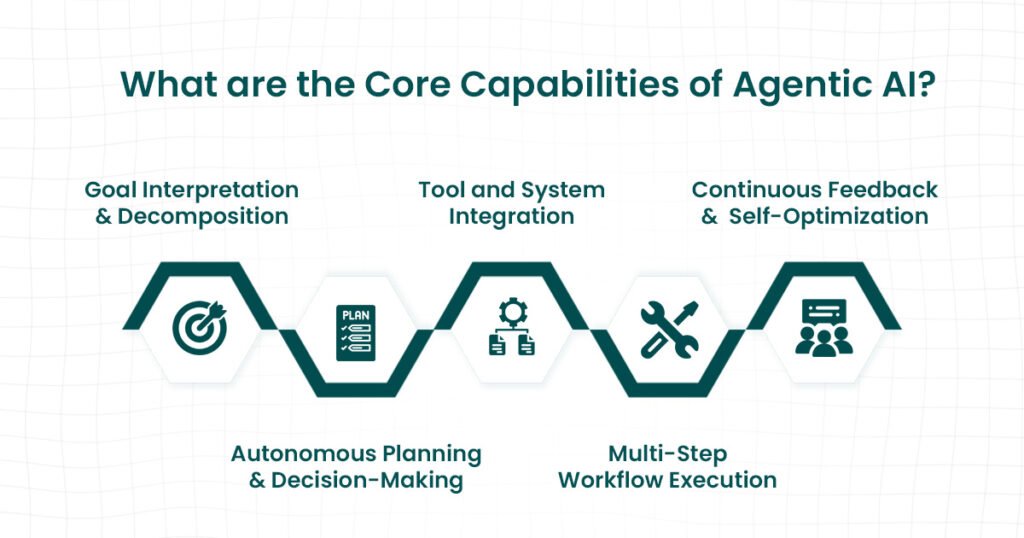
Agentic AI systems are designed to go beyond generating responses; they are built to plan, decide, and execute actions autonomously across business environments. Their value lies in combining intelligence with execution, making them well-suited to real-world enterprise workflows.
1. Goal Interpretation and Decomposition
Agentic AI can understand high-level business objectives and break them into structured, actionable steps. Instead of requiring detailed instructions, it interprets goals like “reduce customer churn” or “improve lead conversion” and decomposes them into smaller tasks such as analyzing customer behavior, identifying at-risk users, triggering retention campaigns, and tracking outcomes. This ability makes it highly effective for complex workflows where manual step-by-step programming is not practical.
2. Autonomous Planning and Decision-Making
One of the most important capabilities of agentic AI is its ability to plan actions independently. It evaluates available options, business constraints, and expected outcomes before selecting the optimal path forward. This allows it to make real-time decisions without waiting for human input, which is especially valuable in fast-moving business environments like sales operations, logistics, and customer support.
3. Tool and System Integration
Agentic AI is built to connect directly with enterprise systems such as CRMs, ERPs, databases, APIs, and communication platforms. This AI integration in mobile apps allows it to take real actions inside business environments, for example, updating records in a CRM, sending emails, generating invoices, or triggering workflows in automation tools.
4. Multi-Step Workflow Execution
Unlike traditional AI systems that handle single tasks, agentic AI can execute complete workflows from start to finish. For example, in procurement, it can identify requirements, search vendors, compare pricing, validate compliance, generate purchase orders, and track delivery—all within a single autonomous process.
5. Continuous Feedback and Self-Optimization
Agentic AI systems continuously learn from the outcomes of their actions. They monitor performance, detect inefficiencies, and refine future decisions based on feedback loops. Over time, this makes them more accurate and efficient, as they adapt to real-world conditions rather than relying on static rules or one-time training.
What are the Types of Agentic AI Systems for Enterprise?
Agentic AI is not a single technology but a spectrum of systems designed to handle different levels of autonomy and complexity. In enterprise environments, these systems are typically categorized based on how they operate, collaborate, and execute business functions.
Task-Specific Agents
Task-specific agents are the most focused form of agentic AI. They are designed to handle one clearly defined function or workflow with high accuracy and consistency. These agents do not try to solve broad problems; instead, they specialize in narrow tasks such as invoice processing, ticket classification, or lead qualification. Their strength lies in reliability and efficiency, making them ideal for automating repetitive but critical business operations.
Multi-Agent Systems
Multi-agent systems involve multiple autonomous agents working together to solve more complex problems. Each agent typically has a specialized role, and they coordinate with each other to achieve a shared objective. For example, one agent may gather data, another may analyze it, and a third may execute actions based on insights. This collaborative structure allows enterprises to handle large-scale, cross-functional workflows that would be difficult for a single agent to manage.
Decision Intelligence Agents
Decision intelligence agents are designed to support or automate complex decision-making processes. These systems analyze large volumes of structured and unstructured data, evaluate multiple scenarios, and recommend or execute optimal decisions based on defined business goals. They are widely used in areas like risk management, pricing strategy, supply chain optimization, and financial forecasting, where decisions must be both fast and data-driven.
Workflow Orchestration Agents
Workflow orchestration agents focus on managing and coordinating end-to-end business processes across multiple systems and departments. Instead of performing a single task, they oversee entire workflows by triggering actions, assigning tasks to other agents or systems, and ensuring process continuity. For example, in an order-to-cash process, these agents can coordinate sales, billing, inventory, and delivery systems to ensure smooth execution without manual intervention.
Agentic AI vs Generative AI: Key Differences
Although agentic AI vs generative AI are often discussed together, they solve fundamentally different problems in enterprise environments. Generative AI is primarily focused on creating outputs, while agentic AI is focused on executing outcomes.
| Aspect | Generative AI | Agentic AI |
|---|---|---|
| Primary Purpose | Creates content (text, images, code, insights) | Executes tasks and achieves goals autonomously |
| Core Function | Content generation and assistance | Decision-making and workflow execution |
| Interaction Style | Prompt-based (reactive) | Goal-based (proactive) |
| Operational Model | Works in a single prompt–response cycle | Works in continuous multi-step execution loops |
| Level of Autonomy | Low to medium (human-guided) | High (self-directed with minimal supervision) |
| System Integration | Limited or indirect integration | Deep integration with enterprise systems (CRM, ERP, APIs) |
| Output Type | Information, content, and suggestions | Actions, completed tasks, and outcomes |
| Business Role | Productivity enhancement tool | Process automation and execution layer |
| Best Use Cases | Marketing content, coding help, summarization | Workflow automation, operations, and decision execution |
| Human Involvement | High (prompting & validation required) | Low (monitoring and exception handling) |
Generative AI vs Agentic AI: When to Use What
A common mistake businesses make is trying to use one type of AI for every problem. In reality, generative AI and agentic AI are designed for different purposes, and choosing the right one depends on what outcome you want: content or action.
Use Generative AI When You Need Creation and Speed
Generative AI is best suited for tasks that involve creating, summarizing, or assisting. It works well in situations where humans are still involved in reviewing or refining the output.
You should use generative AI when:
- You need to create content like emails, blogs, ads, or reports
- You want quick summaries or insights from large data sets
- You need help with coding, documentation, or design ideas
- Your workflow depends on creativity or language generation
In simple terms, if your task ends with information, content, or ideas, generative AI is the right choice.
Use Agentic AI When You Need Execution and Automation
Agentic AI is ideal when the goal is to complete tasks, run workflows, or make decisions automatically. It is designed to reduce manual effort and handle multi-step processes independently.
You should use agentic AI when:
- You want to automate complete business workflows
- You need systems that can make decisions based on data
- You are dealing with repetitive, rule-based operations
- You want to reduce manual coordination across teams and tools
If your task ends with an action being completed, agentic AI is the better option.
What are the Top Benefits of Generative AI in Business?
Generative AI has become a foundational layer for improving knowledge work across enterprises. As part of broader AI adoption in enterprises, its primary value lies in accelerating tasks that involve content, communication, and data interpretation.
Productivity Enhancement
Generative AI significantly reduces the time required for routine tasks such as writing emails, creating reports, drafting documents, and generating code. Employees can offload repetitive work to AI and focus on higher-value activities like strategy and decision-making. This is one of the most visible generative AI business use cases in 2026, where organizations are seeing measurable productivity gains across teams.
Faster Time-to-Market
By automating content creation, design iterations, and AI-powered mobile app development tasks, generative AI helps businesses move from idea to execution much faster. Marketing campaigns, product prototypes, and software features can be launched in shorter cycles. This speed advantage is a key driver behind AI adoption in enterprises, especially in competitive markets.
Cost Optimization in Content and Development
Generative AI reduces dependency on large teams for content creation, documentation, and basic development tasks. Businesses can produce high volumes of output with fewer resources, making it one of the most impactful generative AI business use cases in 2026 for cost efficiency. It also lowers outsourcing costs for routine creative and technical work.
Democratization of Expertise
Generative AI makes specialized knowledge accessible to a broader workforce. Employees without deep technical or creative expertise can perform tasks like writing, coding, or data analysis. This supports faster scaling of teams and aligns with evolving enterprise AI implementation strategy, where AI acts as a capability multiplier across functions.
Business Impact of Generative AI
- Marketing and Sales Transformation
- Product Development Acceleration
- Knowledge Management Optimization
What are the Top Benefits of Agentic AI in Business Operations?
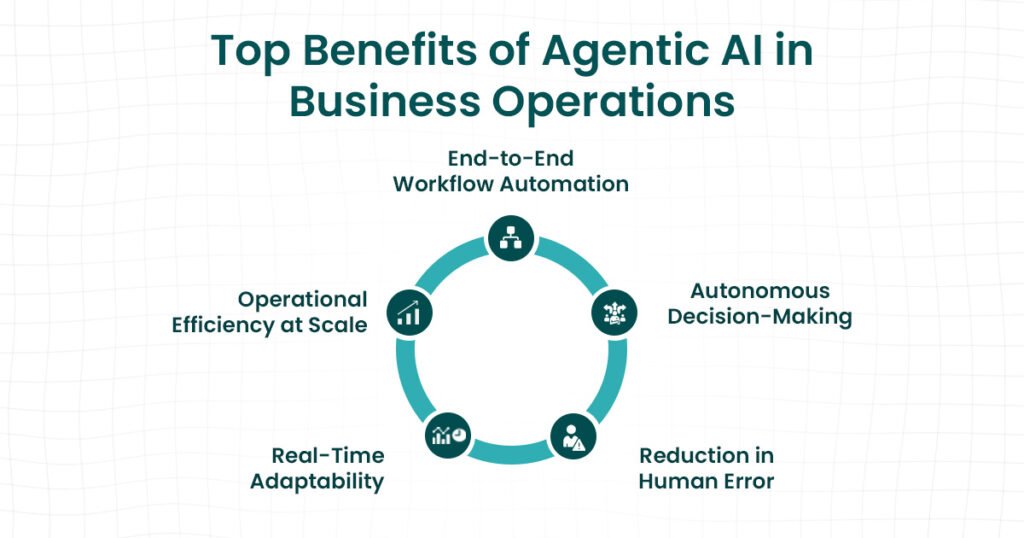
While generative AI improves how work is done, agentic AI transforms how work is executed. The top benefits of agentic AI in business operations are centered around automation, autonomy, and scalability.
End-to-End Workflow Automation
Agentic AI enables full AI automation for B2B workflows by handling entire processes instead of isolated tasks. From lead generation to customer onboarding or procurement to payment processing, these systems can execute workflows independently. This is a core driver of the business impact of agentic AI in modern enterprises.
Autonomous Decision-Making
Agentic AI systems can analyze data, evaluate scenarios, and make decisions without constant human input. This capability is critical for autonomous AI agents in business, especially in areas like supply chain, pricing, and operations, where decisions must be fast and data-driven.
Operational Efficiency at Scale
Agentic AI systems can operate continuously and handle large volumes of tasks simultaneously. This enables organizations to scale operations without increasing costs proportionally, making it a key component of enterprise AI implementation strategy in 2026.
Real-Time Adaptability
One of the defining aspects of the future of agentic AI is its ability to adapt in real time. These systems can respond to changing conditions, such as demand fluctuations or workflow disruptions, and adjust their actions accordingly, improving resilience in business operations.
Reduction in Human Error
By automating repetitive and rule-based tasks, agentic AI minimizes human error and ensures consistent execution. This is particularly important in areas like finance, compliance, and operations, where accuracy directly impacts outcomes. It further strengthens the overall business impact of agentic AI by improving reliability and process quality.
Business Impact of Agentic AI
- Operations and Supply Chain Automation
- Sales and Revenue Operations
- Customer Support Transformation
- Finance and Risk Management
AI Adoption in Enterprises: What are the Current Trends in 2026?
AI adoption in enterprises has moved beyond experimentation into structured, outcome-driven implementation. In 2026, organizations are no longer asking whether to adopt AI; they are focused on how to scale it effectively across business functions.
The current landscape shows a clear shift:
- From isolated AI tools to integrated AI systems
- From productivity gains to operational transformation
- From human-assisted AI to autonomous AI-driven workflows
This evolution is largely driven by two parallel forces: the maturity of generative AI and the emergence of agentic AI systems.
Adoption of Generative AI
Generative AI continues to be the most widely adopted form of AI in enterprises. Its low barrier to entry and immediate productivity benefits have made it the starting point for most organizations.
Businesses are using generative AI for:
- Content creation and marketing automation
- Customer support virtual assistant
- Software development and documentation
- Data summarization and reporting
In many enterprises, generative AI is now embedded into everyday tools such as email platforms, CRMs, and collaboration software. This widespread integration has made it a default productivity layer across departments.
However, while adoption is high, its impact is often limited to task-level efficiency improvements, not full process transformation.
Rise of Agentic AI Systems
Alongside generative AI, there is a rapid rise in agentic AI systems. These systems represent the next phase of enterprise AI maturity, where the focus shifts from assistance to autonomous execution.
Organizations are increasingly exploring agentic AI for:
- End-to-end workflow automation
- Autonomous decision-making in operations
- Real-time process optimization
- Cross-system orchestration
This trend is especially strong in operations-heavy domains like finance, supply chain, and customer support. As businesses aim to reduce manual intervention and increase scalability, AI in Android app development and even iOS is becoming a strategic priority.
Challenges in Enterprise AI Adoption
Despite growing adoption, enterprises still face several challenges when implementing AI at scale.
- Lack of clear strategy: Many organizations adopt AI tools without a defined roadmap, leading to fragmented use cases and limited ROI.
- Data readiness issues: Poor data quality, silos, and a lack of governance can limit the effectiveness of AI systems.
- Integration complexity: Connecting AI with existing enterprise systems (ERP, CRM, legacy platforms) remains a major technical hurdle.
- Skill gaps: There is a shortage of talent with expertise in AI implementation, prompt engineering, and system orchestration.
- Risk and compliance concerns: Issues related to data privacy, model reliability, and regulatory compliance slow down adoption in sensitive industries.
These challenges highlight the need for a structured enterprise AI implementation strategy rather than ad-hoc experimentation.
AI Automation for B2B Workflows
AI is transforming how B2B workflows are designed and executed. Traditional business processes that relied on manual coordination are now being replaced by intelligent, automated systems.
AI automation for B2B workflows focuses on:
- Reducing manual effort in repetitive tasks
- Improving process speed and accuracy
- Enabling real-time decision-making
- Integrating multiple systems into unified workflows
This is where the combination of generative AI and agentic AI becomes particularly powerful—one generates insights or content, while the other executes actions.
Traditional vs AI-Driven Workflows
The difference between traditional and AI-driven workflows is not just incremental; it is structural.
Traditional Workflows:
- Depend heavily on manual intervention
- Operate in siloed systems
- Require multiple handoffs between teams
- Are slower and prone to human error
- Follow static, rule-based processes
AI-Driven Workflows:
- Automate tasks and decision-making using AI systems
- Integrate seamlessly across tools and platforms
- Minimize handoffs through end-to-end execution
- Operate faster with higher consistency
- Adapt dynamically based on real-time data
For example, in a traditional sales process, lead qualification, follow-ups, and CRM updates are handled manually. When it comes to AI in eCommerce, agentic AI systems can manage the entire pipeline while supporting communication and product delivery.
How to Implement AI in Business Operations?
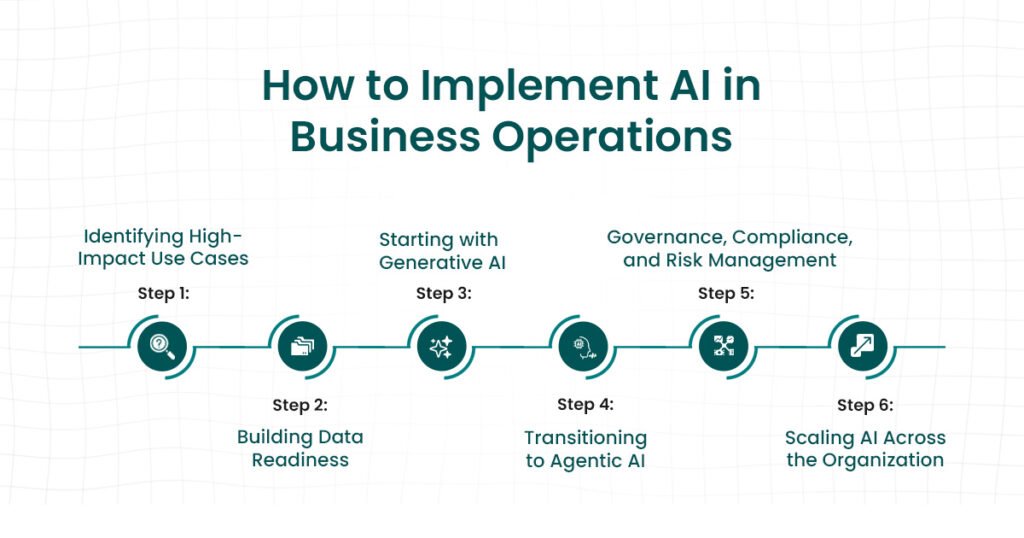
Implementing AI in business operations is not just about adopting tools; it requires a structured, phased approach aligned with business goals. Organizations that succeed in AI adoption in enterprises follow a clear roadmap that balances quick wins with long-term transformation.
Step 1: Identifying High-Impact Use Cases
The first step is to identify where AI can create the most value. Instead of applying AI broadly, businesses should focus on specific, high-impact use cases such as repetitive workflows, data-heavy processes, or customer-facing operations. Common starting points include customer support, marketing automation, finance operations, and sales processes. Prioritizing use cases with clear ROI helps build momentum and internal confidence in AI initiatives.
Step 2: Building Data Readiness
AI systems are only as effective as the data they rely on. Organizations must ensure that their data is accurate, accessible, and well-structured before implementing AI. This involves breaking down data silos, improving data quality, and establishing governance frameworks. Without proper data readiness, even the most advanced AI systems will produce unreliable or limited results.
Step 3: Starting with Generative AI
For most enterprises, the practical entry point is generative AI. It offers quick productivity gains with relatively low implementation complexity. Businesses can start by deploying generative AI business use cases in 2026, such as content creation, coding assistance, reporting, and customer support augmentation. This phase helps teams become familiar with AI while delivering immediate value.
Step 4: Transitioning to Agentic AI
Once workflows are well understood and initial AI adoption is successful, organizations can move toward agentic AI systems. This involves automating multi-step processes and enabling AI automation for B2B workflows. Agentic AI can handle tasks like lead management, order processing, and operational decision-making, driving the business impact of agentic AI through end-to-end automation.
Step 5: Governance, Compliance, and Risk Management
As AI becomes more integrated into business operations, governance becomes critical. Organizations must establish clear policies around data privacy, model usage, accountability, and compliance. This includes monitoring AI outputs, managing risks like bias or inaccuracies, and ensuring alignment with regulatory requirements. Strong governance frameworks are essential for sustainable and responsible AI adoption.
Step 6: Scaling AI Across the Organization
After successful pilots, the focus shifts to scaling AI across departments and functions. This involves integrating AI into core systems, standardizing processes, and enabling cross-functional collaboration. At this stage, businesses move toward a full enterprise AI implementation strategy, where generative AI and agentic AI work together to support both productivity and autonomous operations at scale.
Generative AI and Agentic AI: A Combined Approach
In 2026, the most effective enterprise AI strategies are not built around choosing between systems; they are built around combining generative AI and agentic AI into a unified architecture. Individually, each has clear strengths. Together, they enable end-to-end intelligent automation.
Generative AI excels at creating content, insights, and communication, while agentic AI is designed for execution, decision-making, and workflow automation. When integrated, they form a system where one “thinks” and the other “acts.”
Why Integration Matters
Relying on only generative AI limits organizations to productivity gains, while relying only on agentic AI without strong content intelligence reduces flexibility. Combining both allows businesses to move from task-level efficiency to full process automation.
This integrated approach enables:
- Seamless transition from insight generation to execution
- Reduced manual intervention across workflows
- Faster decision-to-action cycles
- More scalable and adaptive business operations
It also aligns with modern enterprise AI implementation strategy, where AI is embedded across layers of the organization rather than deployed as isolated tools.
How does the Combined Model work?
In a combined setup:
- Generative AI handles thinking tasks such as writing, summarizing, analyzing, and generating responses
- Agentic AI handles action tasks such as triggering workflows, updating systems, making decisions, and executing processes
This creates a continuous loop:
Input < Insight < Decision < Action < Feedback < Optimization
What are the Real-World Hybrid Use Cases of Gen AI & Agentic AI?
Customer Support Automation
Generative AI drafts accurate and context-aware responses to customer queries, while agentic AI retrieves relevant data, sends responses, updates CRM systems, and escalates issues when necessary. This results in faster resolution times and a more consistent customer experience.
Sales and CRM Automation
Generative AI creates personalized outreach emails, proposals, and follow-ups, while agentic AI identifies leads, prioritizes them, schedules meetings, updates CRM records, and manages the sales pipeline. This combination enables true AI automation for B2B workflows in sales operations.
HR and Recruitment Workflows
In HR, generative AI can generate job descriptions, screen resumes, and draft communication with candidates. Agentic AI then takes over by scheduling interviews, managing candidate pipelines, updating HR systems, and coordinating onboarding processes.
Strategic Takeaway
The real business impact does not come from using generative AI or agentic AI in isolation; it comes from orchestrating them together.
This hybrid model is rapidly becoming the foundation for:
- Autonomous AI agents in business
- Scalable workflow automation
- AI-driven enterprise operations
In simple terms, generative AI answers the question “what should be done?”, while agentic AI answers “how it gets done.”
And in 2026, businesses that successfully combine both are the ones moving closest to fully autonomous, AI-driven operations.
How EitBiz Helps You Implement AI at Scale?
Adopting AI is no longer just about tools; it’s about building the right strategy, choosing the right technologies, and implementing them in a way that delivers measurable business outcomes. This is where EitBiz supports enterprises in moving from experimentation to real impact.
As a trusted AI-powered mobile app development company, we help businesses navigate the full journey of AI adoption in enterprises, from identifying the right use cases to deploying scalable solutions. Whether you are starting with generative AI business use cases in 2026 or looking to implement agentic AI for end-to-end automation, our approach is focused on aligning AI with your business goals.
Our expertise includes:
- Designing a clear enterprise AI implementation strategy tailored to your workflows
- Implementing AI automation for B2B workflows to reduce manual effort and improve efficiency
- Building and deploying autonomous AI agents in business operations
- Integrating generative AI and agentic AI into existing systems for seamless execution
- Ensuring governance, compliance, and long-term scalability
We don’t just help you adopt AI, we help you use it where it actually matters.If you’re exploring agentic AI vs generative AI and want to understand what works best for your business, our team can help you define, implement, and scale the right solution with a practical, results-driven approach.