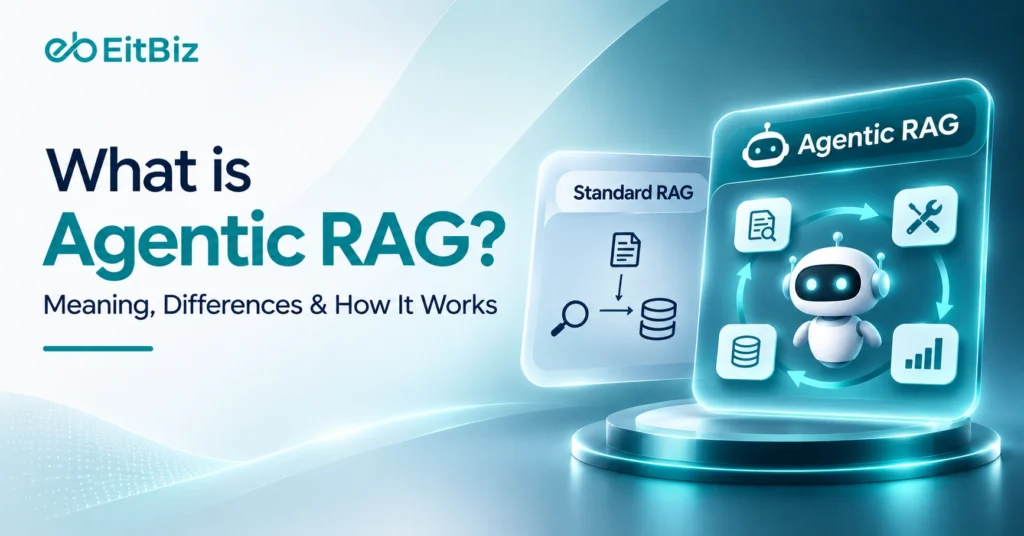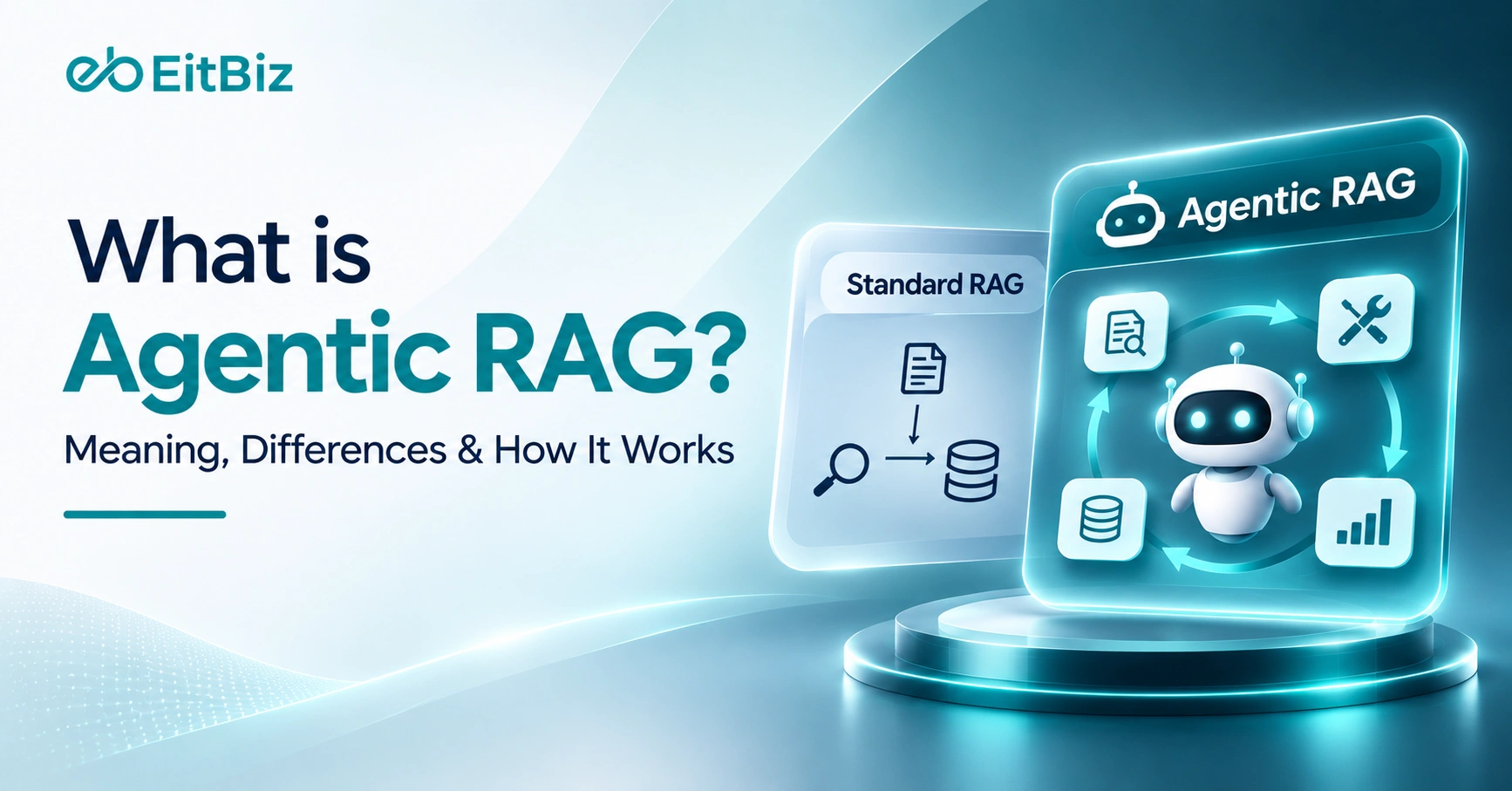
Standard RAG can find relevant information and use it to answer questions. But what happens when a question needs information from different documents, multiple searches, or a few steps of reasoning? That’s where things get tricky. A traditional RAG system usually retrieves information once and passes it to the LLM. It doesn’t always know when to search again or look somewhere else.
Agentic RAG takes a different approach. It uses AI agents to decide what information is needed, where to find it, and whether the retrieved results are good enough. The process doesn’t have to stop after one search.
In this guide, we’ll look at how agentic RAG works, its architecture, real-world examples, and how RAG and agentic AI come together.
What Is Agentic RAG?
Agentic RAG is an advanced form of Retrieval-Augmented Generation (RAG) that uses AI agents to manage information retrieval. Instead of searching once and generating an answer, it can decide what to search, which sources to use, and whether more information is needed.
To understand the RAG agent meaning, think of an AI agent as a system that can plan tasks and make decisions. When connected to RAG, it can break complex questions into smaller steps and choose the right tools.
An agentic RAG system can:
- Break complex questions into smaller tasks.
- Choose suitable data sources and tools.
- Remember previous steps during a task.
- Review results and search again if needed.
This approach is called agentic retrieval augmented generation. It combines RAG with the planning and decision-making abilities of AI agents, making it useful for questions involving multiple sources.
How Does Agentic RAG Work?
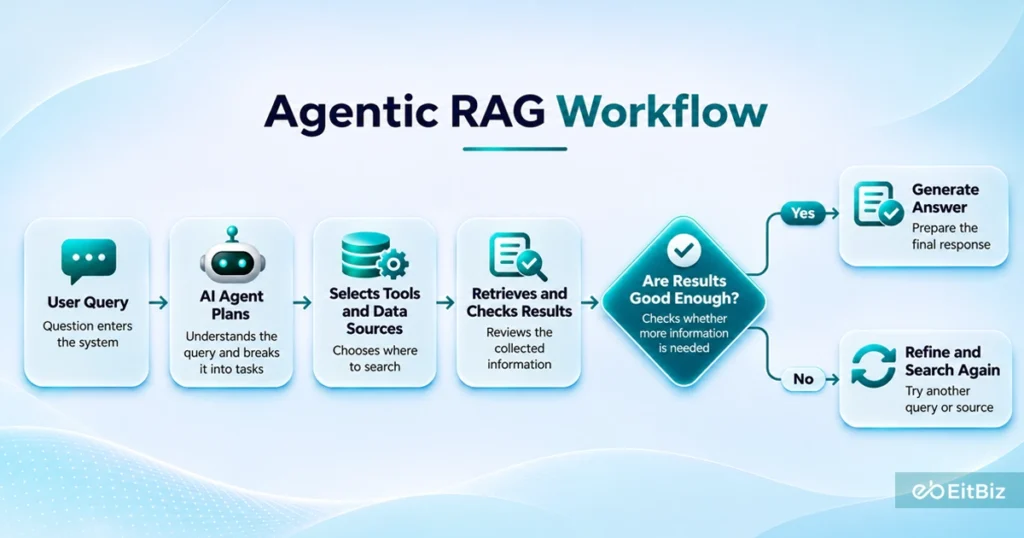
To understand how does agentic RAG work, think of it as a system that doesn’t rush to answer a question. It first understands what the user needs, finds the right information, and checks whether the results are useful. If something is missing, it can search again.
The process generally follows these five steps:
- Understand and plan the query: The AI agent reads the question and identifies what information is needed. For complex queries, it may break the task into smaller parts.
- Choose the right source: It decides where to look for information. This could be a vector database, company documents, APIs, or external tools.
- Retrieve and review information: The agent collects relevant results and checks whether they answer the query. It may also compare information from different sources.
- Refine the search: If the results are incomplete or unclear, the agent can rewrite the query, try another source, or retrieve more information.
- Generate the answer: Once it has enough useful information, the LLM prepares a response using the retrieved context.
For businesses working with private company information, enterprise RAG systems can help connect AI models with internal documents and knowledge sources.
Unlike standard RAG, the agent doesn’t have to stop after one retrieval step. It can go back, change its search approach, and gather more information before responding.
How Is Agentic RAG Architecture Designed?
An agentic RAG system needs more than a retriever and a language model. It brings together different components that help the AI understand questions, find information, and decide what to do next.
Each component has a specific role in the process:
- LLM Agent: Mainly created through LLM development, these agents act as the decision-maker. It understands the query, plans the steps, and decides which tools or data sources to use.
- Retriever: Finds relevant information from connected documents, databases, or other sources.
- Vector Database: Stores document embeddings and helps retrieve information based on meaning rather than exact keyword matches.
- Tools: Connect the agent with APIs, search engines, databases, and external services when additional information is needed.
- Memory: Keeps track of previous actions and useful context, helping the agent make better decisions during multi-step tasks.
The way these components work together depends on the application. Some agentic RAG systems use one agent to manage everything, while others divide the work between multiple agents.
Single-Agent vs Multi-Agent Architecture
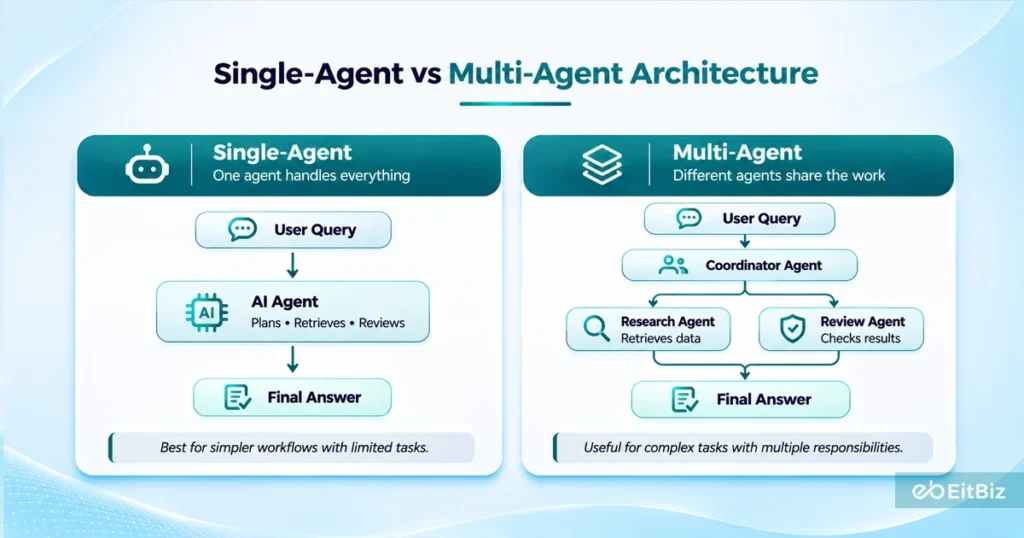
In a single-agent setup, one AI agent manages the entire workflow. It understands the query, selects retrieval tools, checks results, and prepares the response. This setup is easier to build and works well for applications with limited tasks.
A multi-agent setup divides these responsibilities between different agents. For example, one agent can handle information retrieval, another can review the results, and a third can prepare the final answer. This approach is useful when workflows involve multiple data sources or complex tasks.
If you’re exploring how to build such systems, this AI agent development guide explains the important considerations involved in developing intelligent AI agents.
Common patterns used in agentic RAG systems include:
- Routing: Directs a query to the most relevant data source or tool based on what the user asks.
- Query Rewriting: Rephrases unclear or incomplete queries to improve search results.
- Self-Correction: Reviews retrieved information or generated responses and triggers another search when something is missing.
The choice between these patterns depends on the application’s requirements. A customer support chatbot may work well with a single agent and basic routing. However, a research assistant handling information from multiple sources may need several agents and additional review steps.
RAG vs Agentic RAG: Key Differences
Standard RAG works in a straightforward way. A user asks something, the system searches its knowledge base, and the LLM uses the retrieved information to prepare an answer. That’s usually enough for simple questions.
But what if the answer needs information from different places? Or the first search doesn’t return anything useful? Standard RAG has limited flexibility here. Agentic RAG handles such situations differently, as the AI agent can decide what to do next instead of following the same retrieval process every time.
Here’s a closer look at how the two approaches differ:
| Comparison Factor | Standard RAG | Agentic RAG |
|---|---|---|
| Retrieval steps | Searches for relevant information and passes it to the LLM. | Can search multiple times until it finds enough useful information. |
| Decision making | Follows a predefined retrieval process. | The agent decides which steps to take and when to take them. |
| Complex questions | Works well when the answer is available in a single search. | Can break questions into smaller tasks and combine information from different sources. |
| Self-checking | Usually doesn’t check whether another search is needed. | Can review results and try again when something is missing. |
| Tool use | Mainly relies on its configured retrieval system. | Can work with APIs, databases, search engines, and other tools. |
| Cost and speed | Usually faster and cheaper because it needs fewer steps. | May take longer and cost more because of repeated searches and agent decisions. |
| Setup effort | Relatively simple to develop and maintain. | Needs additional logic, tool connections, and testing. |
When Is Standard RAG Still Enough?
Honestly, not every application needs agentic RAG. Consider a chatbot that answers questions from company FAQs or product documentation. If the required information is easy to find, a standard RAG setup can handle the job.
For example, a RAG chatbot that answers questions from business data can provide useful responses without requiring complex agent-based workflows.
Adding agents, memory, and multiple retrieval steps in such cases may increase development costs without making much difference to the answers. The choice between basic RAG vs agentic RAG should depend on what the application actually needs, not simply on which approach is more advanced.
How to Build an Agentic RAG System?
Building an agentic RAG system starts with a basic RAG setup. You can then add an AI agent, connect different tools, and give it the ability to make decisions during retrieval. Here’s how the process usually looks:
- Prepare your data and vector store: Collect your documents, clean the data, and split it into smaller chunks. Generate embeddings and store them in a vector database.
- Build a basic retriever: Set up a retriever that can search the vector database and return relevant information for user queries.
- Add an AI agent: Connect an LLM with the retriever and other tools. The agent should be able to understand queries and decide which tools to use.
- Add checks and retry logic: Let the agent review search results. If the information is incomplete, it can rewrite the query or try another source.
- Test and monitor results: Test the system with different questions. Check answer quality, retrieval accuracy, response time, and running costs.
For businesses planning to implement these solutions, RAG development services can help build systems around their specific data and application requirements. Another option worth evaluating is RAG as a Service, especially when deciding between managed RAG solutions and custom development.
Also, for development, you can use frameworks like LangChain and LangGraph. Both support agentic RAG implementation, but they offer different levels of control.
Build Agentic RAG With LangChain
LangChain provides ready-to-use components for connecting LLMs, retrievers, vector databases, and external tools. Its agent and tool-calling features make it easier to build a LangChain agentic RAG workflow.
It’s a good option when you want to connect existing RAG components with an AI agent without managing every workflow step yourself.
Build Agentic RAG With LangGraph
LangGraph gives developers more control over how an agent moves between tasks. You can define workflow steps, manage state, add conditional paths, and decide when the agent should retrieve information or try again.
Choose LangGraph when your application needs multi-step workflows, multiple agents, or more control over retries and decision-making.
Benefits and Challenges of Agentic RAG
Agentic RAG gives AI systems more flexibility when handling information. But adding agents and extra retrieval steps also brings a few challenges. Before choosing this approach, it’s worth looking at both sides.
Benefits of Agentic RAG
- Better accuracy: The agent can review retrieved information and search again when the initial results aren’t useful.
- Handles complex queries: It can break larger questions into smaller tasks and gather information from different sources.
- Fewer incorrect answers: Additional retrieval and checking steps can reduce errors caused by missing or irrelevant information.
Challenges of Agentic RAG
- Higher cost: Multiple searches, LLM calls, and tool integrations can increase running costs.
- Slower responses: The agent may need several steps before producing an answer, increasing response time.
- Harder to debug: When something goes wrong, finding the issue can be difficult because several agents, tools, and retrieval steps may be involved.
Security also needs attention when agents access different data sources. Understanding common RAG security risks and how to build a secure RAG system can help prevent issues involving data access, retrieval, and information exposure.
Conclusion
Agentic RAG takes traditional RAG a step further by giving AI systems the ability to plan, retrieve, and make decisions. It works well when questions need multiple searches or information from different sources. However, not every application needs this level of complexity.
Choosing the right approach depends on your data, use case, and business requirements.
Looking to build an AI solution that can do more than retrieve information? Explore EitBiz AI engineering services to build intelligent RAG systems tailored to your business needs.