It’s 2026!
And there’s hardly any technology buzzing around the internet more than “Progressive Web Apps” (PWAs)!
And why shouldn’t it be?
Whether you want to connect with a broader audience or provide users with mobile-friendly content, PWAs have got your back!
Well, the stats don’t lie!
Not only does it boost overall user engagement by 137%, but it may also help increase mobile sessions and increase page views by 80% and 42.86%, respectively! (Source: Adobe Experience Cloud).
No matter what device the user is on, these web apps will likely deliver an excellent user experience.
Excited to dive into the world of PWAs? If so, let’s get started!
What are Progressive Web Apps?
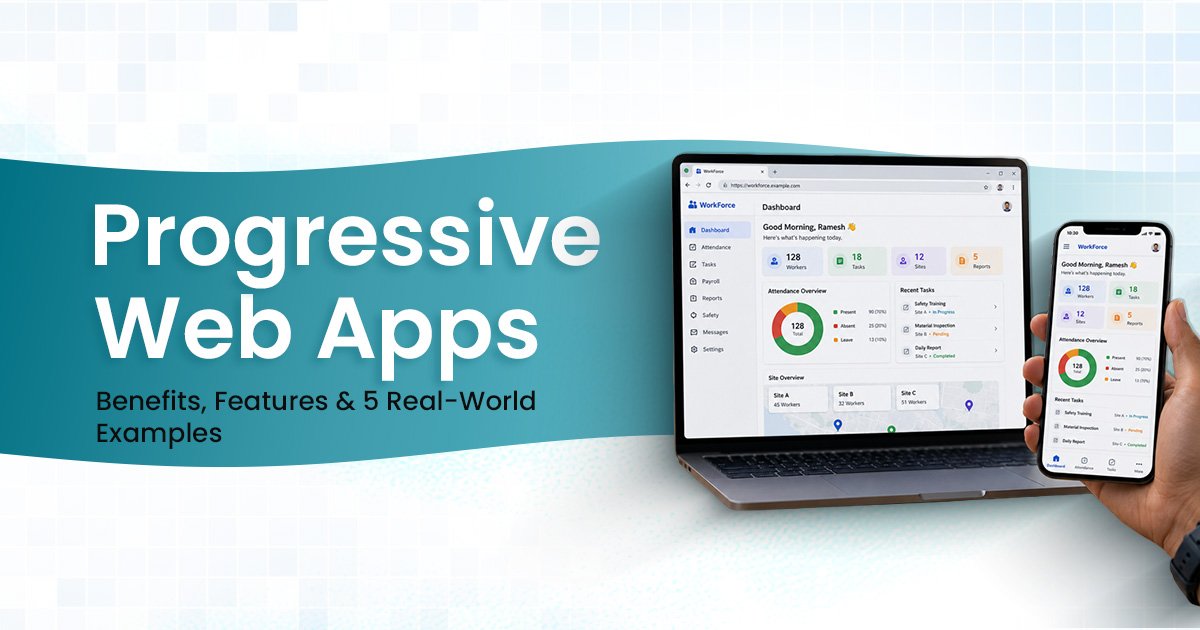
In layman’s language, a PWA is a web app that a user can access via their smartphone or desktop. It is a website built using web technologies, including HTML, JavaScript, and CSS, but it acts exactly like a mobile app. Furthermore, these web apps come with modern APIs, which make it easy to deliver enhanced capabilities along with reliability and hassle-free installation on any device. Also, it comes with a wide range of offline features, including instant loading, Push Notifications, and offline features.
Speaking of the market share, here is the fact!
The global services progressive web apps (PWA) market size is estimated to grow to USD 9,804.0 million by 2033. (Source: Grand View Research).
PWAs aren’t built using one specific technology. Instead, they revolutionize the new approach to web app development using modern features. When it comes to getting started, a website must register a service worker, use HTTP, and have a web app manifest file. Furthermore, these requirements serve to support a variety of modern features and capabilities.
Why are Progressive Web Apps becoming popular among businesses in 2026?
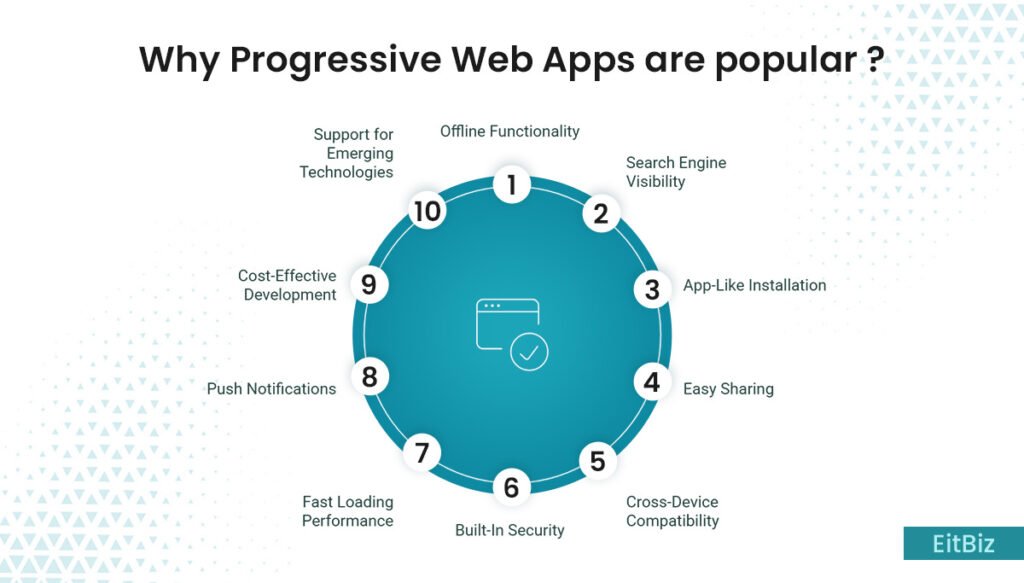
Progressive Web Apps have emerged as a powerful solution by combining the reach of the web with the functionality of native applications. Let’s take a look at the reasons why businesses prefer Progressive Web Apps in 2026.
1. Offline Functionality
PWAs use service workers and caching technology to store content locally, allowing users to access certain features even without an internet connection. It helps businesses deliver a more reliable user experience and improve customer retention.
2. Search Engine Visibility
Unlike native apps, PWAs can be indexed by search engines, making them easier to discover online. This increased visibility helps businesses attract organic traffic and maximize the value of their Web App Development Services investment.
3. App-Like Installation
Users can install PWAs directly from their browser and access them from their home screen without visiting an app store. This streamlined experience reduces friction and increases user adoption.
4. Easy Sharing Through URLs
PWAs can be shared instantly through a simple link, allowing businesses to expand their reach and improve content distribution without requiring downloads or installations.
5. Cross-Device Compatibility
PWAs work seamlessly across desktops, tablets, and smartphones using a single codebase. Thus, it makes them an ideal solution for businesses seeking efficient cross-platform web app development.
6. Built-In Security
Delivered over HTTPS, PWAs provide encrypted communication and enhanced data protection. This level of security is especially valuable for organizations involved in enterprise web application development.
7. Fast Loading Performance
PWAs are designed for speed, even on slower networks. Their ability to load quickly supports effective web app performance optimization, leading to better engagement and conversion rates.
8. Push Notifications
Like native apps, PWAs can send push notifications to users. Businesses can use this feature to share updates, promotions, and personalized content that encourage repeat visits and interactions.
9. Cost-Effective Development
With a single codebase serving multiple platforms, PWAs are often more affordable to build and maintain than separate native applications. This is one reason many companies are turning to progressive web app development services and PWA development services to accelerate their digital initiatives.
10. Support for Emerging Technologies
Modern PWAs can integrate with advanced technologies such as chatbots, recommendation engines, and AI web apps, helping businesses deliver smarter and more personalized user experiences while supporting broader PWAs for Digital Transformation strategies.
How Do Progressive Web Apps Work?
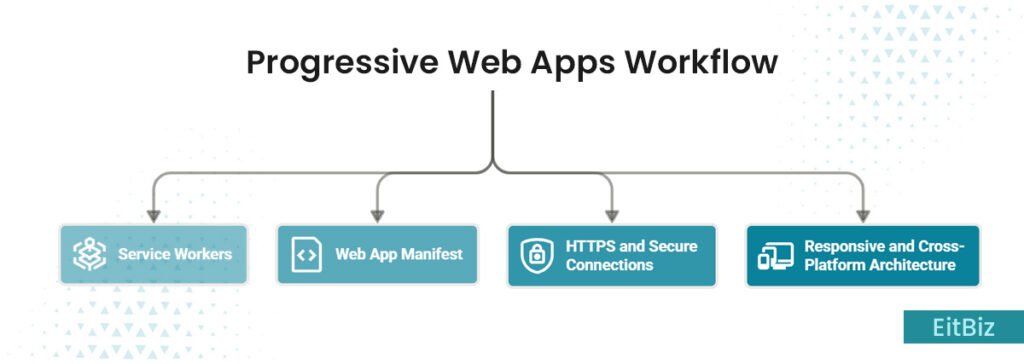
Progressive Web Apps (PWAs) combine the accessibility of a website with the functionality of a mobile application. Unlike traditional websites, PWAs use modern web technologies to deliver fast, reliable, and engaging user experiences across devices. This is one of the reasons why businesses are increasingly investing in progressive web app development services as part of their digital strategy.
At the core of every PWA are three essential components:
1. Service Workers
Service workers are background scripts that enable many of the features users associate with mobile apps. They cache important resources, allowing the application to load quickly and function even when internet connectivity is poor or unavailable. This capability plays a significant role in web app performance optimization, helping businesses reduce load times and improve user engagement.
2. Web App Manifest
A web app manifest is a file that defines how the application appears and behaves when installed on a user’s device. It includes details such as the app’s name, icons, theme colors, and display settings. This allows users to add the PWA directly to their home screen and access it like a native application without visiting an app store.
3. HTTPS and Secure Connections
Security is a fundamental requirement for PWAs. All Progressive Web Apps must be served over HTTPS, ensuring that data exchanged between users and the application remains encrypted and protected. This secure foundation is particularly important for businesses involved in enterprise web application development, where protecting customer and business data is critical.
4. Responsive and Cross-Platform Architecture
PWAs are designed to work seamlessly across desktops, tablets, and smartphones using a single codebase. This approach simplifies maintenance while delivering a consistent experience across devices. As a result, many organizations choose PWAs as a cost-effective solution for cross-platform web app development, eliminating the need to build separate applications for different operating systems.
As businesses continue to embrace digital innovation, PWAs have become an important part of the evolution of the modern web application. From eCommerce platforms to customer portals and even emerging AI web apps, Progressive Web Apps provide the speed, flexibility, and accessibility needed to meet growing user expectations.
Progressive Web Apps vs Native Apps: What’s the Difference?
The debate around PWA vs. native app largely depends on your business goals. Native apps are ideal for applications that require deep integration with device hardware, while PWAs are often preferred by organizations looking for faster deployment and efficient cross-platform web app development.
| Feature | Progressive Web App (PWA) | Native App |
| Installation | Can be installed directly from a browser | Downloaded from app stores |
| Development Cost | Lower, single codebase | Higher, separate development for iOS and Android |
| Platform Compatibility | Works across multiple devices and operating systems | Built specifically for one platform |
| Storage Requirements | Lightweight and consumes less storage | Generally requires more device storage |
| Offline Access | Supported through service workers and caching | Fully supported |
| Updates | Automatic updates through the web | Users may need to download updates |
| Discoverability | Search engine indexable | Primarily discovered through app stores |
| Development Time | Faster to build and launch | longer development cycles |
| Maintenance | Easier with a unified codebase | Separate maintenance for each platform |
What are the Top 5 Examples of Progressive Web Apps?
From eCommerce and transportation to media and food services, these companies have used Progressive Web Apps to improve user engagement and drive measurable business results. Let’s explore five standout progressive web app examples and see what makes them successful.
1. Starbucks
Starbucks wanted to create an online ordering system that was simple, fast, and accessible to all customers. To achieve this, they built a Progressive Web App (PWA) that provides the same smooth experience as their native mobile app.
One of the best features of this web app is that it works offline. Customers can browse the menu, customise their orders, and add items to their cart even without an internet connection. Once they are back online, they can see prices based on their location and place their order.
This offline capability is especially useful for customers who are constantly on the move, as well as those in areas with poor internet connectivity, such as rural regions.
The results of launching this PWA have been impressive:
- The web app is 99.84% smaller than the iOS app, making it much faster and easier to use.
- The number of web users placing orders has doubled.
- Desktop users now place orders just as often as mobile users.
2. BMW
BMW is known for embracing new technology, both in its cars and on its website. To improve customer experience, the company created a PWA that delivers high-quality content while being incredibly fast and efficient.
When users visit BMW’s new website, they immediately notice the stunning, high-resolution images and videos that load almost instantly, four times faster than before.
The impact of this upgrade has been significant:
- 4X more users click from the homepage to a BMW sales page.
- 50% increase in mobile users.
- 49% growth in total website visits.
This proves that a fast, visually appealing, and engaging website can attract more visitors and potential customers.
3. Uber
As Uber expanded into new markets, it needed a faster and lighter version of their app that would work well even on slow 2G networks and low-end devices.
To achieve this, they built a PWA from scratch, offering a similar experience to their mobile app but in a much smaller and more efficient package.
- The core app is only 50kB, making it incredibly lightweight.
- It loads within 3 seconds, even on slow networks.
- Riders using older phones or limited data plans can still book rides easily.
By bringing the Uber experience to the web, the company ensured that everyone, regardless of location or internet speed, could access their services.
4. Pinterest
Pinterest realized that its old mobile website was slow and ineffective, leading to low engagement and fewer sign-ups. Only 1% of mobile visitors signed up, logged in, or installed the app.
To solve this issue, they rebuilt their mobile website as a PWA, improving speed and performance. The results were impressive:
- 40% increase in time spent on the site.
- 44% growth in user-generated ad revenue.
- 60% rise in core user interactions (such as saving and sharing content).
By making the website faster and more engaging, Pinterest successfully attracted more users and increased revenue.
How Much Does It Cost to Build a Progressive Web App?
The cost of building a Progressive Web App (PWA) can vary significantly depending on the project’s complexity, features, design requirements, and integrations. Businesses investing in progressive web app development services can expect costs to fall into one of the following categories:
| Project Type | Estimated Cost Range | Typical Features |
| Basic PWA | $5,000 – $15,000 | Responsive design, offline functionality, push notifications, basic integrations |
| Medium-Complexity PWA | $15,000 – $40,000 | User accounts, payment gateways, APIs, and advanced UI/UX features |
| Enterprise PWA | $50,000 – $150,000+ | Complex workflows, third-party integrations, analytics, high security, scalable architecture |
Several factors influence the final development cost, including:
1. Project Complexity
A simple informational website converted into a PWA will cost far less than a feature-rich eCommerce platform or customer portal. More advanced functionality requires additional development time, testing, and maintenance.
2. Design and User Experience
Custom designs, animations, and interactive features can increase development costs. However, investing in a user-friendly experience often leads to better engagement and higher conversion rates.
3. Third-Party Integrations
Integrating payment systems, CRM platforms, chatbots, analytics tools, or other business software adds to the overall project scope and budget.
4. Development Team Expertise
The experience and location of your development team also affect pricing. Whether you choose to hire progressive web app developer talent in-house or partner with a specialized PWA development agency, the cost will vary based on expertise and project requirements.
5. Ongoing Maintenance and Updates
Like any digital product, PWAs require ongoing monitoring, security updates, feature enhancements, and performance optimization. These recurring costs should be factored into your long-term budget.
Many organizations choose to work with a reputable progressive web app development company because it provides access to experienced designers, developers, and quality assurance specialists under one roof. Others prefer to hire PWA developers on a project basis for greater flexibility.
When Should You Choose a Progressive Web App?
A Progressive Web App is a great choice when you want to deliver an app-like experience without the cost and complexity of building separate native applications. Here are the scenarios in which you need to choose a Progressive Web App.
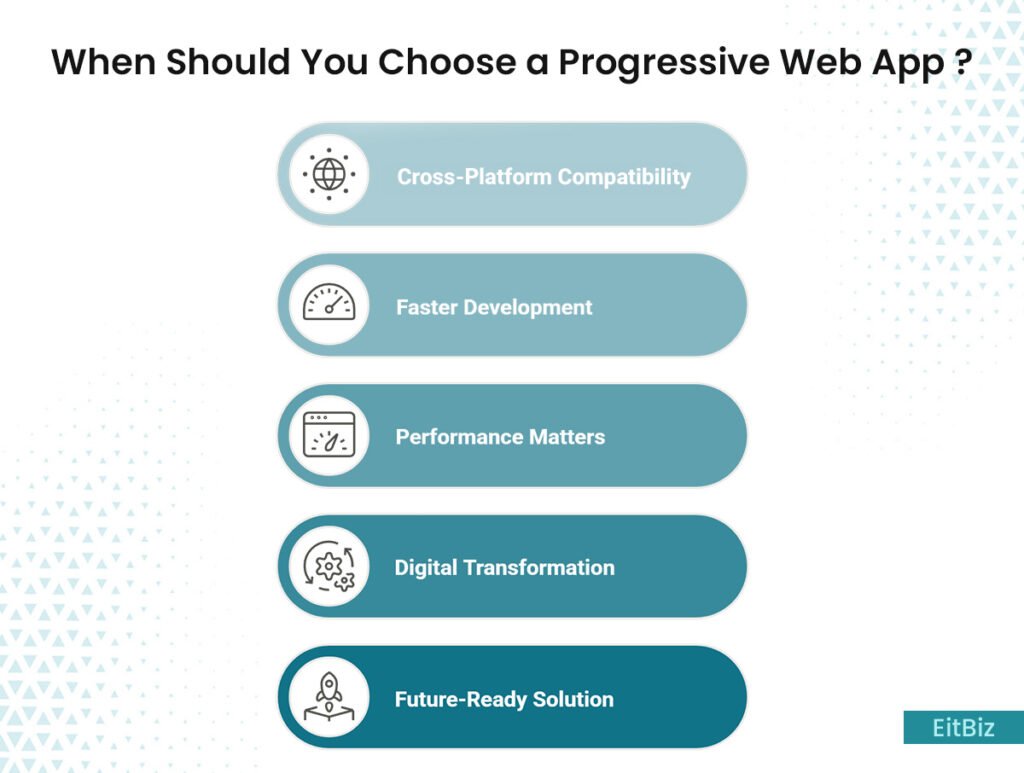
When You Need Cross-Platform Compatibility
PWAs work seamlessly across desktops, tablets, and smartphones using a single codebase, making cross-platform web app development more efficient and cost-effective.
When You Want Faster Development
Compared to native apps, PWAs can be built and deployed more quickly, making them an attractive option for businesses seeking reliable Web App Development Services.
When Performance Matters
PWAs use caching and offline capabilities to improve speed and reliability, supporting effective web app performance optimization and a better user experience.
When You’re Driving Digital Transformation
Many businesses are adopting PWAs as part of their PWAs for Digital Transformation strategy to modernize customer experiences and improve operational efficiency.
When You Want a Future-Ready Solution
As Progressive Web App Trends continue to evolve, PWAs are increasingly being used for eCommerce platforms, customer portals, and even innovative AI web apps.
How EitBiz Helps Build High-Performance Progressive Web Apps
EitBiz helps businesses build high-performing Progressive Web Apps that combine the reach of the web with the functionality of native applications. Our team works closely with organizations to design and develop tailored PWA solutions that align with their business objectives, enhance customer engagement, and support long-term growth.
From concept and development to deployment and ongoing optimization, we focus on creating secure, scalable, and user-centric applications that deliver measurable business value. Whether you’re modernizing an existing web platform or launching a new digital product, EitBiz provides the expertise needed to turn your vision into a reliable and future-ready Progressive Web App.
Ready to build a solid Web App? If so, simply visit EitBiz and attract your user base and turn them into potential customers.