If you’ve already explored our legacy application modernization guide and learned about the cost of legacy app modernization, you likely understand its importance, why it matters, and how much it may cost.
Did you know?
According to a recent survey, 87% of business executives reported that modernization is essential to expand and thrive.
By now, you’re probably thinking:
“Okay, I get it. Modernization is necessary. It’s expensive. But what can actually go wrong?”
That question right there is the real turning point.
Because this is where most modernization projects stumble. Not on the idea. Not on the business case. But on execution.
Most businesses think modernization sounds simple: Upgrade the tech, move to the cloud, improve performance, scale faster.
But here’s the catch- in the real world, it’s messy.
Legacy systems hide years of undocumented logic. Performance drops instead of improving. Data migrations break reporting. Security gaps appear during transition. Teams struggle with new tools. Budgets stretch. Timelines slip.
Well, facts don’t lie!
Nearly 79% of app modernization projects fail due to financial losses.
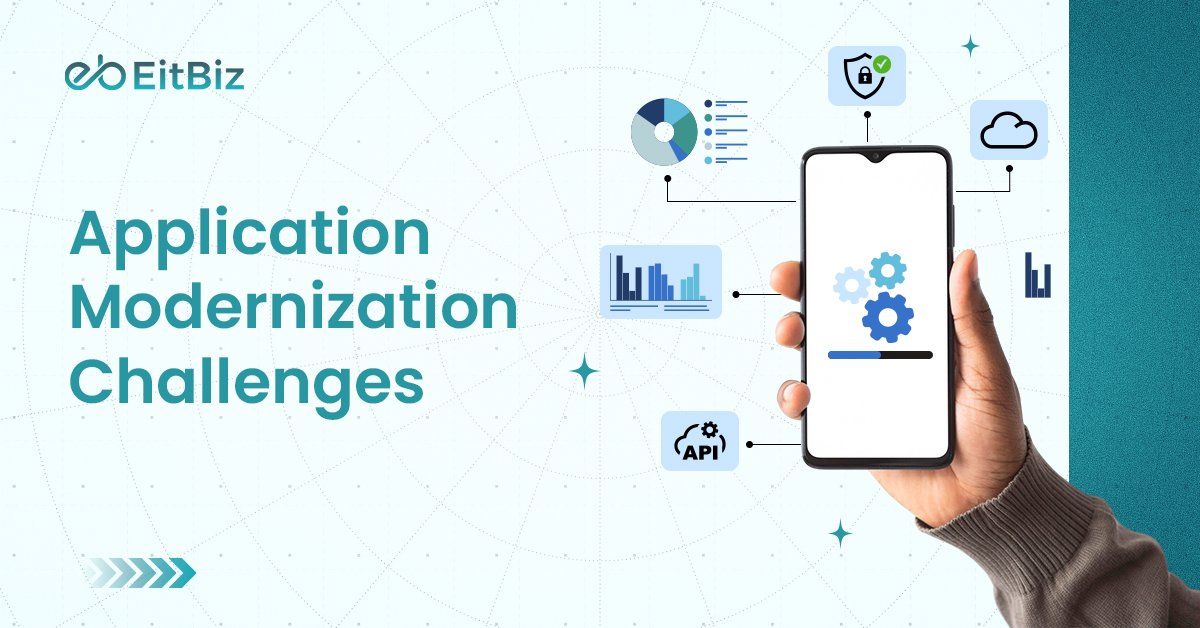
These are not rare edge cases. These are everyday application modernization challenges faced by enterprises across industries, including banking, healthcare, manufacturing, SaaS, and government. The risks are technical, yes.
But they’re also operational, financial, and strategic.
Why Businesses Run into Application Modernization Challenges?
Organizations do not enter modernization initiatives expecting failure. Yet, despite good intentions, many initiatives encounter serious setbacks. These application modernization challenges arise not from a single flaw but from a combination of strategic, technical, and operational missteps. Here are the reasons why businesses fall into these risks.
1. Legacy Complexity Is Often Underestimated
Most businesses significantly underestimate the complexity of their existing legacy systems. Years of patches, workarounds, integrations, and undocumented dependencies create deeply intertwined architectures. Teams often assume they can extract or rewrite services quickly, only to discover that critical business logic is buried in unstable or poorly understood code.
Such a misjudgement directly leads to technical challenges in modernizing legacy systems, where even small changes trigger unpredictable system failures.
2. Modernization Begins Without a Clear Business Strategy
Many companies initiate modernization as a reactive move rather than a strategic one. They act due to outdated software, expiring vendor support, or competitive pressure, not because they established clear business objectives. Without a defined outcome, such as performance improvement, faster product delivery, or regulatory compliance, teams lack direction. This creates one of the most damaging key challenges in modernizing legacy application environments: technology upgrades that do not align with business value.
3. Data Architecture Receives Late Attention
Data forms the operational backbone of every enterprise system, yet organizations often treat data as a secondary concern during modernization planning. Legacy databases frequently contain inconsistent formats, duplicate records, weak validation rules, and tightly coupled transactional logic.
When modernization teams delay data strategy decisions, they encounter severe data integrity issues during migration. This becomes one of the costliest legacy system modernization risks, especially for industries that rely on clean historical data for reporting, compliance, and customer trust.
4. Performance Expectations Are Unrealistic
Many decision-makers assume that modern platforms inherently guarantee better performance. This assumption ignores the architectural changes that modernization introduces, such as distributed services, API dependencies, and cloud networking layers. If businesses fail to model and test these performance shifts, they run straight into application modernization performance challenges. Instead of faster systems, users experience slow response times, unstable service availability, and degraded application behavior. These failures damage user confidence and delay enterprise-wide adoption.
5. Organizations Overlook Workforce Readiness
Technology transformation requires human transformation. Legacy system teams often possess deep expertise in outdated programming languages and frameworks but lack exposure to cloud-native development, DevOps pipelines, containerization, and microservices design.
When businesses modernize without investing in workforce enablement, engineers struggle to maintain new platforms efficiently. This skills gap becomes a persistent source of technical challenges in modernizing legacy systems, leading to poor architectural decisions, operational instability, and long-term vendor dependency.
What are the Major Risks and Challenges in Application Modernization?
Application modernization delivers long-term value, but it also exposes organizations to significant risks if teams fail to plan and execute with precision. These risks represent the most critical application modernization challenges that directly impact system stability, cost control, data integrity, security, and business continuity. Below are the seven significant risks businesses face during modernization.
Challenge #1. Business Disruption and Downtime
Unplanned downtime remains one of the most damaging legacy system modernization risks. Legacy applications often power revenue-generating and compliance-sensitive operations. When modernization disrupts these systems without proper transition planning, businesses experience revenue loss, customer dissatisfaction, and regulatory exposure. Organizations increase this risk when they rely on aggressive cutover strategies instead of phased rollouts, parallel system execution, and rollback mechanisms.
Challenge #2. Data Migration Failures and Integrity Loss
Data migration introduces some of the most severe technical challenges in modernizing legacy systems. Legacy databases commonly contain inconsistent formats, weak validation rules, and tightly coupled transactional logic. During modernization, errors in data transformation, schema mapping, and cleansing can result in permanent data loss or corruption. These failures compromise reporting accuracy, compliance audits, and customer trust.
Challenge #3. Performance Hurdles
Many organizations expect instant performance gains after modernization. In reality, they often encounter latency, unstable response times, and inefficient resource utilization. Distributed architectures, cloud networking layers, and API dependencies introduce new performance bottlenecks. When teams fail to benchmark workloads and optimize architecture early, performance degradation becomes one of the most visible key challenges in modernizing legacy application environments.
Challenge #4. Security Vulnerabilities During Transition
Hybrid environments, where legacy and modern systems coexist, create expanded attack surfaces. Legacy identity frameworks, exposed APIs, weak encryption, and inconsistent access controls increase breach risk during transition. These security gaps represent high-impact legacy system modernization risks, particularly for industries governed by strict data protection and compliance regulations.
Challenge #5. Cost Overruns Due to Hidden Technical Debt
Cost estimates often exclude refactoring complexity, security remediation, data cleanup, testing automation, and post-launch optimization. As these unplanned efforts accumulate, budgets exceed projections rapidly. This financial exposure stands among the most common application modernization challenges, especially for large-scale enterprise systems with decades of embedded technical debt.
Challenge #6. Skill Gaps and Workforce Readiness Issues
Modern platforms require expertise in cloud infrastructure, microservices, container orchestration, automation, and CI/CD pipelines. Many legacy teams lack this experience, which creates sustained technical challenges in modernizing legacy systems. Without structured upskilling programs and architectural governance, organizations experience slower delivery cycles, fragile deployments, and long-term vendor dependency.
Challenge #7. Integration Failures Across Dependent Systems
Legacy applications operate within complex integration ecosystems that include ERP platforms, partner APIs, reporting systems, and data pipelines. During modernization, breaking even one dependency can disrupt entire business workflows. These integration failures form one of the most underestimated key challenges in modernizing legacy application environments. Organizations that fail to map dependencies in advance face cascading operational failures after deployment.
How to Overcome Application Modernization Challenges
While modernization introduces complex risks, organizations can control these risks through structured planning, disciplined execution, and continuous optimization. The most successful transformation programs treat modernization as an enterprise-wide strategy rather than a standalone IT initiative. The following solutions directly address the most critical application modernization challenges and provide a stable foundation for long-term success.
Solution #1. Adopt Phased Modernization to Protect Business Continuity
Organizations must replace high-risk “big bang” migrations with phased modernization strategies. A staged approach allows teams to modernize individual components gradually while keeping critical business operations running without disruption. By executing parallel system operations, controlled cutovers, and clearly defined rollback plans, enterprises actively reduce downtime risk. This method ensures operational stability while enabling continuous progress across modernization phases.
Solution #2. Establish a Structured Data Migration Framework
Organizations must treat data as a primary modernization asset, not a secondary task. A structured migration framework that includes data profiling, cleansing, transformation validation, and reconciliation testing ensures long-term data integrity. Teams should execute multiple test migrations before production cutover and compare output data with legacy benchmarks. By enforcing strict validation at every stage, enterprises actively prevent data loss, corruption, and regulatory exposure.
Solution #3. Engineer Performance Optimization into the Architecture
Organizations must embed performance engineering directly into modernization planning instead of treating it as a post-launch activity. Teams should benchmark legacy workloads, simulate expected production volumes, and optimize API orchestration, caching layers, and infrastructure scaling models before deployment. Continuous performance monitoring further enables proactive tuning. This approach allows organizations to control application modernization performance challenges and deliver measurable user experience improvements.
Solution #4. Implement Security-First Modernization Design
Organizations must integrate security into every layer of the modernized architecture. Teams should replace legacy authentication systems with centralized identity management, enforce encrypted communication across services, and apply Zero Trust access models. Continuous security audits and automated vulnerability scans further strengthen protection during hybrid operations.
Solution #5. Apply Realistic Cost Modeling With Built-In Contingency
Organizations must calculate modernization budgets using full lifecycle cost models rather than surface-level development estimates. Teams should account for refactoring complexity, infrastructure consumption, security remediation, test automation, workforce training, and post-launch optimization. Leadership should also include contingency reserves to absorb unplanned technical debt resolution. This disciplined financial planning prevents budget exhaustion and ensures long-term project continuity.
Final Thoughts
Organizations that underestimate application modernization performance challenges, ignore legacy system modernization risks, or delay addressing technical challenges in modernizing legacy systems often experience budget overruns, prolonged downtime, and delayed business outcomes.
In contrast, businesses that modernize with a phased strategy, security-first architecture, validated data migration, and strong governance consistently achieve faster time-to-market, improved system resilience, and better customer experiences.
If your organization is planning modernization initiatives or struggling with execution complexity, partnering with an experienced legacy app modernization company like EitBiz can significantly reduce risk.
We support enterprises through every stage of legacy application modernization, from strategy and architecture to performance optimization, security alignment, and scalable cloud deployment.
Our team works closely with organizations to define the right modernization strategy, reduce technical debt, improve application performance, strengthen security, and ensure seamless system integrations.
Connect with EitBiz today to discuss your modernization goals and get a clear transformation roadmap tailored to your business.