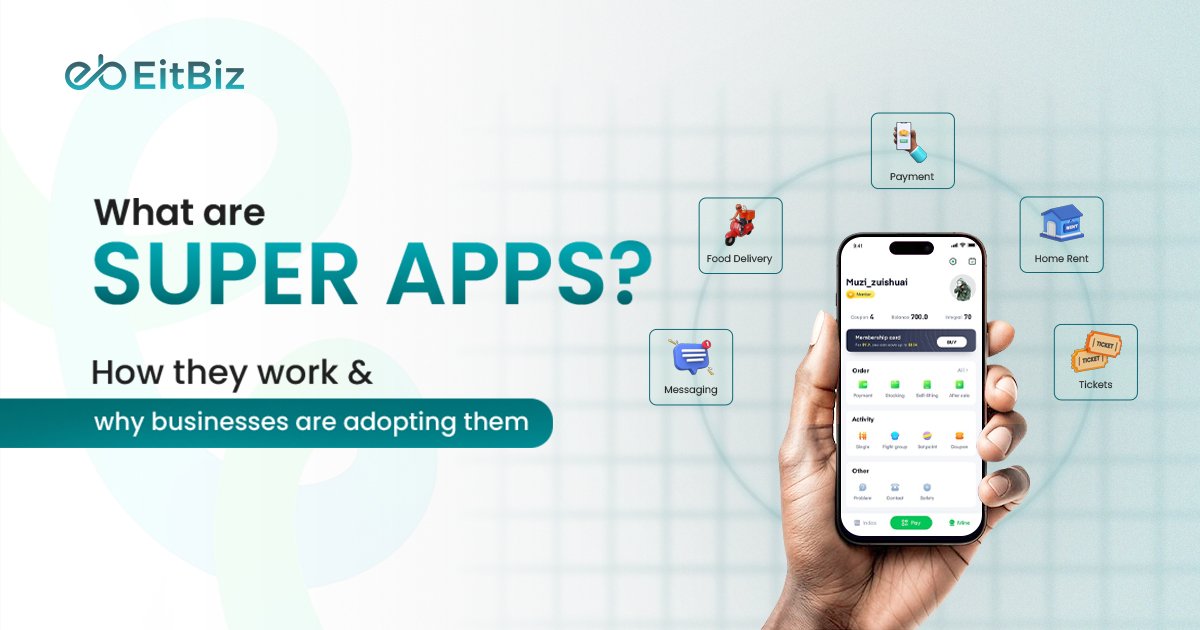
Did you know that 1 in 5 users spends over 4.5 hours per day on their mobile phones?
Now here’s the real question: What if one app could replace most of them?
Think about your daily phone usage. You message someone. You order food. You pay bills. You book a cab. You check your bank balance. Each task usually means switching between multiple apps, logging in repeatedly, and sharing your data across platforms you don’t fully control.
That friction is the problem.
Consumers want speed, convenience, and fewer apps. Businesses want retention, data ownership, and repeat engagement. Traditional single-purpose apps struggle to deliver both.
This is where super apps come in.
Instead of doing one thing well, super apps do many things seamlessly within a single ecosystem. They are not a trend anymore. They are a proven digital model reshaping how people interact with services and how companies scale.
If you’re considering building a super app, this article will give you clarity, not hype.
What Is a Super App?
Speaking to the super application meaning, a super app is a single mobile or web application that combines multiple services into one unified platform. Instead of users downloading separate apps for payments, shopping, messaging, booking, or finance, a super app offers all of these inside one interface.
At its core, a super app functions like:
- A platform (not just an app)
- A service marketplace
- A digital ecosystem
Most multi-service app development starts with a single strong core service (such as payments or messaging) and then expands horizontally by integrating additional services through mini-apps or built-in modules.
How Super Apps Work?
Super apps rely on a modular architecture. That means each service functions independently but shares a common infrastructure.
Here’s how it works step by step:
- Single User Identity
Users log in once. That identity works across all services, including payments, bookings, messaging, and more.
- Core Platform Layer
It includes authentication, payments, notifications, analytics, and security.
- Mini-Apps or Microservices
Each service (food delivery, wallet, ride-hailing) runs as a mini-app within the main app.
- APIs and Integrations
Third-party businesses can plug into the ecosystem without building a full app.
- Unified Data Flow
User behavior across services feeds into one analytics system, improving personalization.
The result?
A smooth experience for users and powerful operational efficiency for businesses.
What are the Key Super App Features Businesses Should Know?
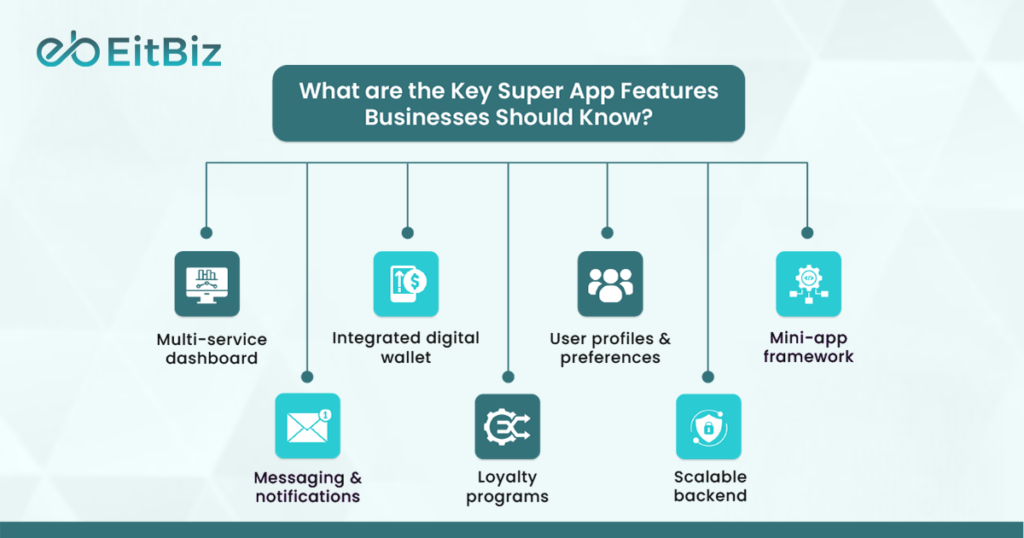
While every super app is different, successful ones share a common set of features:
- Multi-service dashboard: Easy navigation across services
- Integrated digital wallet: Payments, refunds, rewards
- User profiles & preferences: Personalization across services
- Mini-app framework: Add new services without app updates
- Messaging & notifications: Real-time communication
- Loyalty programs: Cross-service rewards
- Scalable backend: Handle millions of users securely
What are the Real-World Super App Examples?
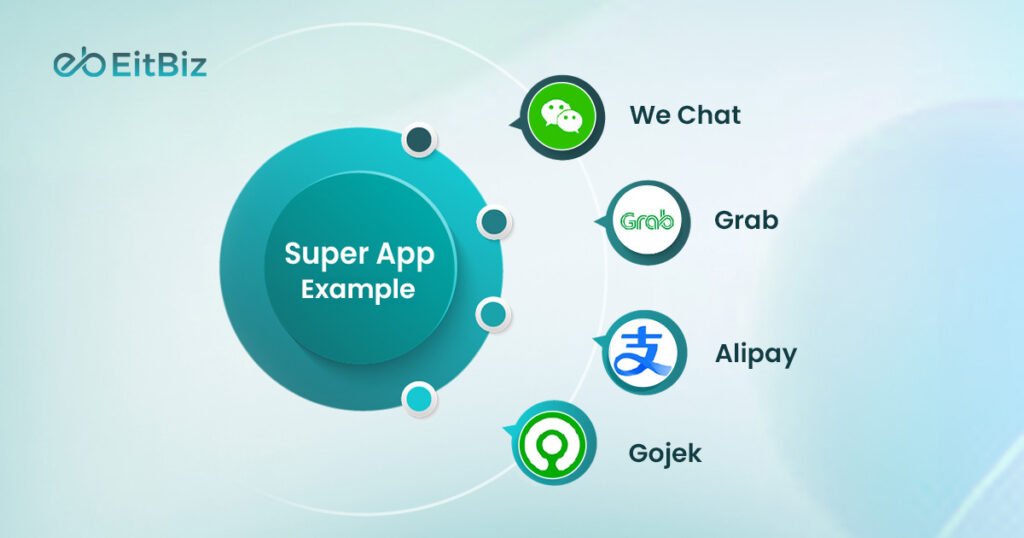
Understanding theory is useful. Seeing it in action is better. Here are well-known super apps and why they work:
- WeChat: Messaging, payments, shopping, government services
- Grab: Ride-hailing, food delivery, digital banking
- Gojek: Transportation, logistics, payments, entertainment
- Alipay: Payments, wealth management, utilities
Each started with one core use case and expanded based on user needs. That pattern matters.
What are the Super App Use Cases Across Industries?
Super apps are no longer limited to tech giants. Businesses across sectors are adopting them. Here are the common super app use cases:
- Retail & eCommerce
Shopping, payments, loyalty, delivery, and customer support in one app - Fintech & Banking
Wallets, lending, investments, insurance, and bill payments - Healthcare
Appointments, telemedicine, prescriptions, payments - Logistics & Mobility
Booking, tracking, payments, and customer communication - Enterprise Services
HR tools, internal payments, communication, and analytics
The model adapts well because it’s modular.
Why Businesses Are Adopting Super Apps?
Businesses adopt super apps for one reason: control.
Instead of relying on third-party platforms, they own:
- The user relationship
- The data
- The monetization channels
Other strategic drivers include:
- Reduced customer acquisition costs
- Higher user lifetime value
- Cross-selling opportunities
- Faster feature launches
A super app turns fragmented interactions into long-term engagement.
What are the Benefits of Super Apps (For Users and Businesses)
The growing adoption of super apps is driven by clear, measurable value on both sides of the ecosystem. When you understand the super application meaning in practice, it becomes obvious why this model works: it simplifies life for users while creating sustainable growth opportunities for businesses. Below is a breakdown of the core benefits of super apps, explained from both perspectives.
For Users
For users, super apps reduce friction at every touchpoint. Instead of managing multiple logins and interfaces, they interact with one platform that does more, faster and more efficiently.
- Fewer apps to download
A single super app replaces multiple standalone apps for payments, shopping, bookings, or services. This saves storage space and reduces digital clutter.
- Faster transactions
Integrated wallets and saved preferences allow users to complete actions in seconds. This is a direct result of how super apps work; shared authentication and unified payment layers eliminate repeated steps.
- Unified experience
Consistent design and navigation across services make interactions intuitive. Users don’t have to relearn workflows for every new feature, which improves satisfaction.
- Better personalization
Super apps use data across services to tailor recommendations, offers, and content. Well-designed super app features ensure personalization feels helpful, not intrusive.
For Businesses
From a business perspective, super apps unlock scale and efficiency that single-purpose apps struggle to achieve.
- Increased retention
Multiple services inside one platform increase usage frequency. This is why super apps for businesses consistently show higher lifetime value per user.
- Multiple revenue streams
Payments, subscriptions, commissions, ads, and third-party integrations create diversified income sources. These super app use cases reduce reliance on one revenue model.
- Centralized data insights
Businesses gain a holistic view of user behavior across services. This data is essential for smarter product decisions and targeted growth.
- Lower operational overhead
Shared infrastructure and unified support systems reduce maintenance costs. Strategic super app development focuses on efficiency as much as scale.
Super App Development: What It Actually Involves
Building a super app is not about stacking features. It’s about designing an ecosystem.
Key development considerations include:
- Scalable microservices architecture
- Strong API strategy
- Data privacy and compliance
- Performance optimization
- UX consistency across services
Poor planning leads to bloated apps. Strategic planning leads to platforms.
Choosing the Right Super App Development Company
Not every development team can build a super app. A capable super app development company should demonstrate:
- Experience with large-scale platforms
- Expertise in fintech-grade security
- Modular architecture knowledge
- Long-term product thinking
Super apps are not one-time projects. They evolve continuously.
What’s Included in Building a Super App?
Building a super app is not about launching everything at once. It’s about making smart, sequential decisions that reduce risk and increase long-term adoption. Below is a practical, experience-backed roadmap businesses follow when they build super apps that actually scale.
1. Start with One Core Service
Every successful super app begins with a single, high-frequency use case. This is the service users need regularly, not occasionally.
Examples include:
- Payments
- Messaging
- Ride booking
- Food delivery
This core service acts as the entry point to your ecosystem. If it doesn’t deliver clear value on its own, users won’t stay long enough to explore additional features. Focus on reliability, speed, and simplicity here before thinking about expansion.
2. Validate User Demand
Before adding more services, confirm that users actually want them.
Validation can be done through:
- In-app surveys
- Feature waitlists
- Usage pattern analysis
- A/B testing limited releases
This step prevents feature overload. Many apps fail because they assume demand instead of proving it. A super app grows based on real user behavior, not internal assumptions.
3. Build Scalable Infrastructure Early
Scalability is not a “later” problem in building a super app. It’s a day-one requirement.
Your infrastructure should support:
- Microservices or modular architecture
- High concurrent user loads
- Secure payment processing
- Real-time data syncing
If your backend can’t scale, every new service becomes a liability. Investing early in cloud-native, API-driven architecture saves time and cost in the long run.
4. Add Complementary Services Gradually
Once your core service is stable, expand horizontally with services that naturally fit user workflows.
For example:
- Payments- bill payments- lending
- Ride booking- food delivery- grocery
- eCommerce – logistics- returns management
Each addition should reduce friction, not add complexity. Gradual expansion keeps the app intuitive and avoids overwhelming users.
5. Enable Third-Party Integrations
A true super app is a platform, not just a product.
By enabling third-party mini-apps or integrations, you allow external businesses to:
- Offer services inside your app
- Reach your user base
- Share revenue
This accelerates growth without increasing internal development load. Clear APIs, documentation, and governance rules are critical at this stage.
6. Optimize Based on Real Usage Data
Data is the feedback loop that shapes the future of your super app.
Track metrics such as:
- Feature adoption rates
- Drop-off points
- Cross-service usage
- Transaction frequency
Use these insights to refine UI, remove unused features, and prioritize high-impact improvements. Continuous optimization is what separates scalable super apps from bloated ones.
Are Super Apps the Future?
Yes, but only when done right. Super apps are not replacing traditional apps because they are “bigger.” They’re winning because they remove friction. Users no longer want to juggle multiple apps, repeat logins, or manage scattered data. When a super app delivers real utility, fast payments, seamless services, and consistent experiences, it earns daily relevance. Without that practical value, even the most feature-rich super app fails to retain users.
For businesses, early adoption creates a structural advantage that is difficult to copy later. Super apps centralize user data, increase engagement frequency, and open multiple revenue channels within a single ecosystem. More importantly, they build long-term trust by managing the full user journey rather than relying on third-party platforms. The future belongs to super apps that prioritize usefulness, security, and simplicity, not scale for the sake of scale.
Final Thoughts
Super apps are not a passing digital trend; they represent a fundamental shift in how users interact with services and how companies scale digital ecosystems. By clearly understanding the meaning of super apps and how they work, businesses can move beyond single-purpose apps and build platforms that drive long-term engagement. When designed with the right super app features, thoughtful use cases, and a phased approach to building a super app, these platforms reduce friction, improve retention, and unlock new revenue streams.
That said, success depends on execution. The real benefits of super apps, data ownership, user loyalty, and ecosystem growth, only materialize with strong planning and scalable technology. Effective super app development requires experience in platform architecture, security, and continuous optimization. EitBiz is a dedicated super app development company that helps businesses plan, build, and scale future-ready super apps by combining technical expertise with practical product strategy, turning ambitious ideas into reliable, high-performing super app platforms.
Ready to build a future-proof super app? Connect with EitBiz and turn your vision into a scalable digital ecosystem.