Key Takeaways
- AI-driven nutrition apps are reshaping healthy eating by replacing manual tracking with automation, real-time insights, and intelligent recommendations.
- Technologies like computer vision, food recognition, and machine learning in nutrition make it possible to scan meals, estimate calories, and personalize diets with higher accuracy.
- Modern users prefer smart solutions such as AI nutrition coach systems and calorie tracker apps that adapt to their goals instead of offering static diet plans.
- Features like an AI food scanning app, real-time nutrition analysis, and meal planning app tools significantly improve consistency and long-term health habits.
- The future of FoodTech is centered on personalized, AI-powered health apps that simplify decision-making and make healthy eating effortless.
Healthy eating is no longer just about counting calories manually or following generic diet charts. Modern users want precision, automation, and personalization in one place in their nutrition tracking app. Research from digital health studies suggests users can be up to 70% more likely to stick to nutrition goals when using AI-based tracking tools, highlighting the rapid shift toward smarter systems like Goodish AI.
This transformation is being driven by next-generation FoodTech app development company innovations that combine intelligence, automation, and real-time insights. Instead of traditional manual logging, users now rely on advanced tools like a calorie tracker app, and a smart nutrition tracking app to simplify everyday management.
With growing demand for smarter wellness tools, features such as an AI food scanning app, an image recognition food app, and computer vision food recognition are becoming standard expectations. These technologies allow users to simply capture their meals and instantly receive accurate calorie and macro breakdowns.
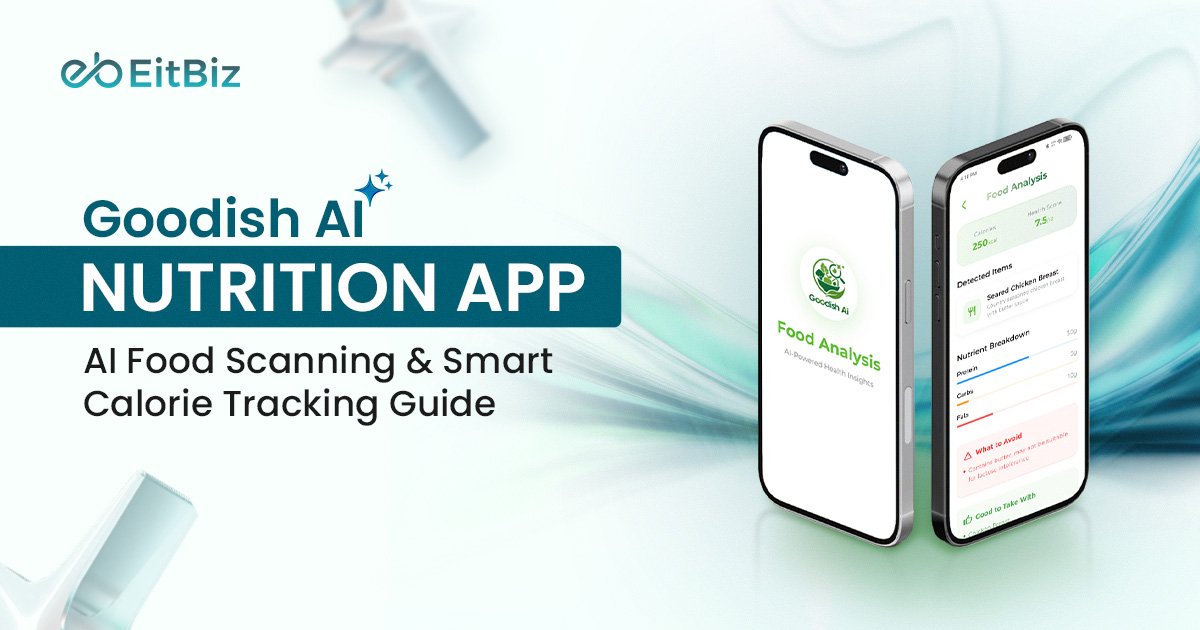
Goodish AI fits directly into this evolution by leveraging machine learning in nutrition, real-time nutrition analysis, AI and ML in app development, and AI nutrition coach systems to make healthy eating more intuitive, automated, and personalized. Instead of asking users to manually track everything, it acts as an intelligent AI diet assistant that understands behavior, goals, and dietary preferences.
As a result, users no longer search only for apps; they look for the best food tracking app or a mobile app development related to nutrition that can actually guide them, not just log data. This shift marks a major turning point in the future of AI-powered health apps and modern nutrition analysis app ecosystems.
How AI Food Scanning Apps Work?
Modern nutrition tracking is shifting away from manual logging toward intelligent automation, and this is where AI food scanning apps are changing the entire experience. Instead of searching for food items in databases or estimating portion sizes,users open their nutrition tracking app and simply take a picture and receive instant nutritional insights. This makes daily tracking faster, more accurate, and far more practical for real-world use.
At the core of this system is a combination of artificial intelligence, deep learning, and image-based analysis that turns food photography into structured nutrition data.
Understanding Food Scanning Technology
Food scanning technology works by analyzing images of meals to identify ingredients, cooking methods, and portion sizes. When a user captures a photo, the system breaks the image into visual components and compares them with a trained food dataset.
This process allows the app to recognize everything from simple items like fruits and salads to complex multi-ingredient dishes like biryani, pasta, or burgers. Unlike traditional calorie tracker app systems that depend on manual input, food scanning removes friction entirely.
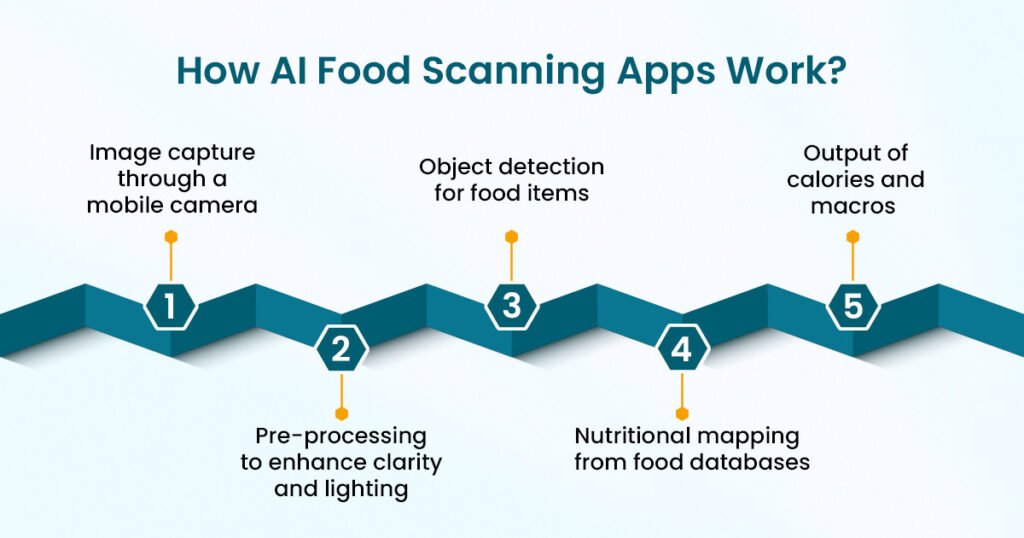
The technology typically follows these steps:
- Image capture through a mobile camera
- Pre-processing to enhance clarity and lighting
- Object detection for food items
- Nutritional mapping from food databases
- Output of calories and macros
This automation is what makes modern AI-powered meal tracker systems significantly more efficient and sets a new standard for any nutrition tracking app in 2026.
The Role of Computer Vision Food Recognition
The intelligence behind this system comes from computer vision food recognition, which enables machines to interpret visual information the way humans do.
Using deep learning models, the system is trained on thousands or even millions of food images. Over time, it learns to identify:
- Food categories
- Ingredients and components
- Cooking styles
- Portion sizes based on plate context
For example, it can differentiate between grilled chicken and fried chicken, or estimate whether a bowl of rice is a small or large serving. This is especially useful for users who rely on a food calorie calculator but struggle with accuracy in manual estimation.
The strength of computer vision lies in its ability to continuously improve. As more users scan food, the system becomes smarter through machine learning in nutrition, refining its predictions and reducing errors over time.
This creates a feedback loop where every scan improves future accuracy, making it one of the most powerful innovations in modern health app development.
How an App That Scans Food and Counts Calories Simplifies Tracking?
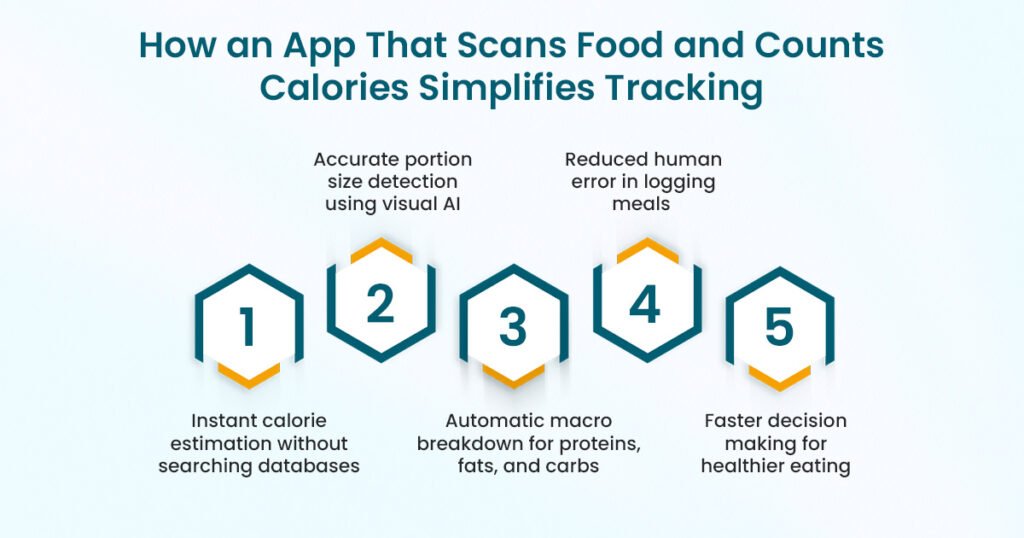
An app that scans food and counts calories completely removes the burden of manual tracking, which is one of the biggest reasons users abandon traditional diet apps. Instead of logging each ingredient individually, users simply point their camera at a meal and get instant results.
This simplicity transforms the experience of tracking calories easily, especially for busy users who want quick insights without complexity.
Key benefits include:
- Instant calorie estimation without searching databases
- Accurate portion size detection using visual AI
- Automatic macro breakdown for proteins, fats, and carbs
- Reduced human error in logging meals
- Faster decision making for healthier eating
When combined with an AI nutrition coach, the experience becomes even more powerful. The app not only tells users what they ate but also explains how it fits into their daily goals and what adjustments they can make.
This is where platforms like Goodish AI stand out, as they combine scanning, tracking, and personalized guidance into a single ecosystem.
By removing friction and guesswork, these systems turn nutrition into a seamless, real-time experience that fits naturally into everyday life.
Smart Calorie Tracking and Nutrition Analysis
Smart calorie tracking inside a modern nutrition tracking app has evolved far beyond simple number logging. Today, AI-driven platforms like Goodish AI combine automation, intelligence, and personalization to deliver deeper insights into daily eating habits. Instead of manually entering every meal, users now rely on AI-powered meal tracker systems that automatically interpret food intake and translate it into meaningful nutrition data.
This shift toward smart calorie tracking is not just about convenience; it is about accuracy and behavior change. By combining food calorie calculator tools with real-time intelligence, modern apps help users understand what they eat, why it matters, and how it impacts long-term health goals.
How a Calorie Counter and Food Calorie Calculator Improve Health Goals
A traditional calorie counter requires users to manually search foods, estimate portions, and input data repeatedly. In contrast, modern systems powered by AI simplify this process significantly.
A food calorie calculator integrated into apps like Goodish AI helps users:
- Track daily calorie intake with higher accuracy
- Understand macronutrient balance (protein, fats, carbs)
- Adjust meals based on fitness or weight goals
- Maintain consistency without manual effort
This makes it easier for users to stay aligned with their health objectives, which is the core purpose of any reliable nutrition tracking app.
By combining automation with intelligence, these tools remove friction from daily tracking and make healthy eating more sustainable.
Why Users Search for ” How Many Calories Should I Eat“
One of the most common nutrition-related queries globally is how many calories I should eat. This question reflects a growing awareness around personalized health, but also confusion about static diet charts that do not account for individual differences.
Calorie needs vary based on:
- Age and gender
- Body composition
- Activity level
- Fitness goals
- Metabolic rate
This is why generic advice often fails. Users now prefer AI-powered health apps that can calculate personalized calorie targets instead of relying on one-size-fits-all recommendations.
Goodish AI addresses this gap by acting as an AI nutrition coach, analyzing user behavior and continuously adjusting calorie recommendations based on real progress.
Benefits of Real-Time Nutrition Analysis
The biggest advancement in modern nutrition technology is real-time nutrition analysis. Instead of waiting until the end of the day to review meals, users now receive instant feedback on every food choice.
This approach offers several key benefits:
- Immediate awareness of calorie and nutrient intake
- Faster correction of unhealthy eating patterns
- Better decision-making during meals
- Improved long term dietary consistency
- Reduced guesswork in portion control
When combined with computer vision, food recognition, and AI food scanning app features, real-time analysis becomes even more powerful. Users can simply scan a meal and instantly understand its nutritional impact.
This is where platforms like Goodish AI stand out, turning a traditional nutrition analysis app into an intelligent system that actively guides users throughout the day rather than passively recording data.The result is a smarter, more responsive approach to health management that aligns perfectly with modern expectations of an AI app for tracking nutrition and personalized wellness technology.
AI Nutrition Coach and Personalized Wellness
The modern approach to nutrition is no longer static or generic. An AI nutrition coach acts like a real-time digital advisor that understands user behavior, goals, and eating patterns. Instead of simply logging meals, it provides actionable guidance that adapts continuously.
With Goodish AI, personalization goes beyond basic recommendations. The system analyzes dietary habits, fitness objectives, and lifestyle constraints to deliver tailored suggestions that feel realistic and achievable. This is where personalized wellness becomes practical rather than theoretical.
Unlike traditional apps, an AI-driven AI diet assistant can:
- Recommend meals based on daily calorie balance
- Suggest healthier substitutions instantly
- Adjust goals based on progress trends
- Provide behavioral insights to improve consistency
This creates a continuous feedback loop where users are guided rather than left to interpret raw data something only a smart nutrition tracking app can deliver consistently. As a result, nutrition becomes more intuitive, sustainable, and aligned with long-term health outcomes.
AI-Powered Meal Tracking and Meal Planning
The evolution of AI-powered meal tracker systems has transformed how users interact with food data. Instead of manual entry, modern systems use automation to identify meals, estimate portions, and calculate nutrition instantly.
Combined with meal planning app functionality, users can now manage both tracking and planning in one ecosystem making it a complete nutrition tracking app experience. This dual capability helps bridge the gap between what users eat and what they should eat.
Key advantages include:
- Automated meal recognition through an AI food scanning app technology
- Smart suggestions based on dietary goals
- Weekly planning aligned with calorie and macro targets
- Reduced dependency on manual food logging
This integration creates a seamless experience where tracking and planning work together to reinforce healthy habits. Users not only record their meals but also improve future choices through intelligent recommendations all within a single nutrition tracking app platform.
Building the Best Food Tracking App in 2026
The competition to create the best food tracking app in 2026 is driven by rising demand for automation, accuracy, and personalization. Users now expect apps that do more than just track calories; they expect intelligent health companions.
To stand out in this evolving market, a successful platform must combine:
- AI automation
- Real-time insights
- Behavioral intelligence
- Seamless user experience
This is why the best nutrition apps are increasingly built around AI-driven ecosystems rather than static databases.
Goodish AI reflects this shift by integrating AI-powered health app capabilities with intuitive design and smart analytics, creating a complete digital nutrition solution.
Essential Features for the Best Nutrition Apps
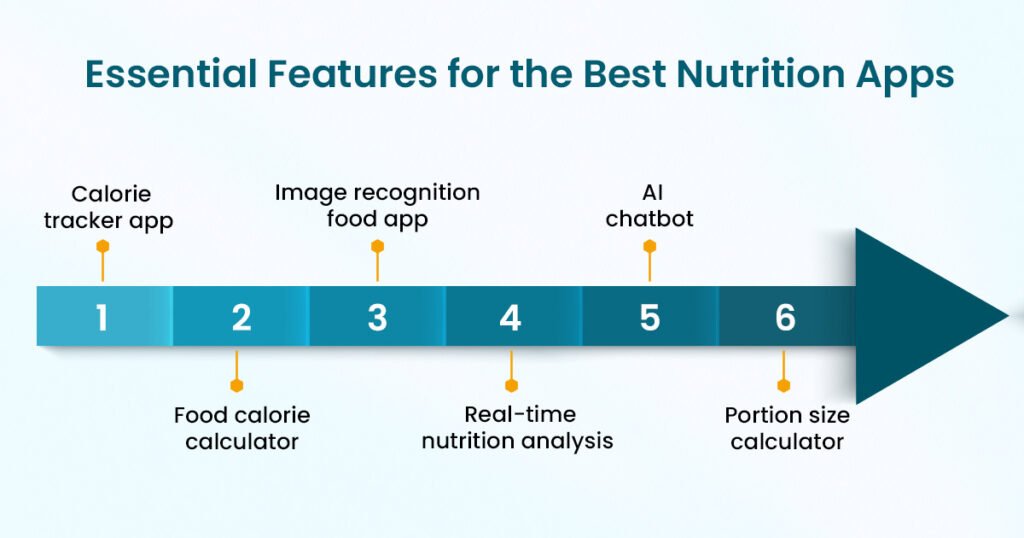
To compete in today’s market, the best nutrition apps must include a combination of intelligence, usability, and personalization. Core features include:
- Calorie tracker app with automated logging
- Food calorie calculator for accurate macro breakdown
- Image recognition food app for instant meal detection
- Real-time nutrition analysis for instant feedback
- AI chatbot for nutrition for conversational guidance
- Portion size calculator for improved accuracy
These features ensure that users do not just track food but understand it in context. The goal is to reduce friction while increasing engagement and long-term adherence.
How Machine Learning in Nutrition Improves Personalization
At the heart of modern nutrition technology is machine learning in nutrition, which allows systems to continuously improve based on user behavior.
Instead of relying on fixed rules, machine learning models analyze:
- Eating habits
- Frequency of meals
- Nutritional preferences
- Progress toward health goals
Over time, this enables highly personalized recommendations that evolve with the user.
For example, if a user consistently exceeds calorie targets in the evening, the system can adjust meal suggestions earlier in the day. This adaptive intelligence is what makes nutrition analysis app platforms far more effective than traditional tools.
Machine learning also enhances computer vision food recognition, improving accuracy in identifying complex meals and portion sizes.
Why Businesses Are Investing in an AI App for Tracking Nutrition?
The demand for a custom AI app development for tracking nutrition solutions is growing rapidly as both consumers and businesses recognize the value of intelligent health systems.
Companies are investing heavily in this space because:
- The global wellness market is expanding
- Users prefer automated health solutions
- AI improves retention and engagement rates
- Personalized nutrition drives long-term subscription models
From a business perspective, building an AI-powered platform is not just about health innovation; it is also about scalable digital transformation.
Startups and enterprises are partnering with a foodtech app development company to build advanced solutions that include AI coaching, food scanning, and predictive analytics.
As the industry evolves, the best FoodTech apps 2026 will be defined by their ability to combine intelligence, automation, and personalization into a single seamless experience.
How to Build a Nutrition Tracking App?
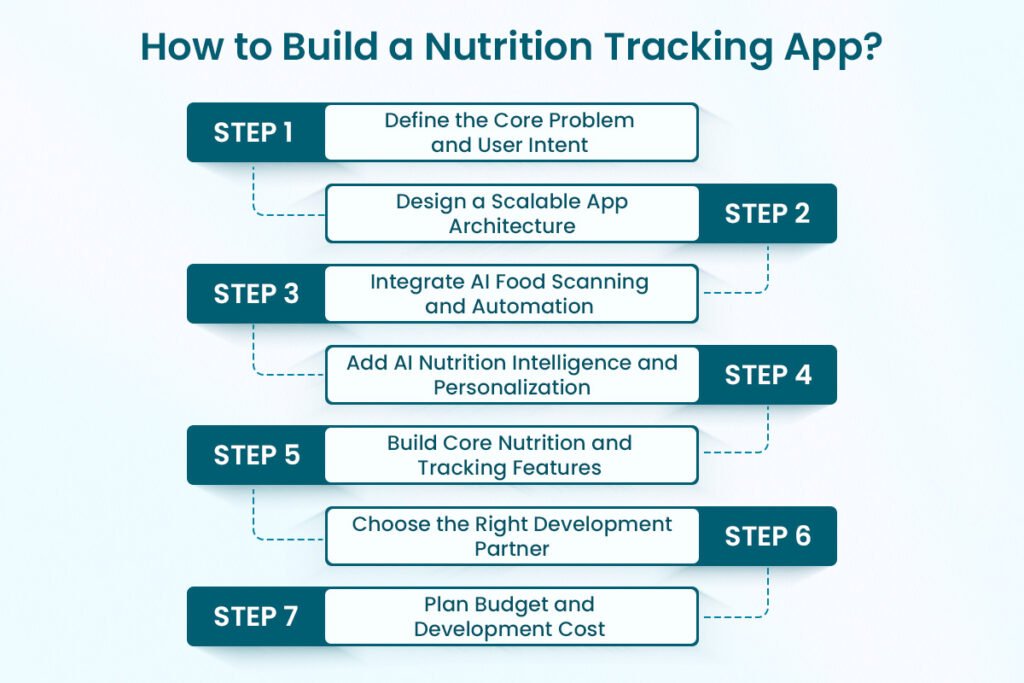
Building a modern nutrition tracking app platform starts with a clear understanding of user problems and evolves into a full AI-driven ecosystem. A successful product today is not just a calorie tracker app, but a complete AI app for tracking nutrition that simplifies how users manage food, health, and lifestyle goals.
Step 1: Define the Core Problem and User Intent
The first step is identifying what your app is actually solving. Most users struggle with inconsistent tracking, manual food logging, and confusion around how many calories should I eat.
Your goal is to remove this friction by designing a system that answers real user needs, such as how to track calories easily while providing clarity through automation. A strong nutrition analysis app begins with understanding these daily pain points and designing solutions around them.
Step 2: Design a Scalable App Architecture
Once the problem is defined, the next step is building a scalable technical foundation. A modern nutrition platform requires multiple interconnected layers, including a data layer for food databases, an AI layer for personalization, a vision layer for computer vision food recognition, and a user experience layer for interaction.
This structure ensures the app can handle everything from basic calorie tracking to advanced real-time nutrition analysis without performance issues.
Step 3: Integrate AI Food Scanning and Automation
After setting up the architecture, the most impactful feature to implement is AI food scanning app functionality. This allows users to simply take a picture of their meal and instantly receive nutritional insights.
Using image recognition food app technology and food scanning technology, the system identifies food items, estimates portion sizes, and calculates calories automatically. This step is crucial for creating an app that scans food and counts calories, removing the need for manual entry.
Step 4: Add AI Nutrition Intelligence and Personalization
The next step is turning your app into an intelligent system by adding an AI nutrition coach. Using machine learning in nutrition, the app analyzes user behavior, eating patterns, and progress over time to deliver personalized recommendations. This transforms the platform into a smart AI diet assistant that adapts continuously, helping users improve their diet decisions instead of just tracking them.
Step 5: Build Core Nutrition and Tracking Features
At this stage, you need to integrate essential tools that support daily usage. This includes a food calorie calculator for macro breakdowns, a portion size calculator for better accuracy, a real-time nutrition analysis system for instant feedback, and an AI chatbot for nutrition for conversational guidance. Adding a meal planning app feature also helps users stay consistent with long-term health goals by organizing their weekly diet effectively.
Step 6: Choose the Right Development Partner
Selecting the right foodtech app development company is critical for execution. You need a team experienced in building AI-powered health apps, working with large datasets, and integrating machine learning models. The development partner should also understand UX design, scalability, and real-time data processing to ensure the final product performs smoothly under real-world usage.
Step 7: Plan Budget and Development Cost
Finally, you must evaluate the nutrition app development cost based on required features and complexity. Advanced systems with AI food scanning, real-time analytics, and personalized coaching typically require higher investment. Costs can range from $5K to $50K+, depending on whether the app includes advanced features like computer vision food recognition, AI coaching, and predictive nutrition systems. Proper planning ensures the project stays scalable and commercially viable.
How to Choose the Right FoodTech App Development Company?
Selecting the right foodtech app development company is one of the most critical decisions in building a successful nutrition platform. Since modern apps are no longer simple tracking tools but advanced AI-powered health apps, the development partner you choose directly impacts product quality, scalability, and long-term success.
A strong development company should not only build apps but also understand how to integrate AI apps for tracking nutrition, computer vision food recognition, and real-time analytics into a seamless user experience.
Step 1: Evaluate Experience in AI and FoodTech Solutions
The first step is to assess whether the company has real experience in building AI-driven products. Developing a nutrition analysis app requires expertise in machine learning, data modeling, and mobile engineering. Companies that have previously worked on AI food scanning app or image recognition food app projects are better equipped to handle complex requirements like food detection, calorie estimation, and personalization.
Look for a portfolio that includes smart systems such as an AI nutrition coach, a calorie tracker app, or an AI-powered meal tracker solution.
Step 2: Check Technical Expertise in Core Technologies
A reliable development partner must have a strong command of key technologies such as machine learning in nutrition, cloud infrastructure, and mobile AI frameworks. These technologies power features like real-time nutrition analysis, automated calorie tracking, and predictive health recommendations.
They should also be skilled in integrating food scanning technology, API-based nutrition databases, and scalable backend systems that support large user bases without performance issues.
Step 3: Assess UI/UX Design Capabilities
Even the most advanced AI system will fail if the UI/UX design is complex or confusing. A good best food tracking app must feel simple, intuitive, and fast.
The development company should prioritize:
- Clean and minimal UI design
- Easy onboarding for first-time users
- Seamless meal logging experience
- Interactive dashboards for nutrition insights
A strong UX ensures users continue using the app instead of abandoning it after a few days.
Step 4: Understand Scalability and Performance Strategy
As your user base grows, your app must handle increasing data loads from food scans, AI predictions, and real-time tracking. A professional healthcare mobile app development company should design systems that scale effortlessly using cloud platforms like AWS or Google Cloud.
This is especially important for apps offering AI diet assistant features, where real-time responses are expected without delay. Performance directly affects user trust and retention.
Step 5: Verify AI and Personalization Capabilities
Modern users expect personalization, not generic recommendations. Your development partner should be capable of building an intelligent AI nutrition coach that learns from user behavior and adapts over time.
This includes:
- Personalized calorie goals
- Adaptive meal suggestions
- Behavioral pattern analysis
- Smart dietary recommendations
Without strong AI capabilities, even the best idea will fail to compete with leading nutrition apps in the market.
Step 6: Evaluate Post-Launch Support and Maintenance
Building the app is only the beginning. A reliable partner will also provide ongoing updates, model training, and performance optimization. Since machine learning in nutrition systems evolves continuously, regular improvements are necessary to maintain accuracy in food recognition and calorie estimation.
Ongoing support ensures your app stays competitive among the best FoodTech apps of 2026 and continues delivering value to users.
Key Technologies Behind Image Recognition Food App Platforms
Modern image recognition food apps rely on a powerful mix of AI and data technologies that work together to identify meals, estimate calories, and deliver real-time nutrition insights with high accuracy.
| Category | Technologies | Examples / Tools |
|---|---|---|
| Computer Vision | Image analysis, visual feature extraction, object detection | OpenCV, YOLO (You Only Look Once), Faster R-CNN |
| Deep Learning Models | Neural networks for image classification | Convolutional Neural Networks (CNNs), ResNet, EfficientNet |
| Machine Learning | Pattern recognition and predictive modeling | TensorFlow, PyTorch, Scikit-learn |
| Food Dataset Systems | Structured food image and nutrition databases | Food-101 dataset, USDA FoodData Central |
| Object Detection | Multi-food identification in a single image | YOLOv5, Detectron2 |
| Image Processing | Preprocessing and enhancement of food images | OpenCV, PIL (Python Imaging Library) |
| Cloud Computing | Scalable backend processing for AI models | AWS, Google Cloud Platform, Microsoft Azure |
| API Integration | Nutrition data retrieval and system connectivity | Spoonacular API, Edamam API |
| Mobile AI Frameworks | On-device AI processing for mobile apps | TensorFlow Lite, Core ML |
| Edge AI Processing | Real-time local inference on devices | Apple Neural Engine, Qualcomm AI Engine |
What is the Cost of Nutrition App Development?
Building a modern AI app for tracking nutrition depends heavily on the features, complexity, and level of intelligence you want to include, especially when integrating AI, automation, and real-time tracking systems.
| App Type / Complexity Level | Key Features Included | Estimated Cost (USD) |
|---|---|---|
| Basic Nutrition Tracker App | Calorie counter, manual food logging, basic food database, simple UI | $5,000 – $10,000 |
| Mid-Level Calorie Tracking App | Food calorie calculator, barcode scanning, meal planning app, user profiles, basic analytics | $10,000 – $20,000 |
| AI Enhanced Nutrition App | AI food scanning app, image recognition food app, portion size calculator, real-time nutrition analysis | $20,000 – $30,000 |
| Advanced AI Nutrition Platform | AI nutrition coach, AI chatbot for nutrition, machine learning in nutrition, personalized diet plans | $30,000 – $40,000 |
| Full Scale FoodTech App (High-End) | AI-powered meal tracker, computer vision food recognition, predictive analytics, cloud scalability, wearable integration | $40,000 – $50,000 |
Why Goodish AI Represents the Future of Healthy Eating?
The future of nutrition is moving toward systems that are intelligent, adaptive, and fully automated, and Goodish AI sits directly at the center of this transformation. Instead of treating food tracking as a manual task, it redefines it as a seamless digital experience powered by AI-powered health apps, real-time insights, and personalized guidance.
At its core, Goodish AI is not just a calorie tracker app; it is a complete ecosystem that combines AI food scanning app technology, computer vision food recognition, and real-time nutrition analysis to simplify everyday eating decisions.
AI-Driven Automation Replaces Manual Tracking
Traditional nutrition apps rely heavily on manual input, which leads to inconsistency and user fatigue. Goodish AI eliminates this problem by introducing automation at every step. With features like an app that scans food and counts calories, users no longer need to search or log meals manually.
This shift makes healthy eating more accessible because it removes the biggest barrier, effort. The integration of food scanning technology and image recognition food app capabilities ensures that tracking becomes instant and effortless.
Personalized Intelligence Through AI Nutrition Coach
One of the key reasons Goodish AI represents the future is its ability to act as an AI nutrition coach. Instead of providing generic diet plans, it analyzes user behavior, goals, and progress to deliver personalized recommendations.
This includes:
- Adaptive calorie targets
- Smart meal suggestions
- Behavioral insights
- Goal based adjustments
By functioning as an AI diet assistant, the platform ensures that every user receives guidance tailored specifically to their lifestyle.
Real Time Nutrition for Smarter Decisions
Goodish AI also transforms how users interact with food through real-time nutrition analysis. Instead of waiting until the end of the day, users get instant feedback on every meal.
This allows them to:
- Make better food choices instantly
- Avoid overeating or nutrient imbalance
- Stay aligned with daily goals
- Understand the portion impact in real time
This level of responsiveness is what makes modern nutrition analysis app systems significantly more effective than traditional tools.
Machine Learning That Improves Over Time
Another major advantage is the use of machine learning in nutrition, which allows the system to continuously improve. As users interact with the app, it learns eating patterns, preferences, and habits, leading to more accurate and personalized suggestions.
Over time, Goodish AI becomes smarter, not static. This evolution is what positions it among the best nutrition apps in the market.
The Shift Toward Intelligent FoodTech Ecosystems
The FoodTech industry is rapidly evolving, and users are increasingly searching for the best food tracking app that offers more than just logging features. They want intelligence, automation, and coaching in one platform.
Goodish AI aligns perfectly with this demand by combining:
- AI-powered meal tracker functionality
- AI chatbot for nutrition support
- Meal planning app integration
- Predictive health insights
This creates a complete ecosystem rather than a fragmented tool.
How EitBiz Powers Next-Gen AI Health and Nutrition Apps?
Building a powerful AI app for tracking nutrition like Goodish AI requires the right mix of strategy, design, and advanced engineering. This is where EitBiz helps businesses turn FoodTech ideas into fully scalable digital products.
As an experienced foodtech app development company, EitBiz specializes in creating intelligent AI-powered health apps that combine innovation with real-world usability. From AI food scanning app development to computer vision food recognition systems, the focus is on building solutions that are accurate, fast, and user-friendly.
EitBiz can help you:
- Design and develop a complete nutrition analysis app with AI capabilities
- Integrate calorie tracker app features with real-time data insights
- Build advanced AI nutrition coach and AI diet assistant systems
- Implement machine learning in nutrition for personalization
- Create scalable architecture for the best nutrition apps and FoodTech platforms
With expertise in food scanning technology, mobile development, and cloud-based systems, EitBiz ensures your product is ready for modern market demands and future growth.Whether you are building the best food tracking app or planning the next generation of best FoodTech apps 2026, EitBiz helps transform your vision into a high-performance digital solution that users actually love to use.