Key Takeaways
- Autonomous AI agents help redesign business operations by shifting from manual workflows to intelligent, self-executing systems.
- Successful transformation depends on tight integration with enterprise systems like ERP, CRM, and data platforms.
- Multi-agent architectures improve scalability by distributing tasks across specialized AI components.
- Governance, security, and human-in-the-loop controls are essential for safe enterprise deployment.
- Organizations achieve the most value when AI is embedded directly into core processes rather than used as standalone tools.
Are you still relying on static chatbots that wait for a human prompt to start working?
If so, you are trailing behind a massive corporate shift toward true operational autonomy.
Today, enterprise leaders are moving away from passive assistants and aggressively embracing agentic AI for the enterprise. Market research indicates a profound shift: a striking Gartner study projects that 40% of enterprise software applications will feature task-specific AI agents by the end of 2026, a massive leap from less than 5% just a year prior.
This rapidly expanding footprint explains why an overwhelming 88% of senior executives plan to increase their upcoming budgets specifically to fund autonomous AI agents for business, according to data from PwC.
Are your current systems genuinely moving the needle, or are they just generating expensive text?
While basic generative tools provide minor individual efficiency spikes, a comprehensive survey by Writer reveals that only 29% of organizations achieve significant, scaled business ROI from standard generative setups. This massive gap highlights a critical reality: simply adding AI to a broken process fixes nothing.
To achieve true enterprise operations automation, you must structurally redesign how your business executes workflows.
How do you transition your business from basic experimentation to a self-optimizing digital workforce?
Let’s break down the exact strategies, infrastructure requirements, and deployment frameworks you need to orchestrate a highly successful, high-yield enterprise AI transformation.
What Is Driving the Massive Shift Toward Agentic AI for Enterprise?
Corporate leaders are rapidly abandoning passive, instruction-based tools. The massive migration toward agentic AI for enterprise stems from a clear realization: basic large language models create minor personal productivity spikes, but they do not solve systemic operational friction.
Four primary market forces accelerate this structural transition:
- The Evolution from Text to Task: First-generation generative tools only summarize, draft, or analyze text. In sharp contrast, autonomous AI agents for business possess goal-directed reasoning capabilities. They independently formulate action plans, execute multi-step workflows, and coordinate tasks across isolated software applications without waiting for a human prompt at every single turn.
- Matured Infrastructure and Cost-Efficient Compute: The entry barrier for advanced AI deployment has dropped drastically. The emergence of robust memory architectures, cheap inference models, and open communication protocols makes running autonomous systems highly practical for large-scale operations.
Real-Life Case Studies: Autonomy in Action
To understand the scope of this transformation, look at how global industry leaders deploy autonomous agents to solve complex, high-volume operational bottlenecks:
- JPMorgan Chase (Financial Compliance & Fraud): The banking giant utilizes autonomous systems to monitor transactions 24/7. Their specialized compliance agents independently track data anomalies and run automated anti-money laundering (AML) screenings. This agentic rollout successfully drove a staggering 95% reduction in AML false positives and accelerated fraud detection speeds by 300x, saving the firm an estimated $1.5 billion. (Source: Planetary Labour).
- Mercedes-Benz & Volkswagen (Automotive Systems & E-Commerce): Moving far beyond basic voice commands, Mercedes-Benz integrates advanced Gemini models via Vertex AI to power its MBUX Virtual Assistant. These agents execute multi-layered tasks, handling personalized navigation, contextual driver queries, and managing backend e-commerce transactions directly through the vehicle’s online storefront. Similarly, Volkswagen of America uses multimodal agents inside the myVW app, allowing users to upload photos of their digital dashboard or physical engine components so the agent can autonomously diagnose issues and pull up relevant owner’s manual steps. (Source: Planetary Labour).
Which Business Units Benefit Most From Comprehensive Enterprise Operations Automation?
For the past decade, Robotic Process Automation (RPA) served as the primary blueprint for corporate efficiency. However, enterprises frequently hit a hard scaling ceiling. Brittle legacy bots break the moment an external vendor alters a user interface, updates a database schema, or shifts a pixel on a web portal.
This operational fragility highlights the core difference between legacy scripts and modern AI agents and automation ecosystems: traditional bots excel at manual execution, while autonomous agents excel at strategic thinking.
The structural evolution from deterministic scripts to goal-oriented reasoning platforms radically shifts how businesses handle data, exceptions, and decision-making across five core dimensions:
- Data Processing (Structured vs. Unstructured): Traditional RPA requires highly structured inputs like standardized spreadsheets. In contrast, modern autonomous AI agents for business natively process unstructured data, seamlessly extracting context from chaotic inputs like PDFs, email threads, and legal contracts.
- Problem Solving (Deterministic vs. Probabilistic): Legacy automation follows hard-coded “if-then” pathways; any deviation halts the workflow. Conversely, agentic systems utilize probabilistic reasoning layers to evaluate unexpected scenarios, calculate the optimal next step, and resolve minor discrepancies independently.
- Operational Scope (Tasks vs. Goals): Traditional automation is restricted to single, isolated tasks. When you shift to agentic AI for enterprise, you automate high-level outcomes. You give an agent a broad operational goal, such as “reconcile outstanding vendor discrepancies”and the agent independently outlines and orchestrates the end-to-end sub-tasks.
- System Integration (UI Fragility vs. API Tool Use): Because RPA frequently interacts with software directly at the User Interface (UI) layer, it remains highly vulnerable to cosmetic application updates. Modern agents bypass this instability by communicating through robust API frameworks and secure database calls.
- The Maintenance Loop (Static Scripts vs. Continuous Learning): When a business process alters, human developers must manually rewrite legacy RPA code. Autonomous agents dynamically adjust their internal planning workflows based on feedback loops, historical audit logs, and contextual environmental changes.
What are the Core Architectural Components of a Secure Enterprise AI Agent Platform?
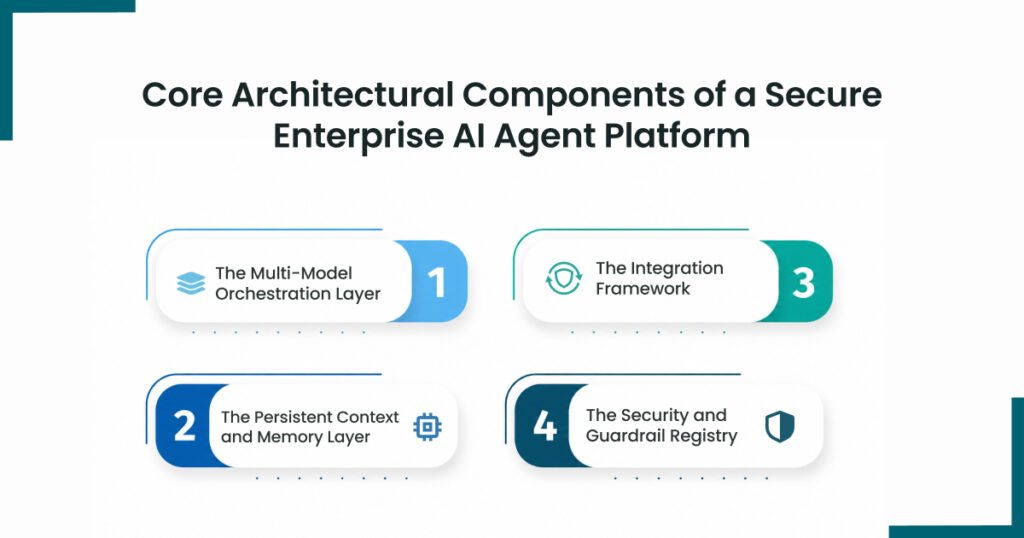
Deploying autonomous agents at scale requires a highly specialized infrastructure. You cannot simply connect a public LLM API to your production databases and hope for the best. To protect intellectual property and ensure operational resilience, organizations must build or buy a dedicated enterprise AI agent platform composed of four foundational architectural pillars:
The Multi-Model Orchestration Layer
The brain of the platform. Instead of relying on a single, expensive monolithic model, a secure platform uses an intelligent router to delegate tasks. Simple text processing goes to small, lightning-fast models, while complex logical reasoning or coding tasks route to advanced frontier models, minimizing compute costs and latency.
The Persistent Context and Memory Layer
For agents to execute long-term goals, they need memory. This layer combines vector databases for semantic search and graph databases to map complex organizational relationships. It allows an agent to remember past vendor interactions, historical compliance choices, and operational preferences across multi-day workflows. Advanced memory architectures are especially important for generative AI business solutions that require continuity, personalization, and contextual awareness across enterprise workflows.
The Integration Framework (Tool Registries & Model Context Protocol)
To take action, agents need hands. A secure platform features a centralized, audited tool registry that exposes specific software capabilities, such as sending an email, querying an SQL database, or updating an ERP record via strict, authenticated API gateways.
The Security and Guardrail Registry
The ultimate corporate perimeter. Strong governance and security controls are fundamental to successful AI strategy and consulting engagements and are a core focus of leading AI automation services for enterprises. This layer intercepts all inbound prompts and outbound agent responses in real time. It scans for prompt injection vulnerabilities, enforces role-based access control (RBAC) to prevent agents from viewing unauthorized data, and redacts personally identifiable information (PII) before data leaves the corporate network.
Why Is Custom LLM Development for Enterprise Essential for Operational Accuracy?
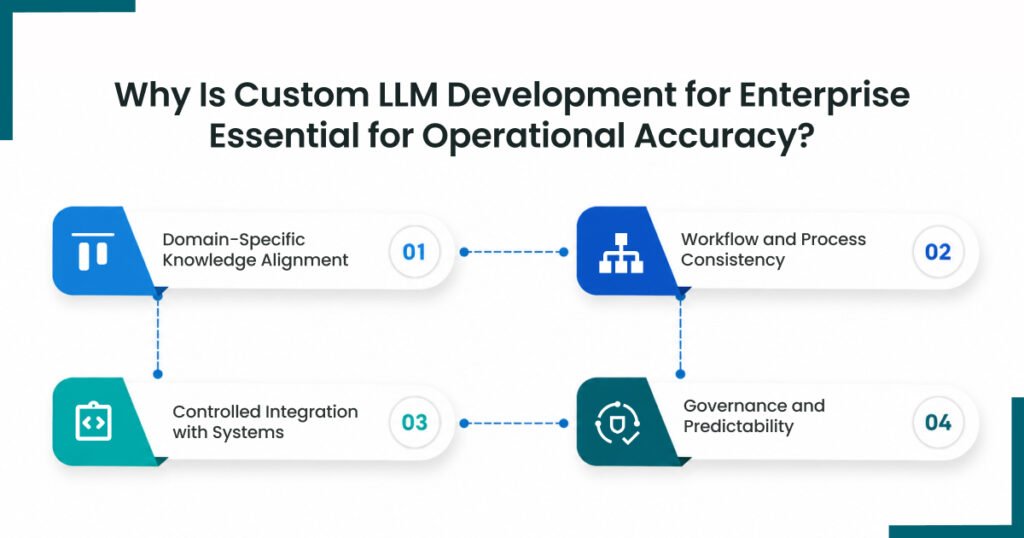
Off-the-shelf LLMs are powerful but often unreliable in enterprise environments where accuracy, compliance, and workflow consistency are critical. Custom LLM development for enterprise improves operational precision by aligning models with proprietary data, internal systems, and governance rules.
1. Domain-Specific Knowledge Alignment
Custom models are trained on internal documents such as policies, contracts, and knowledge bases, which significantly reduces hallucinations and improves factual accuracy.
For example, financial institutions using domain-tuned AI for compliance screening have reported 30–50% reductions in manual review effort, especially in document-heavy workflows.
2. Workflow and Process Consistency
Enterprise environments require structured outputs that match internal systems. Custom LLMs enforce consistent formats for reporting, analysis, and decision support.
In logistics and supply chain operations, AI-driven workflow automation has been associated with 20–35% faster exception resolution times, largely due to standardized reporting pipelines.
3. Controlled Integration with Systems
Custom LLMs integrate directly with ERP, CRM, and analytics platforms, ensuring outputs translate into correct system actions without manual rework.
Retail and e-commerce companies using AI-driven forecasting and inventory integration have seen 10–25% improvements in stock accuracy, reducing both overstock and stockouts.
4. Governance and Predictability
Custom models allow enterprises to embed compliance rules, audit logs, and safety constraints directly into model behavior, improving reliability in regulated environments.
In healthcare and regulated industries, AI documentation systems have reduced administrative workload by up to 40%, while improving audit readiness and compliance consistency.
What Are the Real-World Bottlenecks of Enterprise AI Integration and Deployment?
Even with strong model performance, most organizations struggle when scaling AI integration and deployment from pilot projects to production systems. The core challenges are usually structural, not algorithmic, and directly impact timelines for enterprise AI transformation solutions.
1. Legacy System Fragmentation
Many enterprises still rely on fragmented ERP, CRM, and data warehouse systems that were never designed for AI agents and automation. This creates inconsistent APIs, siloed data, and heavy dependency on middleware.
For example, large manufacturing enterprises often need months of integration work just to connect AI systems across procurement, logistics, and production planning due to incompatible data standards.
2. Data Quality and Accessibility Issues
A major bottleneck in generative AI business solutions is poor data readiness. Enterprise data is often unstructured, duplicated, or locked in PDFs, emails, and legacy systems.
In banking environments, organizations can spend up to 60–70% of total AI project time on data cleaning and preparation before models can be reliably deployed.
3. Security, Compliance, and Governance Constraints
Enterprises adopting autonomous AI agents for business must meet strict requirements around data privacy, access control, and auditability, especially in regulated industries.
For example, healthcare and financial institutions often require multiple validation layers and approval workflows before AI systems can access sensitive data or production environments.
4. Model-to-Production Gap (MLOps Complexity)
Even when models are trained successfully, scaling them into production-grade AI agent development systems requires robust MLOps pipelines, monitoring, and continuous retraining.
In enterprise deployments, model drift and lack of automation are key reasons why many custom AI development services initiatives fail to scale beyond proof of concept.
5. Organizational and Change Management Barriers
A major blocker in AI strategy and consulting engagements is not technology but adoption. Teams often lack clarity on ownership, training, and workflow redesign.
Research shows that a large share of AI transformation failures comes from misalignment between business units and technical teams rather than model performance issues.
What are the Steps to Redesign Business Operations With Autonomous AI Agents?
Enterprise AI transformation solutions are shifting from simple automation to fully agent-driven operating models, where autonomous AI agents for business do not just assist employees but actively execute workflows, coordinate systems, and make constrained decisions inside defined boundaries.
At the core of this shift is a redesign of business operations around agentic workflows rather than human-centric process chains. Instead of employees moving tasks across tools, AI agents orchestrate tasks across systems, data sources, and decision points.
1. From Static Workflows to Agent-Orchestrated Operations
Traditional enterprise workflows are rule-based and linear. An employee triggers a process, moves data across systems, and waits for approvals. In an AI-driven model, agents dynamically orchestrate these steps.
For example, in a procurement department, instead of manually raising purchase requests, an AI agent can:
- Detect inventory shortages from ERP data
- Compare vendor pricing and contract terms
- Generate purchase orders
- Route approvals based on policy thresholds
This is a practical application of AI agents and automation, where decision logic is embedded in the workflow itself rather than scattered across teams.
In large manufacturing firms, this shift has reduced procurement cycle times by 25–40% in early deployments, mainly by removing manual coordination delays.
2. Multi-Agent Systems for Complex Enterprise Functions
Modern enterprises increasingly use multiple specialized agents instead of a single model. Each agent handles a domain function such as finance, HR, or supply chain.
For example, in a global logistics company:
- A demand forecasting agent predicts shipment volume
- A routing agent optimizes delivery paths
- A compliance agent checks customs documentation
Together, these agents collaborate to optimize end-to-end operations without centralized manual intervention.
This architecture is a key part of agentic AI for enterprise, enabling distributed intelligence across business units.
Companies experimenting with multi-agent systems in supply chain operations have reported 15–30% improvements in delivery efficiency through better coordination and fewer manual handoffs.
3. Embedding AI Into Core Enterprise Systems
True transformation requires deep integration into ERP, CRM, HRMS, and analytics platforms. AI agents must operate inside systems, not alongside them.
For instance, in a retail enterprise:
- An AI agent updates inventory in real time across warehouses
- A pricing agent adjusts discounts based on demand and competition
- A customer support agent resolves refund requests directly in CRM systems
This level of AI integration and deployment ensures that decisions made by agents immediately translate into operational changes.
Retailers adopting AI-driven automation in core systems have seen 10–25% reductions in stockouts and overstock situations, improving both revenue and working capital efficiency.
4. Human-in-the-Loop Governance and Control
Despite autonomy, enterprise AI systems must remain controlled. Humans define boundaries, approve exceptions, and monitor outcomes.
In financial services, for example, AI agents can pre-approve low-risk transactions but escalate high-risk cases to compliance officers. This hybrid model ensures speed without sacrificing governance.
This is where AI strategy and consulting becomes critical, as organizations must define:
- What agents can execute independently
- What requires approval
- What must always remain human-controlled
Organizations using hybrid human-AI decision systems in compliance-heavy industries have reported up to 35% faster processing times while maintaining audit compliance standards. (Source: Gartner AI governance insights)
5. Real-World Enterprise Transformation Example
A large insurance provider implemented autonomous AI agents across claims processing:
- Document intake agents extracted structured data from PDFs
- Fraud detection agents flagged suspicious claims
- Approval agents auto-approved low-risk cases
- Human reviewers handled edge cases only
Result:
- Claims processing time reduced by 30–50%
- Operational cost reduced by 20–35%
- Customer satisfaction improved due to faster payouts
This demonstrates how custom AI development services combined with agentic architecture can fundamentally reshape enterprise operations.
How Do CFOs Accurately Measure the Financial ROI of Generative AI Business Solutions?
Measuring ROI for generative AI business solutions is more complex than traditional IT investments because value is distributed across cost reduction, productivity gains, risk mitigation, and revenue enablement. CFOs must move beyond simple “cost vs savings” calculations and adopt a multi-layered financial framework that captures both direct and indirect value creation.
1. Separating Direct Cost Savings From Productivity Gains
The first layer of ROI comes from measurable operational efficiencies. These include reduced labor hours, lower outsourcing costs, and automation of repetitive workflows enabled by AI agents.
For example, in customer support operations, enterprises deploying generative AI assistants have reported:
- 20-40% reduction in average handling time
- 15-30% decrease in ticket resolution costs
A CFO would translate this into reduced full-time equivalent (FTE) requirements or reallocation of headcount to higher-value tasks. (Source: McKinsey generative AI impact)
2. Quantifying Process Acceleration and Time-to-Value
A major but often overlooked ROI driver is cycle time reduction across enterprise processes. In enterprise AI transformation solutions, speed itself becomes a financial lever.
For instance:
- Invoice processing that previously took 5 days may be reduced to under 24 hours using AI document intelligence
- Contract review cycles in legal departments can shrink by 30–60%
Faster cycles directly improve cash flow, reduce operational bottlenecks, and accelerate revenue recognition.
3. Revenue Uplift Through AI-Driven Decisioning
CFOs must also account for top-line impact, not just cost savings. Autonomous AI agents for business can improve pricing, forecasting, and customer targeting.
Examples include:
- Retail pricing optimization increasing margins by 2–5%
- AI-driven lead scoring improves conversion rates by 10–20%
- Demand forecasting reduces lost sales due to stockouts
Even small percentage improvements in revenue drivers can significantly outperform cost savings in ROI calculations.
4. Risk Reduction and Compliance Value
A critical but less visible ROI component is risk mitigation. Generative AI systems embedded in workflows can reduce errors, compliance violations, and financial exposure.
For example:
- Automated compliance checks in finance reduce reporting errors by up to 40%
- Fraud detection systems in insurance reduce false claims payouts significantly
- Contract analysis agents reduce legal exposure from missed clauses
While harder to quantify, CFOs often model this as “avoided cost” or probabilistic loss reduction.
IBM AI governance
5. Measuring ROI Through Total Cost of Ownership (TCO)
CFOs evaluating custom AI development services must also account for full lifecycle costs:
- Model training and fine-tuning
- Infrastructure and compute costs
- Integration with ERP, CRM, and data systems
- Ongoing monitoring and retraining (MLOps)
ROI is only meaningful when compared against long-term TCO, not just initial deployment cost.
Organizations that fail to include operational AI maintenance often overestimate ROI by 20–50% in early pilots.
What Are the Best Use Cases for On-Demand AI Automation Services for Enterprises?
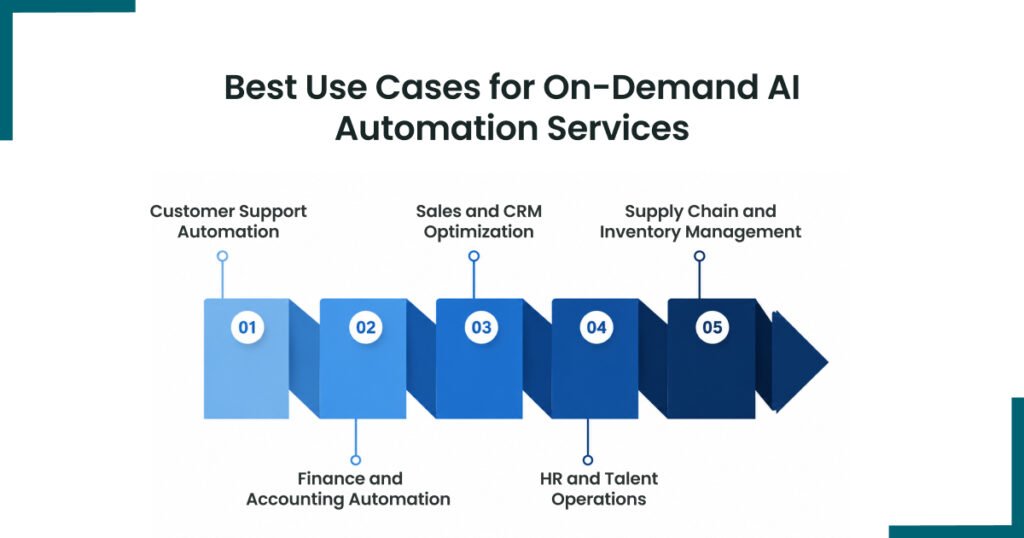
AI automation services for enterprises are most effective when applied to processes that are repetitive, data-intensive, and require consistent decision-making at scale. The real value comes when automation is embedded directly into business workflows through enterprise AI transformation solutions, rather than treated as isolated tools.
Below is a more detailed breakdown of high-impact generative AI use cases with real-world context.
1. Customer Support Automation
AI agents are widely used to manage high-volume customer interactions such as order tracking, refunds, and troubleshooting.
Real example:
Amazon uses AI-driven systems in its customer service ecosystem to handle millions of routine queries like “Where is my order?” and “Return status updates.” These systems reduce dependency on human agents and improve response time across global support operations.
How it works in practice:
- AI reads customer intent from chat or email
- Pulls data from order management systems
- Generates instant responses or triggers actions like refunds
- Escalates only complex cases to human agents
2. Finance and Accounting Automation
Finance teams use AI to automate invoice processing, reconciliation, expense validation, and reporting.
Real example:
Enterprises like Unilever have adopted AI-enabled finance transformation programs to streamline global shared services, particularly in invoice matching and vendor payment workflows.
Operational impact:
- Automatically extracts invoice data from PDFs
- Matches invoices with purchase orders in ERP systems
- Flags discrepancies for human review
- Accelerates monthly closing cycles
This reduces manual accounting effort while improving financial accuracy and audit readiness.
3. Sales and CRM Optimization
AI improves sales efficiency by automating lead scoring, customer segmentation, and follow-ups inside CRM systems.
Real example:
Salesforce Einstein AI is used across enterprises to prioritize leads and recommend next-best actions based on historical conversion patterns.
Operational impact:
- Scores leads based on likelihood to convert
- Suggests personalized outreach timing
- Automates CRM updates and pipeline tracking
- Improves sales team focus on high-value opportunities
4. HR and Talent Operations
AI is increasingly used in recruitment, onboarding, and employee support workflows.
Real example:
IBM uses AI-driven HR systems to help screen candidates and match them to job roles more efficiently.
Operational impact:
- Parses thousands of resumes automatically
- Matches candidates to job requirements
- Automates onboarding documentation
- Handles employee queries via AI assistants
5. Supply Chain and Inventory Management
Machine learning solutions that focus on automation help enterprises optimize demand forecasting, warehouse operations, and replenishment cycles.
Real example:
Walmart uses AI-powered forecasting and inventory systems to manage stock levels across thousands of stores globally.
Operational impact:
- Predicts demand fluctuations using historical and real-time data
- Automates restocking decisions
- Reduces stockouts and overstock situations
- Improves supply chain efficiency
How EitBiz Helps You Deploy Production-Ready AI Systems?
Transforming enterprise operations with AI is not just about adopting new tools; it is about building the right architecture, integrating it with existing systems, and ensuring it delivers measurable business outcomes. Without the right expertise, AI initiatives often remain limited to pilots, fail to scale, or introduce operational and compliance risks.
EitBiz is an enterprise software development company that helps organizations bridge this gap by designing and deploying scalable AI solutions tailored to real enterprise needs. From building custom AI development services to enabling end-to-end AI integration and deployment, our experts support businesses in moving from experimentation to production-grade systems.
Whether it is implementing autonomous AI agents for business, modernizing workflows through AI agents and automation, or building full AI transformation solutions, the focus remains on reliability, security, and operational impact.
Ready to accelerate your enterprise AI journey? Connect with EitBiz to build scalable, secure, and production-ready AI solutions tailored to your business needs.