AI and its FOMO have wrenched every industry, leaving many leaders in a quick adoption race. Over 83% of enterprises want to implement AI, but only around 13% are actually prepared for it, and 18% have finalized their use case in production. The rest of them are either enthusiastic but not prepared or not funded well. This gap is not tech-specific; it’s a readiness issue.
Not every organization is well-prepared for AI integration in their workflows. This specific transformation requires a business to develop stronger governance policies and to have a clear understanding of AI-specific operations, workforce readiness, and data maturity. Here, an AI readiness assessment is helpful. This step bridges the gap between becoming AI-native and falling behind in the FoMo race.
This practice will systematically evaluate your organization’s current legacy tech, data quality, and cultural alignment to build a strategic roadmap. In this blog, we will discuss what assessment looks like, how digital transformation has shaped it, and how to build an effective strategy.
AI is Reshaping Digital Transformation
Artificial intelligence has been a key enabler of the transformation. Enterprises are showcasing interest in integrating AI into their processes. This change has given businesses opportunities to leverage high-end market funnels. However, before the AI wave, the meaning of digital transformation was different for organizations. The speculations revolve around:
- ERP & CRM adoption
- Cloud migration
- Workflow automation
But today, this digital transformation wave has evolved from basic system digitization into intelligent automation. The rise of AI solutions for businesses marks a paradigm shift from reactive data management to autonomous, predictive execution.
While legacy systems simply recorded transactions and automated repetitive tasks, modern intelligent solutions like autonomous AI agents are doing it more fluidly. They adapt to new data, learn from user data, and make real-time decisions to solve multi-step business problems.
But today’s digital transformation efforts with AI deliver more business-centric value only when they are well integrated across the organization’s workflow. AI readiness assessment plays a vital role in realizing the intelligence-backed use case in production.
What is AI Readiness Assessment?
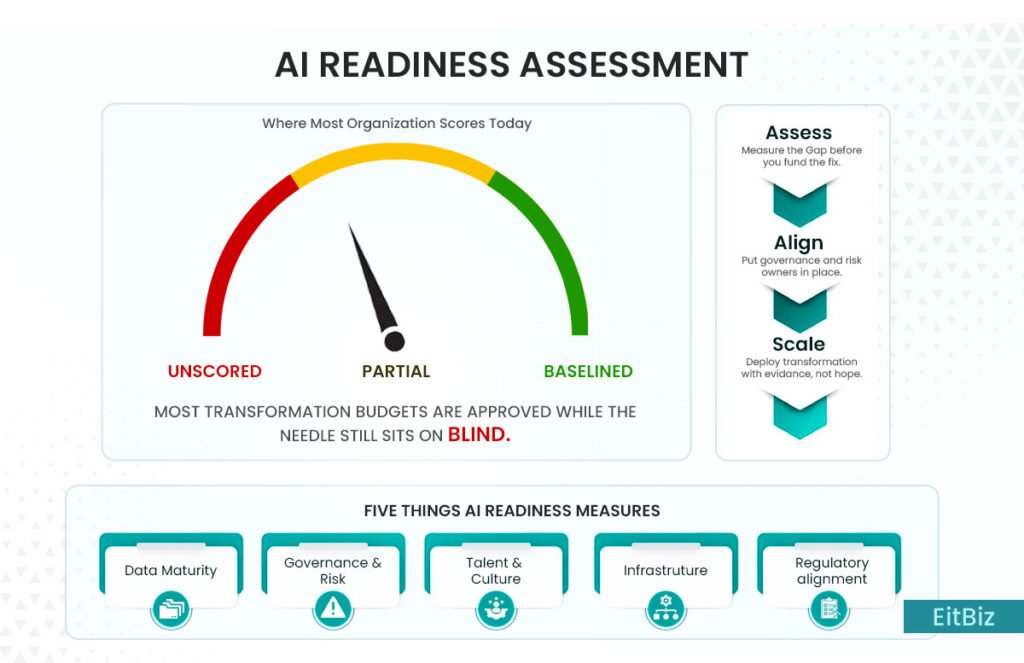
An AI readiness assessment is a complete systematic analysis that checks an enterprise’s preparedness to adopt, implement, and scale artificial intelligence. It evaluates your organization’s data infrastructure, talent, tech stack, AI governance posture, and the strategic alignment of AI with core business objectives.
It strategically determines whether your AI initiatives create enterprise value or quietly deplete capital over the next 16-18 months. The scope of the AI readiness assessment service is what sets it apart.
- It asks tough, direct questions that force business leaders to accept hard organizational truth
- It exposes the friction between an organization’s AI aspiration and its actual operational maturity
- It bridges the critical capability gap by delivering a pragmatic, no-nonsense AI adoption roadmap
This is what makes AI readiness valuable for an enterprise.
Why Organizations Skip AI Readiness Assessment?
Today, no organization wants to wait for a specific period to adopt AI in their workflows. The intense market pressure to quickly deploy intelligence is often driving ad-hoc adoption.
Core Reasons Why AI Readiness Assessments Are Skipped
The AI hype is real among enterprises, SMEs, and startups. This leads decision-makers to treat AI as a plug-and-play tool rather than a complex transformation. Here are the main reasons why AI strategy is often skipped:
- Speed: Executives skip AI assessment readiness because they fear a structured audit will delay deployment timelines.
- Misconception: Some decision-makers believe that creating an enterprise AI readiness checklist is costly and yields low maturity scores without building an action plan.
- Pilot Illusion: Teams easily launch small, heavily curated PoCs in an isolated environment because the pilot works. Considering this is structurally built to work in actual deployment confuses leaders and often creates ad hoc adoption.
This reactive and unstructured process can drive shorter periods of benefits but poses significant risks and costly iteration.
Key Difference between Ad-hoc AI Adoption and AI Readiness
Ad-hoc AI adoption and AI readiness represent the difference between a reactive, siloed approach and a proactive, enterprise-wide strategy. The table below outlines this difference more precisely:
| Attribute | Ad-Hoc AI Adoption | AI Readiness |
| Core Approach | Opportunity-Driven | Strategy-led |
| Primary Driver | Individual team initiative or sudden market pressure | Executive alignment with long-term business goals |
| Data Strategy | Siloed data | Centralized, secured, and governed data pipelines |
| Scalability | Considerably low | Strategy focuses on high-end scalability |
| Risk Management | Minimum guardrails | Strict governance |
| Cost Structure | Often unpredictable | Highly predictable and forecasts TCO |
Thus, ad hoc AI adoption is primarily driven by trends, which often leads to fragmented data silos, unaddressed security gaps, and isolated pilot projects that fail to deliver business value. On the other hand, an AI readiness assessment defines AI use cases for businesses based on data readiness and business impact.
How does an Enterprise AI Readiness Assessment Actually Evaluate?
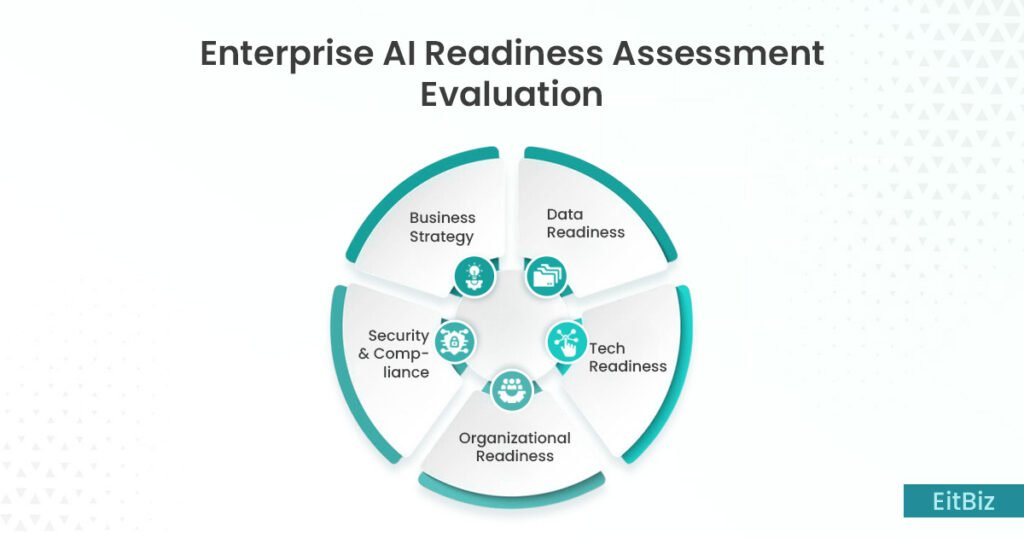
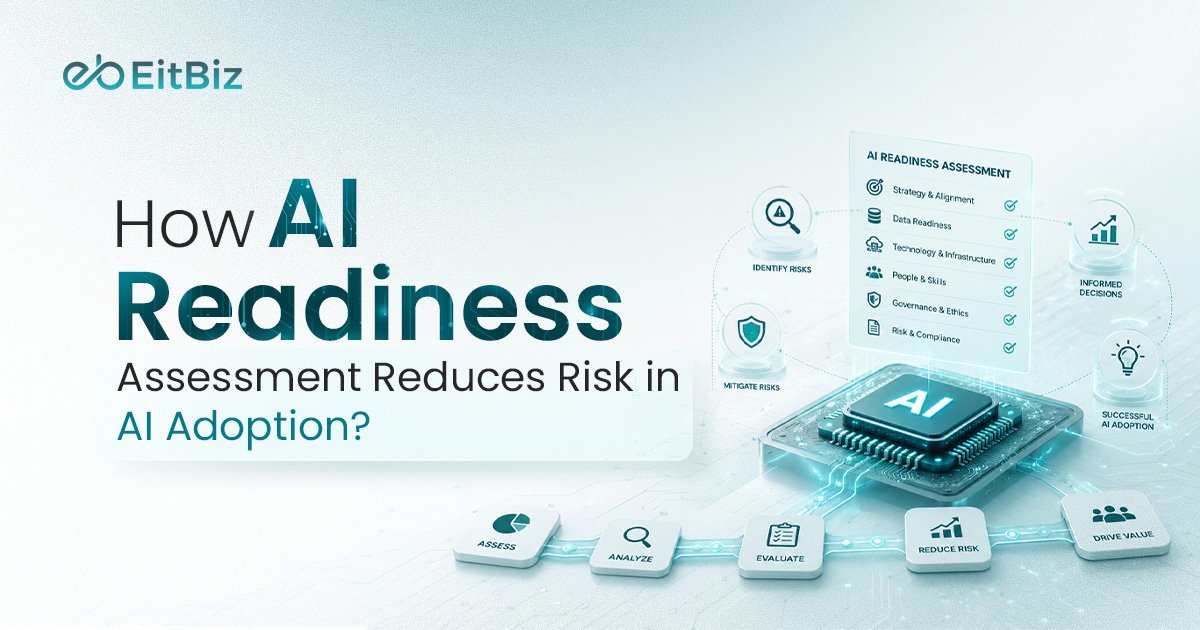
An enterprise AI assessment is a comprehensive multi-dimensional audit that measures an organization’s structural capability to absorb, deploy, govern, and scale AI. This is because AI touches every layer of an enterprise, and it is essential to secure each one of them.
- Business Strategy
AI initiatives must directly align with the organizational goals. This is what a readiness assessment actually does. It evaluates whether your leadership team has shown clear intent for adopting intelligence in their workflow or are they just chasing trends. It asks questions like:
- Do AI initiatives align with the business goals?
- Do you have any KPIs aligned with the AI you are adopting in your workflow?
- What percentage of ROI are you expecting?
- Data Readiness
Whether it’s an AI agent development or building any specific intelligent tool, it is as good as its data. The data type you feed into your solution will deliver the same responses. AI readiness assessment prepares your data. Make sure it is usable within the solution. Checks whether data pipelines connect disparate silos so that the model can pull real-time inputs. Audits historical records for completeness, bias, duplication, and errors.
- Tech Readiness
Deploying a modern enterprise AI solution requires an agile, scalable technical foundation capable of handling heavy computational work. It assesses cloud migration status, multi-cloud flexibility, and elastic compute provisioning. Further, it evaluates:
- How old or monolithic is the system or database you are using?
- Review integration layers to ensure smooth data exchange
- Whether an infrastructure can be scaled horizontally as user concurrency expands
- Security & Compliance
Artificial Intelligence-powered systems ingest sensitive customer and business data. Building guardrails around it is becoming critical to safeguard critical data. Thus, you can not ignore AI governance in today’s time-frame. It will help you formulate better usage policies, implement testing frameworks to mitigate algorithmic bias.
- Organizational Readiness
The success of technology transformation depends entirely on how an organization’s internal team has adopted it. AI readiness assessment service providers audit the tech proficiency of a team and prepare a training program to upskill them.
Benefits of Opting for an AI Readiness Assessment Service
A readiness assessment helps your organization adopt artificial intelligence fast and safely. This evaluation metric provides you with a clear roadmap, prevents wasted money, and deploys strategy-aligned intelligence adoption. AI readiness assessment services offer various benefits that include:
- Quicker Implementation
AI readiness assessment uncovers data silos, unstructured data, and skill shortages early. This will establish a clear step-by-step roadmap that eliminates guesswork in AI adoption. With a proper strategy that aligns business goals, the deployment of AI will be fast-forwarded.
- Better Investment Decisions
When an organization follows an AI readiness assessment framework, it will significantly improve its investment-related decisions. But how? This is because with a foolproof alignment of AI use cases in your workflow, you can identify exactly where AI can solve your specific business bottlenecks and augment operations.
- Lower Implementation Risks
AI assessment secures data pipelines by detecting vulnerabilities, data quality issues, and integration flaws early. This way, it will reduce the high failure rate of AI initiatives by ensuring that foundational technology is stable.
- Stronger Governance
Credibility-defined AI adoption ensures robust governance around the intelligence layer. AI readiness aligns your data usage and algorithmic models with evolving global privacy laws and regulations. An AI governance framework enables strong guardrails by setting up roles, permissions, and overall oversight structures to manage AI outputs safely over time.
- Better ROI
With a clear AI implementation roadmap, you can integrate AI in your workflow or develop custom AI solutions for your business faster. The blueprint covers all the ‘ifs’ and ‘hows’ by focusing on ‘what not to do’ while infusing intelligence. This establishes concrete baselines and KPIs to track financial and operational performance accurately.
AI Readiness Assessment Roadmap
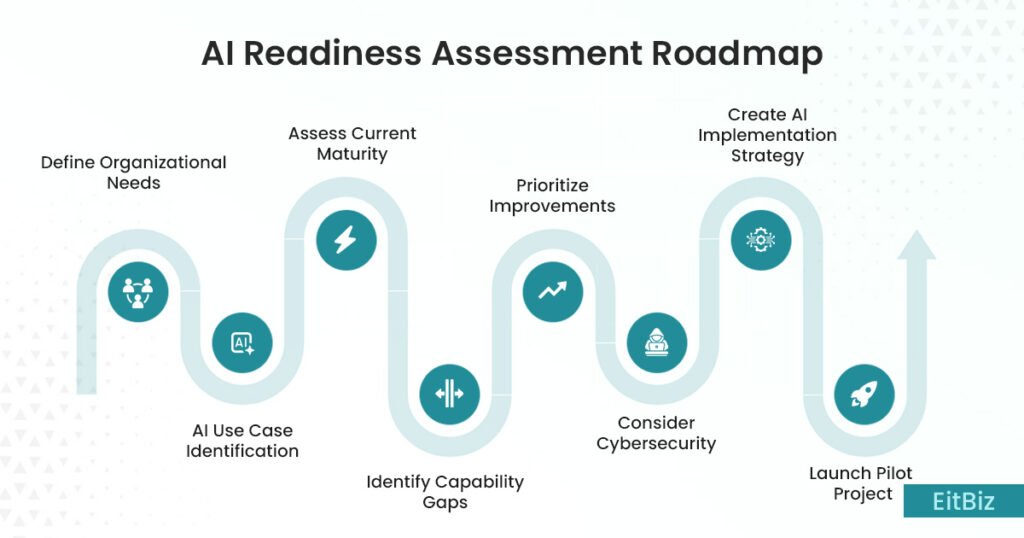
AI readiness roadmap is a practical, step-by-step framework that helps organizations transform from conceptual AI interest to active, secure deployment. Whether it’s legacy application modernization through AI or novel AI-native product development, a structured roadmap ensures that tech investments yield measurable business value within your budget.
- Define Organizational Needs
AI readiness assessment identifies and aligns core business objectives with your data maturity, tech infrastructure, workforce skills, and strategic vision. It evaluates if your organization is prepared to adopt artificial intelligence successfully.
- AI Use Case Identification
The second step after identifying organizational needs is to find the AI use case scope. Map out potential AI solutions for businesses like automated customer service bots or predictive maintenance. Evaluate business value by filtering out ideas based on their potential financial impact.
- Assess Current Maturity
After identifying an AI use case in your specific business workflow, the next step is to identify the maturity of your data, system, and technology. Evaluate the volume, quality, accessibility, and storage architecture of your current data assets. Check on the technical stacks like cloud infrastructure and hardware capabilities to support heavy AI workloads.
- Identify Capability Gaps
Once you have assessed the maturity of your systems during an AI readiness assessment, the next step is to check the ability of your current team/environment to work on the AI solution. This step will help you highlight the data deficiencies, team skill shortages, and uncover technology gaps.
- Prioritize Improvements
A clear, structured readiness report will help you evaluate the identified gaps using a matrix that balances business impact and implementation complexity. Based on this, you can create a realistic budget schedule that ensures critical foundational upgrades are funded first.
- Consider Cybersecurity
AI usage should be governed and managed with strict guardrails and a security layer. You must implement access control, strict encryption, and masking techniques to protect your sensitive data. Building a good cybersecurity strategy while implementing AI becomes essential. It will safeguard critical information from cyber threats.
- Create AI Implementation Strategy
Once you’ve analyzed the “ifs,” “whys,” and “what” to improve, the next step in the AI readiness assessment strategy is the implementation one. For this, prepare a technical outline of the infrastructure, whether on-prem, public, or hybrid. Afterwards, establish clear data and AI governance policies around data ownership, lineage, and ethical AI usage.
- Launch Pilot Project
AI readiness assessment focuses on not performing a full-fledged launch even after you’ve prepared a structured AI roadmap. Do it on a pilot basis. This trial launch uncovers various benefits. It will help you understand whether your AI project is working correctly, at which stage it falls, or what further additions you can make to it.
Common Mistakes that Undermine AI Readiness
Every business is integrating AI in their workflows. The hype is real, but most initiatives often stall. Skipping a thorough assessment can be one of the strongest reasons behind preventable failures. Here are the most evident mistakes that you should avoid:
- Not Prioritizing Business Needs
Artificial Intelligence-powered workflows and solutions are highly in demand, and the majority of business leaders are driven by market pressure. Since every small to large organization is using AI, they should too. Thus, without a clear business use case, they end up with “AI for the sake of AI” that fails to deliver measurable ROI.
- Underestimating Data Readiness
AI works better with data. Every generative AI development project’s foundation relies on data. But the fear of missing out is leading organizations to skip the data readiness step. They often expect sophisticated models to perform magic on messy, siloed, outdated, or cluttered data. Thus, poor data quality results in hallucinated answers and unreliable outputs.
- Ignoring AI Governance
An intelligence layer without governance can negatively impact. Skipping the creation of guardrails for privacy, algorithmic bias, and security is a major risk. Without a framework to govern AI, a business exposes itself to legal liabilities and loss of user trust.
- Scaling AI Quickly
Moving quickly is not always the best step forward. Moving from a PoC to a full rollout without stabilizing foundational layers like infrastructure or a data pipeline for an AI product can result in system crashes. This can lead to unmanageable technical debt and often leads to failure.
Best Practices for Conducting AI Readiness Assessment
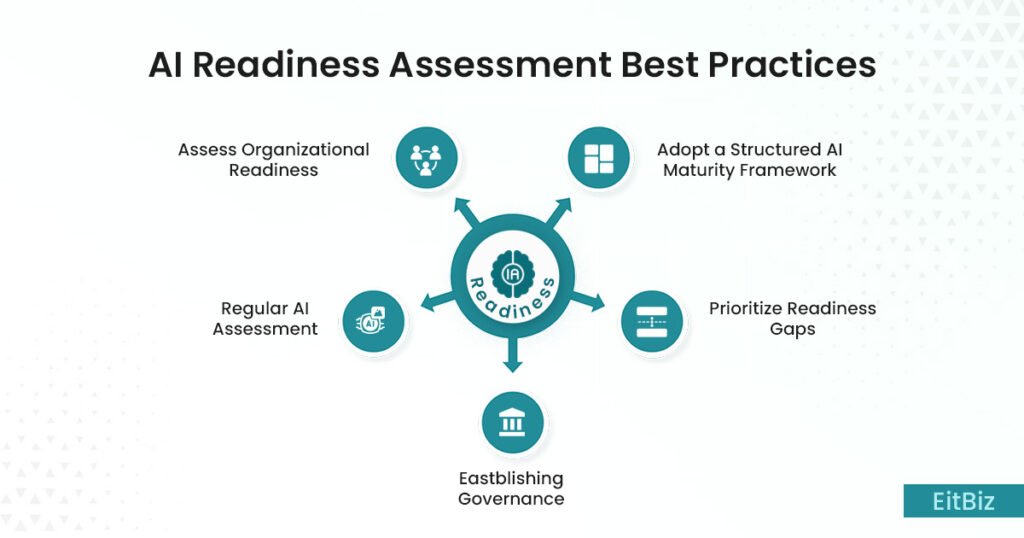
Adopting AI without a proper readiness assessment can be risky. From reputational risk to legal liabilities, it can create serious problems, like wasted money, unhappy customers, or broken systems. To ensure your business does not face any of them. It is crucial to follow the industry best practices for conducting an AI readiness assessment:
- Assess Organizational Readiness
Perform an honest evaluation of your current tech stack, data accessibility, and your workforce’s internal skill levels. This will help you precisely understand your starting point.
- Adopt a Structured AI Maturity Framework
An AI consulting team will guide you to use a standardized framework to measure progress across diverse dimensions. It will ensure that nothing is overlooked, whether strategy or ethics.
- Prioritize Readiness Gaps
Which aspects require fixation first? An honest AI readiness assessment helps you to focus on resolving critical issues first, such as data security or infrastructure. By prioritizing deficiencies based on impact, you will certainly improve AI use cases in your workflow.
- Establishing Governance
Build an effective governance layer across AI to protect your sensitive data and business reputation. Define ownership, roles, and oversight policies early. Remember, governance should be viewed as an enabler of responsible AI adoption.
- Regular AI Assessment
AI enablement is not a ‘one-and-done’ project. AI assessment should happen continuously to stay updated and avoid security threats. Hire AI developers or a company that can help you bridge this gap and adapt to evolving technology or changing regulations.
Conduct an Expert-Level AI Readiness Assessment with EitBiz
The AI bubble is growing at a significant pace. Business leaders want to implement AI quickly but have thrown millions of dollars into failed vanity projects. Successful AI transformation starts long before the first model is deployed. Here, EitBiz works as a strategic partner to help you implement intelligence by building a solid foundation.
Our expert AI consultants specialize in identifying intelligence-integration opportunities while uncovering hidden risks behind them. We provide a clear, actionable roadmap that aligns your AI strategy with your broader business objectives.
Whether you are looking to build NLP solutions, agentic systems, or RAG-powered infrastructure, EitBiz ensures your organization is structurally and culturally prepared for the transformation. We conduct structured AI readiness assessments and have hands-on experience delivering enterprise-grade AI architectures.
Move beyond the hype with EitBiz today through a professional AI readiness assessment and lead your digital transformation with confidence.