Key Takeaways
- Modular ecommerce development breaks a traditional store into independent modules, improving flexibility, scalability, and system efficiency.
- A strong ecommerce architecture ensures each module operates independently, allowing faster updates and smoother performance without disrupting the full system.
- Headless commerce and composable commerce are replacing monolithic ecommerce by enabling API-driven, flexible, and future-ready digital ecosystems.
- AI-enabled e-commerce enhances modular systems through smarter personalization, search optimization, dynamic pricing, and improved customer experiences.
- Businesses adopting modern ecommerce platform development strategies gain faster innovation cycles, better scalability, and long-term competitive advantage.
Many ecommerce businesses outgrow the platforms that once powered their growth. Do you know the reason behind it? It’s because of the monolithic platforms’ nature. Because the entire system is tangled together, you lose the ability to move fast.
A simple tweak in the front-end design requires eCommerce developers to deploy and test the heavy backend datasets code. This architectural friction inevitably caps their growth.
This is why modular commerce is gaining momentum. It solves this by untangling your tech stack so you can scale individual features independently.
In this guide, we will explore how modular ecommerce works, why it is replacing traditional models, and how technologies like AI-powered e-commerce and composable ecosystems are shaping the future of digital retail.
What Is Modular Ecommerce and Why Is It Important for Modern Businesses?
Modular ecommerce is an architectural approach where an online store is built using independent, interchangeable components instead of a single monolithic platform.
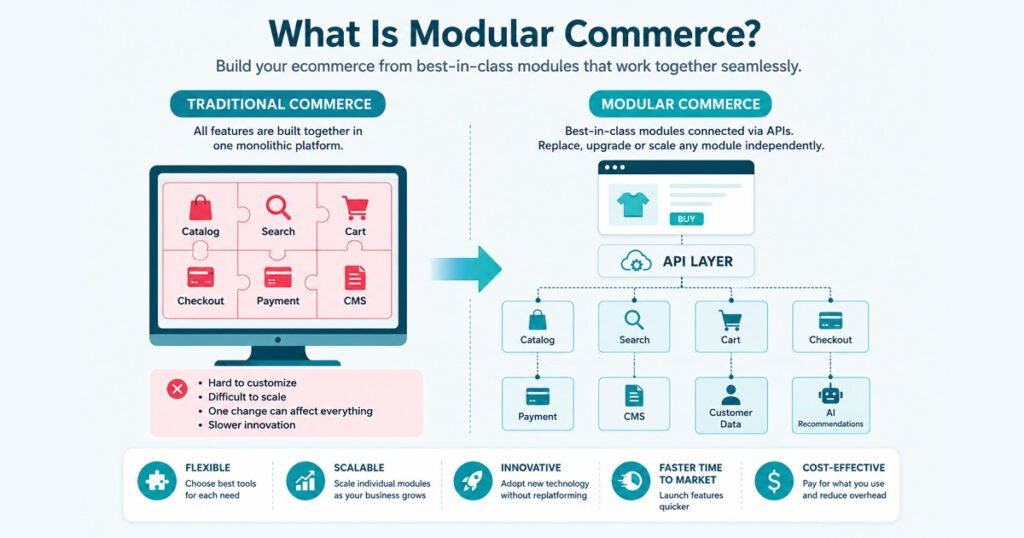
Each business capability, such as product catalog, checkout, search, payments, and personalization, operates as a separate service that connects through APIs.
This structure is a major evolution in ecommerce architecture, designed to improve flexibility, scalability, and speed of innovation for modern digital businesses.
In real-world implementations, modular ecommerce systems are built as a network of specialized services:
- Product data is managed through a dedicated catalog service
- Checkout and payment processing run as independent services
- Search and recommendation engines operate separately
- Frontend experiences are delivered through headless or API-first layers
This separation allows businesses to update, scale, or replace individual components without disrupting the entire system.
For example, a retailer can upgrade its payment gateway or AI recommendation engine without touching the checkout logic or product database.
Why the Industry Is Moving Toward Modular Ecommerce
Industry adoption of modular commerce is accelerating due to increasing complexity in customer expectations and digital operations.
Key drivers include:
- Growth of omnichannel commerce across web, mobile, and marketplaces
- Demand for real-time personalization and AI-driven experiences
- Need for faster release cycles in competitive markets
- Expansion of global ecommerce operations requires a scalable infrastructure
According to Gartner, over 60% of digital commerce organizations are expected to adopt composable principles by 2027, driven by the need for agility and faster innovation cycles.
Similarly, Adobe reports that 89% of leading retailers are investing in flexible commerce architectures to improve customer experience and operational efficiency.
These shifts highlight a clear industry direction: businesses are moving away from rigid systems toward modular, API-driven ecosystems.
Key Benefits of Modular Ecommerce Architecture
Modular eCommerce is gradually becoming the go-to commerce approach for modern-day businesses. The reason is obvious, it’s the benefits of this component-driven commerce. Here are some of the benefits of modular eCommerce architecture:
- Faster deployment of new features
- Independent scaling of services
- Improved system performance and reliability
- Easier integration with third-party tools
- Enhanced customer experiences through personalization
- Greater flexibility for future technology adoption
- Reduced long-term maintenance and operational costs
Key Components of Modular Ecommerce Architecture
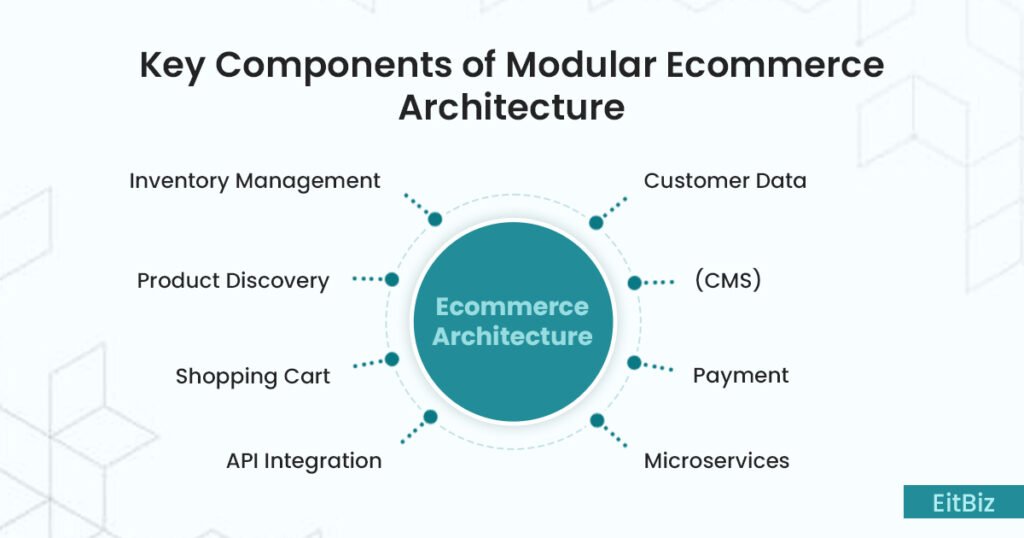
Modular eCommerce architecture is built on a collection of independent, interconnected components that work together to deliver a seamless shopping experience. It encompasses some core components that are quintessential in forming the foundation of a modern-day modular eCommerce platform.
1. Product Catalog and Inventory Management
The product catalogue module serves as the brain for your store. It includes product information that covers descriptions, pricing, images, categories, and inventory levels. This allows businesses to easily update product data, manage stock availability, and synchronize inventory across multiple sales channels.
2. Search and Product Discovery
Modern modular eCommerce platforms use dedicated search service providers that are powered by AI and ML algorithms today. This aids in imporiving the search experience by delivering personalized and more relevant product results, faster. It also encompasses advanced eCommerce search modules that support autocomplete, semantic search, personalized recommendation, and more alike features.
3. Shopping Cart and Checkout Services
Cart and checkout modules handle product selection, order processing, taxes, discounts, and payment workflows. Separating these services allows businesses to optimize conversion rates, improve performance during peak traffic periods, and introduce new checkout experiences without impacting he rest of the platform.
4. Payment and Transaction Processing
A dedicated payment module manages secure transaction processing, fraud detection, refunds, and payment gateway integrations. Businesses can easily add new payment providers or expand into new markets without extensive re-development because it operates independently.
5. Customer Data and Personalization Engine
Modern eCommerce revolves around better customer experiences. Modular commerce plays a crucial role in improving it with personalization modules. These collect and analyze customer behavior, preferences, and purchase history to deliver tailored recommendations. This way, you can improve engagement and increase conversion rates through AI-powered commerce experiences.
6. Content Management System (CMS)
A modular CMS supports faster content publishing, campaign management, and omnichannel content delivery across websites, mobile applications, and other customer touchpoints.
7. API Layer and Integration Framework
APIs are the backbone of modular ecommerce architecture. They enable seamless communication between independent services while maintaining flexibility and interoperability. An API-first approach makes it easier to integrate third-party tools, CRM, ERP, and emerging technologies.
8. Microservices and Cloud Infrastructure
Most modern modular commerce platforms rely on a microservices architecture deployed on cloud-native infrastructure. Every service can be developed, deployed, monitored, and scaled independently. This will ensure better performance, fault isolation, and operational efficiency.
Why These Components Matter
Together, they form a flexible, scalable, and future-ready ecosystem. Businesses can easily replace, upgrade, or scale individual modules without making any changes in the backend’s business logic. This does not slow down the eCommerce store’s performance which makes modular eCommerce an ideal approach for organizations seeking innovation and digital agility.
Modular Ecommerce Development Work in Practice
Modular ecommerce development works by decomposing an ecommerce system into independent, self-contained services that communicate through APIs and event-driven systems. Instead of building a single monolithic application, businesses design multiple specialized components, each responsible for a specific function such as product management, checkout, or personalization.
In practice, this approach reshapes how digital commerce platforms are designed, built, deployed, and scaled, enabling greater flexibility and operational efficiency.
Core Working Model of Modular Ecommerce
A modular ecommerce system follows an API-first, service-oriented architecture where each module operates independently while remaining connected to the broader ecosystem.
Typical ecommerce modules include:
- Product catalog and inventory management
- Cart and checkout services
- Payment processing systems
- Search and product discovery engines
- Customer data and personalization engines
- Content management systems
Each module performs a defined role and communicates with others through APIs, ensuring seamless data flow without tight coupling or system dependency.
Step-by-Step Customer Journey in a Modular System
To understand practical execution, consider how a customer interacts with a modular ecommerce platform:
- A user accesses the storefront built using ecommerce website development practices
- The frontend retrieves product data from a dedicated catalog service
- The user adds products to a cart managed by a separate cart service
- Checkout is processed through payment and order management services
- Order confirmation and fulfillment are handled by backend systems connected via APIs
Although multiple independent services handle each step, the customer experiences a unified and seamless journey.
Role of APIs and Microservices in System Design
APIs form the backbone of ecommerce architecture in modular systems. They enable secure, structured communication between independent services without creating direct dependencies.
Most modern modular ecommerce platforms rely on a microservices architecture, where each module is:
- Independently developed
- Independently deployed
- Independently scaled
- Independently updated
This structure is commonly implemented by an ecommerce software development company using cloud-native infrastructure, containerization, and DevOps pipelines to ensure reliability and scalability.
Deployment and Scaling in Real-World Scenarios
One of the strongest advantages of modular ecommerce is selective scaling based on demand.
In real-world implementations:
- During peak traffic events, only high-load services like checkout or cart are scaled
- Recommendation engines can be upgraded to AI-powered e-commerce systems without affecting core commerce logic
- New payment gateways or regional providers can be integrated without rebuilding the entire platform
Integration with Headless and Composable Commerce
Modern modular systems are often combined with headless commerce and composable commerce strategies to further enhance flexibility.
- Headless architecture separates the frontend experience from backend services, enabling multi-channel delivery
- Composable commerce allows businesses to assemble best-in-class tools for each function
- Individual services can be replaced or upgraded without disrupting the entire system
Real-World Industry Practices in Modular Ecommerce
Organizations implementing modular ecommerce development typically follow established industry practices to ensure scalability and stability:
- Hosting services on cloud infrastructure for elastic scalability
- Using API gateways to manage secure communication between services
- Implementing CI/CD pipelines for continuous deployment and faster updates
- Monitoring each module independently for performance, uptime, and reliability
Why Is Monolithic Ecommerce Being Replaced by Modular and Headless Approaches?
Monolithic ecommerce systems were once the standard for building online stores. But because the entire system is tightly coupled any minor changes required businesses to force retest, deploy, and risk an entire solution’s downtime.
Overcoming the drawback of this solution, modern eCommerce development has shifted towards modular and headless approaches.
- High speed: You’ve the command in your hand. The component-driven approach sets apart modern commerce in terms of speed and flexibility.
- Enhanced scaling: Modern commerce allows businesses to scale independent components without disrupting other components’ work.
- No Vendor Lock-in: You are no longer trapped by a single vendor’s restrictive ecosystem. If a particular module needs change, you can easily replace it.
- Omnichannel Delivery: Headless architecture decouples the front-end from the back-end. This means a single back-end can feed product data to an unlimited number of front-ends.
Difference Between Headless Commerce and Composable Commerce?
Headless commerce and composable commerce are often used interchangeably, but they represent different levels of architectural transformation in modern digital commerce systems.
| Aspect | Headless Commerce | Composable Commerce |
| Core concept | Separates the frontend (presentation layer) from the backend commerce engine | Builds the entire commerce system using independent, best-of-breed services |
| Scope | Focuses mainly on frontend flexibility | Covers the entire commerce ecosystem (frontend & backend services) |
| Architecture style | Decoupled frontend and backend connected via APIs | Modular, API-first architecture combining multiple independent components |
| Flexibility | High flexibility in designing user experiences across channels | Very high flexibility in selecting and replacing any commerce component |
| Customization | Strong control over customer-facing experiences | Deep customization across all business functions, not just frontend |
| Technology approach | One backend with multiple frontends | Multiple interchangeable services for each function |
| Dependency | Backend remains a central system | No single core system, fully distributed architecture |
Monolithic eCommerce vs Modular Ecommerce vs Headless Commerce vs Composable Commerce
The discussion among monolithic and modern commerce architectures has gradually increased. Where some businesses are still using legacy eCommerce systems while others are looking to modernize their solutions. Here is a brief difference that can help:
| Aspects | Monolithic Commerce | Modular Commerce | Headless Commerce | Composable Commerce |
| Coupling | Tightly Bound | Logically Grouped | Decoupled (UI/Data) | Fully Distributed |
| Tech Stack | Rigid | Shared Code | UI Only | Complete Freedom |
| Upgrades | High-Risk Monolith | Core Dependent | Separated Risks | Continuous /Automated |
| Scalability | Scale Everything | Share Resourcable Scale | Front-end Only | Microservice Elastic |
| Architecture | Single Heavy Codebase | Module-Driven | Decoupled | MACH (Microservices, API, Cloud-native, Headless) |
| Speed | Fast Start/ Slow Evolution | Controlled Throughout | Slow Start/ Fast UI | Slow Start/ Infinite Agility |
| Team Setup | One Large Team | Domain Developers | Front-end/Back-end Developers | Cross-Functional Pods |
How to Migrate from Monolithic Ecommerce to Modular Commerce?
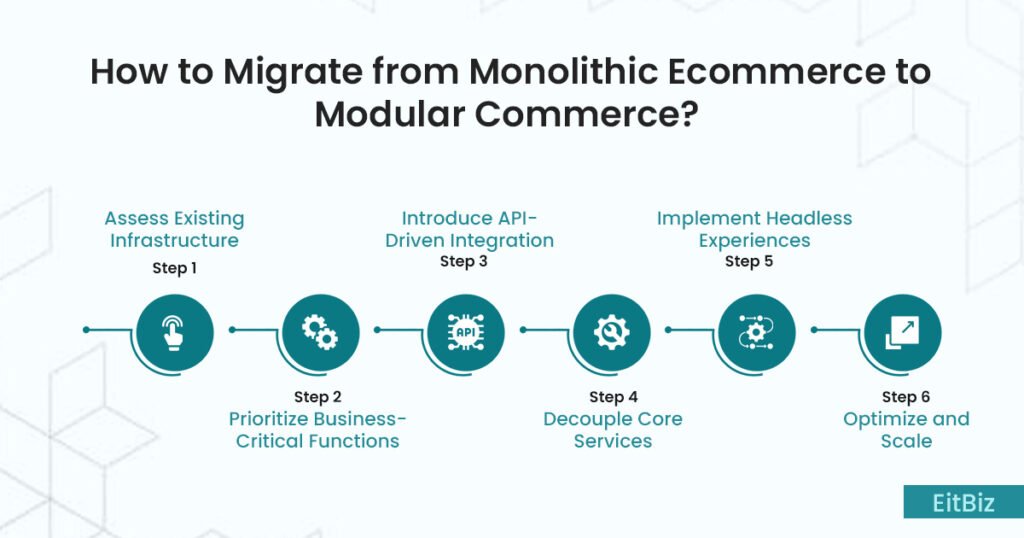
Monolithic to modular commerce migration requires extensive experience in modern commerce development. Partnering with a skilled eCommerce development service provider can help you. However, here are some major steps that you can follow to perform the transition:
Step 1: Assess Existing Infrastructure
Evaluate your current ecommerce architecture, identify bottlenecks, and determine which components limit scalability or innovation.
Step 2: Prioritize Business-Critical Functions
Identify high-impact areas such as checkout, search, inventory management, or customer experience that would benefit most from modularization.
Step 3: Introduce API-Driven Integration
Develop APIs that allow independent services to communicate securely and efficiently.
Step 4: Decouple Core Services
Separate major functions into independent modules that can operate and scale independently.
Step 5: Implement Headless Experiences
Modernize customer-facing experiences across web and mobile channels while maintaining backend stability.
Step 6: Optimize and Scale
Continuously monitor performance and improve individual services as business requirements evolve.
A phased migration approach minimizes risk while delivering measurable business value.
Real-World Examples of Modular Ecommerce
Many of the world’s most successful retailers use modular commerce principles to improve scalability and customer experiences.
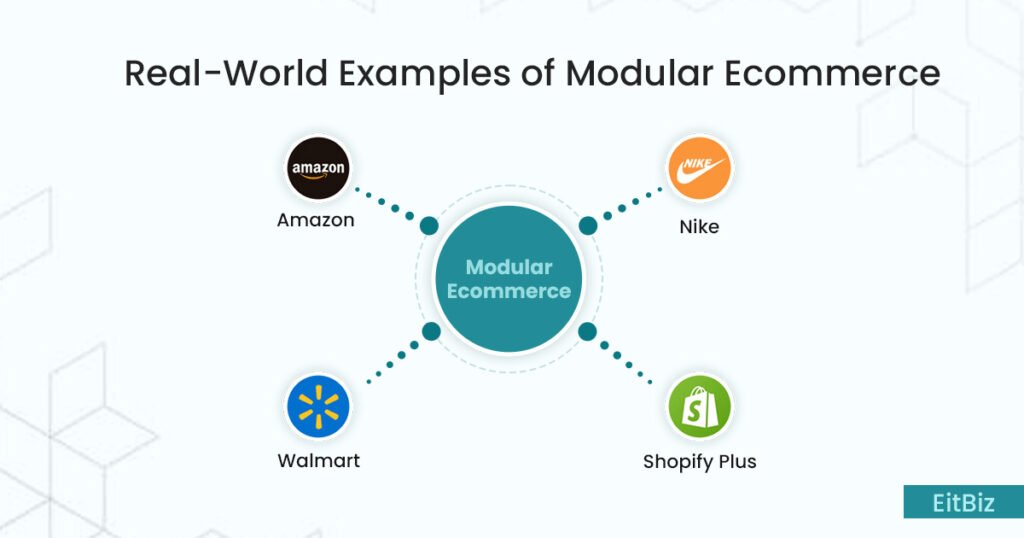
Amazon
Amazon operates one of the largest microservices-based ecommerce ecosystems in the world. Its modular architecture allows independent teams to manage services such as search, recommendations, payments, inventory, and logistics without affecting the entire platform.
Nike
Nike leverages API-driven commerce systems to deliver consistent experiences across websites, mobile applications, retail stores, and digital marketplaces. This flexibility allows the brand to launch new experiences faster while maintaining operational efficiency.
Walmart
Walmart uses a distributed ecommerce architecture capable of handling millions of daily transactions. Independent commerce services enable the company to scale during peak shopping seasons while maintaining performance.
Shopify Plus
Shopify’s ecosystem supports modular commerce through APIs, integrations, and third-party applications. Brands can add specialized services for payments, analytics, personalization, and marketing without rebuilding their commerce infrastructure.
These examples demonstrate how modular ecommerce development enables organizations to innovate faster while maintaining scalability.
How Much Does Modular Ecommerce Development Cost?
The cost of modular ecommerce development varies depending on architecture complexity, integrations, and business requirements.
| Business Type | Estimated Investment |
| Startup Ecommerce Platform | $15,000 – $50,000 |
| Mid-Sized Business | $50,000 – $150,000 |
| Enterprise Commerce Platform | $150,000 – $500,000+ |
Factors influencing cost include:
- Number of commerce modules
- Third-party integrations
- AI-powered features
- Cloud infrastructure
- Security and compliance requirements
- Custom frontend development
While modular systems often require higher initial investment, they typically reduce long-term maintenance costs and improve scalability.
Challenges of Modular Ecommerce Development
While modular commerce delivers significant advantages, organizations should also understand the associated challenges.
Common obstacles include:
- API management complexity
- Data synchronization across services
- Vendor ecosystem management
- Security governance
- DevOps maturity requirements
- Higher initial implementation effort
Businesses that establish strong architectural governance can overcome these challenges and realize substantial long-term benefits.
Future Trends in Modular Ecommerce (2026–2030)
The future of ecommerce development will be shaped by increasingly intelligent and composable ecosystems.
Key trends include:
- AI-native commerce platforms
- Agentic shopping experiences
- Voice commerce adoption
- Hyper-personalization
- MACH architecture expansion
- Real-time inventory intelligence
- Edge computing for ecommerce
- Autonomous customer journeys
Businesses that invest in modular architecture today will be better positioned to adapt to future technological advancements.
Security and Compliance in Modular Commerce
Security remains a critical consideration in distributed ecommerce environments.
Organizations should implement:
- PCI DSS compliance
- GDPR compliance
- API authentication and authorization
- Role-based access controls
- Data encryption
- Continuous monitoring
Strong security governance helps protect customer data while maintaining operational resilience.
Upgrade to Module-Driven Commerce Architecture with EitBiz
While modular ecommerce development offers clear advantages in scalability, flexibility, and performance, many businesses face practical challenges during implementation. Designing a fully decoupled ecommerce architecture, integrating multiple commerce modules, and managing APIs across distributed systems often requires specialized technical expertise.
EitBiz helps businesses bridge the gap between traditional systems and modern modular ecosystems by delivering end-to-end ecommerce platform development solutions. With expertise in custom ecommerce app development, our ecommerce experts focus on building scalable, API-driven systems that align with business goals.
If you are planning to upgrade your ecommerce system or move toward a modular architecture, connect with EitBiz to build a scalable and high-performance commerce solution.