Planning to build an AI dating app, right?
Well, that’s the reason you have landed right here, planning to run into AI-powered dating app development.
Did you know?
- The global online dating app market is expected to reach USD 14.42 billion by 2030. (Source: Grand View Research).
- 72% of users of dating apps are amenable to utilizing AI-powered capabilities. (Source: TechCrunch research).
- AI-driven dating apps increase your chances of matching with people who are more likely to click.
That’s why startups and even established businesses are looking for an AI-powered dating app development cost to build a solid app without going broke.
The best part is that demand for AI-powered matchmaking apps continues to rise.
Ask yourself!
If dating apps already exist by the hundreds, why are users still frustrated with poor matches, ghosting, and unsafe interactions?
Traditional dating apps rely heavily on static filters and surface-level preferences. They struggle to understand intent, context, and evolving human behavior. This gap is why AI-powered dating apps are gaining attention. They promise better matches, safer conversations, and more meaningful connections by learning from real user behavior instead of fixed rules.
In this blog post, we’ll break down how to build an AI dating app from the get-go. We’ll cover features, tech stack choices, development steps, and realistic costs.
What is an AI-Powered Dating App?
An AI-powered dating app uses machine learning, natural language processing, and data analytics to improve how users match, communicate, and stay safe on the platform.
Instead of asking users to fill endless forms, AI observes behavior:
- Who do they like or skip?
- How long do they chat
- What language do they use?
- When conversations drop off
From this, the app adapts in real time.
In simple terms, AI dating app platforms aim to behave more like a human matchmaker and less like a static search engine.
What are the Core Benefits of AI-Powered Dating Apps?
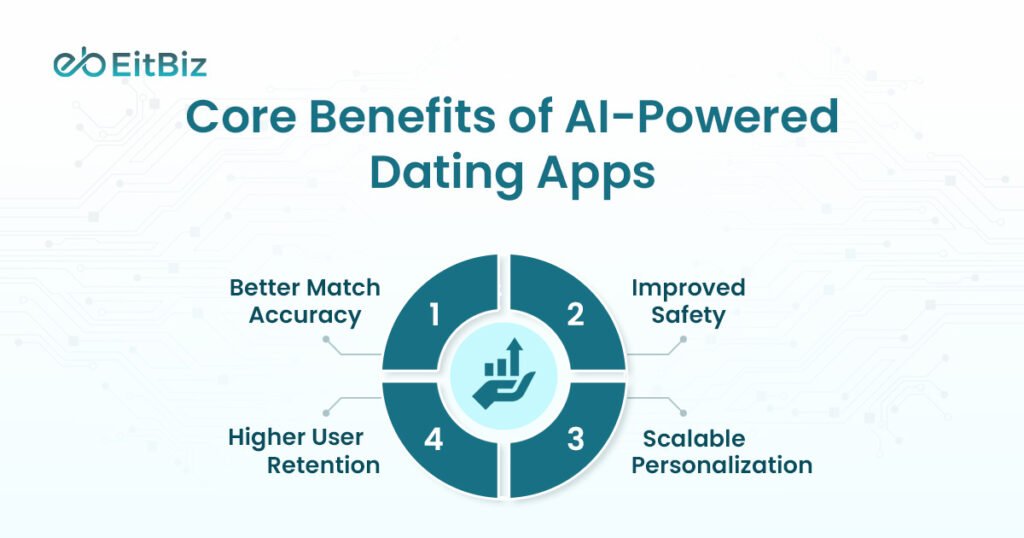
Before jumping into development decisions, it’s important to understand why startups and established companies are actively investing in AI-powered matchmaking apps. The value is not theoretical. It directly impacts match quality, user trust, and long-term growth.
1. Better Match Accuracy
Traditional dating apps rely on static filters, including age, distance, interests, and photos. AI goes further. It learns from how users actually behave inside the app.
For example, AI tracks:
- Which profiles users consistently like or skip
- How long do conversations last?
- When users unmatch or stop replying
- What types of profiles lead to real engagement?
Over time, AI identifies patterns that humans rarely articulate. It may be discovered that a user connects better with certain communication styles, values, or activity preferences, regardless of what they selected in their profile. This leads to matches based on compatibility, not just shared labels.
As a result, AI-powered matchmaking apps deliver fewer but more relevant matches, which users value more than endless swiping.
2. Higher User Retention
Swipe fatigue is one of the biggest reasons users abandon dating apps. Too many irrelevant matches create frustration, not excitement.
AI directly addresses this problem by refining recommendations with every interaction. When users see profiles that feel aligned with their intent, they stay longer and return more often.
From a product perspective, AI improves:
- Daily active users (DAU)
- Session length
- Match-to-conversation ratio
Users don’t consciously think, “This app uses AI.” They think, “This app understands what I’m looking for.” That perception builds emotional loyalty, which is critical in competitive dating markets.
One of the most prominent examples is Tinder, which uses AI and machine learning models to rank profiles and optimize match relevance, helping increase engagement and retention at scale.
3. Improved Safety
Safety is no longer optional in AI-powered dating apps. Users expect platforms to protect them without forcing them to report every issue manually.
AI helps by monitoring activity patterns in real time. It can:
- Detect abusive or threatening language in chats
- Identify bot-like behavior and scam signals
- Flag suspicious profiles based on messaging frequency or repetition
- Reduce catfishing through image analysis
For many users, safety features are a deciding factor when choosing one dating app over another. For example, Bumble uses AI-powered moderation tools to automatically detect inappropriate content and abusive language, creating a safer environment for users.
4. Scalable Personalization
Human matchmaking works well at small scales. It fails when millions of users join the platform.
AI solves this by delivering personalization automatically and consistently. Each user gets a tailored experience based on their behavior, preferences, and evolving intent without manual effort.
AI can personalize:
- Match suggestions
- Profile ranking
- Notification timing
- Conversation prompts
This level of customization scales across regions, cultures, and user segments. As the user base grows, the system improves instead of breaking down.
That scalability makes AI essential for modern dating platforms aiming for long-term growth
What are the Key AI Features for Dating Apps?
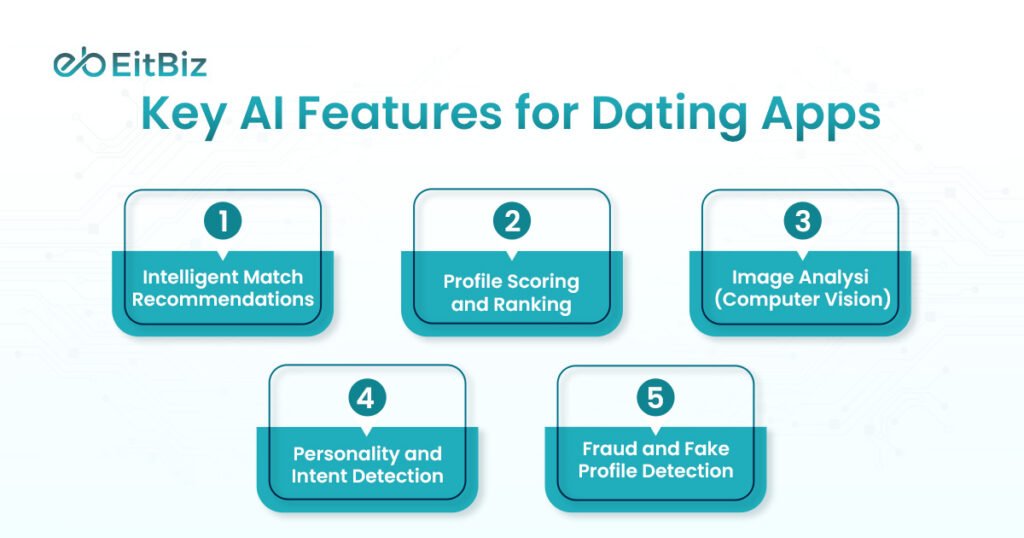
Let’s answer a common user question directly: What AI features should a modern dating app include? As more users demand smarter match experiences and safer interactions, incorporating advanced AI is no longer a “nice to have”; it’s expected. Below, we outline the most effective AI features for dating apps, with real-world examples and, where available, measurable results.
1. Intelligent Match Recommendations
At the heart of every great dating platform is relevance. Intelligent match recommendation systems go far beyond manual filters like age and geography. They analyze user behavior, past interactions, preferences, and feedback loops to deliver increasingly accurate suggestions over time.
These systems adapt dynamically. For example, if someone consistently swipes right on adventurous profiles but never starts chats afterward, the algorithm learns to adjust future recommendations. Many of today’s leading platforms already use variations of this approach. Hinge, for instance, uses AI to learn from engagement and refine match quality, helping it stand out in a crowded market with reported increases in paying users and stronger year-over-year revenue growth.
This power to learn and evolve is a key reason why AI dating app development teams focus early efforts on building adaptive algorithmic recommendation engines.
2. Profile Scoring and Ranking
Not every profile is equal, and AI knows it. Instead of presenting profiles in random order, modern apps use AI-powered ranking systems to score and prioritize profiles that are likely to lead to meaningful interactions.
These scoring models look at indicators like:
- Profile completeness and quality
- Photo engagement (which images get more swipes)
- Message responsiveness
- Length and tone of bios
Platforms like Tinder have experimented with AI tools that dynamically adjust photo display order based on engagement signals, a feature that can boost matches and reduce user fatigue.
AI-driven ranking doesn’t just show profiles randomly. It highlights users most likely to engage positively. That means higher-quality matches earlier in the app experience.
3. Image Analysis (Computer Vision)
Photos matter hugely. But many users struggle to choose the right ones. AI-powered computer vision features can analyze profile images to detect issues like poor lighting, low resolution, inappropriate content, or even deepfakes.
Computer vision also enables:
- Facial recognition for identity verification
- Automated content moderation
- Suggestions for better photos
Some platforms have even taken this further. Bumble’s AI-driven “Private Detector” automatically blurs inappropriate images before users view them, improving safety and comfort, a change that helped reduce scam attempts and boosted female engagement in metro markets where harassment concerns are especially great.
On the flip side, research into AI-generated images shows that authenticity matters: Studies found that overly synthetic photos can receive fewer meaningful replies, even if they initially attract swipes, highlighting why balanced, human-sensitive AI photo analysis is essential.
4. Personality and Intent Detection
Matching people based on shared traits isn’t just about what they choose on a form; it’s about understanding why they choose it.
AI-driven personality and intent detection uses techniques like natural language processing (NLP) to interpret bios and chat behavior. For example:
- Does this user express a desire for long-term relationships or casual meetings?
- Are their messages warm and engaging or curt and transactional?
- What personality traits emerge from written prompts?
Even mainstream apps are testing deeper AI personality features. Tinder’s new experimental “Chemistry” AI tool (with permission to review users’ camera roll for interest cues) aims to offer match suggestions that feel more personalized and psychologically aligned than swiping alone.
By interpreting intent, not just input, AI-powered dating apps can help users connect with those whose goals and styles truly align, not just those who tick the same checkboxes.
5. Fraud and Fake Profile Detection
Trust is foundational, and without it, users won’t stick around. One of the biggest challenges in online dating is bots, fake accounts, romance scams, and identity deception. That’s where AI’s ability to spot abnormal patterns becomes invaluable.
Leading platforms now use machine learning models to detect suspicious behavior patterns such as:
- Mass account creation
- Reused photos or deepfakes
- Rapid swipe-and-message behavior is typical of bots
- Contradictory profile data
Bumble’s AI-powered “Deception Detector,” for instance, flags up to ~95% of scam or fake accounts in internal tests, dramatically improving platform safety and fostering trust among users.
Similarly, many apps now require real-time selfie or short video checks to confirm identity, a strategy Tinder recently expanded in the US that resulted in a notable drop in “bad actor” reports.
In a world where romance scams have led to estimated global losses exceeding $1 billion in recent years, AI’s role in fraud prevention is inevitable.
How to Build an AI-Powered Dating App?
Building an AI-driven dating platform is not just about adding machine learning models. It requires clear intent, responsible data handling, and continuous learning. Below is a step-by-step breakdown of the dating app development lifecycle, based on how successful platforms approach it in practice.
Step 1: Define the Use Case
Every successful dating app starts with a clear audience and purpose. “Dating for everyone” sounds appealing, but it often leads to vague positioning and weak engagement.
You should decide early:
- Who is the app for?
- What problem does it solve better than existing platforms?
Some apps focus on serious relationships. Others serve professionals, niche communities, or specific belief systems. This decision directly influences how your AI matchmaking algorithm for dating apps works. For example, an app designed for long-term relationships should prioritize values and communication patterns, not just attraction signals.
Clear use cases help AI models learn faster and reduce irrelevant matches.
Step 2: Data Strategy
AI systems are only as good as the data behind them. A strong data strategy ensures accuracy, fairness, and user trust.
At this stage, you define:
- What data do you collect (profile data, swipes, & chat behavior)
- How do you store it securely
- How long do you retain it
- How users can control or delete their data
Compliance with GDPR, CCPA, and similar regulations is not optional. Dating apps handle sensitive personal information, and mishandling it permanently damages their credibility.
Step 3: MVP with Core AI
Many teams fail by overbuilding too early. The smarter approach is to launch an MVP with only essential AI features for dating apps.
Focus on:
- Basic AI-driven match recommendations
- Profile verification or fraud detection
- Simple behavioral learning (likes, skips, message starts)
This phase validates whether your AI actually improves match quality. Real user feedback is more valuable than complex models trained on assumptions.
A focused MVP reduces development risk and provides real-world data for future optimization.
{Also Read: MVP Development for Startups (2026 Guide)}
Step 4: Model Training and Testing
Once users interact with the MVP, the real AI work begins.
You train models using anonymized data to protect privacy while extracting meaningful patterns. Testing should go beyond accuracy and include:
- Bias detection across age, gender, and location
- False positives in safety systems
- Match success rates over time
Ethical testing matters. Dating apps influence real human relationships, so biased or unfair models can cause harm. Teams that actively audit their AI gain user trust and reduce regulatory risk.
{Also Read: The Essential Guide to Mobile App Testing You Can’t Skip}
Step 5: App Development
With validated AI logic, teams move into full-scale app development.
At this stage, developers:
- Build native iOS and Android apps or use cross-platform frameworks
- Integrate AI APIs and cloud services
- Optimize performance for real-time matching and chat analysis
The goal is to make AI invisible to users. Matches should feel natural, not mechanical. Latency, crashes, or slow updates undermine even the best algorithms.
Strong engineering ensures that AI-powered dating apps feel smooth, responsive, and human-centric.
Step 6: Monitoring and Iteration
AI systems never stop learning, and neither should your product team.
Post-launch, you track:
- Match-to-conversation ratios
- Conversation duration
- Retention and churn
- User complaints and reports
These signals feed back into the system. If users disengage after matches, the algorithm needs refinement. If safety reports increase, detection models need adjustment.
Continuous iteration keeps the app aligned with real user behavior and evolving dating norms.
What is the Technology Stack Used for AI Dating App Development?
Choosing the right technology stack is essential for building a scalable, secure, and intelligent dating platform. The following stack is commonly used in AI dating app development and supports both MVP launches and future feature expansion.
| Technology Layer | Recommended Technologies |
| Frontend (Mobile App) | React Native, Flutter, Swift (iOS), Kotlin (Android) |
| Backend Development | Node.js, Python (Django, FastAPI) |
| Database | PostgreSQL, MongoDB, Firebase |
| AI / Machine Learning | TensorFlow, PyTorch, Scikit-learn |
| Natural Language Processing (NLP) | spaCy, Hugging Face, OpenAI APIs |
| Computer Vision | OpenCV, Amazon Rekognition, Google Vision API |
| Recommendation Engine | Collaborative filtering, hybrid ML models |
| Cloud Infrastructure | AWS, Google Cloud, Microsoft Azure |
| Security & Compliance | OAuth 2.0, JWT, AES encryption |
| Analytics & Monitoring | Google Analytics, Mixpanel, custom dashboards |
What is the AI-Powered Dating App Development Cost?
If you’re wondering- How much does it cost to build an AI-powered dating app? The answer is that the cost to build an AI-powered dating app may go up to $50,000 or more, depending on the type of app you want to build, features to integrate, technologies used, developers involved, and more. Here’s the complete AI-powered dating app development cost breakdown.
| Cost Section | Estimated Cost |
| Product Discovery & Planning | $4,000 |
| UI/UX Design | $6,000 |
| Core App Development | $15,000 |
| AI Matchmaking Engine | $10,000 |
| AI Safety & Trust Features | $6,000 |
| Image Analysis (Basic AI) | $4,000 |
| Backend & Cloud Infrastructure | $3,000 |
| Testing & Quality Assurance | $2,000 |
| Deployment & Launch Support | $1,000 |
Note: Actual development costs may vary based on feature complexity, AI model customization, technology stack, compliance requirements, third-party integrations, and more.
AI-Powered Dating App Development Cost: What Actually Drives the Budget?
When businesses ask about AI-powered dating app development cost, they are rarely just asking for a number. What they really want to know is why costs vary and where the money goes.
A realistic cost discussion looks beyond surface features and focuses on the technical and operational factors that shape development budgets.
1. Scope of AI Features
AI is not a single feature; it’s a system. The more intelligence you add, the more time and expertise the project requires.
For example:
- Basic AI matchmaking using behavioral data is far more affordable than deep learning models trained on long-term interaction history.
- Simple rule-assisted moderation costs less than real-time NLP-based abuse detection.
- Pre-built AI APIs reduce costs compared to custom-trained models.
A $50,000 MVP typically includes core AI features such as behavior-based matching, basic fraud detection, and limited personalization. Advanced predictive analytics and emotional sentiment models usually come later.
For example, one of the most widely recognized AI-powered dating apps is Hinge. Hinge has actively integrated machine learning into its matchmaking process, including AI-driven compatibility scoring and personalized recommendations. According to recent reporting, Hinge’s use of its Core Discovery Algorithm has helped boost matches and contact exchanges by around 15%, demonstrating how even incremental AI enhancements can meaningfully improve engagement and perceived value.
2. Data Collection and Privacy Requirements
Dating apps handle sensitive personal data, which increases development responsibility.
Costs rise when teams must:
- Design secure data pipelines
- Encrypt personal and conversational data
- Implement user consent and deletion workflows
- Ensure compliance with GDPR, CCPA, or regional regulations
While these steps don’t always appear as visible features, they are essential for trust and legal compliance. Cutting corners here may reduce short-term cost but increases long-term risk significantly.
3. AI Model Type: Custom vs Pre-Built
One of the biggest cost differentiators in AI-powered dating app development is whether you use off-the-shelf AI tools or build custom models.
- Prebuilt AI services (for image moderation, NLP, or recommendations) reduce upfront costs and accelerate launch.
- Custom AI models offer more control and differentiation but require higher upfront investment and ongoing tuning.
Most startups stay within budget by starting with proven AI APIs and gradually transitioning to custom models as user data grows.
4. Platform Choice and Architecture
Your platform strategy directly affects development cost.
- Cross-platform frameworks (Flutter, React Native) reduce cost by sharing codebases.
- Native development offers better performance but costs more.
- Cloud-first architectures lower infrastructure costs early but require scaling plans.
For AI-driven apps, backend efficiency matters more than front-end complexity. Poor backend design can increase AI processing costs over time.
5. Ongoing AI Maintenance Costs
AI is not “set and forget.” Models require continuous updates to stay accurate and fair.
Ongoing costs include:
- Model retraining with new user data
- Monitoring match quality and false positives
- Adjusting algorithms to reduce bias
- Scaling infrastructure as users grow
In most cases, ongoing AI maintenance ranges from $2,000 to $5,000 per month, depending on usage volume and model complexity.
6. Why a $50,000 Budget Still Works
A $50,000 budget works when the focus stays on:
- Validating the concept
- Delivering meaningful matches
- Ensuring basic safety and trust
- Preparing the platform for future AI upgrades
Many successful dating platforms started with limited AI capabilities and expanded only after understanding real user behavior. This staged investment approach reduces waste and improves long-term outcomes.
To calculate the approximate AI-powered app development cost, click here.
Final Thoughts
AI is no longer an experimental add-on in the dating industry. It has become a core driver of better matches, safer interactions, and higher user trust. From intelligent matchmaking to fraud detection and personalized communication, AI helps dating platforms move beyond endless swiping toward more meaningful connections.
However, building a successful AI-powered dating app requires more than choosing the right algorithms. It demands a clear use-case definition, responsible data handling, ethical AI practices, and a development approach that prioritises real user behavior over assumptions. When done right, even a focused MVP with a controlled budget can deliver measurable value and long-term scalability.
If you’re planning to launch or scale an AI-powered dating app, partnering with an experienced development team makes a measurable difference. EitBiz is a trusted AI-powered dating app development company that specializes in AI-driven mobile app development, combining technical expertise with a deep understanding of user behavior, data security, and scalable architecture.
Whether you’re validating an MVP within a defined budget or expanding existing features with advanced AI capabilities, our AI-powered matchmaking app development experts help turn ideas into reliable, market-ready products, without unnecessary complexity.
Ready to build smarter, safer, and more engaging dating experiences? Connect with EitBiz and start building with clarity and confidence.
FAQs
1. What does AI-powered dating app development cost on average?
Generally, AI-powered dating app development costs range from $5,000 to $50,000. The cost can increase with deeper AI integration, such as emotion recognition, advanced NLP, and real-time analytics. These figures reflect general trends in the market for intelligent mobile apps today.
2. How much does AI actually improve match quality in dating apps?
AI isn’t just a buzzword in dating; it drives measurable impact. According to industry research, AI matchmaking can improve match success rates by up to 30% compared with traditional static algorithms. Additionally, nearly 78% of users prefer dating apps that use AI-powered matchmaking algorithms, indicating they value smarter connections over random swiping.
3. Are AI dating apps more engaging than traditional dating apps?
Yes. AI-powered matchmarking apps tend to increase user engagement. In surveys, 85% of dating apps with AI features report increased user engagement, driven by more personalized recommendations, better safety filters, and dynamic user experiences.
4. Do users trust AI recommendations on dating apps?
Trust varies among users, but a growing number see AI as beneficial. Recent statistics show that 72% of users feel AI matchmaking offers a more personalized experience, and around 78% prefer AI-assisted match suggestions because they feel more relevant and less random than traditional filters.
5. How do AI features impact safety and moderation on dating platforms?
Safety is a major driver for AI integration. AI can detect inappropriate content, scam patterns, and fake profiles with high accuracy; some systems reach over 90% effectiveness in identifying catfishing and fraudulent accounts. This significantly reduces manual moderation costs and increases user trust and retention over time.