Key Takeaways
- In 2026, AI has become a core part of business strategy, helping companies improve efficiency, decision-making, and overall competitiveness.
- While AI development costs can range widely, businesses that implement AI with clear goals often see strong returns through automation and growth.
- Functions like customer support, marketing, sales, and operations benefit the most from AI solutions for business.
- Without proper planning, data quality, and execution, AI projects can fail to deliver expected results despite strong potential.
- AI offers powerful advantages, but companies need to manage challenges like integration, cost, and data security to fully benefit from AI-powered solutions.
AI is no longer a “future trend” for companies; it’s already shaping how businesses operate in 2026. From improving decision-making to automating daily operations, leaders are now actively exploring whether AI for business is actually worth the investment or just another tech buzzword.
What’s interesting is how quickly adoption has grown. According to McKinsey, about 72% of organizations have adopted at least one AI capability in their operations, showing how deeply artificial intelligence has entered mainstream business strategy.
Companies are now using AI solutions for business to automate workflows, improve customer support with AI chat systems, and speed up marketing and sales processes. At the same time, generative AI for business is helping teams create content, analyze data, and make faster decisions with less manual effort.
Even smaller companies are adopting AI tools for small businesses to stay competitive, while larger organizations invest in enterprise-level systems to scale operations efficiently.
But as adoption grows, so does the big question: does AI really deliver measurable returns, especially when you factor in implementation effort and cost? The sections ahead break down the real value, costs, and ROI of AI in 2026 so you can decide whether it fits your business strategy.
What Can AI Do for Business in 2026? Real-World Impact of AI for Business
In 2026, AI for business has moved far beyond experimentation. It now plays a direct role in how companies run operations, improve efficiency, and grow revenue. The impact is visible across automation, customer experience, and decision-making, especially as more companies adopt AI solutions for business to stay competitive.
Automation of repetitive business processes
One of the most practical uses of AI for business automation is removing repetitive, low-value tasks from daily workflows. Companies now use AI to handle invoicing, data entry, reporting, and scheduling with minimal human involvement. This reduces operational workload, lowers error rates, and allows employees to focus on higher-impact responsibilities like strategy and innovation. Over time, this also improves overall business speed and consistency.
Smarter customer support through AI chat systems
Modern AI chatbots for business have become far more advanced and are now capable of handling complex customer queries in real time. They provide instant responses, operate 24/7, and deliver more personalized interactions based on user behavior. This improves customer satisfaction while significantly reducing support costs, making AI-driven support systems a core part of modern service strategies.
Better decision-making with AI-driven insights
With AI for business development, companies can analyze large volumes of data to uncover patterns, predict trends, and identify growth opportunities. Instead of relying only on historical reports, businesses now use predictive insights to guide marketing, product planning, and expansion strategies. This leads to faster, more accurate decisions in highly competitive markets.
Content creation and innovation using generative AI
Generative AI for business is transforming how teams create content and develop ideas. Marketing teams use it to generate ads, blogs, and campaigns quickly, while product teams use it for brainstorming and early-stage design. This accelerates innovation cycles and reduces dependency on large creative teams, especially in fast-moving industries.
Improved efficiency and cost optimization across operations
AI helps businesses identify inefficiencies in workflows, supply chains, and resource usage. By analyzing operational data, companies can optimize processes, reduce waste, and improve productivity. This results in better cost control and stronger operational performance without compromising quality.
More personalized customer experiences at scale
AI enables businesses to deliver highly personalized recommendations, offers, and communication. By analyzing user behavior and preferences, companies can create targeted experiences that improve engagement and conversion rates. This level of personalization was previously difficult to achieve at scale without AI solutions for business.
The Rise of AI Solutions for Business and AI Development Solutions Across Industries
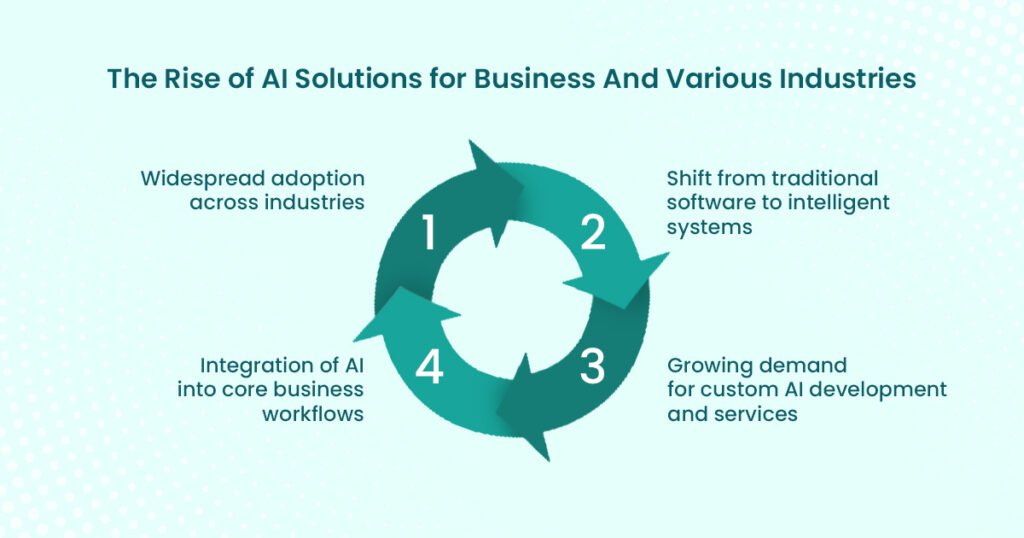
In 2026, AI solutions for business have become a core part of how industries operate, rather than an experimental add-on. Companies across sectors are integrating AI into their daily workflows to improve efficiency, reduce costs, and stay competitive in rapidly evolving markets.
Widespread adoption across industries
AI-powered solutions are now used across healthcare, finance, retail, and manufacturing. Businesses rely on AI for tasks like fraud detection, demand forecasting, and customer personalization. This cross-industry adoption shows that AI is no longer limited to tech companies; it has become a standard tool for improving performance and decision-making everywhere.
Shift from traditional software to intelligent systems
Unlike traditional software, modern AI solutions for business continuously learn from data and improve over time. These systems adapt to changing conditions, making them far more effective in dynamic environments. This shift allows businesses to move from fixed-rule processes to more flexible, data-driven operations.
Growing demand for custom AI development and services
As businesses look for tailored solutions, the demand for AI development services has increased significantly. Many businesses now partner with an AI development company to build systems that align with their specific goals. This trend has made AI more accessible and practical for businesses of all sizes.
Integration of AI into core business workflows
Instead of using AI as a separate tool, companies are embedding it directly into their operations. From supply chain optimization to customer engagement, AI for business automation is now part of everyday processes. This deep integration helps organizations operate faster, reduce inefficiencies, and scale more effectively.
Key Benefits of AI for Business Automation and Growth
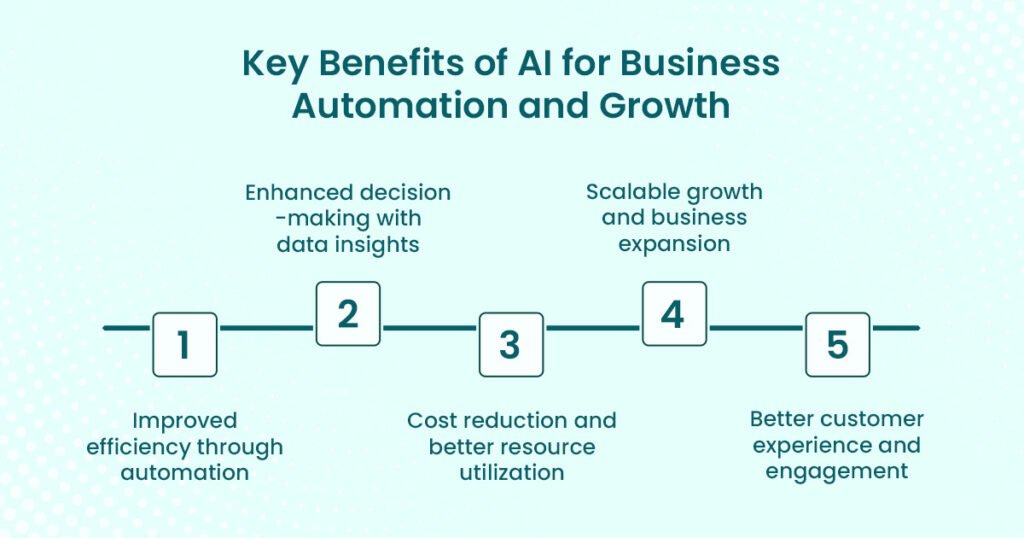
AI is helping businesses move faster, operate smarter, and scale more efficiently by combining automation with data-driven intelligence. Here are some of the most impactful benefits companies are seeing in 2026
Improved efficiency through automation
One of the biggest advantages of AI for business automation is its ability to handle repetitive tasks with speed and accuracy. From processing data to managing routine workflows, AI reduces the need for manual intervention. This not only saves time but also minimizes errors, allowing teams to focus on strategic work that drives growth.
Enhanced decision-making with data insights
Modern AI solutions for business analyze large volumes of data in real time, helping companies make faster and more informed decisions. Instead of relying on guesswork or delayed reports, businesses can use predictive insights to identify trends, understand customer behavior, and plan more effectively.
Cost reduction and better resource utilization
AI helps optimize how businesses use their resources by identifying inefficiencies and streamlining operations. While there is an upfront AI development cost, the long-term savings from automation, reduced errors, and improved productivity often outweigh the initial investment.
Scalable growth and business expansion
With AI-powered solutions, businesses can scale operations without proportionally increasing their workforce. Whether it’s handling more customer queries, processing higher transaction volumes, or expanding into new markets, AI enables growth without adding significant overhead.
Better customer experience and engagement
AI-driven systems, including AI chatbots for business, allow companies to deliver faster and more personalized customer interactions. By understanding user preferences and behavior, businesses can offer tailored experiences that improve satisfaction, increase retention, and ultimately drive revenue growth.
Understanding AI Development Cost in 2026
In 2026, the cost of building and adopting AI varies widely depending on business needs, complexity, and scale. While many companies are eager to invest in AI for business, understanding the actual cost structure is essential to avoid overspending and ensure a strong return on investment.
Project scope and complexity drive the overall cost
The biggest factor influencing AI development cost is the complexity of the solution. A simple chatbot or automation tool costs significantly less than building advanced predictive systems or custom AI platforms. Businesses need to clearly define their use case before starting, as broader or unclear requirements can quickly increase development time and expenses.
Custom development vs ready-made AI solutions
Companies can choose between off-the-shelf tools or fully customized systems. Pre-built AI solutions for business are more affordable and quicker to implement, making them ideal for small to mid-sized companies. On the other hand, custom solutions, often built by an AI development company, offer better flexibility and scalability but come with higher upfront costs.
Cost of hiring AI talent and expertise
Skilled professionals play a major role in pricing. Hiring an experienced AI developer or working with a specialized team increases costs but ensures better quality and performance. Businesses may also need data scientists, engineers, and domain experts, especially for complex AI implementation projects.
Infrastructure and data-related expenses
AI systems require strong infrastructure, including cloud computing, storage, and data processing capabilities. Managing and preparing high-quality data also adds to the cost. These ongoing expenses are often overlooked but are critical for maintaining the performance of AI-powered solutions.
Maintenance, updates, and scaling costs
AI is not a one-time investment. Models need regular updates, monitoring, and improvements to stay effective. As businesses grow, scaling AI systems can also increase costs. Planning for long-term maintenance is essential to ensure that the initial AI development cost continues to deliver value over time.
How Much Does AI Development Cost in 2026?
The cost of implementing AI for business can vary depending on the complexity, features, and level of customization required. In 2026, most businesses can expect AI development costs to range between $5,000 to $50,000, especially for small to mid-scale solutions. Below is a simple breakdown to help you understand what you get at different price levels:
| Cost Range | Type of AI Solution | Features Included | Best For |
| $5,000 – $10,000 | Basic AI tools/automation | Simple chatbots, basic automation, pre-built AI solutions for business | Startups & small businesses |
| $10,000 – $25,000 | Mid-level AI systems | Custom workflows, integrations, analytics, and improved AI for business automation | Growing businesses |
| $25,000 – $50,000 | Advanced AI solutions | Custom-built systems, predictive models, scalable AI-powered solutions | Mid to large-scale companies |

AI ROI: How Businesses Measure Real Returns
Investing in AI for business only makes sense when companies can clearly measure the value it delivers. In 2026, businesses no longer rely on vague expectations; they track specific metrics to understand how AI solutions for business contribute to growth, efficiency, and profitability.
Investing in AI for business only makes sense when companies can clearly measure the value it delivers. In 2026, businesses no longer rely on vague expectations; they track specific metrics to understand how AI solutions for business contribute to growth, efficiency, and profitability.
Productivity and efficiency improvements
One of the most direct ways to measure ROI is through time savings and output gains. With AI for business automation, companies track how many hours are saved by automating tasks like data entry, reporting, or customer support. Increased productivity across teams often translates into faster project completion and reduced operational delays.
Cost savings and operational reduction
Businesses evaluate how AI reduces expenses by lowering labor costs, minimizing errors, and optimizing workflows. Even though there is an initial AI development cost, companies measure how quickly those costs are recovered through reduced spending in daily operations and improved efficiency.
Revenue growth and conversion impact
AI-driven tools help businesses increase revenue by improving customer targeting, personalization, and sales processes. Companies measure ROI by tracking higher conversion rates, increased average order value, and improved customer acquisition. These gains often come from smarter insights provided by AI-powered solutions.
Customer experience and retention metrics
Another key ROI indicator is customer satisfaction. Businesses using AI chatbots for business and personalization tools monitor response times, engagement levels, and retention rates. Better customer experiences often lead to repeat purchases and stronger brand loyalty, which directly impacts long-term revenue.
Speed and quality of decision-making
AI enables faster, data-driven decisions, which can significantly impact business performance. Companies measure how quickly they can respond to market changes, identify opportunities, and reduce risks. Improved decision-making speed and accuracy are a critical but often underestimated return on AI investment.
Where AI Delivers the Most Value
Here’s a quick overview of the key areas where AI for business delivers the most value in 2026:
| Business Area | How AI Adds Value | Key Benefit |
| Customer Support | AI chatbots handle queries, provide 24/7 support, and reduce response time | Lower costs & better customer experience |
| Marketing | Personalized campaigns and customer targeting using data insights | Higher engagement and conversions |
| Sales | Lead scoring, customer insights, and predictive analytics | Faster deal closures and better targeting |
| Operations | Workflow automation, demand forecasting, and process optimization | Improved efficiency and reduced costs |
| Finance | Fraud detection, risk analysis, and automated reporting | Better accuracy and risk management |
Challenges and Risks in AI Implementation
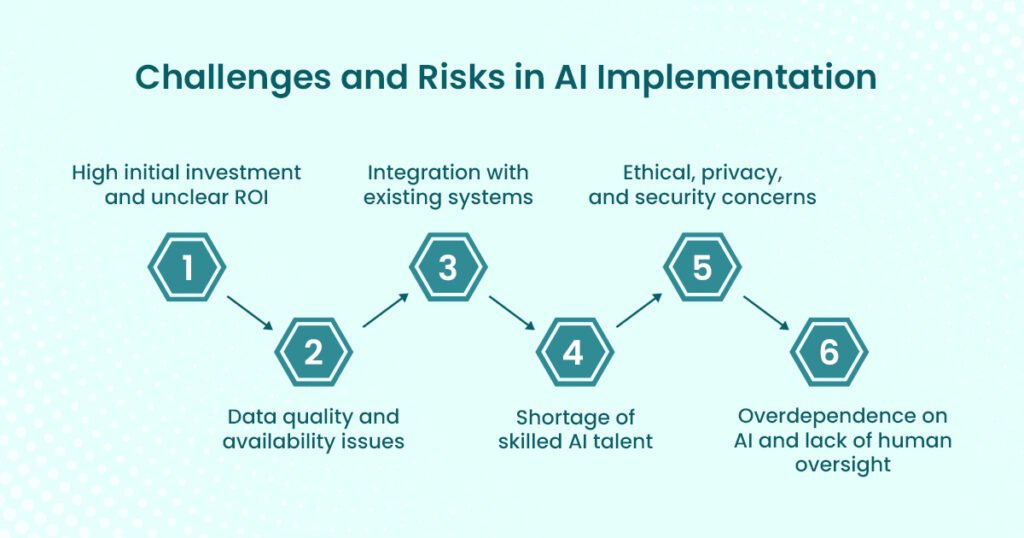
While AI for business offers clear benefits, implementing it successfully comes with its own set of challenges. Many companies struggle not because AI doesn’t work, but because of gaps in strategy, data, or execution. Understanding these risks early helps businesses plan better and avoid costly mistakes.
High initial investment and unclear ROI
One of the biggest concerns is the upfront AI development cost. Businesses often invest in tools or custom solutions without a clear roadmap for returns. Without defined goals and measurable KPIs, it becomes difficult to justify the investment, especially for small and mid-sized companies.
Data quality and availability issues
AI systems rely heavily on data, and poor-quality or incomplete data can lead to inaccurate results. Many organizations lack clean, structured datasets, which makes AI implementation more complex and less effective. Without strong data foundations, even the best AI models fail to deliver meaningful outcomes.
Integration with existing systems
Integrating AI solutions for business into legacy systems can be technically challenging. Businesses often face compatibility issues, workflow disruptions, and additional costs when trying to connect AI with their current infrastructure. This slows down adoption and increases implementation complexity.
Shortage of skilled AI talent
Building and managing AI systems requires expertise that is still in high demand. Hiring an experienced AI developer or working with a reliable AI development company can be expensive and competitive. This talent gap often delays projects or affects the quality of implementation.
Ethical, privacy, and security concerns
AI systems process large amounts of sensitive data, raising concerns around privacy and compliance. Businesses must ensure that their AI-powered solutions follow data protection regulations and ethical guidelines. Failing to do so can lead to legal risks and damage to brand reputation.
Overdependence on AI and lack of human oversight
Relying too heavily on AI without proper monitoring can create risks, especially if models produce incorrect or biased outputs. Businesses need to maintain a balance between automation and human judgment to ensure accuracy and accountability.
AI for Small Business vs Enterprise AI Solutions
AI adoption looks very different depending on the size and scale of a business. While both small businesses and large enterprises benefit from AI for business, their approach, investment level, and implementation strategies vary significantly.
Adoption approach and investment level
Small businesses typically adopt AI in a gradual and cost-conscious way. They rely on ready-made AI tools for small businesses, such as chatbots, marketing automation platforms, or analytics tools that are easy to implement and require minimal upfront investment. In contrast, large organizations invest heavily in enterprise AI solutions, building custom systems that integrate across multiple departments and support complex operations.
Customization vs accessibility
For small businesses, accessibility and ease of use matter more than deep customization. They prefer plug-and-play AI solutions for business that solve specific problems quickly. Enterprises, on the other hand, often require highly customized systems tailored to their workflows, which are usually developed through an AI development company or in-house teams.
Scalability and use cases
Small businesses use AI for focused tasks like customer support, marketing, and basic automation. Their goal is to improve efficiency without increasing costs. Enterprises apply AI at scale, across supply chains, finance, HR, and operations, making it a core part of their infrastructure. This allows them to automate large-scale processes and gain deeper insights from massive datasets.
Resource availability and expertise
Large enterprises have the resources to hire specialized talent, including experienced AI developers, data scientists, and engineers. They may also invest in long-term AI development services to build and maintain complex systems. Small businesses, however, often lack these resources and depend on third-party platforms or managed services to implement AI effectively.
Risk and implementation complexity
For small businesses, the main challenge is budget and choosing the right tools. For enterprises, the challenge lies in managing complexity, integrating AI into existing systems, ensuring data security, and scaling solutions across the organization. As a result, enterprise-level AI implementation tends to be more time-consuming but also delivers a larger long-term impact.

Is AI Worth the Investment in 2026?
In 2026, AI for business is worth the investment for most companies, but only when it is aligned with clear goals and practical use cases. Businesses that adopt AI solutions for business to solve specific problems like automating customer support, improving marketing performance, or streamlining operations are seeing measurable gains in efficiency and revenue. While the initial AI development cost can seem significant, the long-term value often outweighs it through reduced operational expenses, better decision-making, and increased productivity.
At the same time, AI is not a guaranteed success for every business. Companies that invest without a clear strategy or rely on AI for the wrong applications may struggle to see returns. The real value comes from thoughtful implementation, starting small, focusing on high-impact areas, and scaling gradually with the help of AI-powered solutions. In today’s competitive landscape, AI is less of a luxury and more of a strategic tool that, when used correctly, can deliver strong and sustainable business growth.
How EitBiz Can Help in AI Development?
EitBiz is a trusted AI development company that builds and delivers scalable digital solutions, combining mobile app expertise with advanced AI development services. With a strong focus on innovation and business outcomes, the company helps organizations transform their ideas into powerful, AI-driven applications. Whether it’s building intelligent mobile apps or implementing AI for business automation, EitBiz ensures that every solution is tailored to meet specific goals while remaining efficient and cost-effective.
What sets EitBiz apart is its proven track record and client-focused approach.
- 750+ projects delivered across diverse industries, demonstrating strong technical expertise
- 8+ years of experience in mobile app and AI development
- 93% client retention rate, reflecting high client satisfaction and long-term partnerships
EitBiz follows a structured, end-to-end development approach that begins with understanding your business needs and identifying the right AI use cases. From there, the team designs, develops, and integrates customized solutions that align with your workflows. What makes EitBiz different from others is its focus on practical implementation rather than just technology, ensuring that every solution delivers real business value. With continuous support, transparent communication, and a strong emphasis on scalability, EitBiz helps businesses adopt AI confidently and achieve long-term success through reliable AI-powered solutions.