Building an app is no longer optional for many startups, but building the right app is where most founders struggle.
Every week, startup founders face the same real-world problem: they have a solid idea, early market interest, and limited capital, yet no clear execution roadmap.
- Should they build fast or build right?
- Invest in a complete product or test with an MVP?
- Hire developers or outsource?
These decisions are not technical; they are business-critical.
The risk is real. According to CB Insights, 38% of startups fail because they run out of cash, and flawed product development decisions play a major role in that failure rate.
This is why App development for startups demands a different mindset than traditional software development. Speed, validation, cost control, and scalability must align from day one.
So, how do successful founders approach mobile app development for startups without burning time and money and still build something users want?
This practical startup app development guide answers that question with clear steps, real trade-offs, and actionable insights designed for early-stage teams.
Why is App Development Different for Startups?
Here are the core reasons app development works differently for startups.
1. Budget Constraints Are Non-Negotiable
For startups, budget is not a guideline; it’s a hard limit.
Every dollar spent on development is a dollar not spent on marketing, hiring, or extending runway. Unlike enterprises, startups cannot absorb cost overruns or long development cycles. Overspending early often forces founders to make rushed decisions later or to engage in premature fundraising.
Industry data shows that 38% of startups run out of cash before finding traction. This makes cost-aware development essential, not optional. Startups must choose lean architectures, limited features, and development approaches that maximize learning per dollar spent.
The goal isn’t to build cheap software. It’s to build only what is necessary to test the business idea.
2. Requirements Are Unclear by Nature
Startups rarely start with perfect clarity, and that’s normal.
Early assumptions about users, features, and workflows are often wrong. What founders think users want frequently changes after real-world usage begins. This uncertainty makes traditional, fixed-scope development models risky for startups.
In startup app development, requirements evolve as:
- Users interact with the product
- Data reveals behavior patterns
- Feedback exposes friction points
Successful startup teams plan for change instead of resisting it. They build flexible systems and accept that iteration is part of the process, not a failure of planning.
3. Speed Matters More Than Perfection
For startups, speed is a competitive advantage.
Launching earlier allows startups to:
- Validate demand faster
- Collect real user data
- Adjust direction before resources are depleted
A study by Harvard Business School found that startups that test and iterate early are significantly more likely to pivot successfully and survive longer. Perfection delays learning, and delayed learning increases risk.
This is why mobile app development for startups emphasizes fast MVP releases over feature-complete products. A simple, usable app in users’ hands is more valuable than a perfect app no one has seen.
From Idea to MVP: Startup App Journey
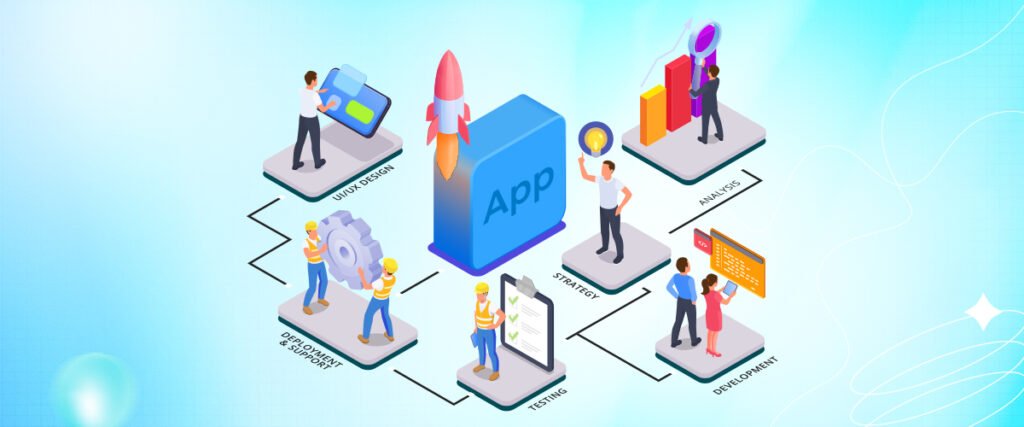
Every successful app follows a clear journey, from uncertainty to validation. Startups that skip steps often pay for it later through wasted budget, low adoption, or complete product failure. In App development for startups, the MVP journey is not about speed alone; it’s about making informed decisions at every stage.
1. Idea Validation
Before writing a single line of code, startups must validate the problem, not the solution.
Many founders fall in love with their idea, but the market may not share that enthusiasm.
This stage involves talking directly to potential users, not relying on assumptions. Interviews, surveys, and informal conversations help uncover real pain points. Competitor analysis adds context by showing what already exists and where gaps remain.
Ask yourself: Are people actively trying to solve this problem today?
Even simple validation tools, such as a landing page, waitlist, or clickable prototype, can reveal whether users care enough to engage. These small experiments often save months of unnecessary development.
2. Define Core Features
Once the problem is validated, the next challenge is restraint.
Startups frequently fail not because they build the wrong thing, but because they build too much. Feature overload increases cost, delays launch, and confuses users. Research shows that nearly 80% of app features are rarely or never used, yet they consume significant development time.
This is where focus becomes critical.
Ask:
- What is the single problem this app must solve at launch?
- Which features are absolutely required for users to get value?
Anything that does not directly support that core use case belongs in the backlog. In startup app development, clarity beats completeness every time.
3. Design for Usability
Usability is not optional, it determines survival.
Users form an opinion about an app within seconds. If onboarding is confusing or workflows feel complex, they leave. Industry data shows that over 70% of users abandon an app within the first few days due to poor user experience.
Good design focuses on removing friction. Clear user flows guide people naturally. Simple navigation reduces cognitive load. Minimal steps help users reach value faster.
Ask yourself: Can a first-time user understand what to do without instructions?
For startups, effective UX design is not about aesthetics. It’s about ensuring users experience value as quickly as possible.
4. Build the MVP
MVP Development is where ideas meet reality.
An MVP is not a demo or a concept; it is a functional product that real users can interact with. Its purpose is to test assumptions, measure engagement, and collect feedback.
In app development for startups, the MVP represents the smallest version of the product that still delivers meaningful value. It should be stable, usable, and measurable, but not overbuilt.
This stage answers the most important question of all:
Will users actually use this product when it exists?
Only after this answer becomes clear should startups invest in scaling, optimization, and advanced features.
How to Choose the Right Tech Stack for Mobile App Development for Startups?
Selecting the right tech stack is crucial for startups because it impacts development speed, cost, scalability, and future iterations. Here’s a simplified breakdown of essential layers and popular technology options used in startup app development:
| Layer | Technology Options |
| Frontend (Mobile App) | React Native, Flutter, Swift (iOS), Kotlin (Android) |
| Backend | Node.js, Django, Firebase |
| Database | PostgreSQL, MongoDB |
| Cloud & Hosting | AWS, Google Cloud, DigitalOcean |
| APIs & Integrations | Stripe, Twilio, Auth0 |
What is the Difference Between MVP vs Full Product?
One of the most critical decisions in startup app development is whether to build a Minimum Viable Product (MVP) or a full-featured product. Choosing incorrectly can waste months of effort and tens of thousands of dollars.
What Is an MVP?
An MVP is the simplest version of your app that still delivers value to users. It focuses on core features only, enough to validate your business idea and collect real user feedback.
Key characteristics of an MVP:
- Limited, essential features only
- Basic design and user interface
- Functional enough to solve the primary user problem
- Built for learning, not scaling
Startups use MVPs to answer questions like:
“Will users pay for this service?” or “Does this feature solve a real problem?”
According to a 2022 report by Startup Genome, startups that launch an MVP before building a full product are twice as likely to achieve product–market fit compared to those that build first and test later.
{Also Read: MVP Development for Startups (2026 Guide)}
What Is a Full Product?
A full product includes:
- Advanced features and multiple user flows
- Polished UI/UX
- Optimized performance and reliability
- Infrastructure built for scale
Full products are designed for long-term growth, retention, and revenue. They are appropriate only after your core assumptions are validated.
Building a full product too early is risky. It increases development cost, delays launch, and may result in building features nobody wants.
What is the Cost of App Development for Startups?
One of the first questions founders ask is: “How much will it cost to build my app?” The answer is not fixed. Costs vary widely depending on features, platforms, tech stack, design, and whether you hire in-house or outsource. Understanding the breakdown is essential for budget planning and fundraising.
According to Clutch 2023, the average mobile app development cost is between $5,000 and $50,000, but startups can launch an MVP for less cost if they prioritise core functionality.
What are the Factors That Affect the Cost of App Development for Startups?
1. Number of Features
More features mean more development time. A simple MVP may have 3–5 core features, while a full product may have 15+.
2. Platforms (iOS, Android, or Both)
Cross-platform apps using React Native or Flutter reduce cost. Building native iOS and Android apps separately increases development effort by 50–70%.
3. Design Complexity
Custom UI/UX and animations add development hours. Simple, clean design is often sufficient for MVPs.
4. Backend & Infrastructure
Apps that require real-time data, heavy analytics, or complex integrations will need more robust backend solutions, increasing cost.
5. Development Approach
- In-house team: Higher cost due to salaries, benefits, and recruitment
- Outsourcing: Can reduce costs by 30–50% without sacrificing quality, especially in regions like Eastern Europe or Asia
| Type of App | Estimated Cost |
| Simple MVP | $5,000 – $15,000 |
| Medium Complexity | $15,000 – $35,000 |
| Advanced / Full Product | $35,000 – $50,000+ |
Timeline: How Long Does It Take?
For startups, time is one of the most critical resources. The faster you get your app into users’ hands, the sooner you can validate assumptions, collect feedback, and iterate. Delays not only increase costs but can also give competitors an advantage.
According to a 2022 GoodFirms report, the average mobile app development timeline ranges from 2 to 12 months, depending on complexity. Understanding typical milestones helps founders plan budgets, marketing, and fundraising accordingly.
In-House vs Outsourcing: What to Choose in 2026?
Choosing in-house development or outsourcing is one of the most strategic decisions in startup app development. It determines cost, speed, flexibility, and even how your product evolves over time.
In-House Development
Hiring and managing your own team of developers, designers, and engineers dedicated to your product.
When It Works Best?
In-house development makes sense when:
- You have reliable funding or revenue.
- You’re building a long-term, complex product.
- You want full control over priorities and execution.
- Product vision will evolve rapidly and internally.
Advantages
- Deep product ownership: Your team understands the product intimately.
- Clear alignment: Easy communication and shared culture.
- Faster iterative decisions: No external dependencies.
Challenges
- Higher cost: Salaries, benefits, taxes, and infrastructure, especially in regions with high-tech salaries, can consume a significant budget early.
- Recruitment time: Hiring can take months and pull focus from product strategy.
- Fixed capacity: You pay even when development needs vary.
What Founders Should Know
Research shows that recruiting and onboarding technical talent can take 60–90+ days per hire in competitive markets. Early-stage startups with limited runway may not afford this time investment.
Best For
Startups with Series A or later funding, or those planning a long development roadmap where building internal technical strength is a priority.
Outsourcing App Development
Hiring external professionals or a dedicated development team (agency or freelancers) to build your app.
When It Works Best
Outsourcing is ideal when:
- You need speed and cost-efficiency.
- You’re focused on validating ideas first.
- Your feature set is limited early on.
- You want access to experienced talent without long-term hiring.
Advantages
- Lower cost: Outsourcing can be 30–60% cheaper than maintaining an in-house team, especially if you partner with skilled teams in regions with competitive rates.
- Faster execution: Experienced teams can start immediately with a defined scope.
- Flexibility: Scale up or down based on development needs.
Challenges
- Requires clear documentation: Without crisp requirements, communication gaps can slow progress.
- Time zone or cultural differences: These need proactive project management.
- Less internal knowledge retention: Your product understanding lives partly outside your company.
What Founders Should Know?
Many early-stage startups successfully use outsourcing for their first 1–3 releases, then transition to hybrid models once they find initial product-market fit and stable revenue.
Best For
Startups that are pre-funding to the seed stage, or founders who want to validate quickly without high fixed costs.
Common Mistakes Startups Make
Even with a great idea, startups often stumble in App development for startups. Learning from common mistakes can save time, money, and stress. Many of these errors are avoidable when founders follow a structured approach and focus on validation.
1. Skipping Idea Validation
One of the biggest mistakes in startup app development is assuming the idea itself guarantees success. Many founders rush to code without talking to potential users or understanding real pain points.
Ask yourself: “Have I tested that people actually want this solution?”
Statistics show that 42% of startups fail because their product doesn’t solve a real market problem. Early validation with surveys, interviews, or prototypes is critical. Using mobile app development services for startups can help test ideas quickly without heavy investment.
2. Building Too Many Features Too Soon
Feature overload is a classic trap. Startups often try to impress users by adding every possible feature, inflating timelines, and budgets.
In mobile app development for startups, simplicity is key. The MVP should focus only on the core problem. According to industry research, 80% of app features are rarely used, yet they consume significant resources.
Prioritize essential features first, then iterate based on user feedback. This approach is emphasized in any solid startup app development guide.
3. Ignoring User Feedback
Another mistake is assuming you know what users want. Launching without mechanisms to collect real feedback can doom your app.
Mobile app development services for startups often include analytics and user testing integrations to capture engagement data, which guides product evolution. Iterating based on actual user behavior reduces risk and increases retention.
Conclusion
Building a successful app as a startup isn’t just about coding; it’s about strategy, validation, and execution. From idea validation to choosing the right tech stack, launching an MVP, and iterating based on feedback, every step matters. Mistakes like overbuilding, ignoring user feedback, or choosing the wrong development approach can cost time, money, and momentum.
For founders looking to navigate this journey effectively, working with a trusted partner makes all the difference. With extensive experience in mobile app development for startups, EitBiz helps them build scalable, user-focused apps quickly and cost-effectively, with real-world results.
Whether you’re planning your MVP or scaling to a full product, we offer tailored startup app development services to guide you from concept to launch.
Start your app development journey today with EitBiz to launch smarter and grow with confidence.
FAQs
How much does mobile app development for startups cost?
For an MVP, expect $5,000–$15,000. Medium apps run $15,000–$35,000, and full products can exceed $50,000. Start small, validate your idea, and scale from there.
How long does startup app development take?
A simple MVP takes 2–4 months, medium apps 4–6 months, and full products 6–12 months. Launch fast to gather feedback and iterate.
What’s the biggest mistake startups make during app development?
Building a full product before validating the idea. Focus on an MVP first, test it, then expand features. Ignoring UX is another common pitfall.
Should startups outsource app development or build an in-house team?
Early-stage startups often benefit from outsourcing to improve speed and efficiency. In-house makes sense after validation for deeper control. Many founders use a hybrid approach: outsource MVP, then build in-house.