Let’s imagine!
You’re standing in line at a coffee shop, tapping your phone to pay.
Before you’ve even put your wallet back, your bank has checked the transaction, verified your identity, and approved the purchase.
Later that same afternoon, your finance app nudges you: “You’ve spent 25% more on eating out this month than usual. Want me to set a weekly dining budget?”
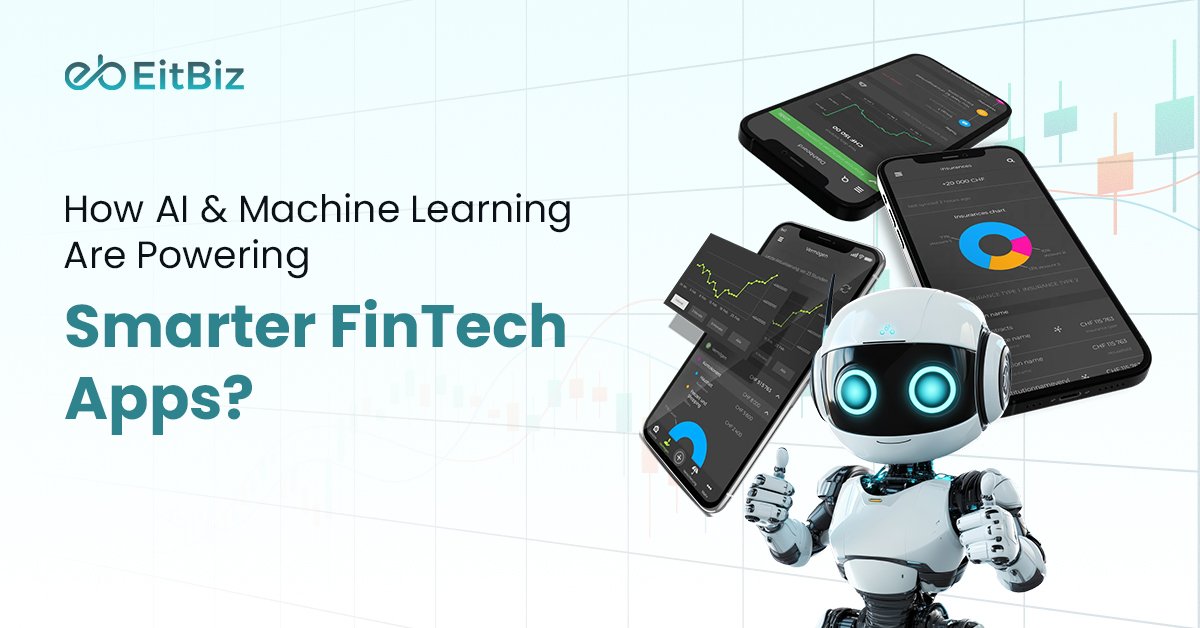
That’s not magic. It’s AI and ML in fintech, the quiet, behind-the-scenes intelligence that now drives many of the apps we use every day.
From Digital Banking to Intelligent Banking
Not so long ago, the most advanced feature in a banking app was a balance check. Online transfers were considered cutting-edge. Those days are gone.
We’ve moved from digital convenience to something much bigger: intelligent financial systems. Thanks to artificial intelligence in finance, apps don’t just display numbers any more. They spot patterns, anticipate risks, and make suggestions that once required a human advisor.
Think about the leap: ATMs gave us access to cash anytime. Online banking made accounts available on our laptops. Mobile wallets put money in our pockets. Now, AI-powered FinTech apps are starting to act like personal financial coaches.
Why Finance and AI Are a Natural Fit?

Finance has always run on information. Every credit card swipe, stock trade, or loan application produces data. The problem is, that data is overwhelming. No team of humans could possibly analyze billions of transactions in real time.
This is where AI in FinTech becomes essential. AI thrives on large datasets. Instead of following rigid rules (like “flag all transactions over $500”), it learns from past behavior. It can recognize when something looks unusual, even if it doesn’t break a rule.
Meanwhile, machine learning in FinTech ensures the system keeps improving. The more data the model sees, the sharper its predictions get. That’s why fraud detection systems, for instance, are far better today than they were a few years ago.
Where You Can See AI at Work?
If you’re wondering, “Okay, but how does this affect me as a user?”—here’s a closer look.
1. Stopping Fraud Before It Happens
Fraud is a constant headache for banks. Years ago, many legitimate transactions were blocked simply because they looked suspicious under old rule-based systems. Today, artificial intelligence in finance helps reduce those false alarms.
Example: If you use your card in New York in the morning and then in Paris that night, AI will catch the impossibility. But if you’re in New York and buy gas, groceries, and dinner in the same neighborhood, it won’t panic—that pattern looks normal.
2. Personalized Spending Advice
Remember when budgeting apps just showed pie charts of your spending? Now, with machine learning in FinTech, they can suggest realistic steps. Overspending on delivery food? The app might propose a weekly cap. Saving for a vacation? It can move extra cash automatically into a short-term goal.
3. Fairer Credit Decisions
Traditional credit scores leave a lot of people behind, especially young adults or those in countries without formal credit systems. With AI and ML in fintech, lenders can evaluate things like bill payments, rent history, or even online transaction habits. That opens the door for people who were previously shut out of loans.
4. Customer Service That Doesn’t Make You Wait
Chatbots used to be a joke. Today, many are surprisingly good. AI-powered bots can answer basic banking questions, reset your login, or even walk you through paying a bill. And if they get stuck, they pass you to a human agent without wasting your time.
5. Smarter Risk Management for Institutions
Banks don’t just worry about fraud. They worry about market swings, bad loans, and compliance failures. Artificial intelligence in finance allows them to simulate scenarios (“What if interest rates rise 2%?”) and prepare for potential shocks before they happen.
Behind the Curtain: How These Apps Get Built?
Users see the polished end product. But FinTech app development is a complex process that brings together data science, security, design, and compliance.
Here’s a simplified version of the journey:
- Collecting data: Transaction histories, customer profiles, market information.
- Training models: Teaching the system to recognize patterns of “normal” vs. “suspicious.”
- Integration: Embedding these models into the app so decisions happen instantly.
- Testing: Checking accuracy, speed, and compliance before going live.
- Deployment: Launching the app, which continues learning as more people use it.
This is why many companies turn to specialists in FinTech software development. Building AI into finance isn’t just about innovation; it’s about getting it right the first time. Mistakes can cost trust, money, or even regulatory fines.
What Could be the Real Benefits for Users?
Why are people drawn to AI-powered FinTech apps? A few reasons stand out:
- Speed. Instant loan approvals or account updates.
- Security. Fraud caught in seconds instead of days.
- Convenience. Help at 2 a.m. via chatbots instead of waiting until Monday morning.
- Clarity. Spending insights that actually make sense.
- Growth. Investment tools that automatically balance portfolios.
In short, apps become less about transactions and more about support.
Why Are Businesses Investing So Heavily?
For financial institutions, the appeal of AI and ML in fintech goes beyond keeping customers happy:
- Automation saves millions in staffing costs.
- Systems scale easily to handle massive growth.
- Fraud losses drop significantly.
- Personalized offerings increase customer loyalty.
- Smarter data insights create new revenue streams.
In other words: AI isn’t just a nice-to-have. It’s becoming a competitive necessity.
What are The Roadblocks Nobody Should Ignore?
Of course, AI in finance isn’t without challenges. Here are the big ones:
- Data privacy. Mishandling sensitive financial data is a recipe for disaster.
- Bias. If the data used to train algorithms is biased, the decisions will be too.
- Cost. Skilled talent and infrastructure don’t come cheap.
- Integration headaches. Legacy systems often resist modern AI tools.
- Regulation. Laws take time to catch up with innovation, leaving gray areas.
None of these problems is unsolvable, but they do require care. Transparency and human oversight remain critical.
What the Future Looks Like?
So, what’s coming next? Here are a few predictions:
- Apps that act like personal CFOs, guiding every money decision.
- Voice-first banking, where you simply ask your phone to transfer funds.
- AI combined with blockchain for secure, intelligent transactions.
- Predictive tools that warn you before your spending goes off track.
- Automated compliance (“RegTech”) to help businesses keep pace with regulators.
If the last 10 years felt fast, the next 10 will make them look slow.
A Quick Story: PayPal’s AI in Action
Here’s one real-world case. PayPal processes hundreds of millions of transactions daily. Fraud is a constant threat. Instead of reviewing each suspicious case manually, PayPal uses AI systems that learn continuously. These systems block bad actors in real time while letting legitimate customers pay without hassle.
The result? Safer transactions and fewer false alarms. Customers barely notice, but that’s the point.
Wrapping Up
Finance has always adapted to technology. ATMs made money accessible 24/7. Online banking made it available from our desks. Mobile wallets put it in our pockets. Now, AI in FinTech and machine learning in FinTech are making money management intelligent.
For customers, that means speed, safety, and smarter insights. For businesses, it means efficiency, growth, and staying ahead of the curve.
As FinTech app development continues to evolve, we’ll move beyond apps that just do what we ask. Instead, we’ll see apps that anticipate what we need, and quietly make it happen.
Ready to build Fintech apps for your business? If so, connect with EitBiz and our Fintech app development experts and build a scalable, conversion-driven product for your business today!
The future of finance isn’t just digital anymore. It’s intelligent. And it’s already here.