The real estate industry is no longer driven only by phone calls, site visits, and printed brochures. It has gone mobile- fast.
According to the National Association of Realtors, 97% of home buyers search for properties online, and more than 70% of those searches happen on mobile devices. Buyers compare listings while commuting. Sellers track inquiries in real time. Agents manage leads from their phones.
Now ask yourself this:
If your real estate business doesn’t have a mobile app, where are your users going instead?
They are opening Zillow. They are browsing Redfin. They use apps that offer instant filters, location-based listings, saved searches, virtual tours, and push notifications, all within seconds.
This creates a clear problem.
Real estate companies without a mobile-first experience lose visibility, engagement, and deals. Websites alone no longer meet user expectations. People want speed, personalization, and on-demand convenience.
That’s where Real Estate Mobile App Development becomes a strategic investment rather than a technical upgrade.
What Is Real Estate Mobile App Development?
Real Estate Mobile App Development is the process of designing, building, and maintaining mobile applications that support buying, selling, renting, or managing properties.
These apps serve multiple stakeholders:
- Buyers and renters
- Property owners
- Real estate agents and brokers
- Enterprises managing large portfolios
Unlike basic listing apps, modern real estate applications combine:
- Property data aggregation
- Geolocation services
- CRM integration
- Secure payments
- AI-powered recommendations
This is why mobile app development for real estate is not just about UI. It’s about building a complete digital ecosystem.
Why Real Estate Businesses Need Mobile Apps Today?

Mobile apps have shifted from being optional tools to essential business infrastructure for real estate companies. Below are the key reasons why real estate businesses need mobile apps today, supported by real-world examples from top US realtors and platforms.
#1. Mobile Is Where Your Audience Lives
Today’s homebuyers don’t wait until they’re at a computer. A large majority start their real estate journey on mobile devices. According to recent industry data, about 76% of homebuyers use mobile devices to search for properties, underscoring the central role smartphones play in property discovery.
Example: The Zillow mobile app alone has 10-11 million monthly active users in the US, underscoring the preference for mobile real estate search. This means your company needs a mobile-first presence if you want to meet users where they already spend their time.
#2. Apps Drive Higher Engagement and Repeat Visits
Mobile apps outperform other digital touchpoints because they stay “top-of-mind” on users’ phones. Users return frequently when they have an app installed, and engagement rates are considerably higher compared to mobile websites. Real estate apps are twice as likely to retain users as mobile sites, critical in a market where decisions can take weeks or months.
Example: Platforms like Redfin and Realtor.com have growing mobile user bases in the millions precisely because of this repeat engagement. By Q1 2025, Redfin’s mobile app had around 3 million monthly active users, and Realtor.com had about 2 million, showing strong mobile traction.
#3. Real-Time Communication Improves Conversion
A core advantage of mobile apps is instant communication: push notifications, real-time messages, and alerts about new listings or price changes. This speeds up decision-making and reduces friction compared to email or phone calls. According to industry insights, 65% of real estate professionals say mobile tools improve their ability to connect with clients quickly, a key driver of conversion.
Example: Large real estate platforms like Zillow use push notifications to alert users about price drops or new listings matching saved searches, directly boosting engagement and deal flow. Real-time communication turns passive browsers into active leads.
#4. Virtual Tours and Interactive Features Increase Engagement
Apps make it easy for users to explore properties beyond static photos. Features like 360° virtual tours, interactive maps, and video walkthroughs keep users engaged longer and provide richer experiences that websites struggle to match. Studies show that users prefer apps with virtual tours, and these features can increase engagement by over 25%.
Example: Both Realtor.com and Redfin integrate virtual tours and map-based browsing in their mobile apps, helping users virtually scope properties before scheduling in-person visits.
#5. Mobile Data Drives Smarter Marketing & Personalization
Mobile apps don’t just display listings; they collect data on user preferences, search behavior, and interaction patterns. This data allows agents and brokers to tailor recommendations and follow-ups more efficiently. A study indicated that apps enhance the ability to segment users based on behavior, which improves marketing accuracy and boosts conversions.
Example: Zillow uses millions of data points from its app to personalize listings and price estimates for users, making its recommendations more relevant, a key reason why it commands a large portion of the real estate mobile market.
#6. Mobile Presence Enhances Brand Authority in Competitive Markets
In markets with many players, simply having a mobile app signals credibility. Users expect top brands to offer modern tools and seamless experiences; without them, users may perceive your business as outdated or hard to work with. With major US real estate players investing heavily in their apps, the bar is high.
Example: Zillow’s app not only draws millions of users but also drives massive ad impressions across social media and digital channels, over 1 billion monthly impressions at times, reinforcing its brand dominance.
What are the Must-Have Real Estate App Features?
Buyers look for convenience and clarity, agents need tools to manage leads and listings efficiently, and enterprises require control, scalability, and data-driven insights.
Real Estate App Features for Buyers
- Advanced Property Search & Filters: Helps buyers quickly find properties matching their budget, location, and lifestyle preferences.
- Map-Based Listings: Allows buyers to visually explore properties and compare neighborhoods in real time.
- Saved Searches & Alerts: Notifies buyers instantly when new listings or price drops match their criteria.
- High-Quality Images & Virtual Tours: Enable buyers to evaluate properties remotely before scheduling visits.
- Mortgage & Affordability Calculator: Helps buyers estimate monthly payments and financial feasibility upfront.
- Neighborhood Insights: Provides information on schools, safety, commute times, and nearby amenities.
- In-App Chat with Agents: Allows buyers to contact agents instantly without switching platforms.
Real Estate App Features for Agents
- Agent Profile & Branding: Enables agents to showcase listings, expertise, and contact information professionally.
- Lead Management Dashboard: Helps agents track, organize, and prioritize buyer and seller inquiries.
- Listing Management Tools: Allows agents to add, edit, and update property listings in real time.
- Appointment Scheduling: Simplifies property showing coordination with automated reminders.
- In-App Messaging & Call Logs: Centralizes all client communication within the app.
- Push Notifications for Leads: Alerts agents immediately when a new inquiry or message is received.
- Performance Analytics: Tracks listing views, engagement, and lead conversion metrics.
Real Estate App Features for Enterprises
- Centralized Admin Panel: Enables enterprises to manage users, listings, agents, and permissions at scale.
- Multi-Agent & Multi-Branch Management: Supports large brokerages operating across multiple locations.
- Advanced Analytics & Reporting: Provides insights into market trends, user behavior, and business performance.
- CRM & Third-Party Integrations: Connects the app with CRM systems, MLS databases, and marketing tools.
- Role-Based Access Control: Ensures secure access for admins, agents, and support teams.
- Data Security & Compliance Management: Protects sensitive user and transaction data through enterprise-grade security.
- Scalable Infrastructure: Supports high traffic volumes and future feature expansion without performance issues.
How to Develop a Real Estate App (Step-by-Step)
Developing a real estate app is not just a technical project. It is a business decision that directly affects user adoption, lead quality, and long-term ROI. Below is a step-by-step process followed by successful real estate application development solutions providers and top platforms in the US.
Step 1: Define the Business Goal and Target Users
Before writing a single line of code, you need clarity on why the app exists.
Start by identifying:
- Who the app is for (buyers, renters, agents, brokers, or enterprises)
- What problem does it solve (property discovery, lead management, portfolio tracking)
- How it supports revenue (ads, subscriptions, commissions, premium listings)
A rental-focused app will differ greatly from an enterprise platform built for brokers managing thousands of listings. This step determines whether you need basic mobile app development for real estate with advanced integrations.
Example:
Redfin designed its app primarily for buyers and sellers, focusing on transparency and data accuracy, while enterprise brokerages often require internal apps for agent productivity and CRM integration.
Step 2: Conduct Market and Competitor Research
Market research prevents feature overload and costly mistakes.
At this stage:
- Analyze top apps like Zillow, Redfin, and Realtor.com
- Identify which features users engage with most
- Study user reviews to spot common complaints
- Evaluate monetization models used by competitors
This research helps you prioritize features that matter instead of copying everything.
A skilled real estate app developer uses research data to recommend features backed by usage patterns, not assumptions.
Step 3: Choose the Right App Platform (iOS, Android, or Both)
Platform choice directly impacts cost, reach, and performance.
You typically have three options:
- Android app development (wider audience)
- iOS real estate app development (higher engagement and premium users)
- Cross-platform development (cost-effective, faster launch)
For luxury real estate in the US. – Focused audiences, iOS often delivers better ROI. For mass-market reach, Android is essential. Enterprises usually choose both.
This decision significantly affects the real estate mobile app development cost.
{Also Read: The Tech Stack Dilemma: Choices That Make or Break Startups}
Step 4: Finalize Core and Advanced Features
Features define the user experience and adoption rate.
At a minimum, most real estate apps include:
- Property search and filters
- Map-based listings
- User profiles and saved searches
- Agent contact options
Advanced apps may include:
- Virtual tours
- AI-based property recommendations
- Mortgage calculators
- CRM dashboards for agents
Feature selection should align with your business goal. Overbuilding at this stage increases cost without improving ROI.
Most real estate app development services recommend starting with an MVP and expanding based on user data.
Step 5: Design a User-Centric UI/UX
Real estate users expect clarity, speed, and visual appeal.
UI/UX design should focus on:
- Fast navigation
- Clean listing layouts
- High-quality images
- Simple filter flows
Bad UX leads to app abandonment, regardless of how powerful the backend is.
Top companies invest heavily in usability testing at this stage because small design changes can significantly impact conversions.
{Also Read: Mobile App Design in 2026: Best Practices & Tools to Consider}
Step 6: Backend Development and System Architecture
The backend is the engine of the app.
This step includes:
- Database setup for listings and users
- API development
- Admin panels
- MLS and third-party integrations
- Cloud infrastructure
For large brokerages and platforms, this is where enterprise real estate app development differs from basic apps. Scalability, security, and performance are critical.
Strong backend architecture ensures the app can handle traffic spikes, data growth, and future feature additions.
Step 7: Testing, Compliance, and Security
Real estate apps handle sensitive data like:
- User contact information
- Financial estimates
- Location data
Testing must cover:
- Performance across devices
- Security vulnerabilities
- Data accuracy
- App store compliance
A professional real estate mobile app development company treats this step as mandatory, not optional.
{Also Read: The Essential Guide to Mobile App Testing You Can’t Skip}
Step 8: Launch, Monitor, and Optimize
Launching the app is only the beginning.
Post-launch activities include:
- Monitoring user behavior
- Fixing bugs
- Optimizing performance
- Rolling out feature updates
Apps that evolve based on real user data generate higher long-term ROI than apps launched and forgotten.
This is where long-term real estate app development services add the most value.
Real Estate Mobile App Development Cost Explained
The cost of developing a real estate mobile app varies widely based on features, platform choice, design complexity, and scalability requirements. Understanding these cost components helps businesses plan budgets realistically and choose the right development approach without overspending.
| App Type / Scope | Features Included | Estimated Cost Range |
| Basic MVP App | Property listings, search & filters, map view, user login, basic admin panel | $5,000 – $10,000 |
| Standard Buyer App | Advanced filters, saved searches, alerts, chat with agents, and high-quality media | $10,000 – $20,000 |
| Agent-Focused App | Lead management, listing management, notifications, and scheduling tools | $15,000 – $25,000 |
| Cross-Platform App (iOS + Android) | Shared codebase, core features for buyers and agents | $20,000 – $30,000 |
| Custom UI/UX App | Tailored design, enhanced user experience, performance optimization | $25,000 – $35,000 |
| Advanced Real Estate App | Virtual tours, mortgage calculators, analytics, third-party integrations | $30,000 – $40,000 |
| Enterprise Real Estate App | Multi-agent management, CRM/MLS integration, role-based access, analytics | $40,000 – $50,000+ |
| Ongoing Maintenance & Updates | Bug fixes, security updates, feature enhancements | $1,000 – $5,000 / year |
Note: If you’re testing a market or launching fast, start with a $5,000-$10,000 MVP. If you’re scaling a brokerage or building a long-term product, expect $40,000-$50,000+ for enterprise-grade development.

What are the Technologies Used in Building Real Estate Apps?
The technology stack behind a real estate mobile app determines its performance, scalability, security, and long-term maintenance costs. Choosing the right combination of frontend, backend, and infrastructure technologies ensures the app can efficiently handle real-time listings, user traffic, and future growth.
| Technology Layer | Technologies Used |
| Frontend (Mobile App) | React Native, Flutter, Swift, Kotlin |
| Backend Development | Node.js, Python, Ruby on Rails |
| Database Management | PostgreSQL, MongoDB |
| Cloud Infrastructure | AWS, Google Cloud, Microsoft Azure |
| Maps & Location Services | Google Maps API, Mapbox |
| MLS & Property Data | MLS APIs, IDX Integration |
| Communication Tools | Firebase, Twilio |
| Payment & Finance | Stripe, PayPal |
| Analytics & Monitoring | Google Analytics, Mixpanel |
| Security & Authentication | OAuth 2.0, JWT (JSON Web Tokens) |
ROI Insights Backed by Real-World Use Cases
Understanding ROI for Real Estate Mobile App Development means looking past downloads to real impact: lead quality, speed of contact, conversions, engagement, and operational value. Below are five concrete insights supported by real industry data.
1. Mobile Search Dominates Buyer Behavior
A mobile presence is essential for capturing homebuyers: around 76 % of homebuyers use their smartphone or tablet to search for properties, underscoring mobile’s role in the buyer journey. Yet despite this dominance, conversion rates on mobile remain low, roughly 2.49 % compared to desktop’s ~5 % for real estate platforms.
Real-World Insight: Top brands like Zillow and Realtor.com constantly refine mobile UX precisely because mobile users overwhelmingly set the demand. These refinements are part of why their conversion rates exceed industry averages, demonstrating that smart real estate mobile app development directly influences user progression from browsing to lead submission.
2. CRM Integration Drives Dramatic Conversion Increases
Apps that integrate with CRM systems are not just nicer to use; they deliver measurable ROI. Real estate platforms that pair their mobile apps with CRM workflows frequently see lead conversion improvements of around 41 % or more because follow-ups become faster, more personalized, and better tracked.
Real-World Insight: Many brokerages that invest in tailored CRM-integrated apps report higher agent responsiveness and fewer lost opportunities, underscoring the point that advanced real estate application development solutions have ROI far beyond initial feature parity.
3. Well-Built Apps Can Achieve 3× Better Lead Conversion Than Standard Sites
Custom real estate apps with the right architecture and engagement features often outperform standard mobile listings sites by a significant margin. In fact, some platforms see up to 300 % higher lead conversion rates when they use smarter features such as push notifications, analytics, and CRM tie-ins, all hallmarks of mobile app development for real estate that’s thoughtfully executed.
Real-World Insight: This is not about bells and whistles. It reflects deeper engineering, faster load times, seamless lead capture, and frictionless communication, which directly accelerate ROI by capturing leads others miss.
4. Enhanced Mobile Engagement Drives Higher User Satisfaction and Retention
Mobile users expect seamless interactions. Apps that provide smooth navigation, in-app communication, and rich media (like virtual tours) produce stronger engagement. Platforms with these capabilities see improved user retention, in some studies, up to 60% higher retention versus web-only interfaces, which means more repeat visits and opportunities to convert.
Real-World Insight: Satisfied users are more likely to re-open an app, explore more listings, and eventually reach out to an agent, directly impacting lifetime value and reducing churn, another piece of ROI not visible on basic analytics dashboards.
5. Real-Time Communication Increases Quality Interactions and Leads
Mobile apps enable instant actions like click-to-call, in-app chat, and push alerts, which all contribute to faster responses and stronger lead quality. Industry sources report that 65 % of real estate professionals believe mobile apps improve their ability to connect with clients quickly, which translates into better conversion outcomes than slower channels like email or static websites.
Real-World Insight: Faster contact doesn’t just improve agent workflows. It meets buyer expectations in a competitive market environment where speed, such as responding to interest within minutes rather than hours, can increase the chance of closing a deal multiple times over.
How Long Does it Take to Build a Real Estate Mobile App?
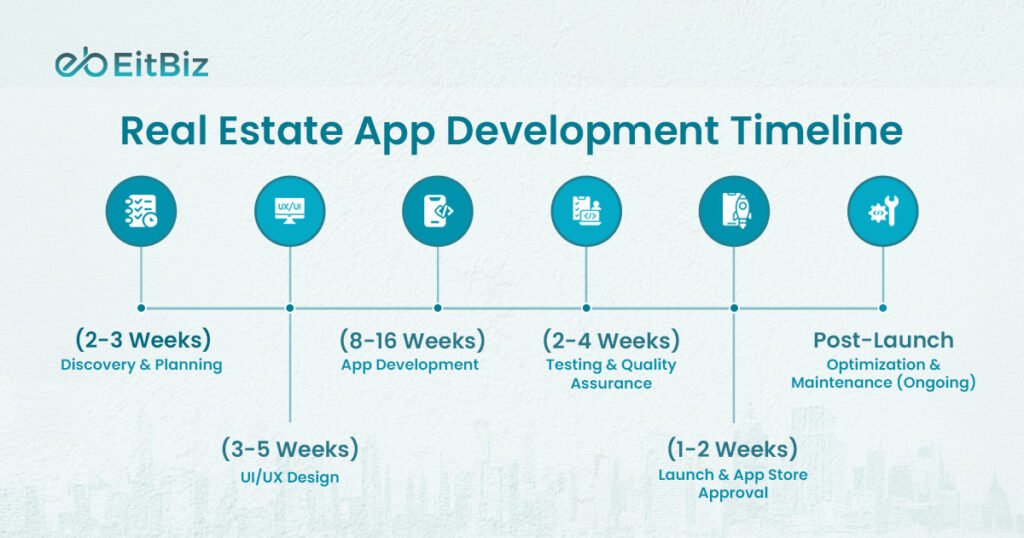
The timeline for Real Estate Mobile App Development depends on app complexity, feature scope, platform selection, and whether the solution is built for consumers or enterprises. While timelines can vary, most services follow a structured process to reduce risk and improve ROI.
- Discovery & Planning (2-3 Weeks)
This initial phase focuses on defining business objectives, target users, and feature priorities. Product requirements, technical feasibility, and integration needs are documented during this stage. A strong discovery phase is essential for efficient mobile app development for real estate, as it prevents scope creep and budget overruns later.
Outcome: Clear roadmap, validated feature list, and development strategy.
- UI/UX Design (3-5 Weeks)
Designers create wireframes, user journeys, and final visual designs tailored for mobile behavior. Real estate apps require special attention to property listings, image-heavy screens, search filters, and map views. Well-planned design directly impacts user adoption and engagement in real estate projects.
Outcome: Clickable prototypes and finalized UI ready for development.
- App Development (8-16 Weeks)
This is the core build phase where frontend and backend development happen in parallel. It includes listing management, search logic, user authentication, notifications, dashboards, and integrations. More complex builds, such as enterprise real estate app development or iOS real estate app development, may take longer due to security and scalability requirements.
Outcome: Fully functional real estate mobile app with core and advanced features implemented.
- Testing & Quality Assurance (2-4 Weeks)
The app is tested across devices, operating systems, and screen sizes. Performance, security, data accuracy, and compliance with app store guidelines are verified. Professional experts treat this phase as critical to ensure stability and trust.
Outcome: Optimized, secure, and bug-free app ready for launch.
- Launch & App Store Approval (1-2 Weeks)
The app is submitted to the App Store and Google Play for review. Approval timelines vary, especially for iOS apps. During this stage, production servers, analytics, and monitoring tools are finalized.
Outcome: Live app available to users.
- Post-Launch Optimization & Maintenance (Ongoing)
After launch, teams track user behavior, fix issues, improve performance, and release feature updates. Continuous optimization is where long-term ROI is realized in app development, especially for growing platforms and enterprises.
Outcome: Higher retention, improved performance, and scalable growth.
How to Choose the Right Real Estate Mobile App Development Company?
Selecting the right development partner is one of the most critical decisions in your app journey. The wrong choice can lead to budget overruns, poor scalability, and low adoption. The right partner becomes an extension of your team and directly impacts ROI.
- Look for Proven Real Estate Domain Experience
A capable company should demonstrate hands-on experience in building property-focused platforms, not just generic apps. Real estate apps involve complex workflows such as MLS integration, geolocation, pricing logic, and lead management. A company with prior experience understands industry regulations, user behavior, and technical challenges, reducing development risk and time-to-market.
- Evaluate Their Technical Expertise and Development Approach
A reliable partner should offer end-to-end real estate app development services, covering strategy, design, development, testing, and post-launch support. Ask how they approach scalability, security, and performance optimization. Strong teams clearly explain their tech stack choices and how they support mobile app development across iOS, Android, or cross-platform environments.
- Assess Their Ability to Build Scalable and Enterprise-Ready Solutions
If your business plans to grow, your app must scale with it. The right company should have experience delivering app solutions that support high traffic, multiple user roles, and complex data operations. This includes backend architecture, role-based access, analytics, and integrations with CRM and third-party platforms.
- Check for Platform-Specific and Specialized Expertise
Not all development companies are equal across platforms. If your target audience is iOS-heavy, ensure the team has proven experience in iOS app development and understands Apple’s design standards, performance requirements, and App Store compliance. A skilled real estate app developer will recommend the right platform strategy based on user demographics and business goals.
- Review Communication, Transparency, and Long-Term Support
The best real estate application development solutions come from teams that communicate clearly, provide transparent pricing, and offer ongoing maintenance. Ask about post-launch support, update cycles, and performance monitoring. Long-term solutions ensure your app stays secure, competitive, and aligned with evolving user expectations.
Final Thoughts
The real estate industry has reached a clear turning point. Buyers expect instant access to listings. Agents need faster ways to manage leads. Enterprises require scalable systems that turn data into decisions. In this landscape, an app is no longer a competitive advantage; it’s a business necessity.
Throughout this guide, we’ve seen that successful real estate apps are built on strategy, not assumptions. From understanding how to develop a real estate app to selecting the right features, managing mobile app development costs, and planning realistic timelines, every decision directly impacts ROI. Apps that focus on usability, performance, and real user behavior consistently outperform those built just to “have an app.”
If you’re looking for a trusted partner to bring your vision to life, EitBiz stands out as a reliable real estate mobile app development company with hands-on experience delivering scalable, ROI-driven solutions. Their team specializes in end-to-end services, covering strategy, UI/UX design, development, testing, and post-launch optimization.
Ready to build a high-performing real estate mobile app? Partner with EitBiz to transform your idea into a scalable, ROI-driven solution that meets modern buyer and agent expectations.
FAQs
- How much does real estate app development cost?
Real estate app development costs typically range from $5,000 to $50,000+, depending on feature complexity, platform choice, design requirements, and integration needs.
- How long does it take to build a real estate app?
Most real estate mobile apps are developed within 3 to 7 months, with timelines varying based on scope, customization, and enterprise-level requirements.
- Do I need separate apps for iOS and Android?
Not always. Separate apps for iOS and Android are not always required; cross-platform development can support both platforms efficiently while reducing development time and cost.
- Can I integrate MLS listings?
Yes, with proper licensing and APIs. MLS listings can be integrated into real estate apps using authorized APIs, provided proper licensing and compliance requirements are met.
- Is maintenance required after launch?
Yes. Ongoing maintenance is essential to ensure app security, performance optimization, compatibility with OS updates, and continuous feature improvements.