The iOS development landscape is changing as Apple expands its intelligence, design, and developer capabilities.
Swift has become central to modern Apple-platform development, while SwiftUI continues to shape application interfaces.
Earlier, choosing a language mainly meant balancing performance, development effort, and platform compatibility.
Today, businesses must also consider AI capabilities, native frameworks, security, scalability, and long-term product requirements.The technology choice can directly affect how an iOS application performs, evolves, and integrates with Apple’s ecosystem.
This article explores the programming languages and technologies businesses should consider for iOS app development in 2026.
What Businesses Should Know About iOS App Development in 2026
The iOS development ecosystem is becoming more capable and more closely integrated with Apple’s intelligence features.
Swift remains central to Apple’s development stack, while SwiftUI continues to support modern interface development across Apple platforms.
AI is also becoming a practical part of iOS applications.
Apple’s Foundation Models framework gives developers a native Swift API for using on-device language models. It also supports multimodal inputs and dynamic AI experiences.
For businesses, this changes how an iOS application should be planned.
An application may now need to support on-device intelligence, AI-assisted workflows, stronger privacy, and deeper integration with Apple services.
The development approach should therefore consider more than the programming language.
Architecture, user experience, AI requirements, security, device capabilities, and long-term maintenance should all influence the technology decision.
This is also why choosing the right iOS app developers matters before development begins. The technology stack needs to support the product roadmap, not just the initial release.
Top 6 Programming Languages for iOS App Development
The right programming language depends on your application’s purpose and technical requirements. Here are the programming languages and technologies businesses should consider for iOS development in 2026.
1. Swift
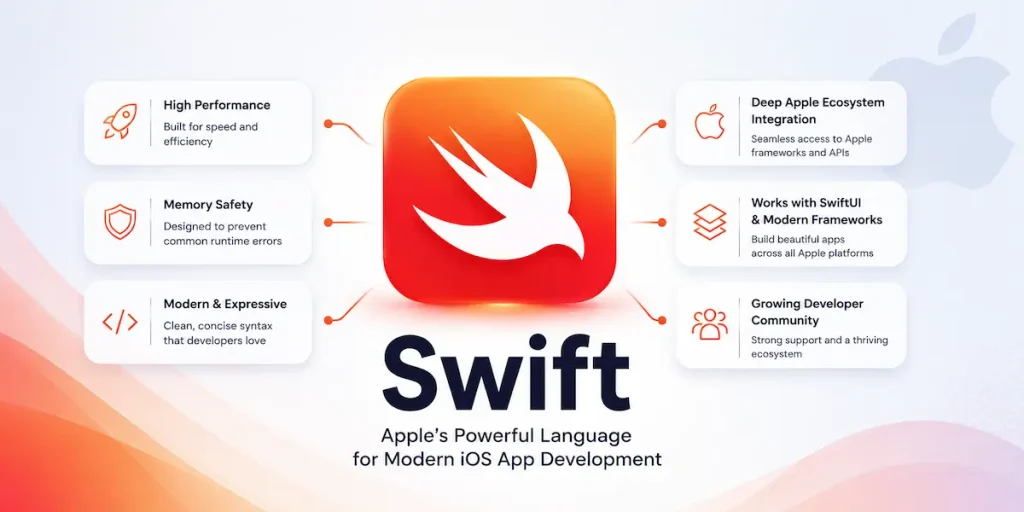
Swift remains the primary language for modern iOS app development.
Developed by Apple, Swift app development is used across the company’s ecosystem, including iOS, iPadOS, macOS, watchOS, and tvOS. Apple continues to expand Swift’s role across its technology stack, including performance- and security-sensitive components.
For a new iOS product, Swift gives iOS app developers direct access to Apple’s latest APIs and frameworks.
It also works naturally with SwiftUI, SwiftData, Swift Testing, and other Swift-based technologies in Apple’s current development ecosystem.
Why businesses choose Swift
Swift is a practical choice when a business needs:
- Native iOS performance
- Direct access to Apple’s APIs
- Strong type and memory safety
- Long-term maintainability
- Integration with modern Apple frameworks
- Support for multiple Apple platforms
Swift is particularly suitable for applications where performance, security, and close integration with the Apple ecosystem matter.
For businesses working with an iOS app development company, Swift also provides a strong foundation for building applications that can evolve alongside Apple’s platform updates.
2. SwiftUI
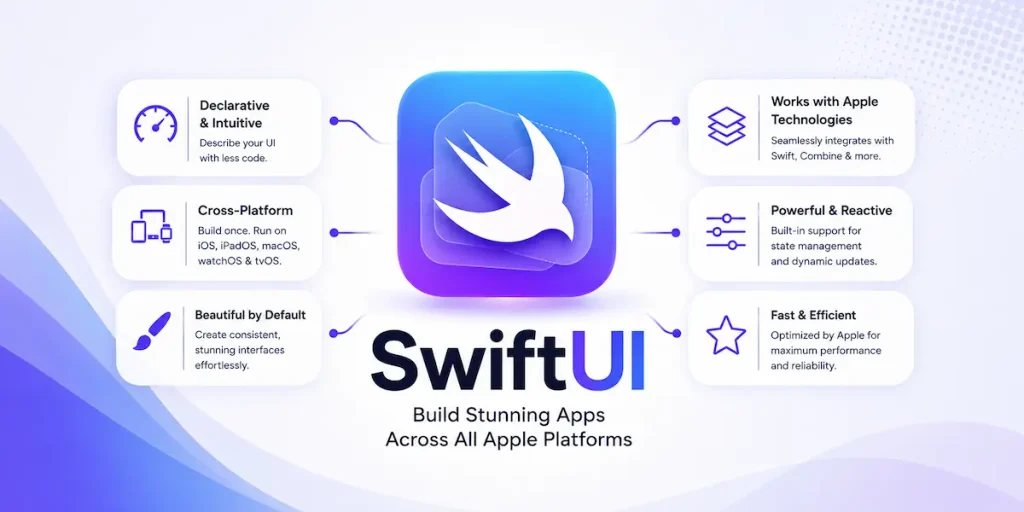
Swift and SwiftUI are closely connected, but they serve different purposes.
Swift is the programming language.
SwiftUI is Apple’s framework for building the application’s user interface.
This distinction matters when planning SwiftUI app development.
SwiftUI uses a declarative approach, allowing developers to describe what the interface should look like and how it should behave. It can also work alongside UIKit, which means businesses can gradually introduce SwiftUI into an existing application.
For new projects in 2026, Swift with SwiftUI is a strong combination to consider.
It also gives product teams greater flexibility when working on iOS app design because the interface layer can be developed around Apple’s current UI framework rather than relying entirely on legacy approaches.
3. Objective-C
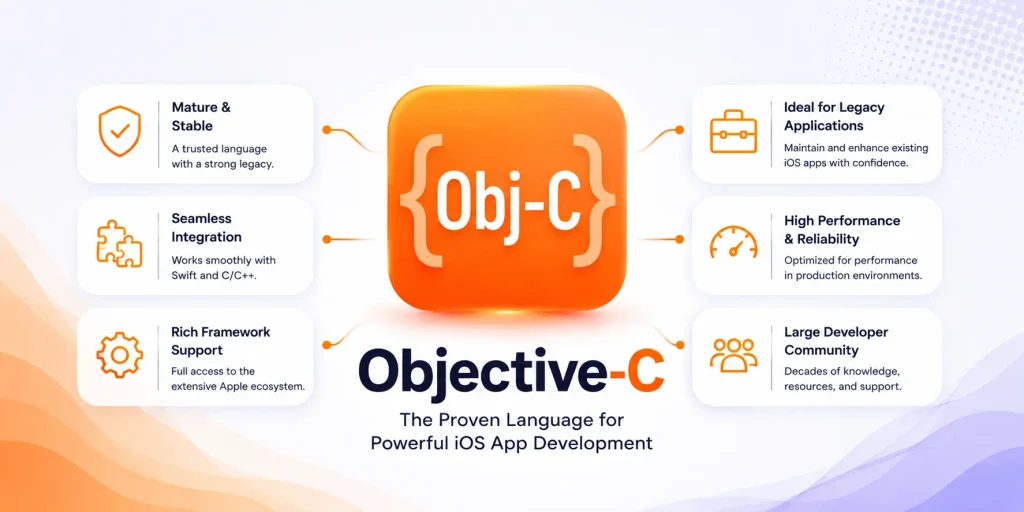
Objective-C is no longer the first choice for most new iOS applications, but that does not make it irrelevant.
Many established enterprise applications were built using Objective-C before Swift became Apple’s preferred language. Those applications can contain years of business logic, custom frameworks, third-party integrations, and production-tested code.
For businesses maintaining such products, replacing everything with Swift may not be the right decision.
Objective-C and Swift can coexist within the same project. Apple continues to document interoperability between the two, allowing teams to introduce Swift into an existing Objective-C codebase incrementally.
When does Objective-C still make sense?
Objective-C can be relevant when:
- You are maintaining a legacy iOS application
- Existing business logic is already written in Objective-C
- A third-party SDK depends on Objective-C
- You are gradually migrating an established codebase to Swift
- Your development team needs to work with older Apple frameworks
For a new application, Swift will generally be the stronger starting point. For an existing enterprise application, Objective-C may still be part of the technology stack for years.
4. C++
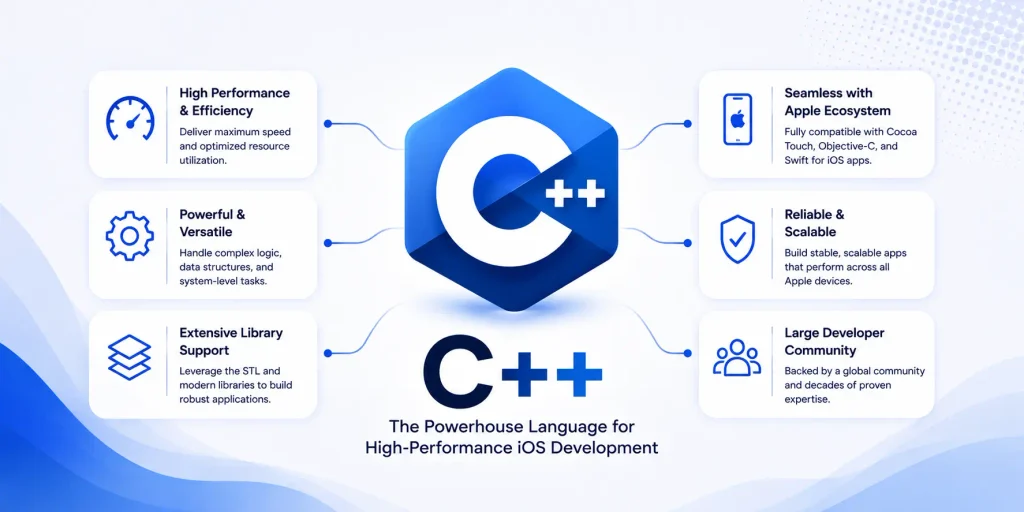
C++ is not a conventional choice for building an entire iOS user interface, but it remains useful for specific parts of an application.
Businesses may use C++ for performance-critical components such as game engines, graphics processing, simulations, media processing, or shared core libraries.
Apple’s current developer documentation also highlights C++ interoperability with Swift. Apple’s 2026 developer material discusses Swift’s continued expansion into performance- and security-critical areas and its ability to interoperate with C++.
That makes C++ useful when an application has a component that requires lower-level control or needs to share an existing C++ codebase.
The important point is that C++ is usually a component-level choice, not the default language for a complete iOS application.
5. C#
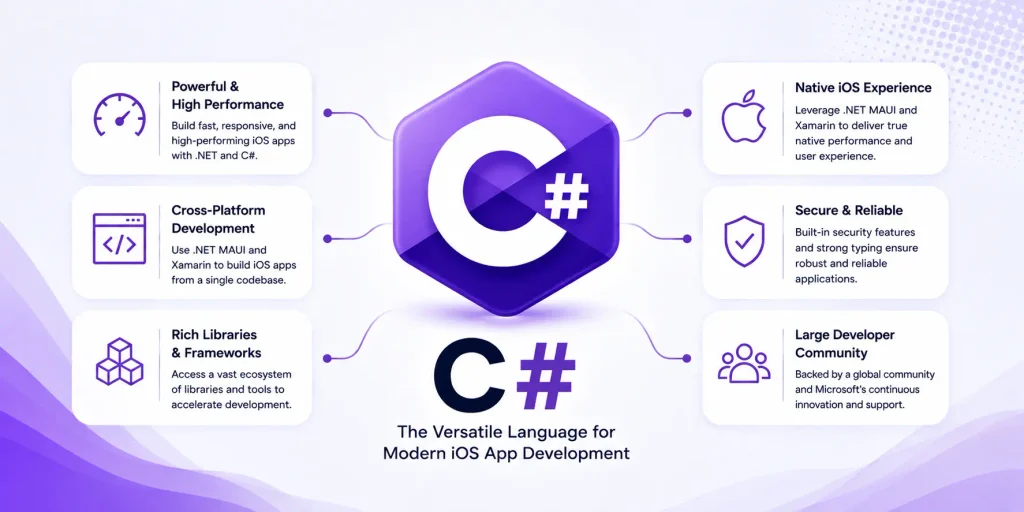
C# becomes relevant when iOS is part of a broader cross-platform product strategy.
C# can be used with .NET-based cross-platform technologies to build applications targeting multiple platforms. This can be useful for businesses that already have a strong Microsoft/.NET technology stack and want to reuse engineering expertise across their products.
The decision here is less about building a purely native iOS application and more about reducing duplicated development across platforms.
If your business already operates a large .NET ecosystem, C# may therefore be worth considering.
However, if the goal is to build a deeply integrated, native-first iOS product, Swift remains the more direct choice.
6. Dart
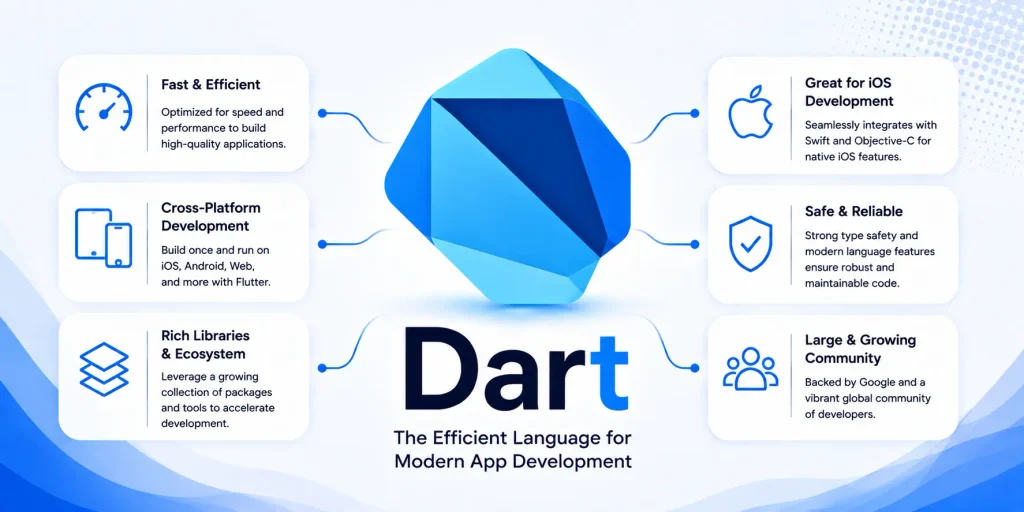
Dart is relevant to iOS development primarily through Flutter.
This distinction is important.
Dart is a programming language. Flutter is the UI framework that uses Dart to build applications for multiple platforms.
For businesses considering cross-platform development, Flutter can provide a shared codebase for iOS and Android while still supporting a polished application experience.
That can make Dart a practical choice when:
- The product needs both iOS and Android
- The business wants to share application code
- Development resources need to be used efficiently
- The product roadmap includes multiple platforms
- A consistent UI across platforms is important
But if your application is designed specifically around Apple’s ecosystem and requires deep native integration, Swift remains the more natural option.
Swift vs Objective-C vs C++ vs C# vs Dart
The right choice depends on the product rather than simply the popularity of a language.
| Technology | Best suited for | Native iOS focus | Cross-platform use |
|---|---|---|---|
| Swift | New iOS and Apple-platform apps | Excellent | Limited |
Objective-C | Legacy iOS apps and existing codebases | Excellent | Limited |
C++ | Performance-heavy components and shared libraries | Strong for components | Strong |
C# | .NET-based cross-platform applications | Moderate | Strong |
Dart | Flutter applications | Moderate | Strong |
For most new iOS products, Swift should be the first option evaluated.
For an existing enterprise application, the answer may be different because the current codebase, integrations, and migration cost all matter.
What Should You Consider Before Choosing an iOS Programming Language?
There is no need to make the decision based on the language alone.
Consider these factors first.
Product requirements
What does the application need to do, and which device capabilities will it use?
- Performance: Does the app require real-time processing, advanced graphics, media processing, or other performance-sensitive functionality?
- Platform strategy: Is the application iOS-only, or will Android and other platforms be part of the roadmap?
- Existing technology stack: Do you already have developers and backend systems built around Swift, .NET, JavaScript, or another ecosystem?
- Integration requirements: Does the application need deep integration with Apple services, devices, enterprise systems, or third-party SDKs?
- Design requirements: Does the product require highly customized iOS app design, complex interactions, or a consistent experience across multiple platforms?
- Maintenance: Who will maintain the application after launch, and how easy will it be to extend the codebase?
- AI requirements: Will the application use on-device AI, cloud AI, Apple Foundation Models, or other machine-learning capabilities?
These questions provide a much better basis for technology selection than simply asking which programming language is “most popular.”

Is Swift Still the Best Choice for iOS Development in 2026?
Yes, for most new native iOS applications, swift is the best choice for iOS development.
Apple’s own developer documentation continues to position Swift as its preferred programming language for Apple-platform development. Swift also works directly with SwiftUI and Apple’s broader modern development ecosystem.
The important qualification is “most new native applications.”
Swift does not automatically become the right choice for every mobile product. A business building an application for both iOS and Android may benefit from a cross-platform approach. An enterprise modernizing a legacy product may need to maintain Objective-C. A performance-heavy product may require C++ components.
The right technology is the one that supports the product’s requirements without creating unnecessary technical constraints.
Final Thoughts
Swift is the clear front-runner for new native iOS applications in 2026, and Apple’s continued investment in Swift and SwiftUI reinforces that direction.
But businesses should not choose a technology stack based on that fact alone.
Objective-C still has a role in legacy modernization. C++ can support performance-critical components. C# and Dart can make sense for cross-platform strategies.
The better question is not “Which programming language is the best?”
It is:
“Which technology gives our application the right balance of performance, scalability, development efficiency, design flexibility, and long-term maintainability?”
That is the decision that should shape your 2026 iOS app development strategy.