Key Takeaways
- A strong SDLC provides structure, reduces risks, and ensures predictable software delivery, making it essential for modern businesses.
- Following the right phases of the software development lifecycle helps control costs, improve quality, and align development with business goals.
- Choosing between agile vs waterfall (or a hybrid approach) depends on project requirements, flexibility needs, and industry constraints.
- Adopting modern software development life cycle trends like AI, automation, and DevOps significantly improves speed, efficiency, and scalability.
- Implementing proven SDLC best practices is the best way to manage software development projects and drive long-term business growth.
Let’s start with something real: software projects fail more often than most businesses expect.
- According to the Standish Group CHAOS Report, nearly 31% of software projects fail, and over 50% face serious challenges like cost overruns or missed deadlines.
- A McKinsey report found that large IT projects run 45% over budget and 7% over time, while delivering 56% less value than predicted.
- Statista estimates global spending on digital transformation will exceed $3 trillion by 2026, and a huge chunk of that goes into software development.
Now here’s the uncomfortable truth:
Most of these failures don’t happen because developers lack skills. They happen because businesses lack structure.
Teams jump into coding without clear requirements. Stakeholders change expectations mid-way. Testing gets rushed. Deadlines slip. Budgets explode.
This is exactly why the Software Development Life Cycle (SDLC) matters more in 2026 than ever before.
Think of SDLC as your business’s operating system for building software. Without it, you’re guessing. With it, you’re executing.
What Is SDLC and Why Does It Still Matter in 2026?
The system development life cycles (SDLC) refer to a structured, repeatable process that organizations use to design, build, test, and maintain software systems. Instead of treating development as a one-off activity, SDLC breaks the entire journey into clearly defined stages, so teams can plan, execute, and improve with consistency.
At its core, SDLC answers a simple but critical question:
How do we build software that actually works on time, within budget, and at scale?
In 2026, that question has become more complex than ever.
Why SDLC Still Matters in 2026 (More Than Ever)
Some businesses assume that modern tools, AI, or Agile methods eliminate the need for structured processes. That assumption is risky.
In reality, the complexity of software today has increased dramatically:
- Applications integrate AI, APIs, and cloud infrastructure
- Systems must scale across millions of users
- Security threats are more advanced
- User expectations for performance are higher than ever
In this environment, skipping structure doesn’t increase speed, it increases failure rates.
This is exactly where SDLC becomes essential.
Why the Software Development Life Cycle Is Important in Software Development
The Why Software Development Life Cycle Is Important in Software Development can be understood through three key outcomes:
1. It Brings Predictability to Uncertainty
Software projects are inherently uncertain. SDLC introduces structure, making timelines and outcomes more predictable.
2. It Reduces Expensive Mistakes
Fixing a bug after deployment can cost up to 100x more than fixing it during the design phase. SDLC ensures issues are caught early.
3. It Aligns Technology with Business Goals
Without a structured approach, development teams often build features that don’t deliver real value. SDLC keeps development aligned with business objectives.
What are the Core Phases of the Software Development Lifecycle?
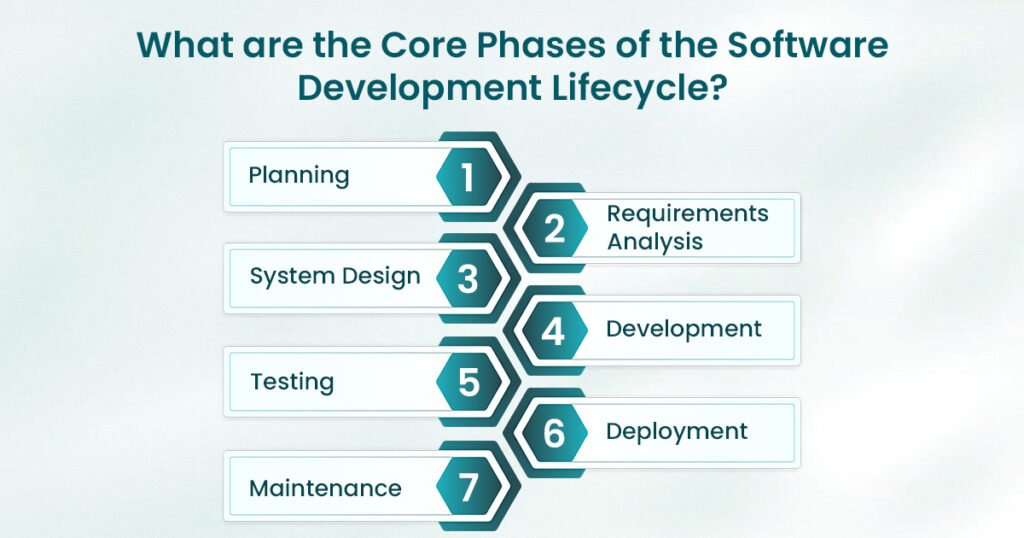
Understanding the phases of the software development lifecycle is essential for building software that is reliable, scalable, and aligned with business goals. Each phase plays a distinct role, and together they create a structured process that reduces risk, controls cost, and improves outcomes.
Planning
The planning phase defines the foundation of the project. Teams identify business objectives, determine project scope, estimate budgets, and assess technical feasibility. This stage ensures that everyone is aligned before any actual work begins. Without proper planning, projects often suffer from unclear direction, unrealistic timelines, and frequent changes later in the cycle.
Requirements Analysis
In this phase, teams gather and document detailed requirements from stakeholders and end users. This includes both functional requirements (what the software should do) and non-functional requirements (such as performance, security, and scalability). Clear requirement analysis eliminates guesswork and ensures that developers build exactly what the business needs, reducing costly revisions later.
System Design
The design phase translates requirements into a technical blueprint. Teams define system architecture, database structures, APIs, and user interfaces. A strong design ensures that the software is scalable, efficient, and maintainable. Poor design decisions at this stage can lead to performance issues and limitations as the system grows.
Development
During development, the actual coding takes place. Developers build features, integrate components, and follow established software development best practices to ensure clean and maintainable code. In modern environments, this phase often happens in iterations, especially when using Agile methodologies, allowing teams to deliver value continuously.
Testing
The testing phase focuses on validating the software to ensure it works as expected. Teams conduct various types of testing, including functional, integration, performance, and security testing. With the help of advanced software development life cycle tools, much of this process is automated, enabling faster and more accurate detection of issues before deployment.
Deployment
Once the software passes testing, it is deployed to a production environment where users can access it. This phase involves setting up infrastructure, managing releases, and ensuring system stability. A well-managed deployment process minimizes downtime and ensures a smooth transition from development to real-world usage.
Maintenance
After deployment, the software enters the maintenance phase, where it is continuously monitored, updated, and improved. Teams fix bugs, add new features, and optimize performance based on user feedback and evolving business needs. This phase is critical for supporting long-term custom software solutions for business growth and ensuring the software remains relevant and effective.
What are the Benefits of the Software Development Life Cycle for Businesses?
A well-defined SDLC directly impacts cost efficiency, product quality, team productivity, and long-term business growth. In 2026, when software drives core operations, SDLC acts as a strategic framework rather than just a technical process.
Improved Cost Control and Budget Predictability
One of the biggest advantages of SDLC is better financial planning. By clearly defining each phase, businesses can accurately estimate the cost to develop custom software and allocate resources efficiently. Instead of dealing with unexpected expenses due to rework or poor planning, organizations gain visibility into where time and money are being spent, leading to tighter budget control.
Faster and More Reliable Time-to-Market
SDLC introduces structured workflows that reduce delays and confusion. Teams follow a defined path from planning to deployment, which minimizes bottlenecks. As a result, businesses can launch products faster without compromising quality, an essential factor in competitive markets where speed matters.
Higher Software Quality and Performance
Quality is built into every stage of SDLC rather than being treated as a final step. Continuous testing, validation, and feedback ensure that the final product is stable, secure, and user-friendly. This reduces post-launch issues and enhances customer satisfaction.
Better Alignment with Business Goals
SDLC ensures that development efforts are closely tied to business objectives. Through proper planning and requirement analysis, teams focus on building features that deliver real value. This alignment is especially important for organizations investing in custom software solutions for business growth, where every feature should support scalability and efficiency.
Reduced Project Risks and Failure Rates
Software projects often fail due to unclear requirements, poor communication, or a lack of planning. SDLC addresses these challenges by introducing structure and checkpoints at every stage. Risks are identified early, and corrective actions can be taken before they escalate into major problems.
What Determines the Cost of Custom Software?
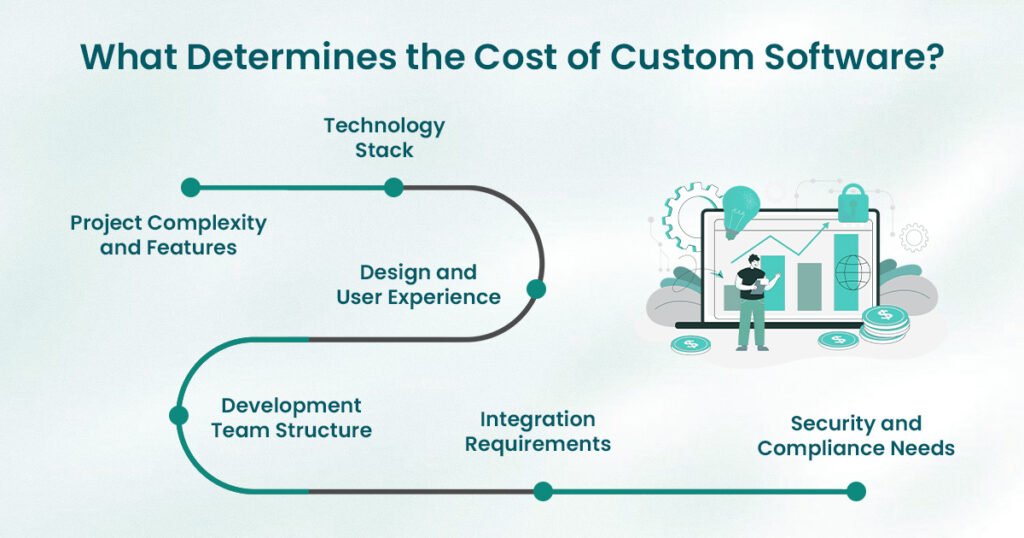
Several factors directly influence the total cost. Understanding these helps businesses make smarter decisions and avoid unexpected expenses.
1. Project Complexity and Features
The more complex your software, the higher the cost. A basic app with limited features will cost significantly less than a system with advanced functionalities like AI, real-time data processing, or integrations with multiple platforms.
2. Technology Stack
The choice of programming languages, frameworks, and infrastructure affects both development and maintenance costs. Modern stacks may improve scalability but require skilled (and often more expensive) developers.
3. Design and User Experience
Custom UI/UX design adds to the cost but significantly improves usability and customer satisfaction. Poor design may save money upfront, but can lead to lower adoption rates.
4. Development Team Structure
Costs vary depending on whether you hire:
- In-house teams
- Freelancers
- Agencies offering Custom Software Development Services
Each option has trade-offs in terms of cost, quality, and control.
5. Integration Requirements
If your software needs to connect with third-party systems (CRMs, payment gateways, APIs), development becomes more complex and costly.
6. Security and Compliance Needs
Industries like finance and healthcare require strict compliance, which increases development effort and cost.

Get a head start on your budget planning, use our Mobile App Cost Calculator to get an instant estimate tailored to your project.
Agile vs Waterfall SDLC: Which Model Is Best for Your Business?
Choosing between agile and waterfall is one of the most important decisions a business makes when defining its development approach. Both models operate within the SDLC framework, but they differ in execution, flexibility, and risk management. In 2026, the decision is less about “which is better” and more about “which fits your business environment.”
| Aspect | Agile Model | Waterfall Model |
|---|---|---|
| Development Approach | Iterative and incremental; development happens in cycles (sprints) with continuous improvements | Linear and sequential; each phase must be completed before the next begins |
| Project Planning | Planning is adaptive and evolves throughout the project lifecycle | Planning is done upfront with detailed documentation and a fixed scope |
| Requirement Handling | Requirements are flexible and can change based on feedback and market needs | Requirements are fixed at the beginning, and changes are difficult to implement later |
| Flexibility | Highly flexible; teams can quickly adapt to changes and new priorities | Low flexibility; changes require revisiting completed phases, increasing cost and time |
| Customer Involvement | Continuous involvement; stakeholders provide feedback after each iteration | Limited involvement; stakeholders are mainly engaged at the beginning and final stages |
| Delivery Model | Frequent releases of small, functional components (continuous delivery) | Single delivery after the entire development process is completed |
| Testing Approach | Testing is continuous and integrated into every sprint | Testing is done after the development phase is complete |
| Risk Management | Lower risk due to early issue detection and continuous validation | Higher risk, as issues are often discovered late in the process |
| Time-to-Market | Faster; early versions of the product can be released quickly | Slower; the product is delivered only after full completion |
How to Implement a Software Development Life Cycle in Your Organization
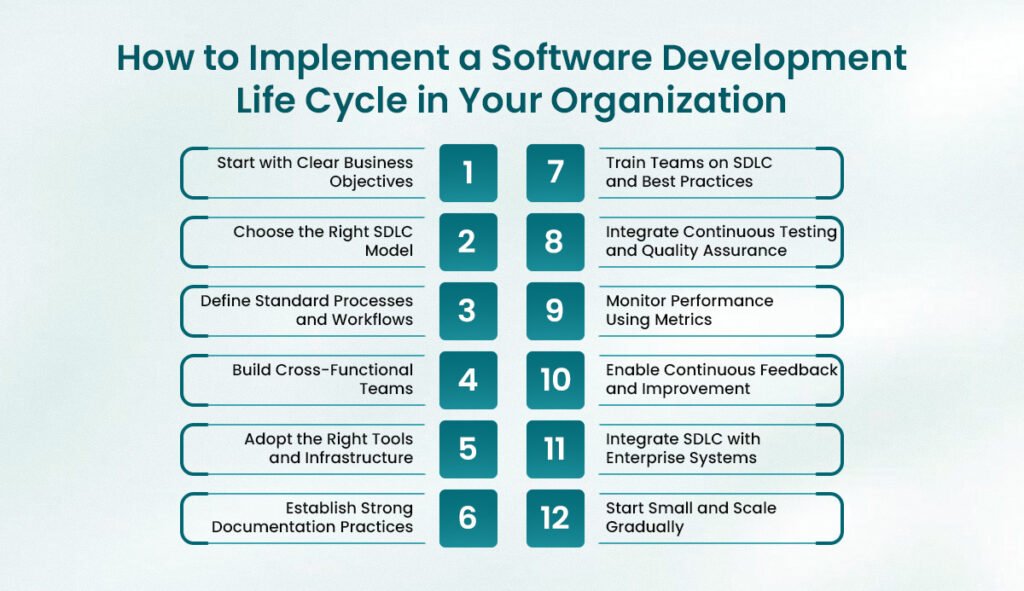
Implementing an effective SDLC requires more than just defining steps, it requires aligning people, processes, and tools with clear business outcomes. In 2026, organizations that succeed with SDLC treat it as a strategic capability rather than a technical checklist. Below is a structured approach with actionable pointers, each explained in detail.
1. Start with Clear Business Objectives
Before implementing SDLC, you must clearly define what you want to achieve. Whether your goal is faster delivery, better product quality, or reduced development costs, aligning SDLC with business outcomes ensures that every development effort creates real value. Without this clarity, teams may focus on technical execution without delivering meaningful results.
- Identify business goals (efficiency, scalability, innovation)
- Define measurable success metrics (ROI, time-to-market, defect rates)
- Align software initiatives with long-term strategy
McKinsey highlights that aligning IT initiatives with business goals improves project success rates.
Choose the Right SDLC Model
Selecting the right model is critical because it defines how your teams will work. Agile works best for dynamic environments with evolving requirements, while Waterfall suits projects with fixed scope and strict compliance needs. Many organizations adopt hybrid models to balance flexibility and control. Choosing the wrong model can lead to inefficiencies and project delays.
- Evaluate project complexity and requirements stability
- Consider industry regulations and compliance needs
- Assess team experience and adaptability
Forrester research shows Agile adoption improves responsiveness and customer satisfaction.
Define Standard Processes and Workflows
Standardizing workflows ensures consistency and repeatability across projects. Clearly defined processes reduce confusion, improve coordination, and ensure that every team follows the same quality standards. This standardization supports effective SDLC integration across the organization and is especially important for scaling development efforts across multiple teams or departments.
- Document workflows for each SDLC phase
- Define approval, review, and escalation processes
- Create reusable templates and guidelines
Build Cross-Functional Teams
SDLC implementation succeeds when teams collaborate effectively. Bringing together developers, testers, designers, and business stakeholders ensures that different perspectives are considered throughout the lifecycle. This reduces miscommunication and leads to better decision-making.
- Include all relevant roles in the development process
- Clearly define responsibilities and accountability
- Encourage regular communication and collaboration
Atlassian emphasizes that cross-functional collaboration drives high-performing teams.
Looking to build the right team? Hire dedicated developers who align with your project goals and delivery timelines.
Adopt the Right Tools and Infrastructure
Modern SDLC depends heavily on tools that enable automation, tracking, and collaboration. Using the right software development life cycle tools helps streamline workflows, reduce manual effort, and improve visibility into project progress. Tools also enable teams to scale operations efficiently.
- Use version control systems like Git
- Implement project management tools like Jira
- Set up CI/CD pipelines for automated deployment
- Use testing frameworks for quality assurance
GitLab reports that automation significantly improves development efficiency.
Establish Strong Documentation Practices
Strong documentation is a key part of software development best practices. Documentation is often underestimated, but it plays a crucial role in maintaining clarity and continuity. Well-documented processes and requirements ensure that teams stay aligned and new members can onboard quickly. It also supports compliance and long-term maintenance.
- Maintain detailed requirement and design documents
- Document testing and deployment procedures
- Keep documentation updated and accessible
Train Teams on SDLC and Best Practices
Even the best processes fail if teams don’t understand or follow them. Training ensures that everyone is aligned with SDLC workflows and understands their role in the process. It also promotes consistency and improves overall productivity.
- Conduct training sessions on SDLC stages
- Promote coding standards and testing practices
- Encourage continuous learning and skill development
Integrate Continuous Testing and Quality Assurance
Quality should be embedded into every phase of development, not just tested at the end. Continuous testing helps identify issues early, reducing the cost and effort required to fix them later. It also ensures that the final product meets performance and security standards.
- Implement automated testing tools
- Conduct regular code reviews
- Monitor performance and security continuously
IBM research shows that early defect detection significantly reduces costs.
Monitor Performance Using Metrics
Measuring performance is essential for improving SDLC processes. By tracking key metrics, organizations can identify bottlenecks, optimize workflows, and make data-driven decisions. This helps refine processes over time and improve overall efficiency.
- Track development cycle time and release frequency
- Monitor bug rates and system performance
- Measure customer satisfaction and product usage
These insights strengthen your SDLC implementation strategies.
Enable Continuous Feedback and Improvement
SDLC is not a static process—it must evolve with changing business needs. Continuous feedback from stakeholders and teams helps identify areas for improvement and ensures that the process remains effective.
- Conduct regular retrospectives
- Gather feedback from stakeholders and users
- Update workflows based on insights
Integrate SDLC with Enterprise Systems
For large organizations, SDLC must connect with other business and technical systems. Effective SDLC integration ensures seamless communication between development, operations, and business units, enabling better coordination and faster decision-making.
- Integrate with DevOps pipelines and cloud platforms
- Connect with security and compliance systems
- Use analytics tools for performance tracking
Start Small and Scale Gradually
Implementing SDLC across the entire organization at once can be overwhelming. Starting with a pilot project allows you to test processes, identify gaps, and make improvements before scaling. This reduces risk and ensures smoother adoption.
- Begin with a small project or team
- Evaluate results and refine processes
- Gradually expand implementation

What are the Modern Software Development Life Cycle Trends in 2026?
The SDLC in 2026 has evolved into a faster, smarter, and more integrated system. While the core structure remains the same, the way organizations execute each phase has changed significantly due to automation, AI, and increasing demand for speed and scalability. Understanding these software development life cycle trends helps businesses stay competitive and future-ready.
AI in Software Development Lifecycle Is Now Mainstream
One of the most significant shifts is the widespread adoption of AI in the software development lifecycle. AI is now used for code generation, automated testing, bug detection, and even documentation. Instead of manually handling repetitive tasks, developers now focus more on problem-solving and system design, making development faster and more efficient.
Rise of AI Agents and Autonomous Development
Beyond basic AI tools, organizations are now using intelligent agents that can plan tasks, execute workflows, and manage parts of the development cycle independently. These systems reduce manual effort and speed up delivery, but they also require strong oversight to ensure quality and security.
DevOps and SDLC Are Fully Integrated
In 2026, SDLC and DevOps are no longer separate practices. Continuous integration, continuous delivery, and real-time monitoring are embedded into the lifecycle. This integration allows teams to release updates faster, identify issues quickly, and maintain system stability.
Automation Across the Entire Lifecycle
Automation now extends beyond testing into coding, deployment, and infrastructure management. Businesses are using automation to reduce errors, speed up processes, and improve efficiency. This shift is a key part of next-gen software engineering trends, enabling teams to focus on innovation rather than repetitive tasks.
Growth of Low-Code and No-Code Platforms
Low-code and no-code tools are becoming increasingly popular, allowing faster development with minimal coding. These platforms enable business teams to participate directly in software creation, reducing dependency on large development teams and accelerating delivery timelines.
Shift Toward Cloud-Native Development
Modern applications are built using cloud-native architectures such as microservices and containerization. This approach allows systems to scale easily, handle high traffic, and adapt to changing business needs, making it a core part of modern software development trends 2026.
Security Integrated into Every Phase (DevSecOps)
Security is no longer treated as a final step. Instead, it is embedded throughout the SDLC. Continuous security testing and monitoring help businesses detect vulnerabilities early and maintain compliance with regulations, making it a critical component of software development best practices.
Real-Time Monitoring and Observability
Businesses now rely on real-time monitoring tools to track application performance and user behavior. This allows teams to detect issues instantly, optimize systems, and improve user experience. Observability has become a standard part of modern development processes.
Focus on Business Outcomes Over Technical Output
Organizations are shifting their focus from just delivering software to delivering measurable business value. Metrics like user engagement, customer satisfaction, and revenue impact are now key indicators of success, aligning development efforts with business goals.
Standardization and Process Discipline
After years of rapid experimentation, companies are now focusing on standardizing workflows and improving governance. This ensures consistency, scalability, and long-term efficiency, reinforcing the importance of structured SDLC even in a fast-paced environment.
Common Software Development Challenges and How SDLC Solves Them
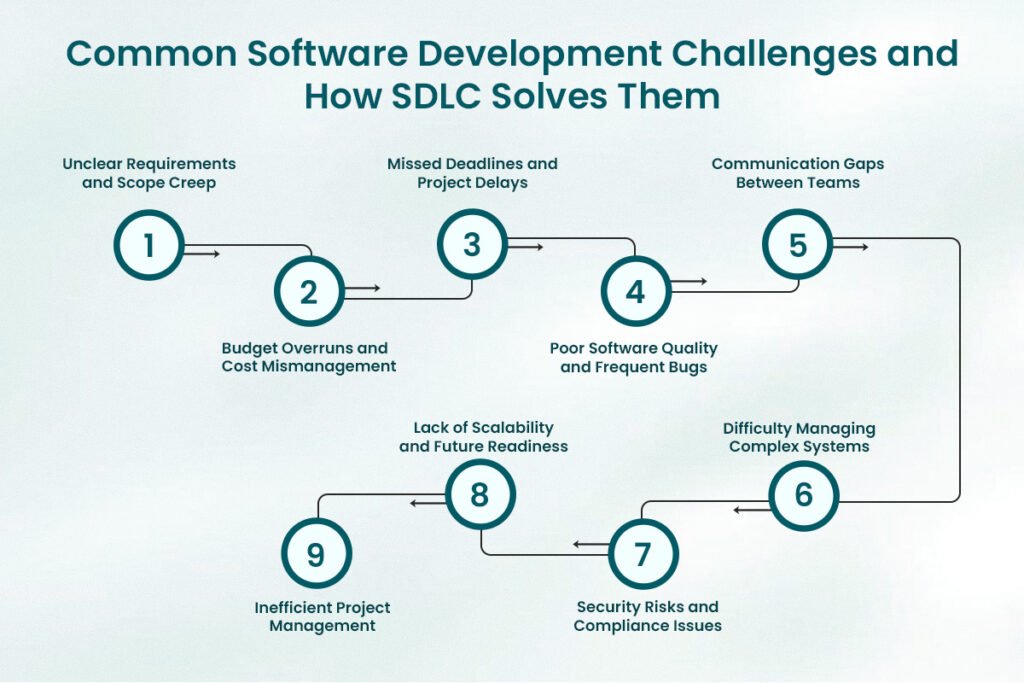
Software development in 2026 moves fast, but it also brings significant complexity. Teams handle changing requirements, tight deadlines, system integrations, and rising user expectations. When organizations lack structure, these challenges quickly lead to delays, cost overruns, and poor-quality products.
A well-defined SDLC helps businesses tackle these issues head-on. It introduces clear processes, accountability, and control, turning common problems into manageable tasks.
1. Unclear Requirements and Scope Creep
Teams often start projects without clearly defining requirements. As development progresses, stakeholders request new features, priorities shift, and the scope expands. This leads to confusion, delays, and increased costs.
SDLC solves this by enforcing a structured requirements analysis phase. Teams gather, document, and validate requirements before development begins. They also implement change management processes to evaluate and approve any new requests. This approach keeps the project focused and prevents uncontrolled scope creep.
2. Budget Overruns and Cost Mismanagement
Many projects exceed budgets because teams underestimate effort or fail to track spending effectively. Businesses often miscalculate the cost to develop custom software, leading to financial strain.
SDLC helps teams plan budgets accurately from the start. It breaks projects into phases, assigns resources efficiently, and tracks costs at each stage. This structured approach allows businesses to control spending, avoid unnecessary rework, and make informed financial decisions.
3. Missed Deadlines and Project Delays
Teams frequently miss deadlines due to poor planning, unclear priorities, or unexpected challenges. Without a structured timeline, projects lose momentum.
SDLC addresses this by defining clear milestones, deliverables, and timelines. Teams monitor progress regularly and identify bottlenecks early. This proactive approach helps them stay on track and deliver projects on time.
4. Poor Software Quality and Frequent Bugs
Teams often rush testing or treat it as a final step, which leads to bugs and performance issues in production. Poor-quality software damages user trust and increases maintenance costs.
SDLC integrates testing throughout the development process. Teams perform continuous testing, conduct code reviews, and follow software development best practices to maintain quality. By using modern software development life cycle tools, they detect and fix issues early, ensuring a stable and reliable product.
5. Communication Gaps Between Teams
Miscommunication between developers, designers, and stakeholders often leads to misunderstandings and inconsistent results. Teams may duplicate work or miss critical requirements.
SDLC improves communication by defining roles, responsibilities, and workflows. Teams document processes, hold regular meetings, and use collaboration tools to stay aligned. This structured communication reduces errors and improves efficiency.
6. Difficulty Managing Complex Systems
Modern applications involve multiple integrations, cloud environments, and advanced technologies. Managing this complexity without structure leads to errors and inefficiencies.
SDLC simplifies complexity by breaking development into manageable phases. Teams focus on one stage at a time, ensuring proper planning, design, and execution. This approach helps them build scalable and maintainable systems.
7. Security Risks and Compliance Issues
Teams often address security too late in the development process, which increases the risk of vulnerabilities and compliance failures.
SDLC integrates security into every phase of development. Teams adopt DevSecOps practices, conduct regular security testing, and ensure compliance from the beginning. This proactive approach reduces risks and protects sensitive data.
8. Lack of Scalability and Future Readiness
Some software works well initially but fails when the business grows. Teams often overlook scalability during development.
SDLC ensures that teams consider scalability during the design phase. They build systems that can handle growth and support custom software solutions for business growth. This forward-thinking approach reduces the need for major redesigns later.
9. Inefficient Project Management
Managing multiple tasks, teams, and deadlines without a structured approach leads to confusion and inefficiency. Projects become difficult to track and control.
SDLC provides a clear framework for managing projects, making it the best way to manage software development projects. Teams organize tasks, track progress, and maintain accountability throughout the lifecycle.
How Can EitBiz Help You in the Software Development Lifecycle?
Software development in 2026 is not just about writing code; it’s about building reliable, scalable, and business-driven solutions in an increasingly complex environment. Throughout this guide, one thing becomes clear: organizations that follow a structured SDLC consistently outperform those that don’t.
End-to-End SDLC Implementation Support
We help you define requirements, design architecture, develop scalable systems, test thoroughly, and deploy with confidence, ensuring nothing is left unstructured or overlooked.
Business-Focused Requirement Analysis
We begin by understanding your business goals, target users, and operational challenges. Our team translates these requirements into clear technical specifications so your software is aligned with measurable outcomes.
Expertise in Agile and Modern SDLC Models
Whether you require flexibility for evolving requirements or a structured approach for fixed-scope projects, we tailor the methodology accordingly. Our experience with SDLC vs agile methodology helps businesses choose the right model and implement it effectively for faster and more predictable delivery.
Use of Advanced Tools and Automation
We leverage modern software development life cycle tools to improve efficiency and transparency across projects. From version control and CI/CD pipelines to automated testing and deployment systems, we ensure every stage is optimized for speed and accuracy.
Strong Focus on Quality and Security
We also implement strong security practices throughout the SDLC to ensure your applications are safe, compliant, and reliable, especially important for enterprise and data-sensitive industries.
Scalable and Future-Ready Architecture
We focus on building systems that support future enhancements, integrations, and evolving business needs without requiring complete redevelopment.
Continuous Support and Maintenance
Our role doesn’t end at deployment. We provide ongoing maintenance, monitoring, and optimization to ensure your software continues to perform efficiently. Get in touch with EitBiz today and take the first step toward building smarter, scalable, and future-ready software.