Businesses across different industries are rushing to adopt artificial intelligence by embedding it into products, workflows, customer experiences, and internal operations at scale. As AI initiatives expand, so do the challenges associated with managing them.
Questions around data privacy, security, compliance, model accountability, and risk management are becoming harder to ignore. This is especially as organizations quickly move towards more autonomous AI systems and agentic workflows.
Having a detailed AI governance strategy becomes crucial here. A well-established AI governance framework helps businesses establish the policies needed to deploy responsible AI models while maintaining security, compliance, and privacy.
What is AI Governance?
AI governance is a set of policies, processes, rules, and monitoring methods that determine how artificial intelligence systems are developed, implemented, monitored, and managed within various organizations. The end goal is to enable innovation while reducing risk.
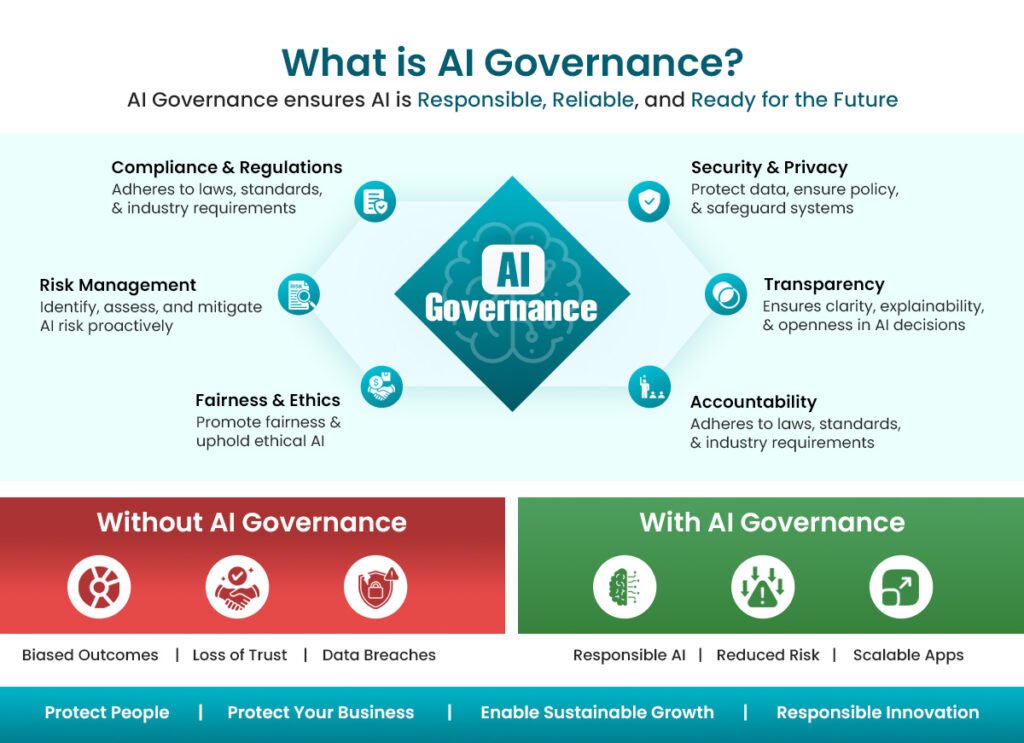
An effective AI governance framework helps an organization answer critical questions:
- Who is responsible for AI decisions?
- What data is being used?
- How are risks identified and mitigated?
- How are AI outputs monitored?
- What happens when AI systems fail?
Simply put, AI governance is the rulebook and guardrails for how your business uses artificial intelligence. Without it, AI adoption can quickly become fragmented and difficult to control.
Why Enterprise AI Governance Cannot Be Ignored
While internal operational issues are dangerous, external legal mandates are moving faster. The global regulatory landscape has shifted from soft guidance to hard enforcement, establishing clear legal boundaries across various jurisdictions:
The EU AI Act Mandate
The core transparency and compliance rules of the EU AI Act officially take effect. Organizations deploying AI within or interacting with the European single market must comply with strict disclosure rules, mandatory synthetic content watermarking, and foundational AI literacy baselines. Failing to meet these carries penalties upto €35 million or 7% of global annual turnover.
The US State-Level Patchwork
It’s a decentralized approach to governance where multiple individual states across the US pass their own policies and rules for issues like AI and data privacy. The comprehensive Colorado AI Act requires documented risk management programs and algorithmic discrimination audits.
India’s Techno Legal Framework
India’s approach to AI governance is modern and based on a strict principle. The techno-legal framework embeds legal and safety principles directly into the design and operations of AI systems.
The Five Business Risks of Ignoring AI Governance
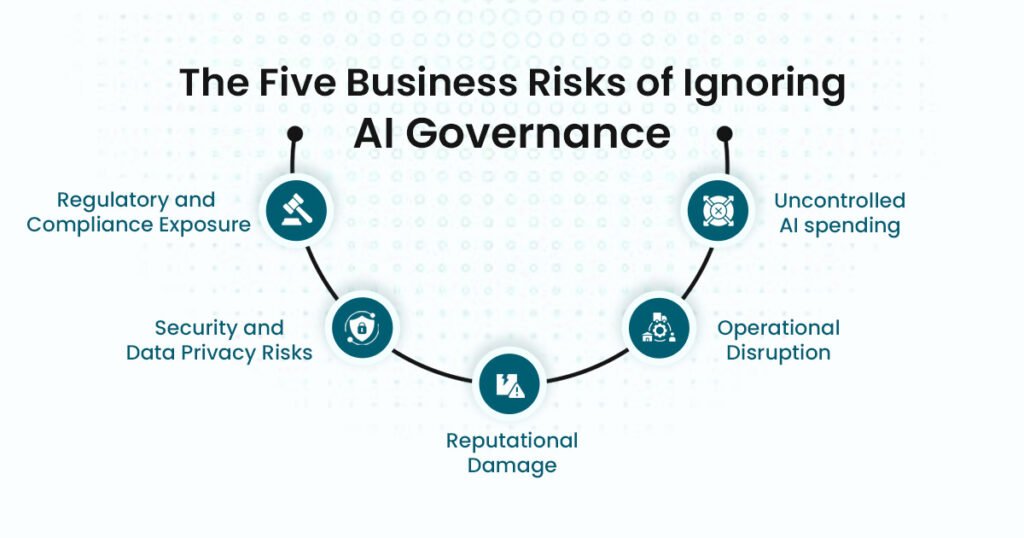
Ignoring the importance of governance over your artificial intelligence system can place your organization on the verge of severe risks. Many businesses have partnered with an AI consulting firm for a top-tier implementation strategy, but few are aware of the importance of governance. And, if you are among them, you must know the risk of ignoring it:
Regulatory and Compliance Exposure
The more we use AI, the stricter the requirements for AI usage will be. Organizations must demonstrate that AI systems are operating responsibly, particularly when they impact customers or critical business processes.
Without governance, businesses may struggle to:
- Document AI usage
- Explain decisions
- Maintain audit trails
- Meet compliance requirements
The result can be legal fines, penalties, or increased scrutiny.
Security and Data Privacy Risks
AI solutions often require access to large volumes of business data. Without proper governance controls, organizations risk:
- Unauthorized data access
- Data theft
- Confidential information exposure
- Security Vulnerability across AI applications
The more connected AI becomes, the greater the importance of clear access controls and monitoring mechanisms.
Reputational Damage
Trust remains one of the most valuable business assets. A single AI-related incident can quickly impact customer experience. Examples include:
- Biased recommendations
- Incorrect outputs
- Publicly exposed confidential data
- Harmful automated decisions
Operational Disruption
8 out of 10 businesses focus only on the AI performance but overlook the operational reliability. This highlights the systemic blind spot in modern enterprise AI deployment. Without governance:
- Models can drift over time
- Outputs can become inaccurate
- Business rules can be bypassed
- Automated processes can fail unexpectedly
Enterprise AI governance includes monitoring, validation, and escalation procedures that reduce operational risks.
Uncontrolled AI spending
AI initiatives often emerge across multiple departments simultaneously. Every department needs a specific tool to work with, whether it’s marketing, operations, or customer support. Without governance over AI usage, a business can often experience:
- Duplicate investments
- Tool sprawl
- Increased licensing costs
- Inconsistent security practices
AI governance implementation can provide visibility into AI usage across the enterprise and help align investment with business objectives.

Why Enterprise AI Governance is Essential in 2026
A business must track where, when, and how AI systems have been utilized. An AI governance framework made this possible. It is an essential control layer that ensures AI systems are compliant, secure, and reliable.
Rise of Agentic AI
Agentic AI is a quickly embracing trend today, as agentic ai solutions can work independently, make decisions, and act on them. In between the entire process is in a “black box.” Like how they do it, what they do it, and how it will be helpful. Risks include unauthorized lateral operations, uncontrollable digital identities, and non-traceable behaviour.
A striking real-world case study of this governance gap that went viral was the Moltbook phenomenon, a bot-only social ecosystem. While the platform itself was intentional, its execution exposed severe security vulnerabilities when a misconfigured database leaked 1.5 million API keys and private agent data.
The agents did that on their own because they were given an open-ended goal without hard, deterministic constraints. Good governance fixes this by mandating guardrails, not just goals.
AI is Becoming Enterprise-Wide
Artificial intelligence adoption is no longer limited to innovation teams. Every enterprise is actively stepping out to adopt this technology. AI in HR, finance, operations, customer service, legal, product teams, etc., is all integrating artificial intelligence into their daily workflow. Thus, with the increasing adoption of AI, building a governance framework becomes crucial for sustainability.
Executive Accountability is Increasing
Boards and executive leadership teams are becoming more active and involved in AI strategy. They are asking important questions like:
- What risks exist?
- Who owns AI governance?
- How are systems monitored?
- What controls are in place?
Organizations that cannot answer these questions may face resistance when expanding AI initiatives.
Key Components of an Effective AI Governance Framework
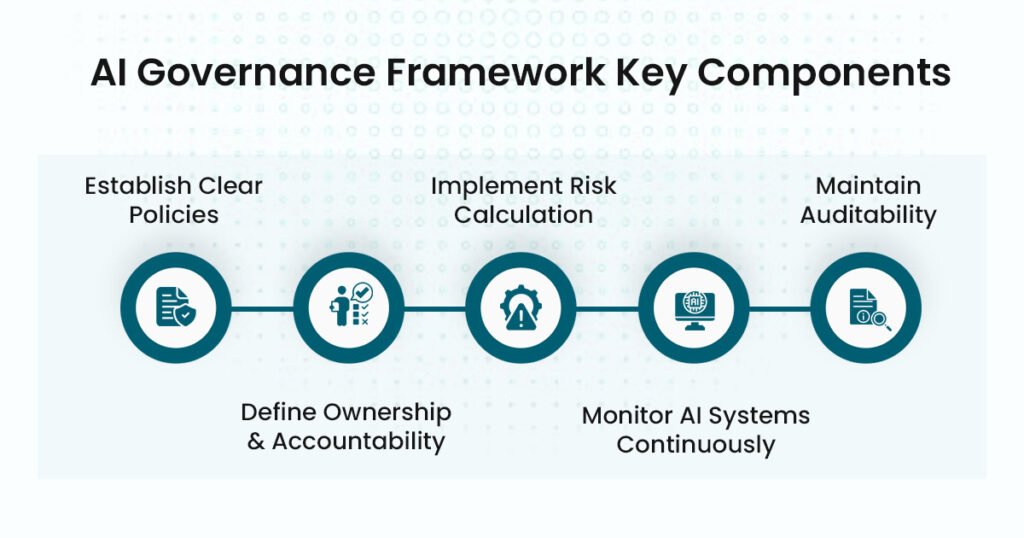
You must follow a structured blueprint to develop and deploy responsible, ethical, and compliant AI systems. The more precisely you follow, the more effectively it will help in mitigating risks and build stakeholder trust by integrating policies, oversight mechanisms, and tech concepts.
Establish Clear Policies
While integrating AI into your business workflows, ensure you have created a clear and efficient usage policy. Organizations need documented guidelines that include:
- Approved AI use case
- Data handling requirements
- Security standards
- Human oversight expectations
- Ethical considerations
This will help in creating consistency across teams.
Define Ownership and Accountability
Once you’ve established clear policies, it is crucial to define ownership and accountability. This is because governance requires clear ownership. The key stakeholders in this process include:
- CTOs
- CIOs
- Compliance Leaders
- Security Teams
- Legal Teams
- Business Unit Leaders
| Stakeholder Role | Governance Responsibility |
|---|---|
| CIOs / CTOs | Infrastructure security, model inventory, and tool centralization |
| Compliance & Legal Teams | Regulatory alignment, audit readiness, and liability management |
| Business Unit Leaders | Operational KPIs, output accuracy, and employee usage compliance |
Establishing this will let them clearly know their responsibilities throughout the AI lifecycle.
Implement Risk Calculation
Not every AI system carries the same amount of risk. To understand this, you must classify your applications based on factors like:
- Business impact
- Data sensitivity
- Regulatory exposure
- Level of autonomy
This analysis will help you uncover the amount of risk your systems carry and significantly contribute to building a precise AI governance framework. Higher risk requires stringent control and oversight measures in comparison to lower or mid-risk.
Monitor AI Systems Continuously
AI governance implementation is not just a one-time exercise. You have to monitor your AI systems continuously to implement the right guardrails at the right time. Ongoing monitoring helps you in evaluating:
- Performance
- Security
- Accuracy
- Compliance
- User behavior
This will help you solve the issues before they appear during the process.
Maintain Auditability
Every significant AI decision must be traceable. You must create and maintain auditability that supports:
- Compliance efforts
- Risk management
- Incident investigations
- Executive reporting
This way, you will have complete visibility across your entire AI lifecycle and data infrastructure, which is really good for AI governance.
AI Governance Creates Competitive Advantage
Many organizations see governance as a barrier to innovation. But it’s not actually. Implementing it will not limit your enterprise’s capability; it will further enhance it. A strong enterprise AI governance framework allows you to:
- Accelerate AI adoption
- Reduce deployment risks
- Build stakeholder trust
- Improve decision-making
- Confidently scale AI initiatives
When governance is built into AI apps/programs from the beginning, teams spend less time addressing preventable issues.
Thus, in 2026, the organizations leading AI adoption are not simply deploying AI. They are more focused on deploying AI responsibly at scale.
How EitBiz Operationalizes AI Governance
Deploying resilient, audit-ready AI requires a technical partner who understands the interplay between machine learning infrastructure, data pipelines, and enterprise security. EitBiz stands as a strategic partner who bridges the gap between raw AI capabilities and strict organizational compliance.
We are an ISO 9001:27001 certified technology partner. Our experts precisely integrate security, data integrity, and deterministic guardrails directly into your software development lifecycle. We follow a structured implementation blueprint:
- Strategic AI consulting: Our team audits your existing tech stack, identifies hidden vectors of “Shadow AI”, and classifies your planned tools into distinctive risk tiers.
- Secure enterprise data engineering: We design secure, permissioned environments to prevent leaks of proprietary data and intellectual property contamination.
- Deterministic guardrails of Agentic AI: Our AI governance team defines the operational boundaries. We configure strict API validation layers, identify validation mechanisms, and human-in-the-loop escalation thresholds. This will ensure autonomous agents never execute unauthorized lateral operations.
So, do not wait for an internal data breach or an intellectual property dispute; partner with us to safeguard your AI systems usage today.