Got a startup idea you truly believe in? Convinced it can solve a real problem?
But here’s the tricky question- Are you sure users will actually want it?
Every year, thousands of startups fail not because of bad ideas, but because they build too much, too soon. According to CB Insights, 35% of startups fail because there is no market need. That number hasn’t changed much, even in 2026. The lesson is clear: guessing is expensive.
This is where minimum viable product development becomes a startup’s most brilliant move.
Instead of spending months building a “perfect” product, founders today focus on MVP development for startups to test ideas quickly, gather honest feedback, and validate demand before burning cash. It’s not about cutting corners. It’s about making informed decisions early.
Ask yourself:
- What is the most miniature version of my idea that users can actually use?
- Which feature proves the value fastest?
- How can I learn before I scale?
That’s the core of startup MVP development.
In 2026, MVPs are no longer optional. Investors expect them. Users demand fast iterations. And founders need clarity, fast. Whether you’re planning MVP app development, exploring platforms for MVP app development for startups, or simply trying to understand how to build an MVP without overspending, the goal is the same: reduce risk while increasing learning speed.
An MVP helps you:
- Validate real user problems, not assumptions
- Test product-market fit with minimal investment
- Control MVP development cost while maximizing insights
- Decide what to build next, based on data, not opinions
In this complete 2026 guide, we’ll break down MVP development step by step. Just practical guidance that answers what founders are actually searching for, from tools and testing to cost and execution.
If you want to build smarter, not just faster, you’re in the right place.
What Is an MVP (and What It Is Not)
A Minimum Viable Product, or MVP, is the most practical way for a startup to test an idea in the real world. At its core, minimum viable product development is about learning- fast, cheap, and with real users. An MVP is not built to impress everyone. It is built to answer one critical question: Does this product solve a real problem for a real user?
{Also Read: Why MVP Development Is the Smartest First Step for Any Tech Startup?}
In modern MVP development for startups, an MVP is a functional product with just enough features to deliver its core value. Users can interact with it, experience the solution, and provide meaningful feedback. That feedback then drives the following product decisions. The goal is not perfection. The goal is validation.
Many founders confuse an MVP with a prototype or a demo. That misunderstanding often leads to wasted time and budget. A prototype shows how a product might work. An MVP shows how a product actually works in users’ hands. This distinction is critical in startup MVP development, mainly when early traction and investor confidence depend on real usage data.
An MVP is also not a scaled-down version of your final product. It is a focused version. During MVP app development, every feature must justify its existence by supporting the primary user outcome. Anything that does not directly prove value should wait.
What an MVP Is
- A real, usable product built for real users
- A focused solution that delivers one clear value
- A tool for learning, validation, and iteration
- A foundation for future MVP app development and scaling
- A way to test demand while controlling MVP development cost
What an MVP Is Not
- A rough prototype with no user interaction
- A half-finished product full of broken flows
- A feature-heavy app built on assumptions
- A “cheap” version of the final product
- A one-time launch with no iteration plan
When done right, minimum viable product development, especially with the support of a custom MVP development company, helps startups move with clarity. It reduces risk, shortens feedback loops, and keeps teams focused on what truly matters, solving the right problem before scaling the solution.
What are the Types of MVP?
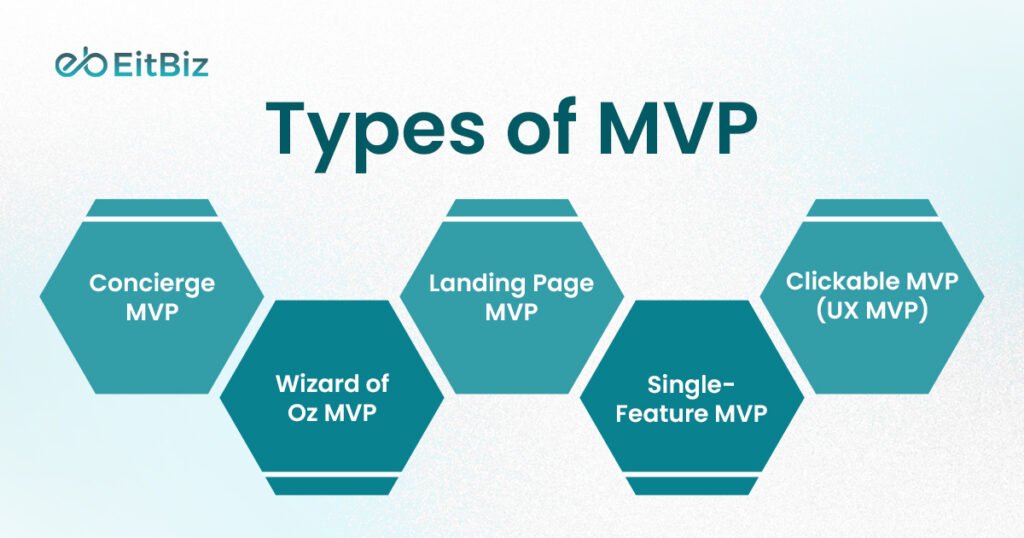
Startups use different types of MVPs depending on what they want to validate: user demand, usability, or technical feasibility, before investing in full-scale product development.
1. Concierge MVP
A concierge MVP delivers the core value manually instead of through automation. Instead of building full software, the startup provides the service manually to validate demand.
This type of MVP is ideal when the goal is to gain a deep understanding of user behavior, pain points, and willingness to pay. Although it doesn’t scale, it provides extremely high-quality feedback early on and avoids unnecessary development costs.
2. Wizard of Oz MVP
In a Wizard of Oz MVP, users believe they are interacting with a fully functional product, but the backend processes are handled manually. From the user’s perspective, everything looks automated.
This approach is useful when testing complex workflows or AI-driven features without investing heavily in engineering upfront. It helps validate user trust and experience before committing to full implementation.
3. Landing Page MVP
A landing page MVP focuses on validating demand rather than functionality. It usually includes a clear value proposition, feature overview, pricing, and a call-to-action such as sign-ups or waitlists.
This type of MVP is great for testing market interest, messaging, and positioning before building anything. It’s fast, inexpensive, and especially effective in competitive or uncertain markets.
4. Single-Feature MVP
A single-feature MVP focuses on solving one core problem extremely well. Instead of building a full product, startups launch with the most critical feature that delivers the primary value.
This approach reduces complexity, shortens time to market, and makes it easier to measure product-market fit. Many successful products started as single-feature MVPs before expanding.
5. Clickable MVP (UX MVP)
A clickable MVP is a non-functional, interactive design typically created with tools such as Figma. Users can click through screens as if the product were real.
This type of MVP is useful for validating user flows, usability, and design assumptions. It’s often used before development begins to reduce rework and align stakeholders.
How to Build an MVP: Step-by-Step?

Building an MVP can feel overwhelming, especially if you’re doing it for the first time. Where do you start? What do you make first? And how do you avoid wasting months on the wrong features?
This step-by-step approach to minimum viable product development is designed for founders. It keeps the process practical, focused, and rooted in real-world execution. Each step builds on the last, so don’t rush it.
1. Define the Core Problem (Not the Product)
Every successful MVP starts with a problem, not a solution. Yet many founders jump straight into features and screens. That’s risky.
Ask yourself:
What exact problem am I trying to solve, and for whom?
Your answer should be specific and grounded in reality. Vague problems lead to vague products.
For example:
- Weak problem: “People need better financial tools.”
- Strong problem: “Freelancers struggle to track unpaid invoices and follow up on time.”
This clarity shapes every decision in MVP development for startups. If you can’t explain the problem in one sentence, your MVP scope will explode.
Spend time here. Talk to potential users. Listen more than you pitch. The better you define the problem, the easier every next step becomes.
2. Identify Your Target User (Be Ruthlessly Specific)
An MVP is not built for “everyone.” It never is.
Who exactly feels this problem the most? Who experiences it often enough to care about a solution?
Ask:
- What is their role or job?
- What tools do they use today?
- What frustrates them the most?
In startup MVP development, narrowing your audience actually increases your chances of success. A focused MVP gets more precise feedback.
Example:
Instead of building a task management app for all professionals, you make it for remote product designers working across time zones. That clarity changes your feature decisions, onboarding, and messaging.
Your MVP should make one specific group say, “This was made for me.”
3. Define the Core Value Proposition
Now that you know the problem and the user, it’s time to define value.
Ask one simple question:
What is the most critical outcome users should achieve with this MVP?
Your MVP should deliver one clear win, fast.
Examples:
- “Create and send an invoice in under 2 minutes”
- “Book a verified home service provider today”
- “Track daily expenses without spreadsheets”
This step is crucial in MVP app development. If users don’t experience value quickly, they won’t return. And without retention, your MVP teaches you nothing.
Avoid stacking multiple value promises. One outcome. One success moment.
4. Decide MVP Scope (Cut More Than You’re Comfortable With)
This is where most founders struggle.
You’ll have dozens of ideas. Dashboards. Notifications. Integrations. Analytics. Resist the urge.
Ask yourself repeatedly:
Does this feature directly support the core value?
If not, cut it.
In minimum viable product development, less is not a compromise; it’s a strategy.
Example:
If your MVP’s goal is to help freelancers track unpaid invoices:
- Must-have: create invoice, see payment status
- Nice-to-have (cut for now): accounting reports, tax summaries, CRM features
A tight scope keeps development faster and lowers MVP development cost. It also helps you launch sooner and learn faster.

5. Choose the Right Tech Stack (Speed Over Perfection)
When it comes to choosing tech stack for MVP, your product does not need the “best” technology it needs the right technology for speed and learning.
Ask:
- What can my team build fastest?
- What tools reduce setup and maintenance?
- What can scale later if needed?
In early MVP development for startups: proven, simple tech wins.
Example stacks:
- Web MVP: React + Firebase + Stripe
- Mobile MVP: Flutter + Supabase
- No-code MVP: Bubble or FlutterFlow
Avoid over-engineering. You’re validating a business idea, not building infrastructure for millions of users.
6. Build, Launch, and Put It in Front of Users
An MVP that stays in development is not an MVP. It’s a delay.
Once the core flow works, launch it even if it feels uncomfortable.
Ask yourself:
Can a real user complete the main task without help?
If yes, you’re ready.
In startup MVP development, early users are collaborators. Watch how they use the product. Where do they get stuck? What do they ignore? What do they repeat?
Example:
You may discover that users love one small feature you thought was minor, while ignoring the one you assumed was critical. That insight is gold.
7. Measure, Learn, and Iterate
The final step never really ends.
Track behavior, not opinions. Look at:
- Activation rate
- Retention
- Time to first value
- Drop-off points
Ask:
What is the product teaching us right now?
Iteration is the real output of minimum viable product development. Each learning cycle brings you closer to product-market fit.
Your MVP is not the destination. It’s the fastest path to building the right product, without guessing.
MVP vs. Prototype vs. PoC
While MVPs, prototypes, and proof of concepts are often used interchangeably, they serve different purposes at different stages of product development. The table below highlights the key differences to help startups choose the right approach.
| Aspect | MVP (Minimum Viable Product) | Prototype | Proof of Concept (PoC) |
| Purpose | Validate business idea with real users | Validate design and user experience | Validate technical feasibility |
| Primary Question | Will users adopt and pay for this? | Is this easy to use and understand? | Can this solution be built? |
| Functionality | Functional and usable | Limited or non-functional | Minimal, experimental functionality |
| Target Audience | Real users and early adopters | Internal teams and test users | Engineering and technical teams |
| Time to Build | Medium (8–16 weeks) | Short (1–3 weeks) | Short (1–4 weeks) |
| Cost | Medium to high | Low | Low to medium |
MVP Development Timeline and Steps
1. Discovery and Planning (1-2 weeks)
This step defines the problem, target users, value proposition, and success metrics. Core assumptions are identified, and non-essential features are intentionally excluded to keep the scope minimal.
2. UX/UI Design (2-3 weeks)
User flows, wireframes, and visual designs are created to ensure usability and clarity. Clickable prototypes are often tested with early users to validate design decisions before development begins.
3. Development (4-8 weeks)
Frontend and backend development are executed in short, agile sprints. Only core features are built, with integrations, APIs, and basic infrastructure configured to support real user interaction.
4. Testing and Iteration (1-2 weeks)
Functional, usability, and performance testing are conducted to identify issues. Feedback is incorporated quickly to improve stability, user experience, and feature effectiveness.
5. Launch and Measurement (1 week)
The MVP is released to a controlled group of users or the public. Analytics and feedback loops are set up to track usage, validate assumptions, and guide the next iteration.
What are the Challenges in MVP Development?
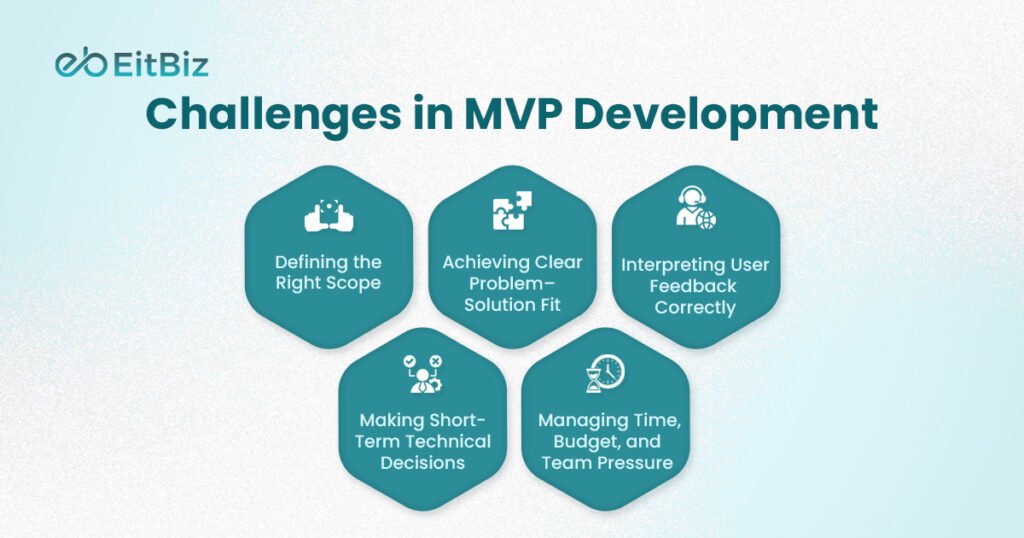
Building an MVP allows startups to move fast and learn early, but the process is rarely straightforward. Teams often face strategic, technical, and operational challenges that can slow progress or weaken results if they’re not addressed early.
1. Defining the Right Scope
Startups frequently struggle to decide what to include and what to leave out. Founders often want to showcase the full vision, while users only need a solution to one core problem.
When teams add extra features “just in case,” development becomes slower, costs increase, and the MVP loses focus. A poorly scoped MVP makes it harder to learn what actually matters to users.
2. Achieving Clear Problem–Solution Fit
Many MVPs fail because teams start building before fully understanding the problem. When assumptions replace real user research, the product may solve the wrong pain point or solve it in a way users don’t care about.
Without a strong problem–solution fit, even a well-built MVP struggles to gain traction or produce meaningful feedback.
3. Interpreting User Feedback Correctly
Early feedback can be confusing, emotional, or even contradictory. Some users request more features, while others struggle with the basics. Teams that react too quickly to every opinion risk constant pivots and product confusion.
Successful MVP teams look for patterns in behavior and usage data rather than relying only on what users say.
4. Making Short-Term Technical Decisions
To move fast, teams often choose quick technical solutions that may not scale. While this is sometimes necessary, poor architectural decisions can lead to performance issues, security risks, or expensive rewrites later.
Balancing speed with a clean, flexible foundation is one of the hardest parts of MVP development.
5. Managing Time, Budget, and Team Pressure
Limited budgets and aggressive timelines put constant pressure on founders and teams. Developers rush features, testing gets shortened, and UX decisions are made quickly.
These compromises can result in bugs, poor usability, or unreliable performance, which hurts early user trust and adoption.
What are the Best Testing Tools for MVP Development in Startups?
When you’re building your MVP, testing isn’t optional; it’s essential. In minimum viable product development, testing tools help you find bugs, understand user behavior, and validate assumptions early. The goal isn’t perfection. It’s learning fast and improving faster.
Here are the most reliable tools used in startup MVP development in 2026, organized by purpose and explained with practical context.
1. Functional Testing Tools
Functional testing ensures your MVP works as expected. It catches broken workflows before users report them.
- Playwright
Playwright lets you automate end-to-end tests across browsers. It’s modern, fast, and supports real user scenarios. If you want reliable testing without a complex setup, it’s a top choice.
- Cypress
Cypress offers a smooth developer experience. It runs tests right in the browser and helps you catch UI bugs quickly. It’s great for smaller teams that need visibility and speed.
- Selenium
Selenium is a veteran tool that supports multiple languages and environments. If your MVP has complex integrations, Selenium’s flexibility can be a big advantage.
Why these matter: Functional testing stops regressions early, so your MVP stays stable even as you iterate.
2. User Behavior & Analytics
Functional tests tell you if your product works. Behavior tools tell you how users interact with it. This insight is critical in MVP app development.
- Hotjar
Hotjar captures heatmaps, session recordings, and user feedback. This helps you see where users pause, click, or abandon flows. It answers questions like: Are users confused here?
- PostHog
PostHog combines analytics, session replay, and feature flags into a single platform. It’s open source and GDPR-friendly, which is helpful for startups operating globally.
- Mixpanel
Mixpanel lets you track events and user journeys with precision. You can measure funnels, retention, and cohorts, data that tells you whether users find value and return.
Why these matter: These tools help you move beyond assumptions. You see real behavior, so your subsequent decisions are data-driven.
3. Performance & Error Monitoring
Once an MVP is live, performance hiccups can quickly erode user trust. The proper monitoring tools provide real-time alerts and insights.
- Sentry
Sentry tracks errors in real time across the frontend and backend. It shows detailed stack traces so you can fix issues fast.
- LogRocket
LogRocket goes beyond errors; it records user sessions so you see exactly what happened before a failure. This speeds up debugging.
- New Relic
New Relic provides performance metrics across servers and services. If your MVP relies on APIs or cloud services, this visibility matters.
Why these matter: Early performance issues can kill engagement. Monitoring tools help teams stay ahead.
- A/B Testing Tools
A/B testing lets you compare two versions of a feature to make decisions based on real performance, not guesses.
- Google Optimize (or alternatives)
Google Optimize is a common choice for simple A/B tests, especially for landing pages. Alternatives like VWO or Optimizely work well if you need advanced targeting.
Why A/B testing matters: Even small UI changes can affect conversion rates. A/B testing gives clarity on what works better.
How Much Does MVP Development Cost in 2026?
In 2026, MVP development cost estimation typically range from $5,000 to $50,000, depending on complexity. A basic MVP with essential features costs $5,000-$20,000, a mid-level MVP with custom logic and integrations costs $20,000-$40,000, and advanced MVPs with AI, real-time data, or scalable cloud architecture can exceed $50,000. Key cost drivers include AI integration, cloud infrastructure, security, and platform support.
An MVP is typically developed within 8 to 16 weeks, depending on product complexity, team size, and technology stack. The process focuses on rapid validation rather than full-scale development.
Conclusion
MVP development is no longer just a startup phase; it’s a mindset. In 2026, successful founders don’t try to predict the market. They test it. They use minimum viable product development to validate real problems, understand real users, and make data-backed decisions rather than assumptions.
A well-built MVP helps you answer the most important questions early. Will users adopt this product? Will they return? Will they pay? By focusing on MVP development for startups, choosing the right tools, controlling cost, and testing continuously, you reduce risk and increase your chances of building something that truly matters.
If you’re looking for a partner who understands the realities of startups, EitBiz can help. With proven experience in startup MVP development services, we work closely with founders to turn ideas into validated products. Our team focuses on clarity, lean execution, and scalable architecture, so your MVP doesn’t just launch, it evolves. From ideation and design to development and testing, we help startups move forward with confidence.
If you have an idea and want to test it the right way, now is the time. Get in touch with EitBiz and start building an MVP that delivers real insights, real users, and real momentum.