Key Takeaways
- Generative AI for business is reshaping how organizations operate by improving productivity, reducing costs, and enabling faster innovation across industries.
- The most valuable generative AI use cases include marketing, customer support, operations automation, and software development, all of which drive measurable business impact.
- A strong AI implementation strategy is essential, starting with clear use cases, proper data preparation, and step-by-step deployment from pilot to enterprise scale.
- Enterprise generative AI requires secure architecture and integration with existing systems like CRM and ERP to deliver accurate, context-aware results.
- Success with generative AI depends on choosing the right generative AI development company or hiring skilled developers to build scalable, custom AI solutions aligned with business goals.
What if your marketing team could create a month of campaign content in a single afternoon? What if your customer support agents had an AI assistant that drafted accurate responses in seconds?
That is the promise of generative AI for business.
What began as a breakthrough technology is now a strategic capability. Organizations are using generative AI solutions to automate repetitive work, improve decision-making, and build entirely new products and services.
The numbers tell a compelling story.
According to McKinsey’s State of AI 2025 report, 88%of organizations now use AI in at least one business function, and 64% say AI is enabling innovation.
So, where does generative AI create the most value? Which generative AI use cases deliver measurable ROI? And what does a practical generative AI strategy look like for companies ready to move beyond experimentation?
In this guide, we will explore the benefits of generative AI, real-world generative AI applications, and a step-by-step AI implementation strategy to help your organization turn enterprise generative AI into a competitive advantage.
What Is Generative AI for Business?
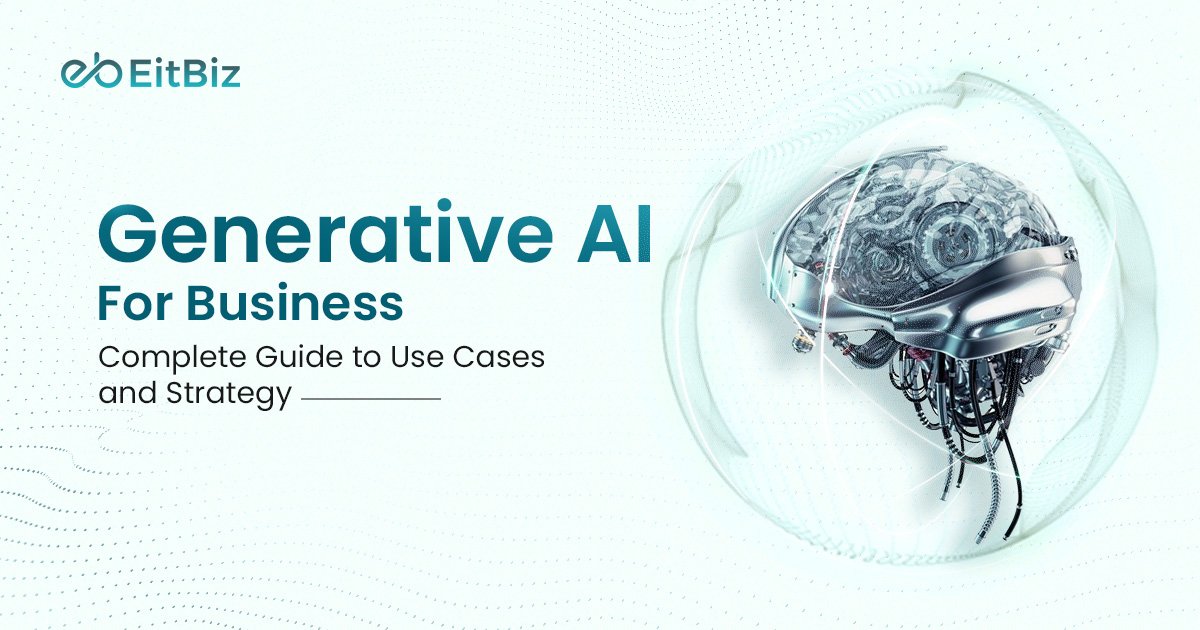
Generative AI for business refers to the use of large language models and multimodal AI systems to create text, code, images, reports, and insights that support business operations.
Common enterprise generative AI capabilities include:
- Drafting marketing content and proposals
- Summarizing meetings and documents
- Generating software code
- Creating customer support responses
- Extracting information from contracts and invoices
- Powering conversational AI assistants
- Automating research and analysis
Generative AI for enterprise environments is typically integrated with proprietary business data, internal knowledge bases, and operational systems such as CRM, ERP, and help desk platforms.
Why Generative AI for Business Transformation Matters?
Generative AI for business transformation matters because it fundamentally changes how organizations create value.
Knowledge-intensive tasks that once required hours of manual work can now be completed in minutes. Teams can scale output without proportional increases in headcount. Decision-makers gain access to insights faster, and customer interactions become more personalized.
Companies that adopt a generative AI strategy early can:
- Respond to market changes more quickly
- Deliver better customer experiences
- Launch products faster
- Improve workforce productivity
- Reduce operational costs
- Create new AI-powered offerings
Generative AI is not just a productivity tool. It is a platform for redesigning business processes and operating models.
What are the Key Benefits of Generative AI for Business?
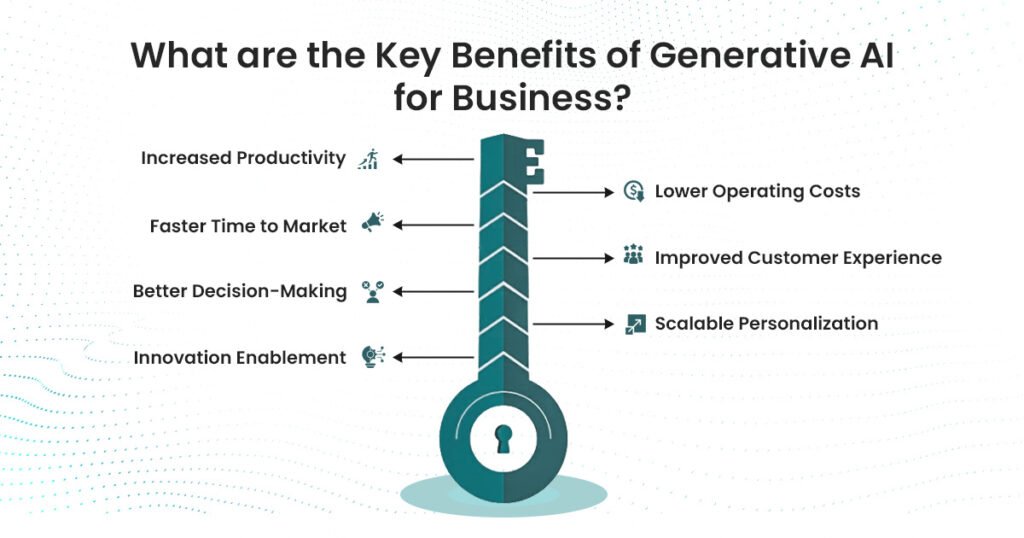
The benefits of generative AI for business extend across every major function, from marketing and customer support to software development and operations. Whether through AI for business automation, generative AI solutions, or custom generative AI development services, businesses are using this technology to drive measurable growth.
Increased Productivity
One of the most immediate benefits of generative AI is increased productivity. Employees can use generative AI applications to draft content, summarize documents, generate code, and analyze data in minutes instead of hours. For organizations focused on generative AI for business transformation, these productivity gains often deliver the fastest ROI.
Lower Operating Costs
Generative AI solutions reduce operational costs by automating repetitive, labor-intensive tasks. From customer support and document processing to software testing, AI automation tools for business help companies scale efficiently without significantly increasing headcount.
Faster Time to Market
Generative AI applications help teams launch products, campaigns, and features faster. Marketing can create assets quickly, product teams can generate requirements, and developers can accelerate work using generative AI software development tools.
Improved Customer Experience
Generative AI for enterprise use enables businesses to deliver faster, more personalized customer support. AI assistants and chatbots provide instant responses, improving resolution times and customer satisfaction.
Better Decision-Making
Enterprise generative AI can summarize large datasets and generate actionable insights. This helps executives and managers make faster, more informed decisions as part of a strong generative AI strategy.
Scalable Personalization
Generative AI for business allows marketing and sales teams to personalize emails, proposals, and recommendations for thousands of customers at once. This improves engagement and conversion rates while reducing manual effort.
Innovation Enablement
Generative AI development empowers businesses to build new products, services, and internal tools. By working with a generative AI development company or choosing to hire generative AI developers, organizations can turn innovative ideas into scalable AI solutions for businesses.
AI Implementation Strategy: Step-by-Step Framework
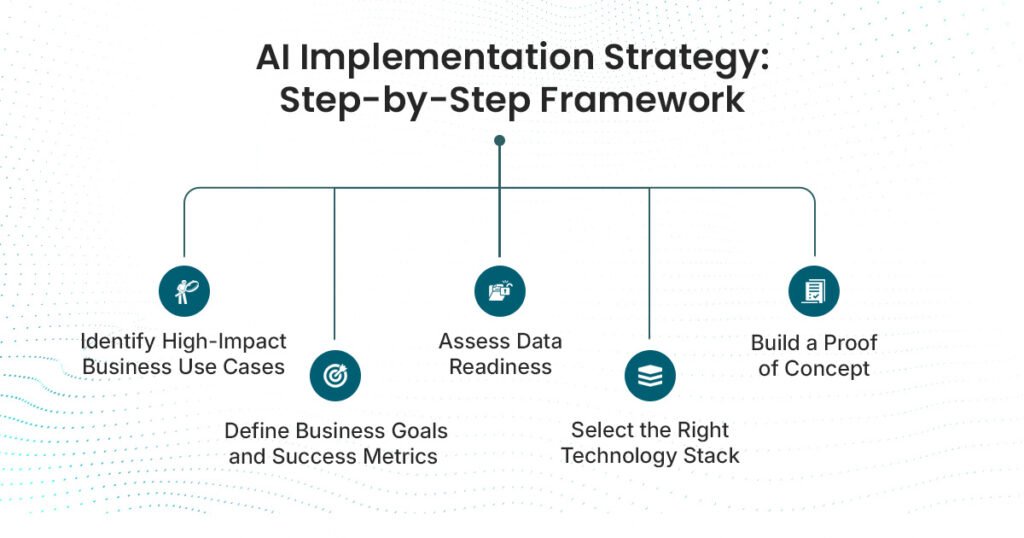
A successful AI implementation strategy requires more than choosing the right model. To realize the full benefits of generative AI for business, organizations need a structured approach that aligns technology investments with measurable business goals.
Whether you are deploying enterprise generative AI to automate workflows, improve customer experience, or build new products, following a clear generative AI strategy reduces risk and accelerates time to value.
1. Identify High-Impact Business Use Cases
Start by selecting generative AI use cases that address real business challenges. Focus on opportunities where generative AI for business can save time, reduce costs, or improve revenue. Common starting points include customer support automation, marketing content generation, document summarization, and software development assistance.
2. Define Business Goals and Success Metrics
Establish clear objectives for your generative AI implementation. Metrics may include productivity improvements, cost savings, faster response times, higher conversion rates, or improved customer satisfaction. Well-defined KPIs make it easier to evaluate the performance of your generative AI solutions.
3. Assess Data Readiness
Generative AI for enterprise depends on access to high-quality data. Review internal knowledge bases, CRM systems, documents, and other data sources to ensure they are accurate, secure, and accessible. This step is especially important for organizations planning custom generative AI development services or retrieval-augmented generation (RAG) systems.
4. Select the Right Technology Stack
Choose the foundation models, vector databases, orchestration frameworks, and cloud infrastructure that best fit your requirements. Businesses can use prebuilt generative AI solutions or partner with a generative AI development company to design a customized architecture.
5. Build a Proof of Concept
Develop a small-scale prototype to validate technical feasibility and business value. A proof of concept helps test prompts, integrations, and user workflows before committing to a full deployment.
6. Integrate With Existing Systems
Use an AI integration service to connect generative AI applications with CRM, ERP, support platforms, and internal databases. Seamless integration ensures that AI outputs are grounded in real business context and fit naturally into existing workflows.
7. Implement Governance and Security Controls
Establish policies for data privacy, access control, human review, and compliance. Responsible governance is essential for secure enterprise generative AI adoption, especially in regulated industries.
8. Pilot and Train Users
Launch the solution with a small group of users and provide role-specific training. User feedback helps refine prompts, workflows, and adoption strategies.
9. Measure Performance and ROI
Track business outcomes against the KPIs defined earlier. Evaluate time savings, cost reductions, accuracy, and user satisfaction to determine the impact of your generative AI strategy.
10. Scale Across the Organization
Once the pilot proves successful, expand to additional departments and use cases. Many organizations choose to hire generative AI developers or work with AI development companies to support enterprise-wide scaling and continuous optimization.
Enterprise Generative AI Architecture and Integration
A robust enterprise generative AI architecture is the backbone of any successful generative AI for business initiative. While standalone AI tools are useful for experimentation, organizations need secure and scalable systems that connect with internal data and business applications. This is what enables enterprise generative AI to deliver accurate, context-aware, and compliant outputs across the organization.
At a high level, enterprise generative AI architecture combines foundation models, retrieval systems, orchestration layers, and AI integration services to power real-world generative AI applications.
| Component | Purpose | Business Value |
|---|---|---|
| Foundation Models | Generate text, code, and insights | Power core generative AI solutions |
| Retrieval-Augmented Generation (RAG) | Pull relevant data from internal sources | Improves response accuracy |
| Vector Database | Stores embeddings for semantic search | Enables intelligent knowledge retrieval |
| Prompt Orchestration Layer | Manages prompts and workflows | Standardizes outputs |
| AI Integration Service | Connects AI to CRM, ERP, and other systems | Embeds AI into business processes |
| Security and Governance Layer | Controls access and compliance | Protects sensitive business data |
| Monitoring and Analytics | Tracks usage, accuracy, and cost | Supports optimization and ROI measurement |
How to Choose the Right Generative AI Development Company?
Choosing the right generative AI development company is one of the most important decisions in your generative AI for business journey. The right partner can help you move from experimentation to production, while the wrong one can lead to delays, security issues, and poor ROI. Beyond technical skills, your ideal partner should understand your industry, business objectives, and long-term generative AI strategy.
With many AI development companies offering generative artificial intelligence development services, it is essential to evaluate each provider carefully.
Technical Expertise in Generative AI Development
A strong generative AI development company should have hands-on experience building production-grade generative AI solutions. Look for expertise in large language models, retrieval-augmented generation (RAG), vector databases, prompt engineering, and model evaluation. They should also understand generative AI software development and generative AI app development best practices to ensure your solution is scalable, secure, and maintainable.
Experience With Enterprise Generative AI
Not all vendors are equipped to build enterprise generative AI systems. Your partner should know how to design solutions that integrate with internal data sources, enforce governance controls, and meet compliance requirements. If your organization operates in a regulated industry, experience with security, privacy, and auditability is essential.
Ability to Deliver Custom Generative AI Development Services
Every organization has unique workflows, data, and business requirements. A qualified partner should be able to provide custom generative AI development services rather than relying solely on generic templates. This includes building internal copilots, intelligent search systems, customer-facing assistants, and other tailored AI solutions for businesses.
AI Integration Service Capabilities
The value of generative AI for business depends heavily on integration. Your chosen provider should offer AI integration services that connect generative AI applications with CRM platforms, ERP systems, document repositories, and customer support tools. Seamless integration ensures that AI outputs are grounded in real business context and fit naturally into existing workflows.
Strategic Consulting and AI Implementation Support
The best generative AI development companies do more than write code. They help define use cases, prioritize opportunities, and create a practical AI implementation strategy. From discovery workshops to proof-of-concept development and enterprise rollout, they should guide your organization through every stage of adoption.
When to Hire Generative AI Developers?
As generative AI for business moves from experimentation to production, many organizations reach a point where they need specialized technical expertise. While off-the-shelf tools can handle basic use cases, building secure, scalable, and customized generative AI solutions often requires dedicated talent. That is when it makes sense to hire generative AI developers.
Whether you are creating an internal copilot, automating business workflows, or launching a customer-facing product, hiring the right team can significantly accelerate your generative AI implementation.
You Need Custom Generative AI Solutions
If your use case requires proprietary data, specialized workflows, or industry-specific functionality, prebuilt tools may not be enough. In these situations, it is best to hire generative AI developers who can build custom generative AI development services tailored to your business requirements. This includes internal assistants, intelligent search platforms, and domain-specific AI applications.
You Want to Integrate AI With Existing Systems
Generative AI delivers the most value when connected to systems such as CRM, ERP, help desk platforms, and document repositories. If your project involves complex integrations, hiring experienced developers ensures your AI integration service is secure, reliable, and aligned with your operational workflows.
You Are Building a Customer-Facing AI Product
When developing chatbots, AI copilots, recommendation engines, or other generative AI applications for customers, you need production-grade architecture and robust quality controls. Organizations investing in generative AI app development and generative AI software development often hire gen AI developers to ensure performance, scalability, and security.
You Need Faster Time to Market
If speed is a priority, bringing in specialized talent can shorten development cycles considerably. Experienced developers understand the best tools, frameworks, and implementation patterns, allowing your team to move from concept to deployment much faster.
You Require Enterprise Security and Compliance
Businesses in regulated industries such as healthcare, finance, and legal services need strong controls around privacy, governance, and auditability. Hiring developers with enterprise generative AI experience helps ensure your solution meets security and compliance requirements from the beginning.
Your Internal Team Lacks Specialized Expertise
Many engineering teams are strong in software development but have limited experience with large language models, RAG pipelines, and model evaluation. In these cases, companies often hire generative AI developers or partner with a generative AI development company to fill the skills gap and transfer knowledge to internal teams.
You Are Scaling Multiple Generative AI Use Cases
Once initial pilots succeed, organizations often expand to new departments and workflows. Hiring dedicated developers helps standardize architecture, manage infrastructure, and accelerate rollout across the enterprise.
You Are Exploring Agentic AI Development
If you want to build autonomous systems that can plan, reason, and execute tasks, you need advanced expertise. Companies pursuing these initiatives often work with an agentic AI development company or hire developers experienced in agent-based architectures and orchestration frameworks.
What are the Common Challenges in Generative AI Implementation?
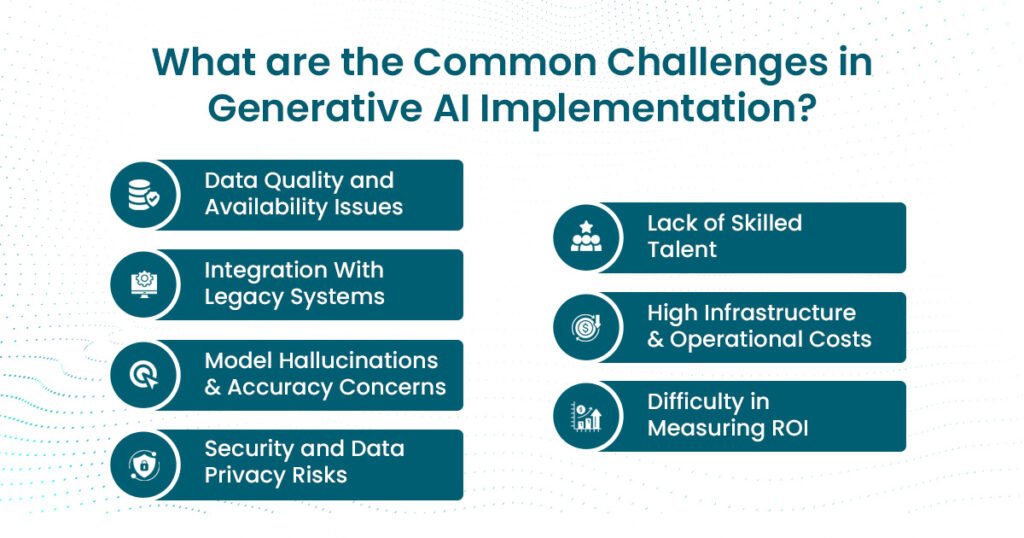
Implementing generative AI for business can unlock significant value, but it also introduces technical, operational, and organizational challenges. Many companies struggle to move from pilot projects to scalable enterprise generative AI solutions due to gaps in data readiness, governance, integration, and talent. Understanding these challenges early helps build a stronger generative AI strategy and improves long-term success.
Data Quality and Availability Issues
One of the biggest challenges in generative AI implementation is poor data quality. Generative AI applications rely heavily on accurate, structured, and well-maintained data. When organizations have fragmented systems, outdated documents, or inconsistent data sources, the output quality of generative AI solutions drops significantly. Without strong data pipelines, even advanced models cannot deliver reliable results.
Integration With Legacy Systems
Many enterprises still operate on legacy CRM, ERP, and internal tools that are not designed for modern AI integration. Connecting these systems with enterprise generative AI requires careful engineering and often custom AI integration services. Without proper integration, generative AI for business remains isolated and fails to deliver end-to-end automation.
Model Hallucinations and Accuracy Concerns
Generative AI models can sometimes produce incorrect or misleading outputs, commonly known as hallucinations. This creates trust issues, especially in high-stakes environments like finance, healthcare, and legal operations. Organizations must implement validation layers, human-in-the-loop processes, and retrieval-augmented generation (RAG) to improve reliability in generative AI applications.
Security and Data Privacy Risks
Security is a major concern in enterprise generative AI deployments. Sensitive business data, customer information, and internal documents must be protected from unauthorized access. Without proper governance, encryption, and access controls, generative AI solutions may expose organizations to compliance violations and data breaches.
Lack of Skilled Talent
There is a shortage of professionals with expertise in generative AI development, prompt engineering, RAG pipelines, and LLMOps. Many organizations struggle to find the right talent, which slows down generative AI implementation. This is why companies often choose to hire generative AI developers or partner with a generative AI development company.
High Infrastructure and Operational Costs
Running generative AI applications at scale can be expensive due to compute, storage, and API usage costs. Without proper optimization, organizations may face unexpected expenses. Effective cost management strategies are essential when scaling AI for business automation across departments.
Difficulty in Measuring ROI
Many companies struggle to measure the real business impact of generative AI for business transformation. Without clear KPIs, it becomes difficult to justify continued investment. Organizations need structured frameworks to track productivity gains, cost savings, and revenue improvements from generative AI solutions.
What are the Future Trends in Enterprise Generative AI?
Enterprise generative AI is evolving rapidly, moving from experimental pilots to core business infrastructure. As organizations mature in their generative AI for business journeys, the focus is shifting from basic automation to intelligent, autonomous, and deeply integrated systems. These future trends will shape how companies design generative AI solutions, build generative AI strategy, and scale enterprise generative AI across industries.
Rise of Agentic AI Systems
One of the most significant future trends is the growth of agentic AI development. Unlike traditional generative AI applications that respond to prompts, agentic systems can plan, reason, and execute multi-step tasks autonomously. This shift will enable businesses to automate entire workflows such as customer onboarding, procurement, and report generation. Many organizations will increasingly work with an agentic AI development company or hire generative AI developers with expertise in autonomous systems.
Multimodal Generative AI Applications
Generative AI is expanding beyond text into multimodal capabilities that include images, audio, video, and structured data. This will significantly enhance generative AI applications in marketing, training, design, and customer engagement. For example, enterprises will use generative AI solutions to automatically generate product videos, design assets, and voice-based assistants, improving both speed and creativity in content production.
Expansion of AI for Business Automation
AI for business automation will become more advanced and deeply embedded into enterprise systems. Instead of handling isolated tasks, AI automation tools for business will orchestrate entire workflows across departments. This evolution will allow companies to automate end-to-end processes in finance, HR, supply chain, and customer service, reducing manual intervention and improving operational efficiency at scale.
Growth of Domain-Specific Models
While large general-purpose models remain important, the future will see a rise in domain-specific generative AI development. Businesses will increasingly adopt fine-tuned or smaller specialized models trained on industry data. These models will deliver higher accuracy, better compliance, and improved performance for specific use cases such as legal analysis, medical diagnostics, or financial forecasting.
On-Premise and Private AI Deployments
As concerns around data privacy and regulation increase, more enterprises will move toward private or on-premise generative AI solutions. This approach allows organizations to maintain full control over sensitive data while still benefiting from advanced generative AI for enterprise capabilities. Industries such as banking, healthcare, and government will lead this shift.
How EitBiz Can Help With Generative AI Development and Implementation?
EitBiz is a trusted Generative AI development company that helps businesses adopt generative AI for business through end-to-end generative AI development services, covering strategy, development, and deployment. With 750+ projects delivered, 9+ years of experience, and a 93% client retention rate, EitBiz brings proven expertise in building scalable generative AI solutions. The focus is on practical enterprise generative AI use cases such as automation, content generation, customer support, and decision intelligence, enabling real generative AI for business transformation.
EitBiz also provides AI integration services to connect generative AI applications with CRM, ERP, and enterprise systems for seamless AI for business automation. Along with custom generative AI development services, enterprise architecture support, and options to hire generative AI developers, EitBiz ensures secure, scalable, and ROI-driven implementation of generative AI solutions across industries.
Ready to turn your idea into a real-world AI product? Connect with EitBiz to build scalable generative AI solutions tailored to your business goals and start your AI transformation today.