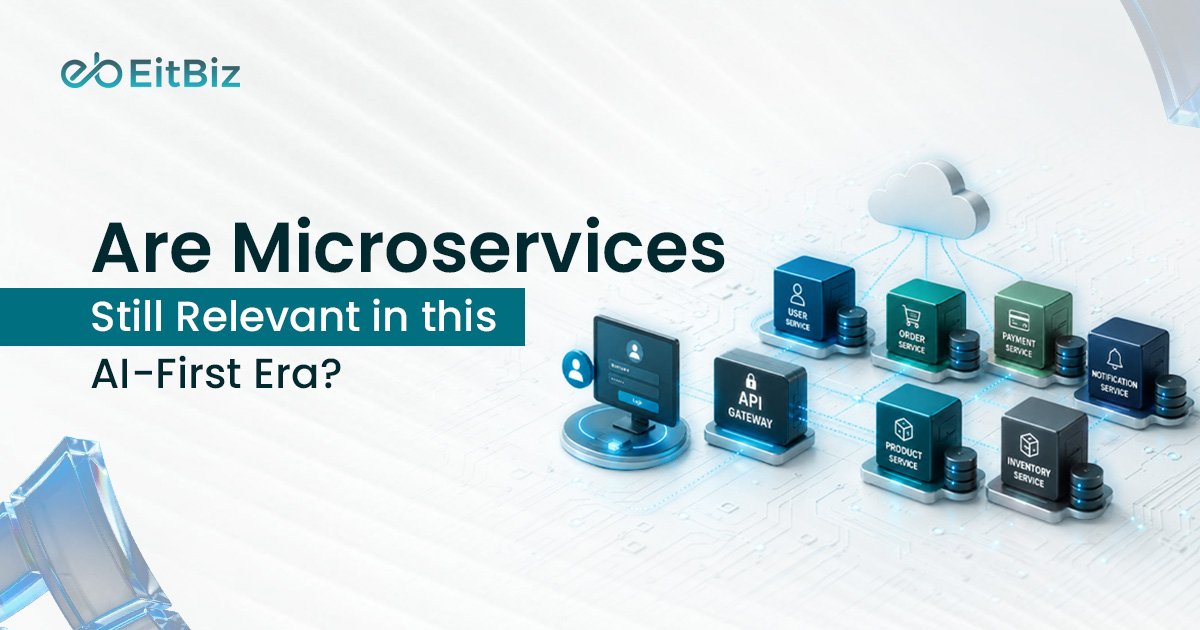
AI is transforming how modern applications are built. Today’s systems rely on large language models, autonomous agents, and complex workflows that demand real-time decision-making and orchestration. As these requirements evolve, many engineering teams face a key challenge: Is microservices architecture still relevant, or do they add unnecessary complexity for AI-driven applications?
Microservices have long been the go-to approach for building scalable and resilient software. However, AI and agentic applications introduce new demands such as stateful interactions, model inference, and continuous context management that can test the limits of traditional architectures.
In this blog, we’ll discuss whether microservices are worth it in the age of agentic applications, explore the evolving microservices architecture benefits, and examine how organizations can effectively architect microservices for AI-driven systems.
What is Microservices Architecture?
Microservices architecture is a software design approach that breaks an application into smaller, independent services. Each service handles a specific business function, runs its own processes, and communicates with other services through APIs. Instead of building and deploying a single large application development teams create multiple services that work together to deliver a complete user experience.
This approach differs significantly from a monolithic application, where all features exist within a single codebase. The ongoing debate around monolithic vs microservices architecture often comes down to scalability, flexibility, and long-term maintenance. While monolithic systems may work well for smaller applications, microservices allow organizations to scale individual components without affecting the entire system.
Example of Microservices Architecture
Consider an e-commerce platform. Rather than running as one large application, the platform can be divided into separate services such as:
- User authentication service
- Product catalog service
- Shopping cart service
- Payment processing service
- Order management service
- Customer notification service
Why Microservices Architecture Became the Industry Standard?
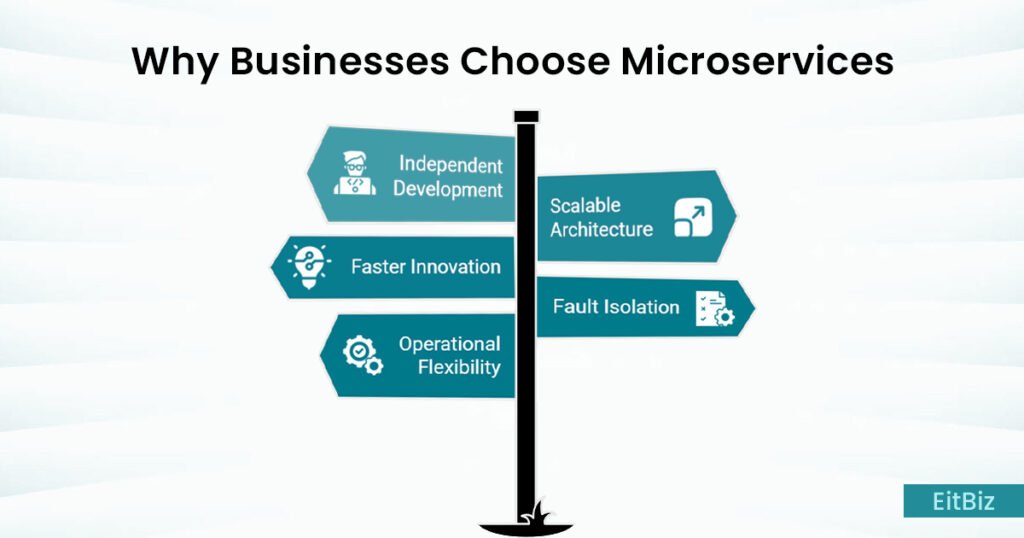
The widespread adoption of microservices architecture did not happen by chance. As digital products became more complex and user expectations continued to rise, organizations needed a more flexible way to build, scale, and maintain applications. The growing use of microservices helped businesses overcome many of the limitations associated with traditional monolithic systems.
Here are the key reasons why microservices became the industry standard:
Independent Development
Teams can build, test, and release individual services without waiting for changes across the entire application. This accelerates development cycles and reduces deployment risks.
Scalable Architecture
Organizations can scale only the services experiencing high demand instead of scaling the entire application. For example, Netflix relies on microservices to manage millions of streaming requests while scaling different platform components independently.
Faster Innovation
Development teams can choose the most suitable programming languages, frameworks, and databases for specific services without affecting the rest of the system.
Fault Isolation & Resilience
If one service experiences an issue, other services can continue operating. For instance, Amazon uses a service-oriented architecture that allows individual components such as product recommendations, payments, and inventory management to function independently.
Operational Flexibility
Many of the most recognized microservices architecture benefits stem from the ability to update, optimize, and expand applications without major disruptions. This flexibility is one reason organizations often choose microservices when evaluating monolithic vs microservices architecture for large-scale systems.
What is the Difference Between Monolithic and Microservices Architecture
The monolithic vs microservices architecture debate is rising continuously in this era that is powered by agentic systems and AI solutions. While both architectures remain relevant, organizations building AI-driven products increasingly prioritize flexibility, scalability, and rapid innovation, areas where microservices architecture often has an advantage.
| Aspect | Monolithic Architecture | Microservices Architecture |
| Application Structure | All components exist within a single codebase. | Applications consist of multiple independent services. |
| Scalability | Teams must scale the entire application, even when only one component requires additional resources. | Teams can scale individual services based on workload demands. |
| AI Model Integration | Integrating and updating AI models can become complex as the application grows. | Teams can deploy, update, and optimize AI-related services independently. |
| Development Speed | Changes often require coordination across the entire application. | Independent teams can develop and deploy services simultaneously. |
| Fault Isolation | A failure in one component can impact the entire system. | Service failures remain isolated, reducing overall system disruption. |
| Support for AI Agents | AI agents may face limitations when interacting with tightly coupled systems. | AI agents can easily access specialized APIs and services across the ecosystem. |
| Infrastructure Complexity | Simpler to deploy and manage initially. | Requires additional monitoring, orchestration, and governance. |
| Flexibility for Innovation | Technology choices are often restricted by the overall application stack. | Teams can choose different technologies for different services. |

Are Microservices Worth It for Modern Software Development?
Yes, microservices are worth it for modern software development, especially for organizations building scalable, cloud-native, and AI-powered applications.
The reason is simple: today’s software products must evolve quickly, handle unpredictable workloads, and integrate with an increasing number of technologies. A well-designed microservices architecture gives development teams the flexibility to adapt without constantly rebuilding or disrupting the entire application.
Here are the key reasons why many organizations continue to invest in microservices:
They support rapid innovation.
Teams can develop, test, and deploy new features independently, reducing time-to-market and enabling faster experimentation.
They scale more efficiently.
Instead of allocating resources to an entire application, organizations can scale only the services that need additional capacity.
They align well with cloud environments.
Most modern cloud platforms are optimized for distributed applications, making the use of microservices a natural fit for digital businesses.
They simplify AI integration.
As companies adopt machine learning and agentic systems, microservices make it easier to deploy AI models, APIs, and intelligent workflows as independent services.
They improve system resilience.
Service-level isolation prevents a single failure from bringing down the entire application, which is one of the most valuable microservices architecture benefits.
Microservices vs AI Agents: Complete Comparison
As modern software systems evolve toward automation and intelligence, understanding the distinction between microservices and AI agents has become essential for architects and developers.
| Aspect | Microservices Architecture | AI Agents |
| Core Purpose | Structure applications into independent services | Performs reasoning, planning, and decision-making |
| Primary Role | Executes business logic and system functions | Orchestrates tasks and determines what actions to take |
| Focus Area | System design and scalability | Intelligence and automation |
| Nature of Operation | Deterministic and rule-based execution | Probabilistic and context-aware behavior |
| Dependency Model | Depends on APIs, databases, and infrastructure | Depends on tools, APIs, and underlying services (often microservices) |
| Example Function | Payment processing, authentication, and inventory management | Deciding to refund a customer or escalate a support ticket |
| Best Use Case | Large-scale, distributed, cloud-native systems | Automation, reasoning, and autonomous workflows |
What are the Steps in Building Microservices Using AI Agent Capabilities?
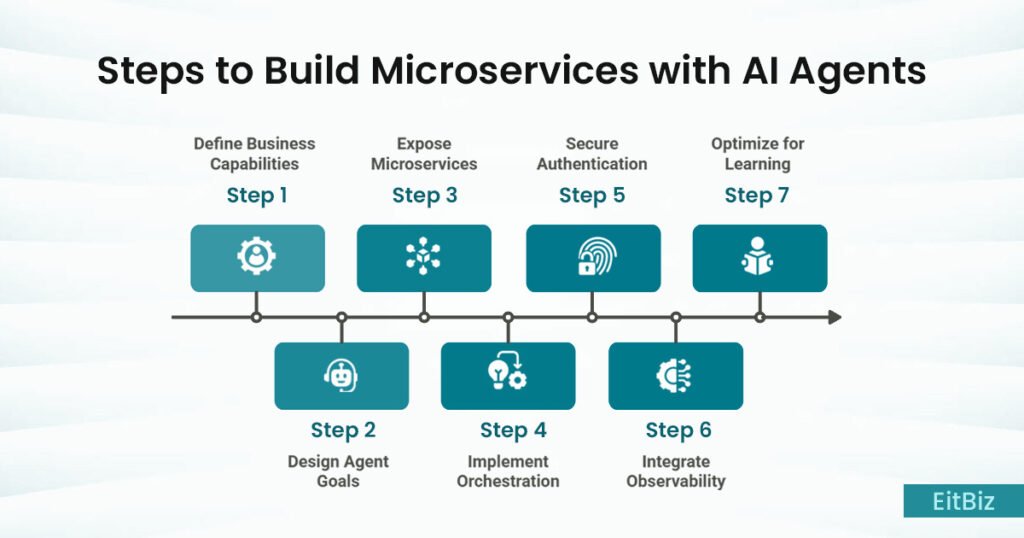
Building microservices using AI agent capabilities requires more than simply connecting an AI model to an application. Organizations need a well-structured microservices architecture that allows agents to access data, execute actions, and coordinate workflows efficiently. By following a systematic approach, businesses can create scalable systems that combine the reliability of microservices with the intelligence of AI agents.
Step 1: Define Clear Business Capabilities
Begin by identifying the core business functions your application needs to support. Instead of creating large, multifunctional services, divide the system into smaller services focused on specific responsibilities such as user authentication, inventory management, payments, or customer notifications.
This approach makes services easier to develop, maintain, and scale. It also gives AI agents access to specialized capabilities without requiring them to interact with a complex, tightly coupled application.
Step 2: Design Agent Goals and Responsibilities
Before building an AI agent, clearly define its objectives. Determine what tasks the agent should perform, what decisions it can make, and what level of autonomy it should have.
For example, a customer support agent may be responsible for answering questions, retrieving account information, processing refunds, and escalating complex issues. Clearly defined responsibilities prevent agents from making unnecessary API calls and help create more predictable workflows within microservices AI agent environments.
Step 3: Expose Microservices Through APIs
AI agents need a reliable way to communicate with backend systems. This is why every microservice should expose secure and well-documented APIs.
For instance, an order management service might provide endpoints for creating orders, checking status, or updating delivery information. By standardizing API communication, organizations make it easier for AI agents to interact with services and execute business processes accurately.
Step 4: Implement an Agent Orchestration Layer
An orchestration layer acts as the decision-making hub for AI agents. Instead of directly embedding business logic into every service, the agent analyzes user requests, determines the required actions, and coordinates interactions across multiple microservices.
For example, if a customer asks for a refund, the AI agent may verify eligibility, access payment services, update order records, and send a confirmation notification. This illustrates how microservices vs AI agents is not a competition but a collaboration between intelligence and execution.
Step 5: Enable Secure Authentication and Access Control
As AI agents gain access to critical business systems, security becomes a top priority. Every interaction between agents and microservices should be protected through authentication, authorization, and access-control mechanisms.
Organizations should define clear permissions for agents, ensuring they can only access the data and services necessary to complete assigned tasks. This reduces security risks and helps maintain compliance with organizational policies and industry regulations.
Step 6: Integrate Observability and Monitoring
Monitoring is essential when AI agents interact with multiple services across a distributed environment. Organizations should track API calls, service performance, agent decisions, response times, and workflow outcomes.
Comprehensive observability helps teams identify bottlenecks, troubleshoot failures, and understand how agents interact with the system. It also improves transparency, which is particularly important when agents make autonomous decisions.
Step 7: Optimize for Feedback and Learning Loops
AI-powered systems improve when they continuously learn from outcomes. Organizations should collect feedback from users, service responses, and operational metrics to evaluate agent performance.
For example, if an agent frequently misroutes customer requests, developers can use historical data to refine prompts, improve decision logic, or adjust workflows. Continuous optimization strengthens the overall use of microservices while making AI agents more effective over time.
What are the Challenges of Combining Microservices and Agentic Applications?
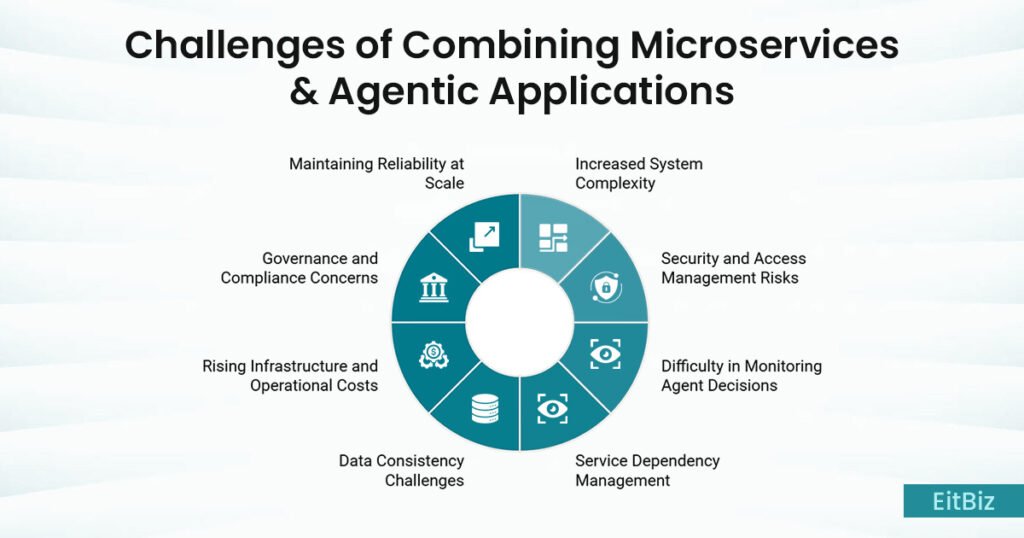
While the combination of microservices architecture and AI agents unlocks powerful automation capabilities, it also introduces new layers of complexity. Organizations must manage not only distributed services but also intelligent systems capable of making autonomous decisions. Without proper planning, the benefits of this approach can quickly be overshadowed by operational and governance challenges.
Here are some of the biggest challenges businesses face when combining microservices and agentic applications:
Increased System Complexity
Microservices already involve multiple services, APIs, databases, and communication channels. Adding AI agents introduces another layer of orchestration and decision-making.
As agents interact with dozens of services simultaneously, tracking workflows and understanding system behavior become significantly more difficult. Organizations must invest in strong architectural practices to keep complexity under control.
Security and Access Management Risks
AI agents often require access to sensitive business systems, customer data, and operational workflows. If organizations fail to implement proper authentication and authorization controls, agents may gain excessive privileges or access unintended resources.
As the adoption of microservices AI agents grows, securing service-to-agent interactions becomes a critical priority.
Difficulty in Monitoring Agent Decisions
Traditional applications follow predefined workflows, making them relatively easy to monitor and debug. Agentic systems behave differently because they can dynamically choose actions based on context.
This makes it challenging to understand why an agent selected a specific workflow or service. Organizations need advanced observability tools to monitor both service performance and agent reasoning.
Service Dependency Management
AI agents often interact with multiple microservices to complete a single task. If one service becomes unavailable or experiences performance issues, the entire workflow may be affected.
Managing dependencies across a large microservices architecture requires careful planning, fault-tolerance mechanisms, and fallback strategies.
Data Consistency Challenges
Because microservices operate independently, data is often distributed across multiple services. AI agents may need to retrieve information from several sources before making decisions.
Ensuring that agents always work with accurate and up-to-date information can be difficult, especially in environments with high transaction volumes and real-time updates.
Rising Infrastructure and Operational Costs
Running AI models, agent orchestration platforms, and multiple microservices can significantly increase infrastructure expenses.
Organizations must account for:
- Compute costs for AI inference
- API traffic between services
- Monitoring and logging tools
- Cloud infrastructure expenses
- Data storage and processing requirements
Without proper optimization, costs can escalate quickly as workloads grow.
Governance and Compliance Concerns
Many industries operate under strict regulatory requirements regarding data privacy, security, and decision-making transparency. Autonomous agents can create compliance challenges if organizations cannot explain how decisions were made.
Establishing governance frameworks is essential when deploying microservices using AI agent capabilities in regulated environments such as healthcare, finance, and insurance.
Maintaining Reliability at Scale
As systems grow, both the number of services and the number of agent interactions increase. A poorly designed architecture can create bottlenecks, latency issues, and cascading failures across services.
Organizations must continuously optimize their use of microservices and agent workflows to ensure reliable performance under heavy workloads.

The Future of Microservices in an Agent-First World
As AI agents become more sophisticated, many organizations are asking: are microservices worth it in a future dominated by intelligent automation? The answer is likely yes. Rather than replacing microservices architecture, AI agents are increasing the demand for modular, scalable, and API-driven systems. The future will be shaped by a strong partnership between AI agents and microservices, with each technology handling different responsibilities.
AI Agents Will Become the New Orchestration Layer
In the coming years, AI agents will take over many orchestration responsibilities that currently rely on workflow engines and predefined business rules. Instead of following static processes, agents will dynamically decide which services to call based on user intent and business context. For example, an AI travel assistant could book flights, reserve hotels, process payments, and send notifications by coordinating multiple microservices. This trend highlights how microservices AI agents can work together to automate complex workflows.
APIs Will Become More Agent-Friendly
As businesses continue to architect microservices for intelligent applications, APIs will evolve to support agent interactions more effectively. Future APIs will include richer metadata, better discoverability, and standardized communication protocols, making it easier for AI agents to understand and use services without extensive customization.
Microservices Will Become More Specialized
The future use of microservices will focus on creating smaller, highly specialized services that perform a single task exceptionally well. This specialization will allow AI agents to combine different capabilities more efficiently and build dynamic workflows based on real-time requirements. As a result, organizations will unlock even greater microservices architecture benefits, including flexibility, maintainability, and scalability.
Autonomous Business Workflows Will Become Common
Businesses will increasingly rely on AI agents to automate end-to-end processes. For example, an e-commerce AI agent could manage product returns by verifying purchases, approving refunds, updating inventory, and notifying customers through different services. This is a practical example of microservices using AI agent capabilities to streamline operations and reduce manual effort.
Governance Will Become a Competitive Advantage
As organizations deploy more agentic systems, governance will become a critical success factor. Companies will need robust monitoring, security controls, and compliance frameworks to oversee AI-driven decisions. Strong governance practices will ensure that both AI agents and microservices operate safely, transparently, and in alignment with business objectives.
Hybrid Architectures Will Dominate
The future is unlikely to be defined by microservices vs AI agents. Instead, organizations will adopt hybrid architectures where AI agents provide intelligence and decision-making, while microservices handle execution and business functionality. This combination offers the best of both worlds: intelligent automation and scalable infrastructure.
How EitBiz Helps Businesses Build Future-Ready Microservices and AI-Powered Applications
As we’ve explored throughout this blog, the future is not about choosing between AI agents and microservices. Organizations that want to remain competitive must build architectures that combine intelligent automation with scalable, reliable infrastructure. However, successfully implementing a modern microservices architecture, integrating AI capabilities, and managing complex distributed systems requires specialized expertise.
EitBiz helps businesses design, develop, and optimize scalable software solutions that align with evolving technology demands. Whether you’re evaluating monolithic vs microservices architecture, planning to architect microservices for enterprise applications, or exploring microservices using AI agent capabilities, EitBiz provides the technical guidance and development expertise needed to turn your vision into reality.
Our team specializes in:
- Designing a cloud-native microservices architecture for scalable applications
- Modernizing legacy monolithic systems
- Developing AI-powered and agentic applications
- Building secure API ecosystems and service integrations
- Implementing automation-driven business workflows
- Optimizing application performance, scalability, and resilience
- Creating future-ready digital solutions that support business growth