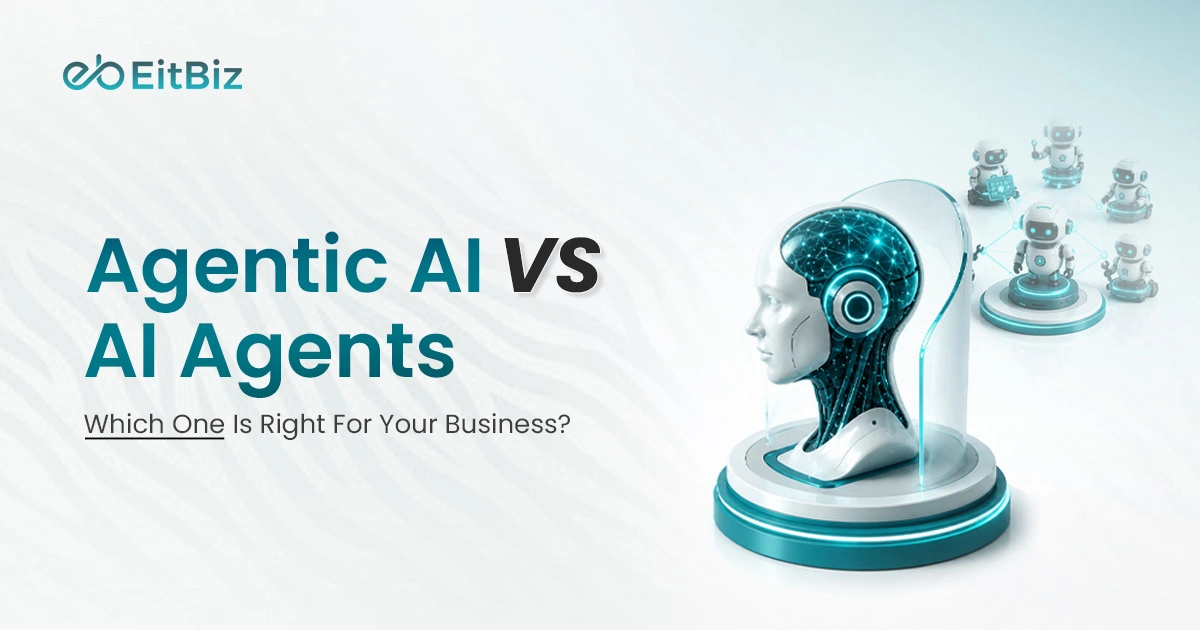
AI has gradually become the centripetal force around businesses. The conversations around enterprise AI have evolved significantly over the past few years. The debate is growing, especially between agentic AI and AI agents. On the surface, both terms may sound similar, but the reality is totally opposite.
One focuses on enabling AI to perform specific tasks. The other represents a broader vision where AI systems can pursue goals, make decisions, and coordinate actions with greater autonomy.
The distinction goes beyond terminology. It includes tech investments, governance strategies, integration efforts, and much more. This blog highlights the agentic AI vs AI agents difference and helps you choose the right approach for your needs.
What is Agentic AI?
Agentic AI is an autonomous system that can plan, reason, and execute actions on its own across multiple tools and data sources to achieve broader goals with limited supervision.
Agentic AI understands the objective, determines the required sequence of steps, prepares an action plan, and adapts its approach based on the real-time context. This entire thing operates at the workflow level, executing simple to complex tasks from start to finish.
An agentic AI can handle an entire business workflow, whether it’s employee onboarding or system updates. Agentic agents plan dependencies, execute workflows, and ensure timely completion of the process.
Also Check: Generative AI vs Agentic AI
How Do Agentic AI Systems Work?
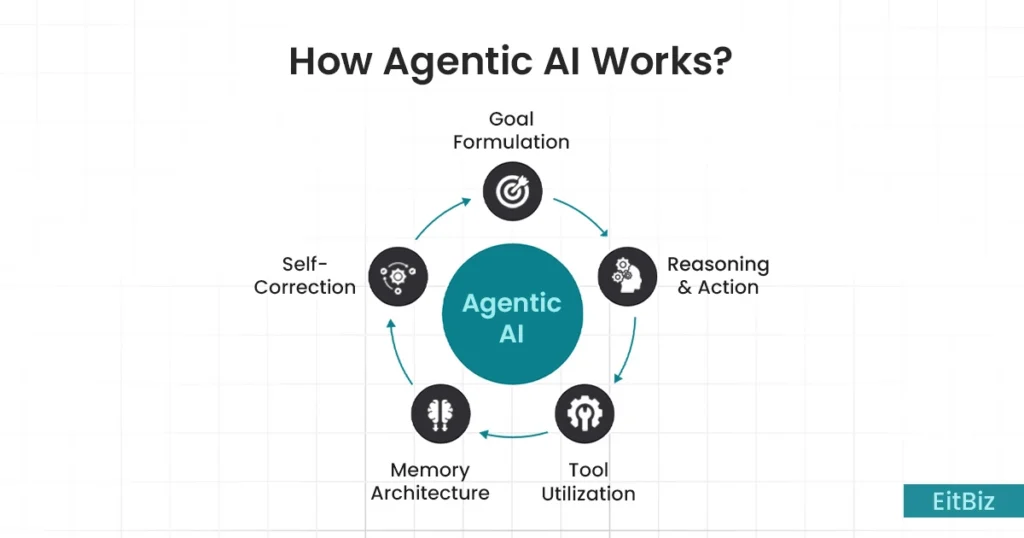
Agentic AI systems typically work on continuous reasoning and execution loops. These systems automatically execute and accomplish multi-step objectives. Agenftic AI systems use a continuous “perceive → reason → plan → act” cycle to accomplish complex goals. Here is the step-by-step breakdown of how agentic AI systems function:
1. Goal Formulation
You set the high-level goal for your agentic AI system. For instance, you command the system to find the best hotel in your locality within your specific budget, check availability, and draft an itinerary. The system uses LLM and NLP techniques to understand the user intent and then decomposes the large goal into micro-chunks to execute the task.
2. The Agentic Loop
Once the plan is created, the agent enters an active execution loop. This is driven by cognitive frameworks like ReACT (Reasoning and Action).
- Reason: The AI evaluates its current state
- Act: It chooses a specific action or tool
- Observe: It analyzes the raw output returned by that tool
- Reflect: It updates its internal understanding
3. Tool Utilization
This is where the difference is visible between standard AI chatbots and agentic AI solutions. Standard bots are locked in their own private chat window, whereas Agentic AI is given hands through APIs. The agent reads the documentation provided by developers to understand how and when to use tools like web scrapers, database queries, and software integrations.
4. Memory Architecture
The agent stores and retrieves context and previous interactions. Memory is a crucial element of an agentic system, helping in successfully running long workflows. An agentic solution actually relies on two types of memory:
- Short-term Memory: This keeps track of the current conversation and the immediate subtasks it is executing.
- Long-term Memory: This often uses vector databases. It helps an agent to recall all the past conversations across days or weeks.
5. Self-Correction
Agentic AI solutions are programmed to handle any encountered errors autonomously. These systems review their own output against the original goal. They identify discrepancies and attempt to self-correct by modifying their prompt, changing their reasoning path, or selecting a different tool.
What are AI Agents?
These are autonomous software systems that perform tasks independently to reach specific predefined goals within boundaries. AI agents analyze, understand, use tools or APIs, make decisions, and take multi-step actions to execute a goal.
Unlike passive AI solutions that perform tasks in response to prompts, an agent independently directs its own workflow. Artificial Intelligence-powered agents can use predetermined rules, machine learning, or natural language processing to deliver information. For example:
- An intelligent real estate agent might extract data, filter out unsellable listings, perform comparisons, and deliver a valuation sheet with pricing.
- A smart EdTech agent can evaluate the user’s interests, tailor tutoring, and offer real-time feedback on learning.
Individual task agents serve as the structural foundations for larger, collaborative agentic systems.
How do AI Agents Work?
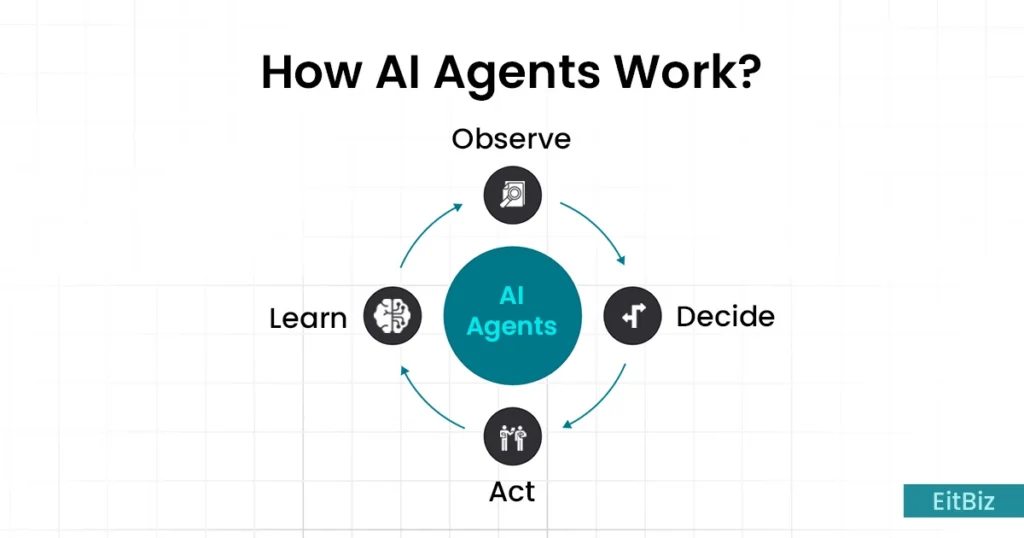
AI agents operate with complete freedom inside specific boundaries. Every agent is built differently and is specific to understand a defined input provided by the user and take actions accordingly. These digital assistants can make decisions only for the defined work. They function within a continuous loop called the Perceive → Observe → Act → Learn.
1. Observe
The agent collects data from its surroundings. It ingests both structured and unstructured data through IoT-powered sensors or APIs. This could be user text prompts, database embeddings, or system states. This data forms the agent’s current state environment.
2. Decide
Once it observes data, the agent decides “what” and “how” to execute the task. A large language model processes the current state. With techniques like Chain-of-Thoughts (CoT) or specific prompting, it breaks a large goal into logical subtasks. This helps an agent to select an appropriate tool/software for the task.
3. Act
After it has observed and made a decision, the agent takes action towards goal fulfilment. The system executes program code or triggers an external API call. With tools like a Python code interpreter, database writer, or a web scraper, autonomous AI agents change the environment.
4. Learn
Smart AI solutions check their results and remember what happened. The AI agent stores the outcome in its short-term memory (context window) to track immediate progress, and long-term memory (vector database) via embeddings. This evaluates the success metrics to optimize the next decision.
Types of AI Agents
AI agent development encompasses various architectures, ranging from simple rule-based systems to complex autonomous models. These are designed to interpret unstructured user inputs, perceive their environment, reason through tasks, and execute specific actions.
1. Simple Reflex Agents
As the name states, these are the AI agents that operate on a strict, pre-determined set of “if-then” rules based entirely on the current output. These agents have no memory of past states and cannot handle unexpected changes.
Example: A basic thermostat that turns on the AC only if the current temperature crosses over 24
2. Model-Based Reflex Agents
These digital copilots are one step better than the simple reflex agents. They maintain an internal memory (or model). This helps them track elements they cannot see. Model-based reflex agents specialize in combining the current input with history to make decisions.
Example: A digital assistant trained to check on security and update access decisions based on changing user context.
3. Goal-Based Agents
Goal-based agents are more advanced as they operate with a clear objective. These AI agents evaluate multiple sequences of actions and choose the path that successfully leads to their target goal. This makes them highly proactive.
Example: A route planning mobile application that integrates AI to deliver a complete route map to travelers to reach the specific location.
4. Utility-Based Agents
Utility-based agents are more advanced AI agents that go beyond achieving a specific goal. These agents evaluate how “good” or “efficient” the result will be and take actions accordingly. They weigh the probability of an outcome, calculating the expected outcome.
Example: A SaaS financial portfolio management agent that precisely adjusts investments to minimize risks and maximize returns.
5. Learning Agents
AI agents that learn autonomously from their past interactions and feedback. These intelligence-powered systems feature as a “critic” to evaluate performance and a learning element to update and improve their internal logic over time.
Example: A RAG-first agent is a prominent example that refines relevance based on search patterns.
Agentic AI vs AI Agents – Key Differences
AI agents vs agentic AI is a key topic of discussion among decision-makers. They might sound the same, but they operate on different automation levels. AI agent development is task-specific, while agentic AI is high-capability-focused.
| Points of Difference | AI Agents | Agentic AI |
|---|---|---|
| Scope of Work | Narrow and isolated | Broad and systematic |
| Role | Execution-focused (employee level) | Orchestration-driven (manager level) |
| Decision-making | Bounded autonomy within predefined rules | Autonomy is strategic |
| Initaition | Reactive | Proactive |
| Adapatibility | Follows predefined paths | Adjusts plans dynamically |
| Memory | Short-term or session-based | Long-term, evolves based on the context |
| Ideal for | Repetitive, well-defined tasks | Complex tasks requiring reasoning |
| Examples | A customer service chatbot solving user queries | An automated supply chain ecosystem |
Why AI Agents vs Agentic AI Distinction Matters for Enterprise Intelligence?
The distinction between agentic AI and AI agents is important for enterprises looking to perform an AI readiness assessment and infuse smart operations. This is because AI agents are discrete, task-focused software solutions, whereas agentic AI represents a system-level architecture capable of performing autonomous functions.
Failure to understand this can lead directly to misallocated budgets and severe AI governance gaps that can stall an enterprise’s transformation efforts.
- The agent-washing (repackaging basic chatbots with RPA scripts) hype is high in the tech market these days. This distinction clarifies the exact boundary between localized task execution and autonomous orchestration.
- Precisely formulate the specific cybersecurity strategy for specific AI agents or agentic AI systems to secure interactions.
- Understanding this distinction helps organizations move beyond staff augmentation and toward a truly intelligent, self-scaling operational ecosystem.
How to Decide between Agentic AI and AI Agents?
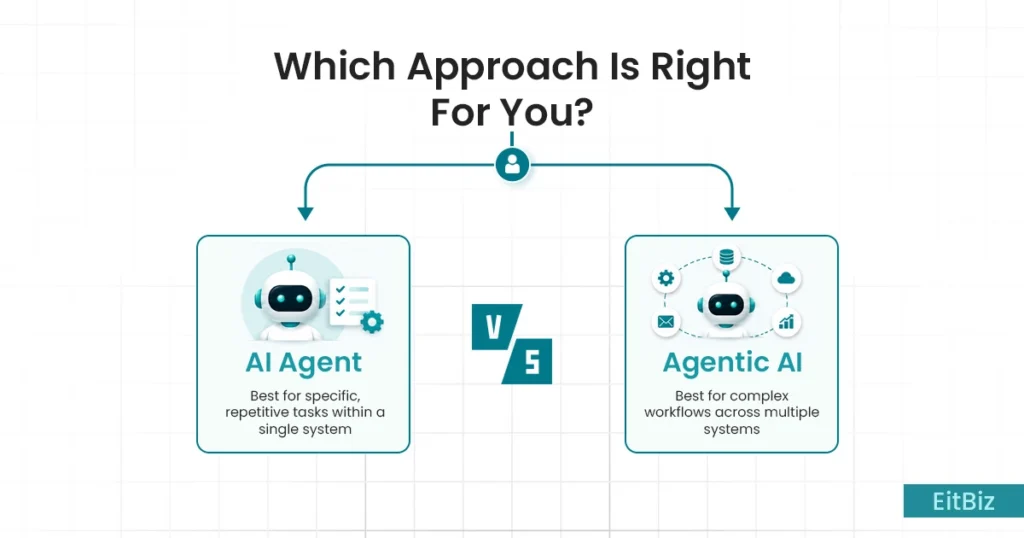
Choosing between AI agents and agentic AI depends on your business requirements. The key is understanding that certain business processes require both an agentic system and smart agents to complete the operational workflow.
AI agents are task-focused, while agentic AI is built for workflows requiring planning, reasoning, and coordinated actions across systems. However, let’s decide when AI agents are ideal and when agentic AI is preferred.
AI Agents are ideal when:
- The task is well-defined, repetitive, and mundane
- The scope of work stays within one system
- Decisions follow rules or narrow inputs explicitly
- Inputs are structured, and data schemas do not change frequently.
Agentic AI is a suitable fit when:
- The workflow spans across multiple systems or tools
- The high-level objective fulfilment requires multi-step planning, reasoning, and action
- The outcome must follow enterprise policies and procedures
- The workflow requires cross-system orchestration while managing varied data access permissions
Enterprise Considerations Before Choosing Either
Before choosing between AI agents and agentic AI for your enterprise, it is essential to evaluate more than just technology. The right evaluation approach depends on the organizational complexity and governance. For adopting a long-term AI solution:
- Identify whether you’re solving a task-specific problem or replacing your legacy platform with a modern, goal-driven system
- Check if you have not ignored AI governance policies before AI adoption
- Evaluate how the AI accesses enterprise systems and third-party evaluation
- Assess how the solutions will connect with existing CRM, ERP, or third-party systems
- Determine Human-in-the-Loop for high-impact business decisions
- Consider whether the architecture supports business use case or evolving requirements.
Build the Future of Intelligent Operations with EitBiz
Agentic AI vs AI agents discussion has evolved gradually. Enterprises must center their intelligence initiative around their goals. However, merely defining them is not enough. It is crucial to build the operational infrastructure capable of executing them. The most successful enterprises align their AI integration investments with clear business objectives, scalable architecture, and strict governance.
At EitBiz, we approach agentic development by prioritizing security, governance, and user needs. Our AI developers have helped organizations design and implement enterprise-grade AI agents and agentic systems.
The line between AI agents and agentic workflows is defining the next era of digital businesses. Through expert AI consulting and readiness assessments, we help you navigate this shift and deploy the precise level of autonomy your operations demand.
Ready to build AI that delivers measurable business value? Get in touch with EitBiz today to discuss your AI strategy and discover how agentic AI and AI agents can transform your operations.