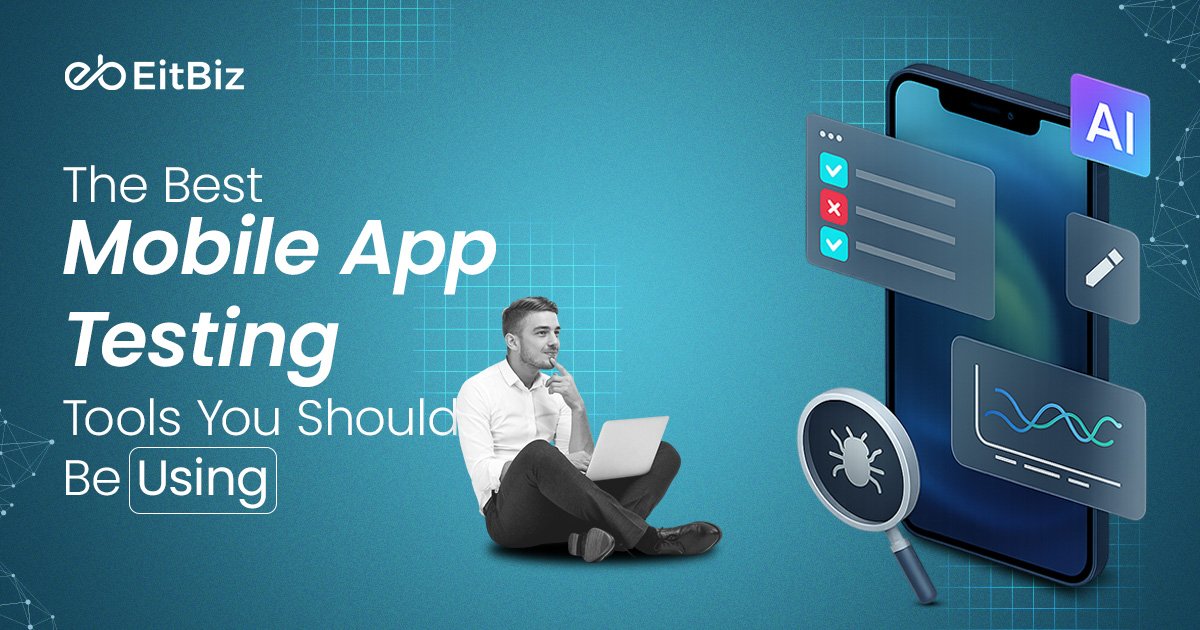
It’s 2026, and the mobile app development market is showing no signs of slowing down!
Though every other business is glued to building a mobile app that drives and converts, only a few are focusing on quality and performance.
This is where the importance of mobile app testing comes in!
While checking bugs and errors manually is an important part of testing, it’s still not enough to make your app a perfect “revenue-driven” machine.
Remember that leveraging advanced automated mobile app testing tools can streamline testing, improve efficiency, and enhance app performance.
Now, the question is- Why should I use mobile app testing tools?
- Crashes cause nearly 70% of app uninstallations. (Source: Browser Stack).
- Nearly 70% of people abandon their app because it takes too long to load.
- A poor mobile experience may cause 65% customers to lose interest in a brand.
Sounds interesting, doesn’t it?
Now, another question arises: What are the best mobile application security testing tools? How can I choose the best mobile app testing tools?
Without further ado, let’s dive in!
What is Mobile App Testing?
To put it simply, mobile app testing is the process of evaluating a mobile application to ensure it functions correctly, performs smoothly, and delivers a consistent user experience. Furthermore, it helps identify bugs, usability issues, security vulnerabilities, and performance bottlenecks before the app is released to users.
Mobile app testing encompasses a wide range of tests to verify that the app behaves as expected in real-world scenarios. With app testing, developers can improve quality, reduce crashes, boost user satisfaction, and increase the likelihood of long-term success in the highly competitive app market.
Why is Mobile App Testing Important?
Mobile app testing is crucial to ensure your app performs smoothly, securely, and consistently across different devices and platforms. Furthermore, it helps catch bugs early, improves usability, strengthens security, and prevents costly post-launch failures, leading to higher user satisfaction.
#1. Ensures App Stability
Mobile app testing is important to ensure that the application remains stable under different conditions. It helps identify crashes, bugs, broken user flows, and performance issues before users encounter them. Furthermore, it delivers a reliable app that performs predictably, reducing user frustration and preventing negative reviews after launch.

#2. Enhance User Experience
Testing evaluates how smooth, intuitive, and responsive the app feels for real users. When you choose mobile app automation testing tools, they may easily check navigation flow, interface clarity, animation speed, and overall usability. Furthermore, testing helps create an engaging, satisfying experience that encourages users to stay longer, interact more, and return frequently.
#3. Improves Security & Data Protection
Mobile app testing examines vulnerabilities that could expose sensitive user data or allow malicious activities. It verifies secure authentication, encrypted communication, safe data storage, and proper permission handling. Furthermore, strong security testing helps prevent breaches, maintains user trust, and ensures the app complies with industry standards and regulatory requirements.
#4. Boosts Device and Platform Compatibility
Testing confirms that the app works consistently across different devices, screen sizes, OS versions, and hardware specifications. It simulates various real-world usage environments, including low battery, slow networks, and varying performance levels. Furthermore, it ensures a seamless user experience for everyone, regardless of their device or mobile platform.
#5. Reduces Development and Maintenance Costs
Identifying bugs early in the development cycle is far less expensive than fixing problems after launch. Mobile app performance testing tools may help avoid rework, delays, and emergency patches. Furthermore, it streamlines development, supports faster releases, and reduces long-term maintenance costs by preventing serious issues that could harm the app’s performance or reputation.
What are the Different Types of Mobile App Testing?

Mobile app testing tools automate a wide range of tasks, enabling a more efficient and thorough testing process. Here are the different types of mobile app testing.
- Functional Testing
Functional testing verifies whether the app’s features work exactly as intended. It checks user interactions, workflows, buttons, forms, navigation, and integrations. The goal is to ensure that every function delivers the expected output and that the app behaves correctly under different user scenarios.
Did you know?
The mobile app testing market is expected to increase to $13.6 billion by the end of 2026. (Source: Testlio).
- Performance Testing
Performance testing measures how well the app performs under stress, peak load, poor network conditions, and limited system resources. It identifies slowdowns, crashes, battery drain, memory leaks, and lag. Furthermore, it keeps the app smooth and responsive, even under heavy use or on lower-end devices.
- Usability Testing
Usability testing assesses how intuitive, simple, and user-friendly the app is. Testers evaluate navigation flow, design clarity, accessibility, readability, and overall user experience. This type of testing ensures users can easily complete tasks without confusion, improving satisfaction and retention.
- Compatibility Testing
Compatibility testing checks how the app performs across various devices, OS versions (iOS/Android), screen sizes, chipsets, and resolutions. It ensures the app behaves consistently for all users, regardless of their device configuration or operating system updates.
- Security Testing
Security testing identifies vulnerabilities that could expose sensitive data or allow unauthorized access. It evaluates authentication methods, data encryption, API security, permission handling, and potential breach points. Furthermore, it protects user information and ensures compliance with industry regulations.
What are the Top Mobile App Testing Tools in 2026?

Here are the top mobile app automation testing tools to consider in 2026 for enhanced performance. engagement, and retention.
1. Appium
Appium remains one of the most popular mobile app testing tools thanks to its flexibility, open-source nature, and support for native, hybrid, and mobile web apps. It allows testers to write automated tests in multiple programming languages and integrate them into CI/CD pipelines. In 2026, its cross-platform support and strong community make it a top choice for scalable mobile testing.
2. Espresso
Espresso is counted among the best mobile app security testing tools, which remains the gold standard for Android UI testing due to its speed, reliability, and tight integration with Android Studio. It allows developers to write concise, stable tests that run directly within the app’s process, resulting in faster execution. As Android continues to evolve, Espresso’s native support keeps it ahead for robust, dependable mobile UI automation.
3. XCUITest
For iOS developers, XCUITest is the most powerful and recommended framework for UI and functional testing. Built by Apple, it offers exceptional stability, seamless Xcode integration, and high performance. Its ability to simulate real user interactions with precision makes it essential for quality-focused iOS teams in 2026.
4. Katalon Studio
Katalon Studio is one of the most trusted mobile app automation testing tools, supporting mobile, web, API, and desktop testing. Its low-code environment, built-in record-and-playback system, and advanced analytics make it accessible to beginners while still powerful for QA teams. In 2026, its hybrid approach, low code and script-based, keeps it a favorite for teams wanting speed and flexibility.
5. Kobiton
Kobiton is preferred for real-device mobile testing in the cloud, offering fast access to hundreds of physical Android and iOS devices. It supports both manual and automated testing and integrates smoothly with Appium for large-scale automation. In 2026, Kobiton’s essential components, like device lab, AI-powered insights, and performance monitoring, will make it essential for teams needing real-world validation.
6. TestComplete
TestComplete by SmartBear is known for its robust automation capabilities and support for scriptless and script-based testing. It enables teams to test mobile apps through powerful object recognition, extensive integrations, and support for real devices. As app complexity grows, TestComplete’s advanced automation makes it a strong player in 2026 for enterprise-level mobile testing.
7. Squish
Squish is a professional-grade GUI testing tool used widely for cross-platform applications, including mobile apps. It supports multiple scripting languages and reliably tests complex UI components. With organizations increasingly requiring multi-platform consistency, Squish’s ability to test mobile, desktop, embedded, and web apps from one framework keeps it relevant and valuable in 2026.
Final Thoughts
So, there you have it! That’s a wrap on the best mobile application security testing tools for 2026! Choosing the right mobile app testing tools is essential for delivering a high-performing, secure, and user-friendly app in today’s competitive market. With so many devices, operating systems, and user expectations to consider, thorough testing is no longer optional; it’s a necessity. The tools highlighted above help development teams improve accuracy, speed, and overall app quality, ensuring a seamless digital experience for users in 2026 and beyond.
If you’re looking to build a flawless mobile app or need expert guidance in testing and quality assurance, EitBiz is the partner you can trust. With extensive experience in usability testing tools for mobile apps, robust testing practices, and end-to-end digital solutions, our mobile app testing experts help businesses launch apps that are fast, secure, and built to scale.
Whether you’re developing a new product or optimizing an existing one, we strive to make your mobile app stand out with exceptional performance and reliability.
Are you ready to enhance your app quality? If so, get in touch with EitBiz and let’s help you build, test, and launch your mobile app that drives conversions.
Frequently Asked Questions
1. What is the best tool for mobile testing?
There isn’t a single tool that fits every project, as the “best” option depends on factors like your app type, automation needs, and budget. Popular choices include Appium for open-source cross-platform automation, Espresso and XCTest for fast native Android and iOS testing, and cloud platforms like BrowserStack or Sauce Labs for real-device testing without maintenance.
2. Can I test apps on real devices without owning them?
Yes, you can test on real devices without owning any hardware by using cloud-based device testing platforms. Services such as BrowserStack, Sauce Labs, AWS Device Farm, Firebase Test Lab, and Kobiton provide access to a wide range of real Android and iOS devices hosted remotely.
3. How do I choose the right mobile app testing tool?
Choosing the right mobile testing tool involves evaluating your app’s platform requirements, the types of tests you need (manual, automated, performance, or compatibility), and the level of device coverage necessary. Furthermore, you should also consider your team’s skills, integration with CI/CD pipelines, budget constraints, and whether you need real devices or are comfortable with simulators and emulators.