Digital products are core to modern business strategy. From acquiring users to improving retention and loyalty, mobile and web apps define competitive advantage.
But this leads to hard questions: Which technology stack will serve my business best? Which tools deliver speed without compromising quality? Can I scale without dramatically increasing costs?
2026 is a critical year for evaluating Flutter in 2026, not as a buzzword, but as a measurable asset to your development roadmap.
Here’s why:
- Nearly half of all cross-platform apps worldwide are built with Flutter, reflecting widespread developer trust and industrial adoption.
- Platforms using Flutter report significant performance and development gains, becoming a serious consideration for enterprises beyond startups.
- Flutter’s community continues to grow, with millions of active developers worldwide regularly contributing and building real products.
These aren’t isolated facts. They show a clear pattern: Flutter has transitioned from experimental to business-critical.
But real questions remain for decision-makers: Is Flutter the right choice for your next app? How does its evolution impact budget, time-to-market, and long-term scalability?
What should companies expect when investing in Flutter app development services or planning Flutter MVP development?
In this piece, we answer those questions directly. We blend flutter app development trends, real statistics, and practical business takeaways so you can make informed decisions, not speculative ones.
Let’s dive into how Flutter is evolving in 2026, what trends are shaping the market now, and how to align your product strategy with fundamental industry shifts.
Flutter’s Core Evolution: What’s New in 2026?

Stronger Performance, Less Overhead
Flutter’s rendering engine continues to get faster. Improvements in low-level graphics, memory handling, and JIT-to-AOT transitions mean smoother apps with smaller binary sizes. This matters a lot for markets with limited connectivity or lower-end devices.
Enhanced Desktop & Web Support
Desktop and web were once add-ons. In 2026, they are first-class citizens.
- Desktop builds work natively with richer file-system access and platform integrations.
- Web builds feel more responsive and less “mobile-in-browser”.
Now, a single codebase can power Android, iOS, Windows, macOS, Linux, and browser experiences with a near-native feel.
Better Integration with OS-Level Features
Flutter now has deeper hooks into device APIs, including cameras, sensors, payments, biometrics, and more. Plugins are more stable, reducing risk for production apps.
What are the Top Trends for Flutter in 2026?
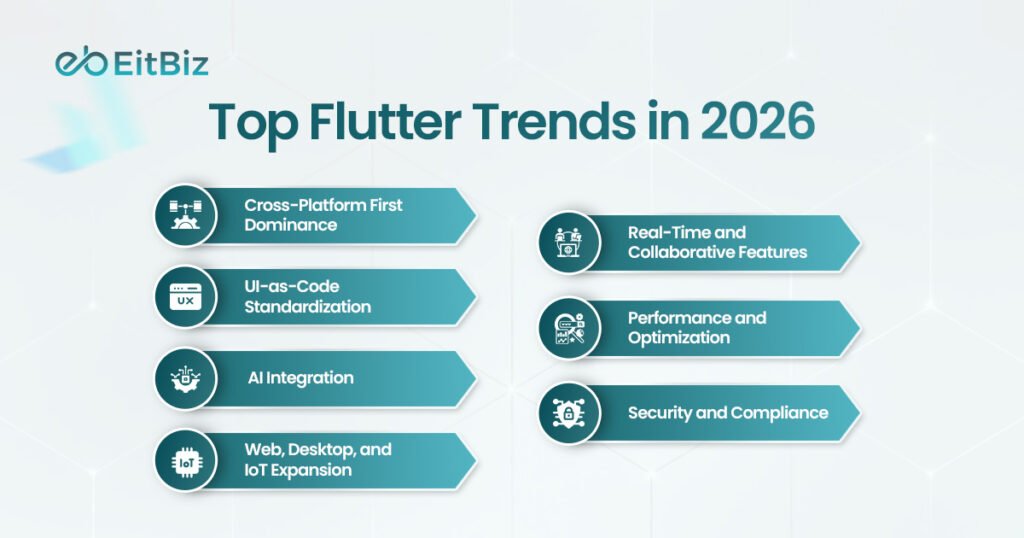
As we step into 2026, businesses and developers alike are asking: What makes Flutter the go-to framework for modern app development, and which trends will define its future? The following Flutter app development trends highlight how the framework is evolving, what features are becoming essential, and how companies can leverage it for faster, wiser, and more secure app development.
1. Cross-Platform First Dominance
Have you noticed how many businesses now ask, “Do I really need separate Android and iOS teams?” In 2026, the answer for most cases is no. The shift toward Flutter app development trends continues to favour a single codebase for all platforms. According to industry surveys, nearly 70% of new apps in 2026 are expected to use cross-platform tools like Flutter, because companies want faster delivery and lower costs.
{Also Read: Top 10 Flutter App Development Companies in the USA}
This is not just a technical trend; it’s a business strategy. Writing once and deploying everywhere slashes development time by up to 50% compared to maintaining separate native codebases. That means quicker time-to-market and fewer bugs caused by inconsistent features across platforms. For businesses considering Flutter app development services, this trend signals a significant shift toward efficiency without sacrificing quality.
2. UI-as-Code Standardization
Have you ever wondered how teams maintain visual consistency across so many devices today? The answer in 2026 is UI-as-code. Instead of designers handing over static files to developers, entire design systems now live inside the code. This approach ensures that UI reflects the brand, behavior stays consistent, and UI bugs drop dramatically.
The result is a much smoother user experience and fewer misalignments between design and implementation, a major win for organizations investing in Flutter MVP development. In competitive markets where first impressions matter, apps built with consistent UI patterns can boost engagement and retention by presenting a familiar, polished experience across screens.
3. AI Integration
What if your app could anticipate user needs? In 2026, AI isn’t optional; it’s embedded. Companies estimate 40% of enterprise apps will use built-in AI features such as personalization, automation, and real-time insights.
For Flutter developers, this means the framework isn’t just for UI anymore; it becomes a conduit for intelligent experiences. AI can help automate tedious coding tasks, assist in debugging, and even optimize UI performance. For businesses evaluating the future of Flutter, this trend signals that apps will no longer display data, they’ll interact with users in more meaningful and context-aware ways.
4. Web, Desktop, and IoT Expansion
Ask any product leader: “Can we reach users on more than just phones?” The answer in 2026 is a confident yes. Flutter has extended far beyond phones, powering web apps, desktop apps (Windows, macOS, Linux), and even Internet of Things (IoT) interfaces. Apps built with Flutter run on smart kiosks, wearables, in-car dashboards, and more.
Statistically, Flutter’s adoption has steadily grown, with over 45% of all cross-platform apps using Flutter, and millions of developers contributing monthly.
This means your business can now reach users on literally any screen, while maintaining design and logic consistency. For companies investing in Flutter app development services, this trend offers a future-proof strategy for multi-touchpoint engagement.
5. Real-Time and Collaborative Features
Have you ever been frustrated when your app didn’t update immediately? Real-time experiences, like live collaboration, shared dashboards, chats, or synchronized dashboards are no longer “nice to have,” they’re expected. Flutter’s architecture is now well-suited for these real-time features thanks to modular state management and fast rendering.
Developers are building tools where multiple users see updates instantly, without page reloads. This trend positions Flutter as not just a UI framework, but a backbone for interactive, dynamic apps. For businesses building feature-rich products, investing in real-time capabilities during Flutter MVP development is becoming a competitive necessity rather than a future add-on.
6. Performance and Optimization
Is cross-platform performance good enough yet? The short answer: increasingly yes. Flutter’s rendering engine, built on Skia, ensures apps feel native-like, with 98%+ code reuse across platforms and performance close to native builds.
The trend matters because users today expect smoothness. Slow launch times or laggy animations cause abandonment. Businesses leveraging Flutter app development services should prioritise performance optimization, not just delivery speed, because polished performance directly correlates with higher engagement and retention.
7. Security and Compliance
When businesses ask, “Is cross-platform secure?” they’re no longer met with vague answers. In 2026, the future of Flutter includes robust support for security and compliance features, such as encrypted storage, secure authentication flows, and modern privacy standards. With rising data privacy regulations across global markets, app security must be built in from the start.
This trend means flutter app development services won’t just build your UI; they will integrate secure practices that align with regulations like GDPR, CCPA, and local privacy laws. Security isn’t a nice-to-have; it’s a core feature that affects trust and compliance.

What Businesses Should Expect in 2026?
As Flutter continues to mature in 2026, businesses need to prepare for a landscape that’s faster, smarter, and more cross-platform than ever. The question isn’t just “Should we adopt Flutter?”, it’s “How will adopting Flutter shape our development strategy and business outcomes?” Here’s what companies can realistically expect.
1. Faster MVPs with Lower Risk
Startups and enterprises alike are focusing on speed. Flutter MVP development will increasingly become the go-to approach for testing ideas quickly. With a single codebase supporting mobile, web, and desktop, businesses can launch a minimum viable product in a week faster than using separate native teams.
{Also Read: Choosing the Best Tech Stack for Your MVP: 10 Proven Tips}
Faster MVPs mean quicker validation of business hypotheses. According to recent studies, startups that iterate quickly improve product-market fit by 35% faster than those using traditional native stacks. Investing in Flutter and its tools for your MVP ensures your team can test ideas without overcommitting resources.
2. Higher Demand for Skilled Developers
With Flutter adoption rising, the competition for experienced developers will intensify. Businesses can expect higher costs for top talent, but also access to a global pool of skilled Flutter professionals.
Companies should invest in internal training, foster mentorship programs, and consider remote hiring. This not only secures talent for ongoing projects but also ensures quality in Flutter app development services.
3. Emphasis on Performance and UX
By 2026, users will expect cross-platform apps to feel as fast and polished as native apps. Performance optimization will no longer be optional. Flutter’s engine improvements allow for near-native rendering, smaller binary sizes, and smoother animations.
Apps that perform well retain users. Slow or laggy apps lose up to 50% of first-time users, according to industry reports. Investing in performance-focused Flutter development is a direct path to higher engagement and retention.
4. Seamless Integration with Existing Systems
Enterprises won’t replace legacy systems overnight. Expect Flutter app development services to increasingly focus on integration, connecting new Flutter apps with CRM, ERP, and other backend systems.
Companies should plan for architecture that supports both innovation and continuity. Flutter’s improved API integrations and plugin ecosystem make it easier to connect to existing infrastructure without heavy rewrites.
5. Security as a Core Requirement
In 2026, security won’t be an afterthought; it will be central. With growing regulations like GDPR, CCPA, and other local privacy laws, businesses will expect Flutter apps to include secure authentication, encrypted storage, and safe API communication by default.
Apps that fail on security risk, user trust, and regulatory penalties. Choosing Flutter app development services with a strong security-first approach ensures compliance and protects both your business and users.
Final Thoughts
Flutter in 2026 is no longer an emerging option; it’s a strategic decision. Businesses want speed, scalability, and consistency across platforms. Flutter delivers all three. From faster MVP launches and reduced development costs to improved firm performance and long-term maintainability, the future of Flutter closely aligns with real business needs.
Flutter is not just about writing less code. It’s about making smarter product decisions. Companies that adopt modern Flutter app development trends will move faster, validate ideas earlier, and scale with fewer technical roadblocks. Whether you’re a startup testing a new idea or an enterprise modernizing legacy systems, Flutter offers a practical and future-ready path forward.
Finding the best Flutter app development services? If so, look no further than EitBiz!
EitBiz is a trusted Flutter app development company that specializes in delivering reliable, scalable Flutter app development services tailored to business goals, not just technical requirements. From rapid Flutter MVP development to full-scale enterprise solutions, our Flutter app development experts focus on performance, security, and long-term growth.
If you’re planning to launch a new product, modernize an existing app, or explore Flutter’s potential for your business, get in touch with EitBiz today!