Architectural fragmentation is a silent killer of velocity in enterprise software development. Piecing together a frontend stack from mismatched third-party libraries frequently leads to maintenance nightmares and security vulnerabilities. To solve these challenges, engineering teams are increasingly turning towards Angular web development because of its unified ecosystem.
This framework (development platform) helps teams keep apps secure and easier to maintain, and key examples are in banking, healthcare, and SaaS. This comprehensive guide evaluates the “why” behind picking Angular for web development in 2026.
Angular Overview
Angular is an open-source web framework based on TypeScript used by developers to design dynamic web applications. The framework makes it easier for developers to build maintainable, robust web solutions. You can build scalable and secure cross-page or single-page applications. Consider that the Angular we are using today is not similar to AngularJS web development (2010).
The architecture, approach, and almost everything is different since it became a development platform. Angular for web development covers a collection of well-integrated libraries that cover a wide range of features helpful in development.
Why Angular Web Development in 2026 Still Matters for Enterprise
Angular is a complete frontend web development framework that offers strong options for building large-scale business web applications. This Google-supported framework makes maintenance, security, and long-term stability for enterprise solutions easier.
Google’s continued long-term support
Angular has been strongly backed by Google for years. The tech giant ships updates on a fixed schedule. Security patches come quickly. The roadmap is public, so as a tech business, you can thoroughly investigate and then invest in this framework-supported web application development.
Angular’s evolution
Angular for enterprise applications is evolving there itself along with time. We can say that Angular for web development in 2026 is completely different from 2020.
Signals: It evolved into signal patterns, which helps the angular to understand what exactly changed. Before this, it needed to check many parts of the application repeatedly to detect changes. It helps with fast UI updates, avoids unnecessary rendering, boosts application performance, and simplifies state management.
Standalone Components: This component is an Angular component that works without being declared inside the NgModule. Angular Web Development Service 2026 still supports these components because it helps to simplify the architecture and reduce the boilerplate module files. Angular developers get a better experience in development, along with fewer configurations and direct imports.
SSR Improvements: This is a first-class feature in Angular that helps you to get ready-to-read HTML in browsers. It helps in the development of web applications with hydration by default, which skips the part of rebuilding the page, and browsers reuse the server-rendered HTML.
Stability compared to rapidly changing frameworks
Angular software development has a feature that evolves predictably and is backward compatible, unlike some frameworks where API and tooling can change very quickly. It provides long-term application support that can run and receive updates for years without rewrites.
Enterprise Ecosystem Maturity
Angular web development services in the enterprise ecosystem reduce development time, improve consistency across teams, and simplify long-term maintenance through official tools, reusable libraries, UI component frameworks, testing support, and predictable integrations. This makes Angular a reliable choice for enterprise-scale web applications.
What Makes Angular Different from Other JavaScript Frameworks
Decision-makers always first compare how Angular development is different from other frameworks like React or Vue. It works as a complete, opinionated development platform rather than only a UI library. It provides a complete structural environment for developing large web applications.
| Features | Angular | React | Vue |
|---|---|---|---|
| Performance | Large applications with ahead-of-time features. | This works with high optimization for performance with its virtual DOM features. | It performs well for small-to-mid-sized projects. |
| Scalability | This works with two-way data binding for efficient code management for big teams and complicated applications. | It is a component-based architecture that allows developers to build reusable modular UI components. | Good for growing applications with its data binding and component-based system. |
| Architecture | It provides an opinionated architecture along with the tools that developers need to build applications. | This comes with a flexible architecture. Developers need to focus on other tools for state management and routing. | It is similar to React but provides more opinionated guidelines. |

Top Benefits of Angular for Enterprise Applications
For enterprise organizations, choosing a frontend framework is about more than building a functional application. It is about creating software that can scale with business growth, remain secure, and be maintained efficiently over time. These benefits of Angular make it a preferred choice for enterprise web development.
1. Scalability
Enterprise applications often grow from a few features to hundreds of interconnected modules. Angular’s modular architecture allows development teams to build applications in independent, reusable components that can scale without making the codebase difficult to manage. This makes Angular development suitable for SaaS platforms, ERP systems, CRM solutions, and enterprise dashboards where new features are continuously added.
Business value: Applications remain organized as the product grows, reducing redevelopment costs.
2. Strong Security
Security is a top priority for industries such as healthcare, banking, insurance, and eCommerce. Angular includes several built-in security mechanisms that help protect applications from common vulnerabilities.
Key security capabilities include:
- Built-in protection against Cross-Site Scripting (XSS).
- Automatic HTML and URL sanitization.
- Secure handling of templates and data binding.
- Support for authentication and authorization integrations.
These features of an Angular development company help organizations build secure customer-facing applications while meeting enterprise security standards.
3. Faster Development
Angular provides many features out of the box, reducing the need for multiple third-party libraries.
Development teams benefit from:
- Built-in routing.
- HTTP client for API communication.
- Reactive and template-driven forms.
- Dependency Injection.
- Testing utilities.
- Angular CLI.
This integrated ecosystem improves developer productivity and shortens development timelines for web development application projects.
Angular Features That Help Enterprises Build Future-Ready Applications
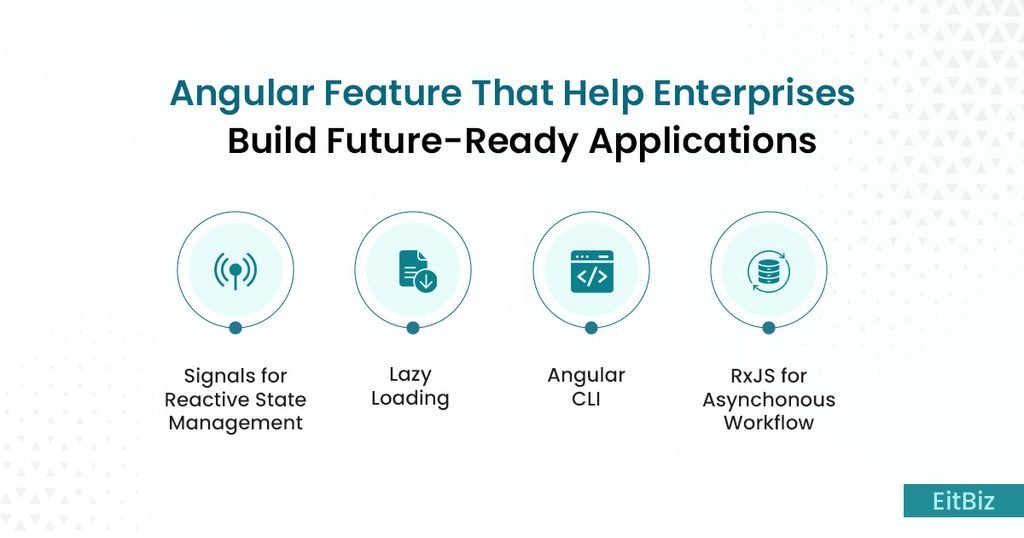
These features of the Angular development service help to improve productivity, along with providing a clear path for your developers. The features given below meet the requirements.
Signals for Reactive State Management
It highlights the simplicity of reactive state management by automatically updating only the parts of the UI affected by data changes. This helps you reduce re-rendering, which improves web application performance and makes Angular web development more predictable and easier to maintain.
Lazy Loading
This allows applications to load feature modules only when users access them instead of loading everything upfront. These features help your developers to reduce the initial bundle size, speed up page load times, and improve user experiences in your applications that scale up efficiently.
Angular CLI
This is one of the official command-line tools that automates common development tasks such as creating components, generating services, testing, building, and deployment. This improves productivity in your web applications, which increases consistency in project structure with a standardized workflow.
RxJS for Asynchronous Workflow
This helps Angular handle asynchronous operations like API calls and real-time data streams using observables. It directly impacts your web application by boosting efficient data flow and improving error-handling quality.
Angular Use Cases Across Industries
This JavaScript-powered web development framework has been widely used across industries. Its prowess in web development makes it one of the most popular. It supports architectural scalability, strong security, and long-term maintainability.
Banking
The framework has been used by the banking industry to build secure internet banking portals, payment gateways, investment platforms, and financial dashboards.
Healthcare
Angular plays a role in managing patient portals, appointment booking, and electronic health platforms. This helps your web application to provide real-time data or keep you updated about your patients and their medical history.
eCommerce
It powers enterprise e-commerce websites, inventory management systems, order tracking platforms, and customer dashboards.
Why Pick Angular for Single-Page Application Development
Angular is a premier choice for building single-page web applications. The capability of the Angular framework to seamlessly manage client-side state, render instant view transitions, and optimize network payloads makes it exceptionally engineered for SPA development.
Unlike multi-page setups, a true SPA must function as a fluid desktop application within a single browser tab. Angular achieves this specific capability through a tightly integrated architecture:
- Zero-Refresh Routing: Swaps views instantly inside the browser without reloading the page.
- Granular UI Updates: Uses Signals to modify only the precise HTML elements that change.
- Lazy Loading: Chunks code so the browser only downloads features as the user needs them.
- Unified State Caching: Keeps data alive and consistent across views without losing user progress.
Angular vs React: Which Framework Is Better for Enterprise Projects
When you choose between Angular vs React, you may find they look similar, but they fulfil different needs. Angular is a complete framework with built-in tools, while React is a UI library that often requires additional libraries for routing, state management, and other features.
| Angular | React |
|---|---|
| A complete framework with built-in routing, state management options, forms, and testing tools. | A JavaScript library focused on building user interfaces, with additional libraries needed for full application development. |
| Best suited for large-scale enterprise applications with complex architecture. | Commonly used for flexible, component-based applications and fast UI development. |
| Uses TypeScript by default, improving code consistency and maintainability. | Supports both JavaScript and TypeScript, depending on project requirements. |
| Offers a standardized project structure that helps large development teams collaborate. | Gives developers more flexibility in choosing project structure and tools. |
| Includes built-in dependency injection, routing, HTTP client, and CLI support. | Requires third-party solutions for routing, state management, and many development utilities. |
| Backed by Google’s long-term support and regular enterprise-focused updates. | Maintained by Meta with a large open-source ecosystem and community support. |
Which is Better for an Enterprise Project?
In enterprise projects, Angular is a strong choice when an organization needs an opinionated, scalable framework with built-in tools. Where an organization looks for UI flexibility and incremental adoption, React is a strong option for those enterprises.
When Should a Business Choose Angular for Web Development
Angular is becoming a popular choice in enterprises nowadays because it provides scalable and maintainable web applications that support long-term and complex workflows.
Enterprise SaaS
This is ideal for enterprise SaaS platform forms that serve thousands of users and require role-based access. Its modular structure and TypeScript support make large applications easier to maintain and expand over time.
Internal Business Platform
Used to build employee portals, HR systems, and line-of-business applications that need consistent performance and security across departments.
Should You Hire Angular Developers or an Angular Development Agency?
The right choice for Angular development depends on project size, budget, and long-term development needs. Both options offer distinct advantages for enterprise web development.
Hiring Angular developers directly
A good option to hire Angular developers when a business needs full control over a project. Developers stay closely focused on the work, building a full-fledged user interface for websites and applications, often reducing overall development costs and suiting businesses that need customer-centric enterprise applications.
Working with an Angular development agency
Typically the better fit for businesses that need a complete team of developers, designers, QA engineers, and project managers under one roof. We deliver as an end-to-end Angular development agency without the overhead of building an internal team, making us a practical partner for organizations ready to scale their digital platforms quickly and reliably.
Invest in Angular Web Development with EitBiz
Angular remains one of the most reliable foundations for enterprise-grade web applications, offering the scalability, built-in security, and long-term stability that growing businesses depend on. From SaaS platforms to CRM portals, its mature ecosystem keeps software easy to maintain and extend, not rebuilt every few years.
Realizing that value depends on the team building with it. This is where EitBiz helps. We help businesses build Angular-powered web applications. With over a decade of experience, we have delivered Angular solutions catered to the specific needs of diverse industries. We follow every project with precision and utilize a structured process that covers idea to production without sacrificing security or performance.