Key Takeaways
- AI in HR is helping enterprises transform HR from an administrative function into a strategic, data-driven business partner.
- AI-powered enterprise workforce management software improves hiring, retention, workforce planning, and employee experience.
- High-impact use cases such as predictive workforce analytics, AI talent acquisition software, and smart leave management systems deliver measurable ROI.
- Successful HR digital transformation depends on clear objectives, strong data governance, seamless integrations, and effective change management.
- Organizations that adopt AI in HR today can reduce costs, improve decision-making, and build more agile, future-ready workforces.
Modern HR teams are under pressure from every direction.
They need to hire faster, retain top talent, improve employee experience, reduce administrative overhead, and deliver workforce insights that help executives make better business decisions.
At the same time, many HR departments still spend hours on repetitive tasks like screening resumes, approving leave requests, answering policy questions, and compiling reports.
Sound familiar?
If so, you are not alone.
Across industries, technology leaders are rethinking how HR operates. They are investing in AI in HR to automate routine work, unlock actionable insights, and transform HR into a strategic function that drives business growth.
And they are seeing results.
From AI talent acquisition software that shortlists the best candidates to predictive workforce analytics that flags attrition risks, AI is rapidly becoming a core component of enterprise workforce management software.
Did you know?
The global artificial intelligence in HR market size is projected to reach USD 15.24 billion by 2030.
The question is no longer, “Should we use AI in HR?”
The real question is, “How quickly can we implement it to gain a competitive advantage?”
In this article, we will explore why tech leaders are prioritizing AI in HR, the key areas where it is creating measurable business value, and how enterprises are using AI to modernize workforce management.
What Is AI in HR?
AI in HR refers to the application of artificial intelligence technologies such as machine learning, natural language processing (NLP), and generative AI to streamline and enhance human resource functions. Instead of relying on manual processes and intuition alone, HR teams can use AI to analyze workforce data, predict trends like employee attrition or hiring needs, generate documents such as job descriptions and offer letters, answer employee questions through intelligent chatbots, automate workflows, and recommend next steps based on real-time insights.
Combined with modern enterprise workforce management software, AI helps organizations manage talent more effectively and efficiently.
From Administrative Function to Strategic Driver: Why AI in HR Is Gaining Momentum
There was a time when HR was viewed primarily as an administrative department. The team focused on essential operational tasks such as payroll processing, maintaining employee records, managing leave requests, and handling compliance documentation. While these responsibilities are still critical, the expectations placed on HR have expanded dramatically.
Today’s HR leaders are responsible for a much broader set of strategic priorities, including:
- Workforce planning
- Talent acquisition
- Employee engagement
- Learning and development
- Succession planning
- Retention strategies
- Organizational design
In other words, HR has evolved into a strategic business function that plays a direct role in driving organizational growth and performance.
To succeed in this role, HR teams need access to accurate data, intelligent automation, and real-time insights. This is where AI in HR and advanced ai hr solutions are transforming the way enterprises manage people.
Enterprise HR departments generate vast amounts of workforce data and manage numerous repetitive, rules-based processes. That makes HR an ideal environment for artificial intelligence. By integrating AI with modern enterprise workforce management software, organizations can automate routine tasks, uncover trends, and make more informed decisions.
Technology leaders are turning to AI because it enables HR teams to:
- Automate manual processes
- Improve decision-making
- Reduce operational costs
- Deliver better employee experiences
- Scale HR operations globally
When implemented correctly, AI does not replace HR professionals. Instead, it eliminates low-value administrative work so HR teams can focus on strategic initiatives, employee development, and organizational outcomes.
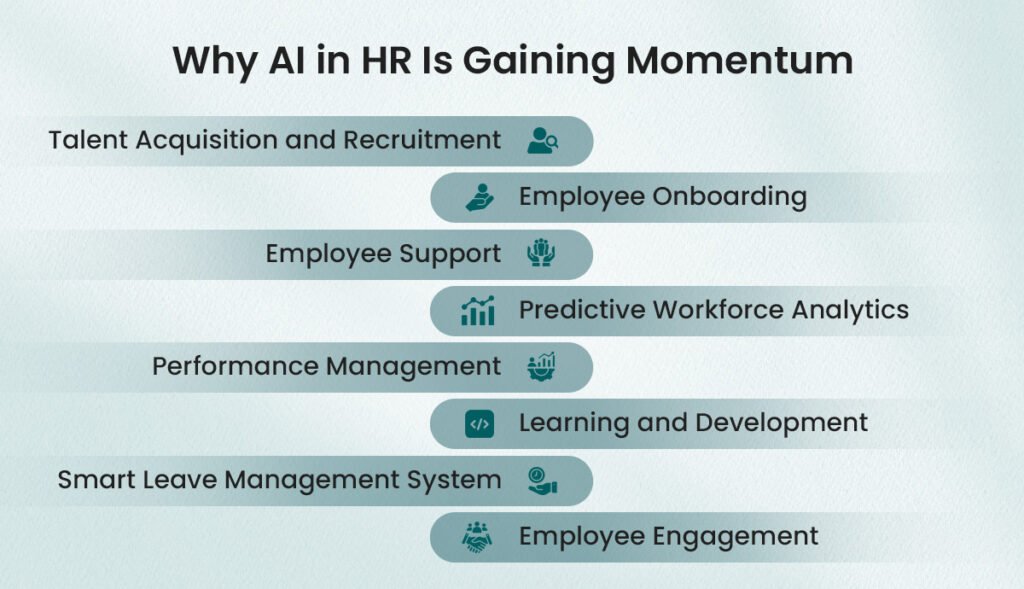
The strongest reason technology leaders are investing in AI in HR is simple: it delivers measurable business results. From reducing hiring costs to improving retention and employee experience, AI is helping HR teams operate with greater speed, accuracy, and strategic impact. Below are the most valuable ways enterprises are using AI to transform workforce management.
1. Talent Acquisition and Recruitment
Recruiting is one of the most widely adopted use cases for AI in HR. Traditional hiring processes require recruiters to review hundreds of resumes, create job descriptions, coordinate interviews, and maintain communication with candidates. These tasks are time-consuming and often repetitive.
AI talent acquisition software automates much of this work. It can parse resumes, rank candidates based on job-fit criteria, generate compelling job descriptions, draft personalized outreach emails, create structured interview questions, and summarize interviewer feedback.
AI can:
- Parse resumes
- Rank candidates
- Generate job descriptions
- Draft outreach emails
- Create interview questions
- Summarize interviewer feedback
Business Impact:
- Faster hiring cycles
- Lower recruiting costs
- Improved quality of hire
- Better candidate experience
2. Employee Onboarding
Employee onboarding often involves coordination between HR, IT, finance, and hiring managers. Without automation, delays can occur and create a poor first impression for new hires.
AI streamlines onboarding by automating document generation, welcome communications, policy acknowledgments, training assignments, and IT provisioning requests. AI-powered onboarding agents ensure each step is completed consistently and on time.
AI can automate:
- Welcome communications
- Document generation
- Policy acknowledgments
- Training assignments
- IT provisioning requests
Business Impact:
- Faster ramp-up time
- Improved new-hire satisfaction
- Reduced administrative effort
3. Employee Support and HR Service Delivery
HR teams spend significant time answering routine employee questions about leave balances, payroll, benefits, and company policies.
AI-powered assistants can respond instantly with accurate, context-aware answers. This is a core component of AI-driven people operations, where virtual HR agents provide 24/7 support while reducing ticket volume for HR teams.
Common employee questions include:
- How many leave days do I have?
- When will I receive my bonus?
- What is the parental leave policy?
- How do I update my tax information?
Business Impact:
- Faster response times
- Higher employee satisfaction
- Increased HR productivity
4. Predictive Workforce Analytics
One of the most strategic applications of AI is predictive workforce analytics. By analyzing historical and real-time employee data, AI can identify patterns and forecast future workforce trends.
AI can predict:
- Attrition risk
- Absenteeism trends
- Skills shortages
- Promotion readiness
- Engagement levels
For example, if a critical team begins showing signs of burnout or disengagement, AI can detect those signals early and alert leaders before turnover increases.
Business Impact:
- Better retention
- Improved workforce planning
- More proactive decision-making
5. Performance Management
Performance reviews are often subjective and administratively heavy. Managers may struggle to consolidate feedback and write balanced evaluations.
Generative AI in HR simplifies this process by summarizing achievements, analyzing feedback trends, drafting review narratives, and recommending development actions. This helps create more consistent and objective evaluations.
AI can:
- Summarize achievements
- Analyze feedback trends
- Draft review narratives
- Recommend development actions
Business Impact:
- Reduced bias
- Faster review cycles
- Better coaching outcomes
6. Learning and Development
Employees increasingly expect personalized learning opportunities that align with their career goals.
AI identifies skill gaps and recommends targeted learning paths based on job roles, performance data, and future business needs. This use of machine learning in HR helps organizations invest in training programs that deliver measurable value.
Business Impact:
- Improved skill development
- Higher training completion rates
- Stronger internal mobility
7. Smart Leave Management System
Leave administration can be complex, especially for global enterprises managing different policies, accrual rules, and compliance requirements.
A smart leave management system uses AI to automate approvals, detect unusual leave patterns, forecast staffing gaps, and enforce policy compliance.
AI can:
- Automate approvals
- Detect unusual patterns
- Forecast staffing gaps
- Enforce policy compliance
Business Impact:
- Reduced manual work
- Better scheduling visibility
- Lower compliance risk
8. Employee Engagement and Sentiment Analysis
Understanding how employees feel is essential for maintaining a healthy workplace culture.
AI can analyze employee surveys, feedback comments, chat data, and exit interviews to uncover sentiment trends. Generative AI in HR summarizes recurring themes and recommends targeted actions to improve engagement.
Business Impact:
- Improved engagement
- Early issue detection
- Stronger workplace culture
How Is Generative AI Transforming HR?
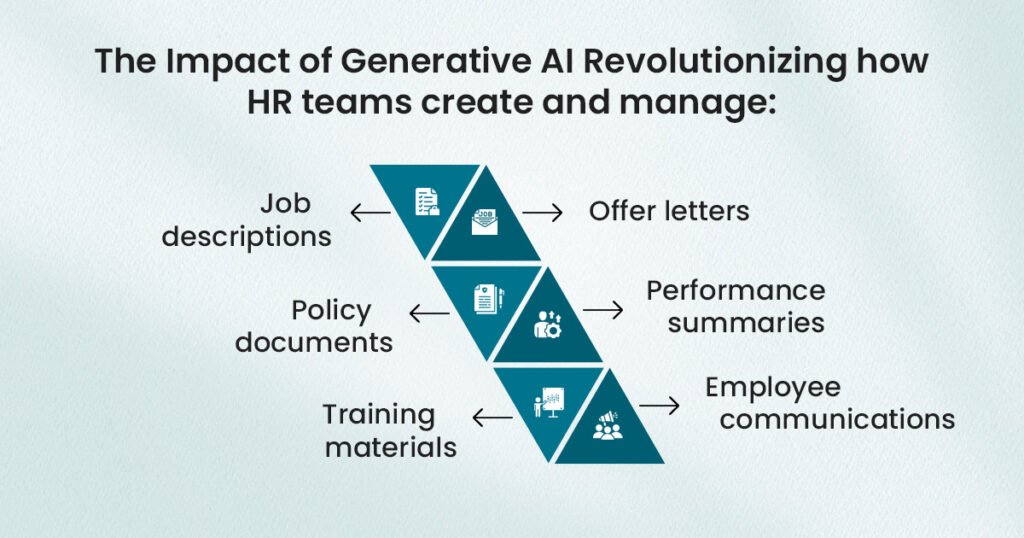
Generative AI in HR is transforming how organizations handle content-heavy and communication-intensive tasks. HR teams create a large volume of documents every day, from job descriptions and offer letters to policy documents, performance summaries, training materials, and employee communications. Traditionally, drafting and updating this content required significant manual effort and often led to inconsistencies across departments.
Generative AI streamlines this process by producing high-quality, context-aware content in seconds. It can tailor outputs based on role requirements, employee information, company policies, and business objectives. For example, recruiters can generate inclusive job descriptions, HR managers can create personalized offer letters, and learning teams can develop training materials aligned with specific skill gaps.
Generative AI in HR can create:
- Job descriptions
- Offer letters
- Policy documents
- Performance summaries
- Training materials
- Employee communications
When integrated with enterprise data and workflows, generative AI delivers highly personalized and accurate outputs that reflect organizational standards and employee context. This not only reduces content creation time but also helps HR teams respond faster, maintain consistency, and improve the overall employee experience.
How Does AI Workflow Automation Improve HR Operations?
HR teams typically rely on a wide range of systems to manage different processes. These may include an HRIS for employee records, an ATS for recruitment, payroll platforms, learning management systems, service desks, and collaboration tools. While each system serves a specific purpose, they often operate in silos, forcing HR professionals to manually transfer data between platforms.
AI workflow automation eliminates these disconnected handoffs by orchestrating tasks across systems automatically. Once a trigger event occurs, such as a candidate accepting an offer or an employee submitting a leave request, AI can initiate and manage the entire process end to end.
Many HR teams rely on systems such as:
- HRIS
- ATS
- Payroll platforms
- Learning management systems
- Service desks
- Collaboration tools
For example, when a candidate accepts an offer:
- The HRIS creates an employee profile.
- IT receives provisioning requests.
- Required training modules are assigned.
- Welcome emails are sent automatically.
- Payroll records are initiated.
This is the practical value of AI integration in HR. It reduces manual effort, eliminates errors, accelerates processes, and ensures that workflows are executed consistently across the organization.
How Is Enterprise Workforce Management Software Becoming AI-Driven?
Traditional enterprise workforce management software focused primarily on time tracking, attendance management, and scheduling. While these capabilities remain essential, modern enterprises now expect workforce management platforms to deliver predictive insights and intelligent recommendations.
Today’s AI-powered systems can analyze historical and real-time workforce data to optimize labor planning and operational efficiency.
Advanced capabilities include:
- Labor forecasting
- Shift optimization
- Overtime prediction
- Compliance monitoring
- Staffing recommendations
This evolution is driving the adoption of AI workforce management platforms that help organizations anticipate labor needs, reduce unnecessary costs, and improve productivity. Instead of simply recording workforce activity, these systems actively guide decision-making.
How Does Machine Learning in HR Turn Data Into Decisions?
Machine learning in HR helps organizations uncover patterns and relationships hidden within workforce data. By analyzing historical information, machine learning models can generate predictions and recommendations that support more informed HR decisions.
Machine learning can help organizations:
- Predict resignations
- Identify top-performing candidate profiles
- Detect compensation inconsistencies
- Forecast staffing needs
For example, machine learning models can identify employees at risk of leaving or highlight which candidate characteristics correlate with long-term success.
These insights allow HR leaders to act proactively rather than react after problems emerge, making machine learning a foundational technology for strategic HR decision-making.
What Is AI-Driven People Operations?
AI-driven people operations represents a new HR operating model where artificial intelligence handles operational work and HR professionals focus on strategic priorities.
Rather than functioning as a reactive service department, HR becomes an intelligence-driven business partner. AI agents and analytics tools take over high-volume administrative tasks, enabling HR teams to concentrate on:
- Strategic planning
- Talent development
- Leadership support
- Culture initiatives
This model allows organizations to scale HR capabilities without proportionally increasing headcount. It also improves responsiveness, consistency, and the overall quality of decision-making across the employee lifecycle.
How Is AI Accelerating HR Digital Transformation?
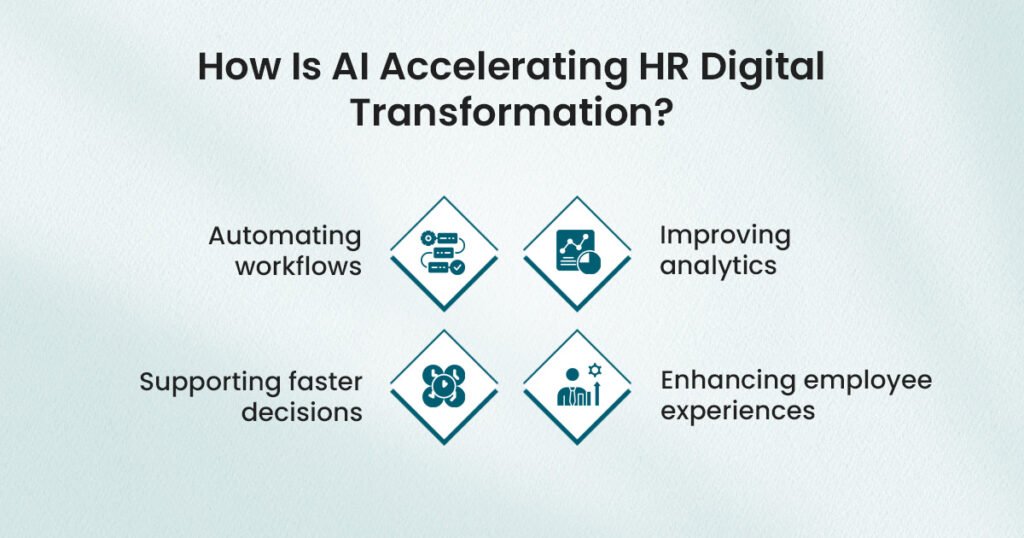
AI adoption is a core component of HR digital transformation. Digital transformation in HR involves modernizing systems, processes, and decision-making through advanced technology.
AI accelerates this transformation by:
- Automating workflows
- Improving analytics
- Enhancing employee experiences
- Supporting faster decisions
With AI, HR teams can move away from disconnected tools and manual processes toward integrated systems and real-time insights. This creates more agile, efficient, and future-ready HR functions.
Organizations that embrace AI as part of their HR digital transformation strategy are better equipped to adapt to changing business needs, support employees effectively, and drive measurable business outcomes.
Implementing AI in HR is not just a technology upgrade. It is a strategic initiative that affects processes, data, governance, and people across the organization. Enterprises that achieve the greatest value from AI in HR approach adoption with a clear roadmap rather than deploying tools in isolation.
Successful strategic HR technology adoption requires leaders to align AI investments with business goals, prepare their data foundations, ensure responsible governance, and support users throughout the transition. Below are the key factors every technology and HR leader should consider.
What Should Leaders Consider for Strategic HR Technology Adoption?
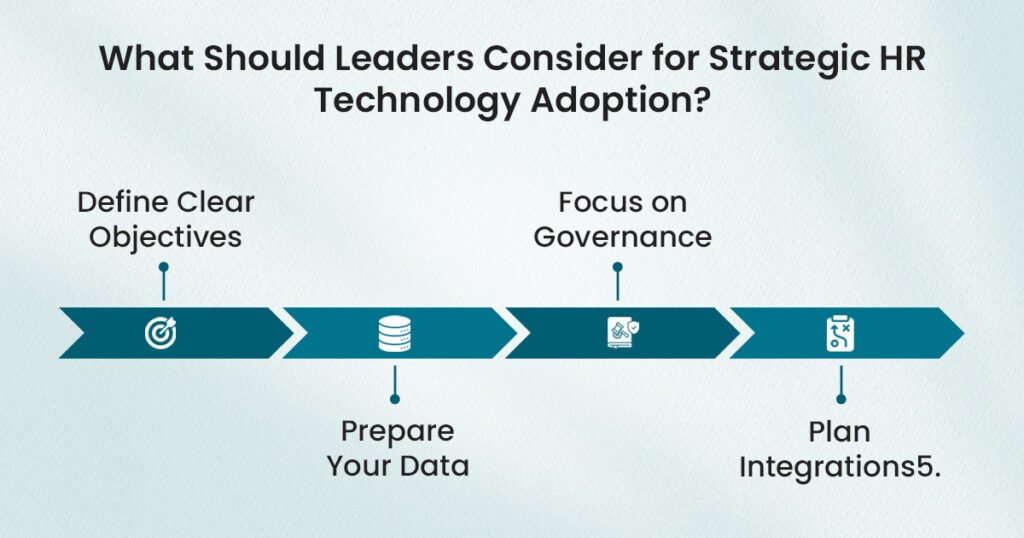
1. Define Clear Objectives
The first step in any AI initiative is identifying the business outcomes you want to achieve. Without clear objectives, organizations risk investing in technology that adds complexity without delivering measurable value.
Start by asking questions such as:
- Which HR processes consume the most time?
- Where are bottlenecks affecting employee experience?
- What workforce decisions would benefit from better insights?
- Which metrics matter most to leadership?
Common goals include:
- Reducing time-to-hire
- Improving retention
- Automating leave approvals
- Enhancing employee support
By setting specific, measurable objectives, leaders can prioritize high-impact use cases and establish success metrics from the outset.
2. Prepare Your Data
AI systems are only as effective as the data they rely on. If workforce data is incomplete, inconsistent, or siloed across systems, AI outputs will be unreliable.
Before implementation, organizations should assess the quality and accessibility of data related to recruitment, performance, compensation, attendance, and employee records.
Data preparation should focus on:
- Cleaning duplicate or outdated records
- Standardizing data formats
- Consolidating information across systems
- Establishing data ownership
- Strengthening employee data management practices
A strong data foundation ensures AI models generate accurate insights and recommendations that leaders can trust.
3. Focus on Governance
Responsible AI adoption requires robust governance. HR data is highly sensitive, and AI decisions can directly affect employees’ careers and experiences.
Leaders should establish clear controls for:
- Data privacy and security
- Bias detection and mitigation
- Model transparency
- Auditability
- Regulatory compliance
Governance frameworks help ensure AI is used ethically and in alignment with company values and legal obligations. They also build trust among employees, managers, and stakeholders.
4. Plan Integrations
HR technology ecosystems often include multiple platforms, such as HRIS, ATS, payroll systems, learning management systems, and collaboration tools.
To maximize impact, AI solutions must integrate seamlessly with these systems. Without integration, HR teams may still need to manually move data between applications, limiting the value of automation.
Integration planning should address:
- API availability
- Data synchronization
- Workflow orchestration
- Security requirements
- Scalability
Strong AI integration in HR enables end-to-end automation and ensures AI becomes part of everyday operations rather than a disconnected add-on.
5. Invest in Change Management
Even the most advanced AI tools will fail if users do not understand or trust them. HR professionals need training, support, and confidence to incorporate AI into their daily work.
Effective change management includes:
- Communicating the purpose and benefits of AI
- Providing hands-on training
- Addressing concerns about job displacement
- Sharing success stories
- Gathering user feedback for continuous improvement
When HR teams see AI as a tool that enhances their capabilities rather than replaces them, adoption accelerates and outcomes improve.
Build vs Buy: Should You Consider Custom AI Development?
Off-the-shelf software works well for standard use cases.
But many enterprises require tailored workflows, custom analytics, and specialized integrations.
In these cases, custom AI development offers greater flexibility.
Custom solutions can include:
- Proprietary predictive models
- Industry-specific compliance automation
- Custom dashboards
- Personalized employee experiences
Organizations exploring building AI HR software often choose this route to create competitive differentiation.
1. The Role of Employee Data Management
AI depends on clean, centralized data.
Strong employee data management ensures that workforce information is accurate, secure, and accessible across systems.
Without robust data management, AI models produce unreliable outputs.
For enterprises, data governance is foundational to successful AI adoption.
2. Custom HR Software Development for Unique Business Needs
Every enterprise has unique processes.
Custom HR software development allows organizations to build solutions tailored to their workflows, policies, and compliance requirements.
Examples include:
- Industry-specific onboarding systems
- Advanced leave management platforms
- Specialized workforce analytics tools
Custom development ensures the technology aligns with business objectives rather than forcing teams to adapt to generic software.
Measuring ROI: Understanding the Cost of AI for Business
When evaluating the cost of AI for business, leaders should look beyond the upfront investment and focus on measurable business outcomes. The true return on investment (ROI) of AI in HR comes from operational efficiencies, faster decision-making, and improved workforce outcomes. Many organizations begin to see returns within a few months as AI reduces manual work, accelerates hiring, and helps HR teams make more informed decisions.
The table below highlights the key metrics enterprises use to measure the ROI of AI-powered HR initiatives.
| Metric | What It Measures | How AI Improves It | Business Impact |
|---|---|---|---|
| Time-to-Hire | The average time required to fill an open position | AI talent acquisition software automates resume screening, candidate ranking, and interview coordination | Faster hiring and reduced vacancy costs |
| Cost-per-Hire | Total recruiting expenses divided by the number of hires | AI reduces manual recruiting effort and reliance on external agencies | Lower recruitment costs |
| Attrition Rate | Percentage of employees leaving the organization | Predictive workforce analytics identifies employees at risk of leaving | Improved retention and reduced turnover costs |
| HR Response Time | Average time HR takes to resolve employee requests | AI-powered assistants answer common questions instantly | Faster support and better employee experience |
| Employee Satisfaction | Employee perception of HR services and workplace experience | Personalized support and quicker issue resolution improve satisfaction | Higher engagement and stronger employer brand |
| Administrative Hours Saved | Time eliminated from repetitive HR tasks | AI workflow automation reduces manual approvals, document creation, and data entry | Increased HR productivity |
What Are the Real-World Enterprise Use Cases of AI in HR?
The value of AI in HR becomes even clearer when you look at how enterprises are applying it in real-world scenarios. Across industries, organizations are using AI to solve workforce challenges, improve operational efficiency, and make better talent decisions. From predicting employee attrition to automating compliance-heavy processes, AI is helping HR teams deliver measurable business impact.
1. Global Technology Company: Predicting Flight Risks Among Critical Talent
Technology companies compete fiercely for highly skilled engineers, data scientists, and product specialists. Losing even a handful of key employees can disrupt innovation and delay product roadmaps.
To address this challenge, many global technology companies use predictive workforce analytics to identify employees who may be at risk of leaving. AI models analyze factors such as engagement scores, tenure, compensation trends, manager changes, and workload patterns to detect early warning signs.
With these insights, HR leaders and managers can intervene proactively through career development discussions, compensation adjustments, or workload balancing.
Business Impact:
- Improved retention of critical talent
- Reduced replacement costs
- Greater workforce stability
2. Retail Enterprise: Optimizing Staffing During Seasonal Demand Spikes
Retail organizations face dramatic fluctuations in workforce needs during holidays, promotional events, and peak shopping seasons.
Using AI workforce management, retailers can forecast labor demand based on historical sales, customer traffic, and seasonal patterns. AI then recommends optimal staffing levels and schedules to meet demand while controlling labor costs.
This ensures stores are adequately staffed without over-scheduling employees.
Business Impact:
- Lower labor costs
- Improved customer service
- Better schedule accuracy
3. Financial Services Firm: Automating Compliance Documentation and Employee Support
Financial institutions operate in highly regulated environments where documentation and policy compliance are critical.
AI helps automate compliance-related HR processes, including policy acknowledgments, audit documentation, and regulatory reporting. At the same time, AI-powered assistants answer employee questions about benefits, payroll, and internal policies.
This reduces administrative burden while improving consistency and audit readiness.
Business Impact:
- Reduced compliance risk
- Faster documentation
- Improved employee service delivery
4. Healthcare Organization: Balancing Staffing and Compliance with Smart Leave Management
Healthcare providers must maintain appropriate staffing levels while managing complex leave policies and strict regulatory requirements.
A smart leave management system uses AI to automate leave approvals, forecast staffing gaps, and ensure compliance with labor regulations and internal policies.
This helps healthcare organizations maintain patient care standards while reducing administrative workload.
Business Impact:
- Better staffing continuity
- Lower compliance risk
- Faster leave processing
What Are the Common Challenges in AI Adoption?
While the benefits of AI are substantial, successful implementation requires organizations to address several common challenges.
- Data Silos
HR data often resides in disconnected systems such as HRIS, ATS, payroll, and learning platforms. These silos limit AI’s ability to generate accurate insights.
Solution: Invest in strong data integration and centralized employee data management.
- Bias and Fairness
AI models can unintentionally reflect biases present in historical data, particularly in hiring and performance decisions.
Solution: Conduct regular audits, use diverse datasets, and implement governance controls to ensure fairness.
- Employee Trust
Employees and managers may be hesitant to adopt AI if they do not understand how it works or how decisions are made.
Solution: Communicate transparently about AI usage, data privacy, and human oversight.
- Legacy Infrastructure
Older systems may lack the APIs and integration capabilities required for modern AI solutions.
Solution: Use phased implementation strategies and prioritize high-value use cases that can integrate with existing systems.
What Does the Future of AI in HR Look Like?
The future of AI in HR is moving beyond automation toward intelligent, autonomous systems that can reason, act, and continuously improve.
The next generation of HR technology will include:
- Autonomous HR agents
- More advanced predictive workforce analytics
- Personalized employee experiences
- Real-time workforce intelligence
- Stronger governance frameworks
Autonomous agents will be able to manage end-to-end processes such as recruitment, onboarding, and employee support with minimal human intervention. Predictive models will become more accurate, helping leaders make better workforce decisions. Employee experiences will become increasingly personalized, with AI tailoring communications, learning recommendations, and career guidance to each individual.
At the same time, stronger governance frameworks will ensure AI is used responsibly, ethically, and in compliance with regulations.
As generative AI in HR and agentic AI in HR workflows continue to evolve, HR will become more proactive, intelligent, and strategically aligned with business goals. Organizations that invest early will be better positioned to build agile, resilient, and future-ready workforces.
How Can EitBiz Help You Implement AI in HR?
Adopting AI in HR requires more than choosing the right technology. It demands a strategic approach that aligns AI capabilities with your HR goals, integrates seamlessly with your existing systems, and delivers measurable business outcomes. That is where EitBiz can help.
EitBiz specializes in building custom, scalable AI solutions for enterprises looking to modernize their workforce operations. Whether you want to automate recruitment, deploy predictive workforce analytics, or create a smart leave management system, EitBiz helps you design and implement solutions tailored to your unique business requirements.
Our AI in HR Services includes:
- Custom AI development for HR-specific use cases
- Custom HR software development aligned with your workflows
- AI workflow automation across HRIS, ATS, payroll, and LMS platforms
- Machine learning in workforce analytics for attrition prediction and staffing forecasts
- Employee data management and integration services
- Development of AI-powered chatbots and employee support assistants
- Generative AI solutions for document creation and HR communications
We work closely with your HR and technology teams to identify high-impact opportunities, integrate AI into your existing infrastructure, and ensure responsible implementation.
With EitBiz, you gain a technology partner that can help you:
- Reduce HR operational costs
- Improve decision-making
- Enhance employee experiences
- Accelerate HR digital transformation
- Build future-ready workforce management systems
Whether you are exploring AI solutions for businesses, evaluating the cost of AI for business, or planning to start building AI HR software, EitBiz can help you turn your vision into a practical, high-impact solution.
Ready to transform your HR operations with AI? EitBiz can help you build intelligent, scalable HR systems that drive measurable business results.