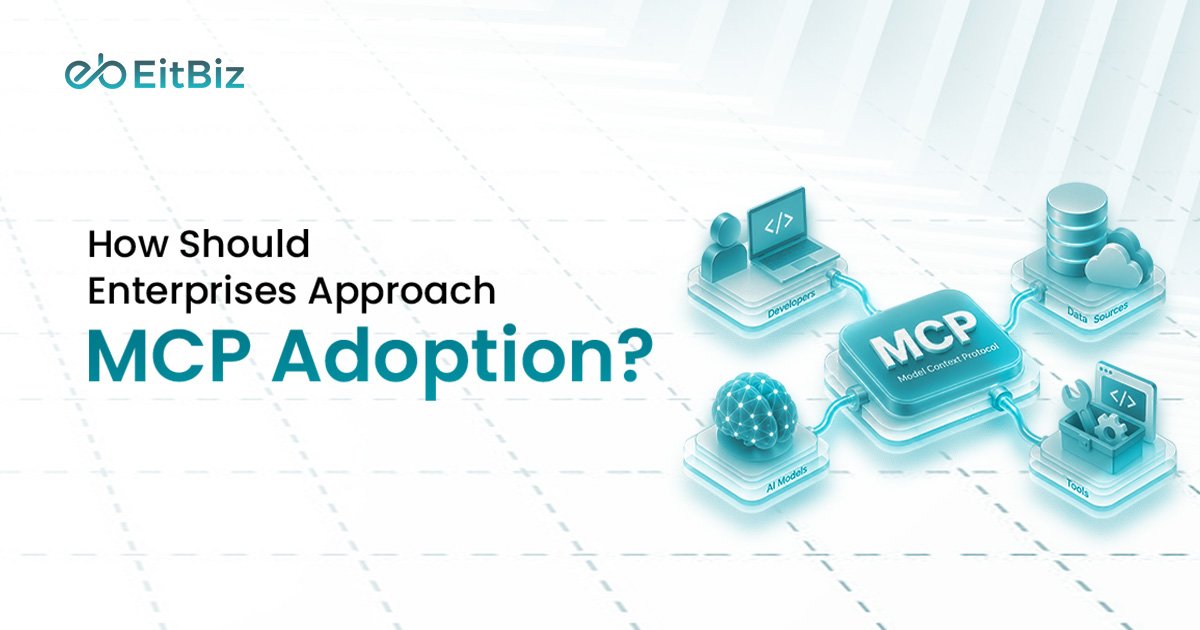
The speed at which enterprise technology is transforming is quickly rewiring the traditional integration paradigms. The recent wave of MCP adoption is quite common among them.
Earlier, APIs have historically served as the foundational bridge connecting apps, data sources, and software stacks.
Today, the architectural demands of autonomous AI agents have introduced the concept of Model Context Protocol as a sovereign integration facilitator. However, MCP adoption is not as simple as adding a new server to your existing tech stack. It is much more complicated.
The challenge lies in establishing a scalable, standardized connective issue between intelligence and enterprise data. This article sheds light on the challenges in enterprise AI integration, how MCP resolves them, and the approach you must follow while navigating MCP adoption.
What is Model Context Protocol (MCP)?
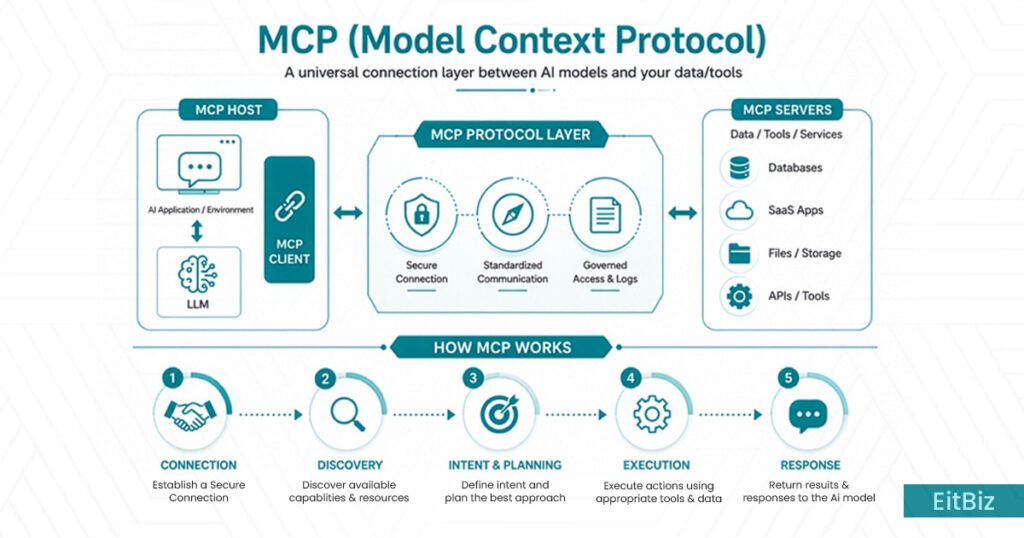
MCP is an acronym for Model Context Protocol. Basically, MCPs establish a secure, bidirectional, and standardized connection layer between AI models and local/remote resources. These establish a universal framework that any AI model or tool can adopt.
To enforce strict AI governance and system security, the host application enforces granular access and activity logging across the connection layer.
For instance, you are chatting with Claude to update your tasks on Notion, all within a single conversation window. With MCP adoption, your AI model can access your Notion account and update the tasks all within that window, without requiring you to custom code anything.
Core Components of MCP
The Model Context Protocol uses a client-server architecture to provide LLMs with safe and structured access to local and remote data sources.
MCP Host
The main AI application or environment (could be an IDE or a desktop app) that runs the Large Language Model and orchestrates your request.
MCP Clients
A dedicated module inside the host that maintains a 1-to-1 secure session with a server. This handles capability negotiation and message routing.
MCP Servers
These are the external services that wrap data sources, APIs, or local files and expose them in a standardized and discoverable format. Simply put, MCP servers are the software programs that provide context to the MCP clients.
Transport Layer
Typically known as a connecting layer that binds both the client and server by using standard input/output (stdo) for local tools or HTTP with Server-Sent Events (SSE) for remote services.
The work process of MCP looks like this:
Connection → Discovery → Intent & Planning → Execution → Response.
| Steps | Who Drives It? | Technical Action |
|---|---|---|
| Connection | Client & Server | Establishes communication via stdio or HTTP SSE |
| Discovery | Client | Lists capabilities using tools/list |
| Intent & Planning | LLM (Top Layer) | Evaluates user prompt and decides which tool to evoke |
| Execution | Client → Server | Sends a tool/call JSON-RPC request with parameters |
| Response | Server → Client | Returns content (image, video, or text) back to the model. |
MCP vs API
The Model Context Protocol (MCP) and Application Programming Interface (API) are the complementary integration standards redefining custom software development. But both are distinctive among them.
Traditional APIs are code-heavy and designed for engineers to wire software endpoints, while MCPs are a dynamic, semantic protocol that allows AI agents to autonomously discover and orchestrate toolsets at runtime.
| Aspect | Traditional APIs | Model Context Protocol (MCP) |
|---|---|---|
| Core Concept | Custom endpoints | Universal standard |
| Implementation | Manual hardcoding | Plug-and-play |
| Connection Type | Stateless requests | Persistent streams |
| Lifecycle | Instantly closes | Sustained sessions |
| Protocol Transport | Standard HTTP | JSON-RPC 2.0 |
| Data Capabilities | Raw JSON payloads | Native AI primitives |
The Model Context Protocol translates GraphQL or REST APIs into a model-native architectural format.
Key Challenges in Enterprise AI Integration
Not every enterprise AI project is successful. In fact, the data showcase some staggering figures. Over 70-95% of them fail due to complexities in the intelligence integration.
Some of the challenges that hinder the adoption of artificial intelligence among enterprises:
- Integration Sprawl
Custom-coding point-to-point API connectors for every LLM and enterprise data source quickly becomes unmanageable. If a SaaS application development project requires connecting multiple AI models and various data repositories, building and managing these bespoke pipelines creates a highly fragile, unmaintainable M x N matrix.
- Context Stagnation & Latency
Static training batches or manual RAG batching cause stale information. This will negatively impact the context-driven accuracy of your AI model because outdated data increases factual errors and increases model hallucinations.
- Context Fragmentation
When an enterprise lacks a detailed cybersecurity strategy for AI, data context becomes fragmented across siloed systems. Attackers can exploit centralized tracking and missing role scopes via unstructured prompt injections to bypass business logic layers.
How MCP Resolves AI Integration Challenges
The Model Context Protocol solves these challenges through a lightweight, open standard client-server architecture. It methodizes how AI clients and query tools, resources, and prompt components are from modular enterprise servers.
| Challenges | How MCP Resolves Them |
|---|---|
| Integration Sprawl | Reduces M x N matrices and shifts it to M +N standard where server exposes universal schemas once |
| Context Stagnation | Provides live, two-way, stateful context matching loops so model queries actual data sources on demand |
| Context Fragmentation | Tools encapsulated within dedicated servers maintain strict access controls and clear schemas. |
Where Does Model Context Protocol Fit into Enterprise Architecture?
You must have gained substantial information about what MCP is, how it works, and how it is resolving traditional challenges related to intelligence integration. But how does it actually fit into an enterprise architecture?
Model Context Protocol’s role is very specific. It provides a standardized interface through which compatible applications can find and use the required resources and tools. For instance, if you are investing in infusing agentic AI for enterprise workflows, MCP will simplify how agents connect with your business systems, APIs, databases, and knowledge sources.
Thus, it acts as a USB-C port for software, replacing messy custom integration with a single shared communication layer.
MCP as an Access Layer for AI Applications
A simplified enterprise architecture can look like:
AI Applications / Agents
↓
MCP Client
↓
MCP Servers
↓
Existing APIs / Services / Data Sources
↓
CRM | ERP | Databases | SaaS | Internal Systems
An MCP server can showcase selected capabilities from these systems in a format that apps compatible with MCP can interact with. This creates a separation between:
- The application that needs a capability
- The MCP interface exposing the capability
- The underlying enterprise system providing it
In the context of modern organizations, this separation becomes highly relevant as organizations deploy more apps that need access to the same business capabilities.
Where MCP Integration Can Add Value
Antropic’s formulated MCP becomes increasingly relevant where AI applications need to interact with multiple tools, services, or sources of enterprise context. For example:
Customer support application holds various things like:
- Customer records
- Knowledge base
- Ticketing system
- Order Information
- Payment Wall
Earlier, you needed to hire dedicated developers to build a separate pattern for every application, which is a bit of a messy and code-heavy workflow. Here, the MCP-based approach provides a fairly clear and standardized interface to the capabilities an application requires.
This can support:
- Reusable tool access
- More consistent integration patterns
- Easier addition of newer capabilities
- Greater separation between apps and underlying systems.
Here is how MCP creates value across three core operational pillars:
- Enterprise System Connectivity
When scaling infrastructure, the debate often comes down to agentic AI vs AI agents. The MCP adoption replaces this by replacing fragmented, siloed, custom-coded interactions with a secure, bidirectional, and unified communication layer. It makes the connection with the databases, code repos, and SaaS applications easier through a single, open standard.
- Operational Workflows
MCP transforms static software into dynamic, AI-driven workflows by allowing models to safely execute actions across your stack. It acts as an intelligence layer on top of the MACH architecture. This enables an enable client to dynamically stitch together separate distributed systems into an automated workflow.
- Reduced Engineering Overhead
The Model Context Protocol completely changes the protocol of artificial intelligence development by shifting the engineering focus from integration to innovation. Combining MCPs with microservices architecture for AI applications prevents “integration sprawls” and prevents developers from constant code rewrites.
MCP Security Considerations for Enterprise
It is clear by far that MCP is not a replacement for APIs, but these are built on top of them. It acts as a wrapper or translator that sits between an LLM and your application.
Do not ignore AI governance and security. It must be considered while deploying an MCP in an enterprise workflow.
This is because MCP standardizes tool and data connectivity without built-in security, so every organization building it must layer externally.
- Credential & Token Management
MCP hosts must securely authenticate with MCP servers without exposing sensitive credentials to the model’s generation context. Setting a high-end governance framework that precisely manages the token and credential becomes crucial.
- Data Exfiltration Controls
You might be shocked, but MCP is the prime target for prompt injection attacks. Because it can read local files, query databases, and call external APIs on demand. Security practices like
- Network segmentation
- Context window leak prevention
- Strict protocol whitelisting
An AI development company with experience in building and integrating MCP can help you build guardrails around your data by applying security best practices.
- Human-in-the-Loop Controls
Autonomous tool execution poses the highest operational risk in an enterprise. You must include HITL (Human-in-the-Loop) in an MCP server to ensure that high-impact triggers explicitly require human approval. This prevents unauthorized data modifications or data loss.
MCP Adoption Best Practices
You must not treat MCP adoption as a standalone technology rollout. Its success highly depends on how well it fits into existing architecture, security, and operational processes. You should invest in an AI readiness assessment to avoid unnecessary complexity as you evaluate and implement the Model Context Protocol.
- Prioritize High-impact Use Case
Do not make a mistake of introducing MCP for every different use case. It is always good to start with a problem that is specific and has a high impact on your business use case. Prioritize use cases where the MCP architecture can:
- Reduce duplicate integrations
- Provide reusable access to tools or resources
- Simplify interactions across multiple systems
The objective is to validate the high-impact areas where MCP adoption can drive maximum value.
- Ensure Role-based Access Control
Remember, not every user or application can have access to your MCP server or tool. It is good to include RBAC and provide access based on data sensitivity, user roles, application type, required tools, and resources. This way, you will have complete control over the MCP’s access.
- Integrate with Existing System Architecture
The Model Context Protocol should complement existing APIs, systems, or integration platforms rather than operate as a disconnected layer. The more inclusion will have a complete ecosystem and act as an intelligent bridge that reduces friction.
- Monitor and Manage
You should treat MCP servers as managed enterprise components, rather than temporary development utilities. For this, you can define a process for version management, performance tracking, security reviews, logging, and updating. This will ensure operational stability and provide full auditability across all LLM-focused applications.
A Practical MCP Adoption Approach for Enterprises
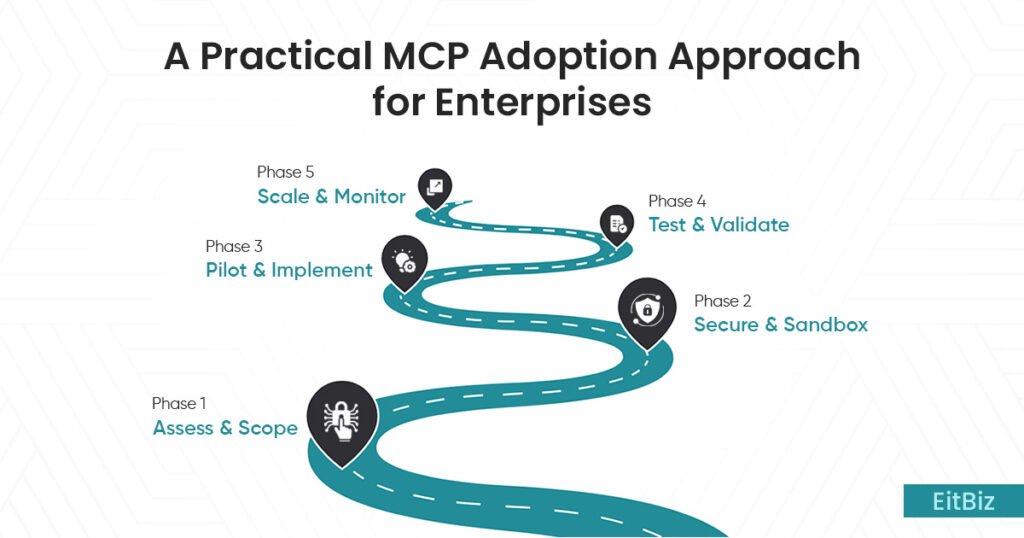
Once you identify the suitable use case for MCP across your enterprise workflow. The next step is to follow a practical approach to adopt it. It is crucial to adopt a phased approach to allow technology and security teams to validate the architecture before expanding its use.
- Phase 1: Assess & Scope
Start by assessing the use case by identifying where the MCP integration is most beneficial for a business. You can do this by evaluating existing integrations, APIs, and applications that require access to multiple tools, data, and security requirements. This will help you define the scope.
- Phase 2: Secure & Sandbox
Once the requirements of MCP adoption are assessed, the next step is to create an isolated environment for the initial implementation. Establishing role-based permissions, tool-level access controls, and credentials management ensures that the protocols operate safely without exposing production infrastructure or sensitive enterprise data.
- Phase 3: Pilot & Implement
You should implement MCP around the selected use case and connect it to the required enterprise capabilities. Keep the initial scope limited. You must focus on validating integration effort, tool accessibility, reliability, developer experience, and operational requirements to ensure alignment with existing enterprise architecture.
- Phase 4: Test & Validate
After you implement MCP, do not forget to test its functionality and validate. You can do this by performing several tests for access control failures, unexpected tool usage, data exposure, performance, reliability, and feature handling. This phase will help you validate the Model Context Protocol before production environment deployment to guarantee system resilience.
- Phase 5: Scale & Monitor
If the pilot project demonstrates clear business value, establish repeatable standards before expanding MCP adoption. You must define security requirements, deployment patterns, ownership, and governance to ensure that the protocol can safely handle enterprise-grade production workloads.
Leverage EitBiz’s Experience in Enterprise MCP Architecture Integration
MCP adoption has been fast-paced. Every leading company is either looking to build its own or implement one in its workflows. It is essential to have a clear understanding of where the protocol fits, how it interacts with the existing systems, and what security and governance controls need to surround it.
The process is complex and requires hands-on experience. This is where EitBiz’s experience in MCP integration can help you drive maximum benefits.
We help enterprises evaluate high-impact use cases, design the supporting architecture, and integrate MCP with existing enterprise systems. Our team follows a strict governance and security approach to ensure every bit of information is secured. We establish the controls needed for secure MCP adoption.
Build a practical MCP integration roadmap with us!