Every technology leader has sat through the same meeting this year. Someone on the team pulls up a demo of an autonomous AI agent that performs tasks with precision and closes the work loop without human intervention. But is this safe to run in production? Who’s accountable if something goes wrong?
These are the right questions, and this year they’ve moved from theoretical to operational. This is because autonomous solutions enable software to think, reason, answer, and adapt if the response is incorrect. Gartner predicts that at least 15% of work decisions will be made autonomously by agentic AI by 2028.
This showcases enterprises’ interest in adopting agentic operations, which creates an opportunity for businesses like yours to invest. However, considering the what, when, and how becomes essential, and this article highlights these aspects with precision.
What is an Autonomous AI Agent?
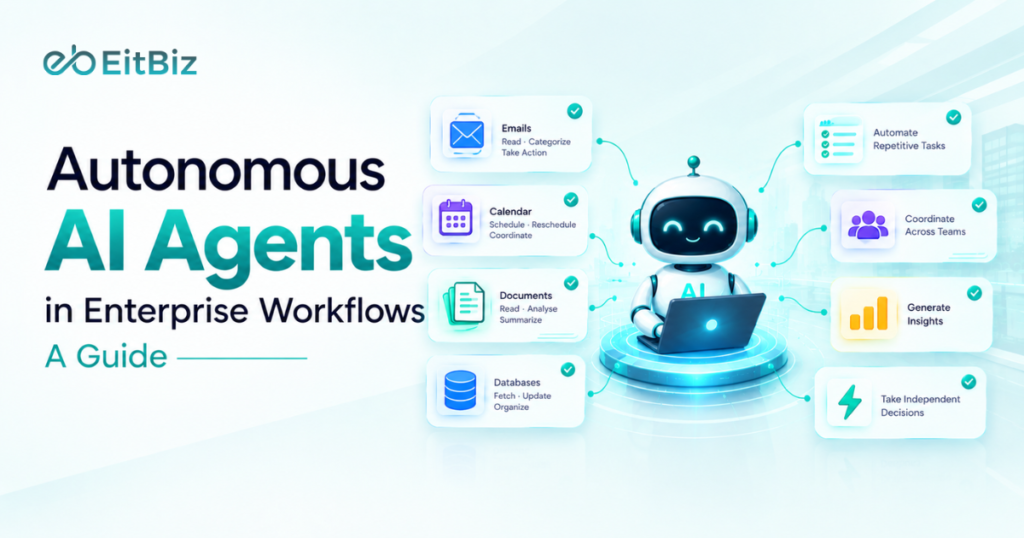
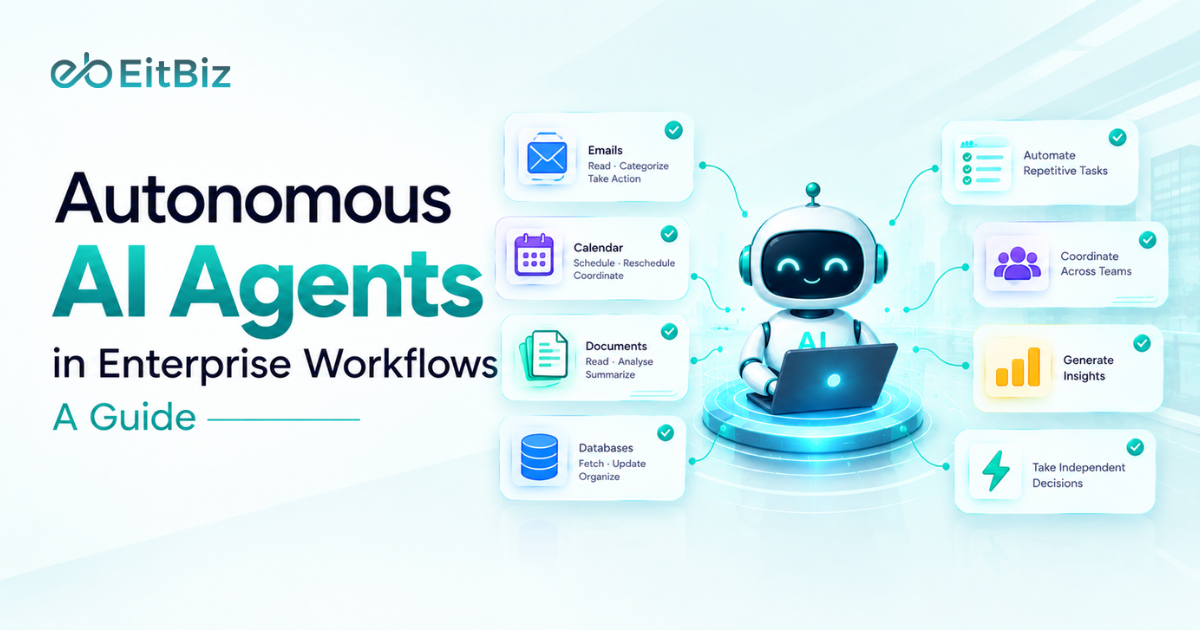
An autonomous AI agent is a software system that can perceive its environment, reason through complex problems, plan multi-step actions, and execute tasks by using tools with less human interaction. Simply put, these systems think, plan, and act independently.
An autonomous AI agent solution is completely different from a chatbot or copilot. A chatbot answers questions, a copilot suggests next steps and waits for human approval, while an autonomous AI agent uses LLMs as reasoning engines to execute a task.
These agentic AI solutions alter systems and orchestrate workflows, representing a shift from automation to autonomy.
Core Characteristics of Autonomous AI Agents
Autonomous solutions are goal-focused. You decide a goal for an agent to complete, and it will work in a loop to execute the task with precision. These autonomous AI agents share some characteristics to consider:
- Autonomoy
They operate independently, self-directing their workflow across multiple steps. Agentic AI systems can select actions, use tools, and make decisions within defined boundaries.
- Planning & Reasoning
Autonomous artificial intelligence agents can plan and break down complex goals into smaller sub-tasks. They can reason through multiple steps before taking an action.
- Context Awareness
Autonomous AI agents maintain an understanding of relevant information and the current state. Context awareness enables them to interpret situations more accurately and make decisions that are appropriate to the circumstances.
How Do Autonomous AI Agents Work?
Autonomous AI agents take in information, decide what needs to happen, act on it, and adjust based on what happens next. They work like this:
- Perceive: Gather information from the environment, systems, or user.
- Understand: Interpret the information and identify what matters.
- Plan: Decide what steps are needed to reach the goal.
- Act: Use available tools and systems to carry out those steps.
- Evaluate: Check the results and determine whether the goal was met.
- Continue or Escalate: Keep going when the next step is clear, or involve a human when judgment or approval is needed.
Autonomous AI Agent vs Traditional AI Agents
Autonomous solutions work independently to achieve goals, while a traditional AI agent follows rigid, pre-programmed instructions to execute a specific task with human oversight. Both terms are often used interchangeably, but they show different capabilities.
| Capability | Traditional AI | Autonomous AI |
|---|---|---|
| Decision-making | Rigid, rule-based logic | Dynamic, goal-driven |
| Adaptability | Low | High |
| Human Oversight | Constant | Minimal, runs independently |
| Autonomy Level | Low, task-specific execution | High, end-to-end execution |
| Task Scope | Single, narrow | Complex, multi-step workflow |
| Human Role | Primary | Supervision |
Why Enterprises Are Moving Toward Autonomous AI Workflows
For years, enterprises have been operating on static, if-then logic. This was effective for predictable outputs, but the legacy solutions/database break when user behavior changes or unexpected expectations arise. This has led enterprises toward a shift to modernize legacy systems and adopt more in-trend autonomous workflows. Here is why enterprises are moving toward this shift:
- Fragmented Enterprise System
Enterprise data usually operates in silos. Trapped in disconnected systems like ERP, CRM, and others, making it difficult to get a single, clear view and make decisions. Autonomous AI agents act as an intelligent layer that binds all the data and provides a unified database view across systems. This boosts insight-backed decision-making.
- Repetitive Decision-heavy Work
Employees waste their time on repetitive work that requires simple or complex analysis but lacks fixed, predictable rules. Here, Generative AI-powered agents trained on advanced algorithms can evaluate context, read unstructured text, and make complex choices. This frees up humans to focus on strategic tasks.
- Operational Bottlenecks
Enterprise workflows pause constantly while waiting for human reviews, approvals, or manual entries. This is what is expedited by autonomous AI agents. The autonomy level enables an agent to run continuously, process workloads instantly, and alert humans only when an error occurs.
Balanced Approach for Enterprises Towards Managing Autonomous Operations
Autonomy seems good. It gives a proper sci-fi picture where machines work on themselves and operate nicely, but it can also be a noticeable threat. Ignoring AI governance is one of the major mistakes businesses make. Completely unguided AI is a liability for highly regulated sectors. Modern enterprises succeed by deploying governed autonomy. A balanced approach pairs the adaptability of autonomous workflows with the safety rails of traditional automation.
| Metric | Traditional Automation | Autonomous Workflows |
|---|---|---|
| Logic Basis | Fixed Rules | Intent, reasoning |
| Adaptability | Breaks on data changes | Self-corrects and adjusts accordingly |
| Scope | Isolated, repetitive | Multi-system, end-to-end workflow |
An enterprise should focus on the core pillars of governed autonomy, including:
- Human-in-the-loop
- Guardrail Framework
- Continuous Auditing
How Autonomous AI Agents Reshape Enterprise Workflows
The surge in AI integration in business operations has driven the growth of automation. Enterprises are actively adopting an intelligent layer across their workflows. But traditional rule-based automation breaks whenever user expectations change. Autonomous AI agents introduce dynamic reasoning, understand user needs, plan actions, and execute tasks accordingly.
- Automating Mundanity
Artificial Intelligence solutions reduce routine tasks by shifting work from execution to orchestration. By doing this, these autonomous AI solutions reduce the administrative burden that reduces employee productivity.
- Context-Aware Decisions
Simple bots fail when encountering nuance. Autonomous agents leverage organizational knowledge to make informed decisions. By integrating RAG, these autonomous solutions work like seasoned employees.
- Multi-Step Workflow Execution
Traditionally, AI agents handle one task at a time. But the advent of autonomy in AI agents enables multi-step workflow execution. They can spawn sub-agents in parallel to break down and handle different parts of a large project.
- Dynamic Escalation
Autonomous AI agents know their limitations. If they encounter a roadblock or a query outside their capability limits, they escalate tasks to humans. The agent packages the context, explains its reasoning, and presents the human operator with a choice.
Enterprise Use Cases of Fully Autonomous AI Agent Solutions
The value of autonomous agents becomes more apparent when they move from basic operation to executing complex workflows. These autonomy-first solutions have some potent use cases across industries:
- IT Operations
Autonomous AI agents are critical in expediting IT operations. They help orchestrate much of an enterprise’s work. The traditional workflow starts with an alert and ends with an update. However, an autonomous solutions workflow is much deeper. It goes like:
Alert → Gather Context → Analyze → Diagnose → Execute Approved Remediation → Validate → Document → Escalate if Needed
- Sales
Sales involves multiple repetitive and mundane operations, which take up most of the employees’ time. Autonomous AI agents are extremely helpful in connecting mundane activities into a continuous workflow.
- Customer Support
Repetitive investigation and system interaction are more common in the customer support area. A support request may require an employee to do everything necessary, from identifying customer intent to documenting resolution. These activities drain employees’ time, effort, and energy. Autonomous AI agents can coordinate these steps as a single workflow.
- Cybersecurity
Security teams must process large volumes of alerts while determining which events require immediate action. Investigating an alert can involve a large amount of work. Autonomous agents can coordinate these investigative steps and take predefined actions when appropriate. However, building a cybersecurity strategy is a must to avoid security vulnerabilities in autonomy-first solutions.
How to Build an Autonomous AI Agent?
The development of an autonomous AI agent requires a system design that can reason, plan, and execute the task. This requires more than just basic prompt engineering. It becomes essential to follow a detailed process that can help you build one.
- Document the Goal
When building an autonomous agent, start by defining the goal through an in-depth AI readiness assessment. This will help you further refine your development goal. Document the core objective of your solution and map out the required data points it will read. Also, include the success criteria of the work in your documented brief, like what constitutes a completed task and when it will be escalated to a human.
- Choose the Model
Once you define the objectives of your autonomous AI agent, the next step is to pick the right large language model for your solution. It will act as the brain of your autonomous system. If you find it difficult, you can opt for AI consultation. The experts will guide you in choosing the best model that fits your requirements and budget.
- Pick an Autonomous AI Agent Framework
After documenting and picking the right LLM for your autonomous solution, choose the most appropriate autonomous AI agent framework. This is essential in allowing the brain to use tools, remember past tasks, and work on its own.
- LangGraph is appropriate for complex workflows
- CrewAI is ideal for setting up role-based multi-agent systems
- AutoGen is good for establishing multi-agent conversations
- LlamaIndex Workflows is excellent for data-centric agents
- Connect Tools and Memory Stores
Once you pick the right agent framework, the next step is to connect tools and a database so that your autonomous solution can pick and complete the task. An experienced service provider will bind the tools via APIs and script executors to the model JSON schemas. Also, implement an in-memory state or use a vector database for short-term and long-term agent memory.
- Implement Governance Layer
Do not miss building guardrails around your autonomous AI agent. Implementing a governance layer enforces corporate safety. You can opt for AI governance consultation to understand the “what” and “why” of the loophole. This will help you implement input-output guardrails, better access control, and set rate limits to strengthen governance.
- Validate
Perform stress testing against chaotic real-world scenarios to identify whether it’s working as envisioned or requires more work. You can perform things like edge-case injection, prompt injection attacks, tool failure resilience, and an evals framework to measure the accuracy and hallucination rates.
Challenges of Fully Autonomous AI Agents
Building an autonomous solution is trend-first without a doubt, but it is also important to understand the development challenges. Here are some of them that you must consider while planning to invest in one:
- Hallucinated Actions
One of the major issues with autonomous AI agents is that they can hallucinate a lot. Since these are built to complete a task offered, sometimes with little to no information, they fabricate their actions to reach the goal.
- Technical Bloat
Building an agent’s infrastructure sometimes requires more code than the agent itself. This will make the agent technically bloated and harder to maintain. When infrastructure code takes over, your project becomes slow to change and difficult to test.
- Governance Risk
Fully automated operations create vast legal, security, and corporate compliance blind spots by removing human oversight. This lack of visibility can lead to undetected system errors, severe regulatory breaches, and unclear legal liabilities when an autonomous system fails.
- Cost
The processing power required to run a continuous, reasoning-heavy autonomous AI agent scales rapidly. When an agent hits an error and retries a task five times, your API consumption costs multiply exponentially for a single transaction.
Implement Autonomous AI Agent with EitBiz
The rise of autonomy-first solutions is growing significantly among enterprises. They are investing enthusiastically in building one because of the prowess these smart solutions offer. From automating mundane work to dynamic task escalation, these help bridge the gap between rigid software workflows and real-world, complex business operations.
Leveraging the prowess of these intelligent agents requires expert supervision. Here, EitBiz serves as an AI development company that harnesses the power of autonomous AI in your business operations. We follow a systematic process to understand our clients’ requirements precisely and help them build a top-tier solution.
Our team has hands-on experience in deploying reliable, scalable, and outcome-focused multi-agent architectures. Partnering with us allows you to leverage the strategic advantages in autonomous AI agent development. As we:
- Focus on implementing security-first architecture
- Include a governance layer around your intelligent solution
- Embed custom solutions directly into your legacy systems
- Accelerate time-to-market of your solution
Infuse innovation in your enterprise with EitBiz’s years of expertise on your side.